Meanwhile, researchers from the School of Psychology at the University of Sussex have revealed how horses communicate:

Meanwhile, researchers from the School of Psychology at the University of Sussex have revealed how horses communicate:
I heard a great poem on Radio 3 last night. It was part of a programme that preceded a late night promenade concert during which, at 10pm, people across the country were invited to turn their lights out and place a candle in their window as an act of remembrance. From what I could see, not many in my street bothered, but I did…
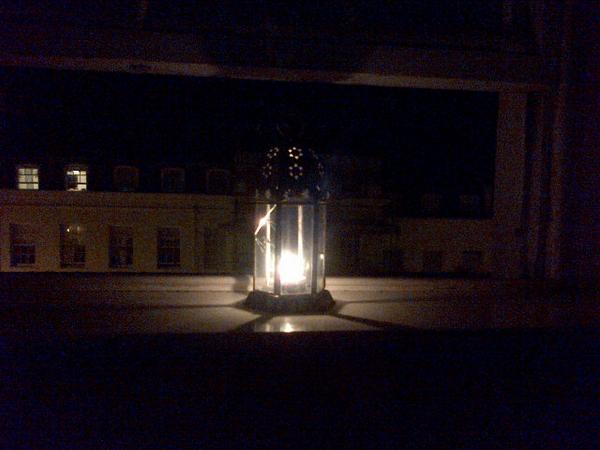
The poem I heard was written by Russian poet Anna Akhmatova on the eve of her country’s entry into World War 1. It’s actually just the first part of a poem called JULY 1914 (the capitalization is deliberate). It perfectly captures that sense of foreboding she felt as the clouds gathered, and the hot weather we’ve been having made it all the more effective:
It smells of burning. For four weeks
The dry peat bog has been burning.
The birds have not even sung today,
And the aspen has stopped quaking.
The sun has become God’s displeasure,
Rain has not sprinkled the fields since Easter.
A one-legged stranger came along
And all alone in the courtyard he said:
“Fearful times are drawing near. Soon
Fresh graves will be everywhere.
There will be famine, earthquakes, widespread death,
And the eclipse of the sun and the moon.
But the enemy will not divide
Our land at will, for himself;
The Mother of God will spread her white mantle
Over this enormous grief.”
by Anna Akhmatova (1889-1966).
Follow @telescoper
Since today, 4th August 2014, is the centenary of Britain’s entry into the First War I thought I’d repost an edited version of a piece I wrote some time ago which says very clear what I feel about the War that some people insist on calling “Great”…
–0–
Ten summers ago, in 2004, I spent an enjoyable day walking in the beautiful Peak District of Derbyshire followed by an evening at the opera in the pleasant spa town of Buxton, where there is an annual music festival. The opera I saw was A Turn of the Screw, by Benjamin Britten: a little incongruous for Buxton’s fine little Opera House which is decorated with chintzy Edwardiana and which was probably intended for performances of Gilbert & Sullivan comic operettas rather than stark tales of psychological terror.
When Buxton’s theatre was built, in 1903, the town was a fashionable resort at which the well-to-do could take the waters and relax in the comfort of one of the many smart hotels.
Arriving over an hour before the opera started, I took a walk around the place and ended up on a small hill overlooking the town centre where I found the local war memorial. This is typical of the sort of thing one can see in small towns the length and breadth of Britain. It lists the names and dates of those killed during the “Great War” (1914-1918). Actually, it lists the names but mostly there is only one date, 1916.
The 1st Battalion of the Nottingham and Derbyshire Regiment (known as the Sherwood Foresters) took part in the Battle of the Somme that started on 1st July 1916. For many of them it ended that day too; some of their names are listed on Buxton’s memorial.
On the first day of this offensive, the British Army suffered 58,000 casualties as, all along the western front, troops walked slowly and defencelessly into concentrated fire from heavy machine guns that were supposed to have been knocked out by the artillery barrage that preceded the attack. The bombardment had been almost entirely ineffective, and it finished well before the British advance started, so the Germans had plenty of time to return to their positions and wait for the advancing British.
Rather than calling off the attack in the face of the slaughter, the powers that be carried on sending troops over the top to their doom for months on end. By the end of the battle in November that year the British losses were a staggering 420,000, while those on the German side were estimated at half a million. The territory gained at such a heavy price was negligible.
These numbers are beyond comprehension, but their impact on places like Buxton was measurably real. Buxton became a town of widows. The loss of manpower made it impossible for many businesses to continue when peace returned in 1918 and a steep economic decline followed. It never fully recovered from the devastation of 1916 and its pre-war posterity never returned.
And the carnage didn’t end on the Somme. As the “Great War” stumbled on, battle after battle degenerated into bloody fiasco. Just a year later the Third Battle of Ypres saw another 310,000 dead on the British side as another major assault on the German defences faltered in the mud of Passchendaele. By the end of the War on 11th November 1918, losses on both sides were counted in millions.
I thank my lucky stars that I never had to live through conflict on the scale my grandparents’ generation had to face and curse those who have inflicted that fate on others. I quote a great First World War poet, Siegfried Sassoon (writing here in prose) whose words are as apt today as they were ninety years ago:
I have seen and endured the sufferings of the troops, and I can no longer be a party to prolonging these sufferings for ends which I believe to be evil and unjust. On behalf of all those who are suffering now I make this protest against the deception that is being practised on them; also I believe that I may help to destroy the callous complacency with which the majority of those at home regard the continuance of agonies which they do not share, and which they have not sufficient imagination to realize.
That could just as easily have been written about Iraq or Afghanistan or Ukraine or Gaza as Flanders (1917).
Last night I listened to a broadcast of the Mozart Requiem on BBC Radio 3. Mozart left this piece unfinished at his death. The performance was preceded by an interesting discussion about the subsequent completion by his student, Süssmayr, and the various alternatives including the one by Robert Levin we heard last night. Of course nobody will know exactly how Mozart intended this work to be completed because Mozart died before he was able to finish it. We’ll never know what the millions that died before their time during World War 1 would have achieved either. Among the lists of the dead and maimed were great poets, artists, musicians, scientists and engineers but we’ll never know what they might have created because death had the last word.
I thought I’d end with a poem by, Wilfred Owen. This is his Anthem for Doomed Youth, the references in the poem to church services adding tragic irony to his already powerful verse.
What passing-bells for these who die as cattle?
-Only the monstrous anger of the guns.
Only the stuttering rifles’ rapid rattle
Can patter out their hasty orisons.
No mockeries now for them; no prayers nor bells;
Nor any voice of mourning save the choirs,-
The shrill, demented choirs of wailing shells;
And bugles calling for them from sad shires.
What candles may be held to speed them all?
Not in the hands of boys but in their eyes
Shall shine the holy glimmers of good-byes.
The pallor of girls’ brows shall be their pall;
Their flowers the tenderness of patient minds,
And each slow dusk a drawing-down of blinds.
Wilfred Owen died in battle in 1918, aged 25, just a week before the armistice was signed. Another statistic.
Follow @telescoper
Brighton Pride is coming up this weekend. I heard some people on the train the other day saying that they didn’t think such events were needed any more because “gays have everything they need, especially in Brighton”. Although I was tempted, I didn’t interrupt, though I did disagree. Things have indeed changed a lot over the last twenty years, but they could easily change back if we get complacent and Brighton has its fair share of intolerance and bigotry still.
I was myself beaten up on Brighton’s seafront many years ago, during my previous existence at the University of Sussex as a PhD student and a postdoctoral researcher. There was no doubt why I was attacked: the four young men who surrounded me and punched and kicked me to the ground were shouting just one word over and over again, “faggot”. It’s still a word I hate to hear used, even if purportedly in jest. That event left me with deep psychological scars that contributed to a breakdown I had as recently as two years ago.
Thirty or so years after my encounter with the queerbashers, attitudes have definitely changed, and so has the law. Certain types of criminal offence are now officially recognized as hate crimes: the list treats sexual orientation as equivalent to race, gender, religious belief and disability in such matters. The Police are now obliged to treat these with due seriousness, and penalties for those found guilty of crimes exacerbated by homophobia are consequently more severe. All Police forces now have special units for dealing with them; here is an example.
These changes are mirrored in other aspects of life too. For example, employment law relating to discrimination or harassment in the workplace now puts sexual orientation on the same footing as race, gender, disability and religious belief. In many universities in the UK, staff have been required to attend training in Equality and Diversity matters not only to raise awareness of the legal framework under which we all have to work, but also to promote a sensitivity to these issues in order to improve the working environment for both staff and students. Now we have equal marriage too.
This training isn’t about over-zealous busybodies. Under the law, employers have a vicarious liability for the conduct of their staff with regard to harassment and discrimination. This means that a University can be sued if, for example, one of its employees commits harassment, and it can be shown that it did not make appropriate efforts to ensure its staff did not engage in such activities.
Of course not everyone approves of these changes. Some staff have refused point-blank to attend Equality and Diversity training, even though it’s compulsory. Others attend grudgingly, muttering about “political correctness gone mad”. You may think all this is a bit heavy handed, but I can tell you it makes a real difference to the lives of people who, without this legal protection, would be victimised, harassed or discriminated against. It is, also, the law.
I think the efforts that have been made to improve the legal situation have been (at least partly) responsible for the changes in society’s attitudes over the last twenty years, which have been extremely positive. I’m old enough to remember very different times. That’s not to say that there’s no bigotry any more. Even in this day and age, violent crimes against gay men are still disturbingly common and police attitudes not always helpful even though many police forces do now have Lesbian and Gay teams, something that was just unthinkable 25 years ago.
Although relatively few universities appear in the list of gay-friendly employers compiled by the campaigning organisation Stonewall, my experience generally, having worked in a number of UK universities (Sussex, Queen Mary, Nottingham and Cardiff), is that they are generally friendly and comfortable places for an openly gay person to work. So much so, in fact, that there’s no real need to make a big deal of one’s sexual identity. It doesn’t really have much to do with the way you do your work – certainly not if it’s astrophysics – and work-related social events are, as a rule, very inclusive.
However, even in the supposedly enlightened environment of a University there do remain islands of bigotry, and not just about gay or lesbian or bisexual or transgender staff. Sexism is a major problem, at least in science subjects, and will probably remain so until the gender balance improves, which it slowly doing, despite the actions of certain professors who actively block attempts to encourage more female applicants to permanent positions. Universities still do not seem to me to treat sexual orientation with the same seriousness as, say, race or gender discrimination. I’ve had plenty of experiences to back that up.
I recently took part in an interesting meeting involving various staff from the University of Sussex with a representative of Stonewall. The topic was how we could work with Stonewall to make it more gay-friendly. If I remember correctly, there are 78 UK Universities currently taking part in Stonewall’s programmes. It is a matter of some embarrassment to me that the University of Sussex is not among them. Perhaps the attitude is that because there is such a large and visible gay population in Brighton it’s not necessary for the University of Sussex to take any steps in this direction. I disagree, and am absolutely convinced that there are many Lesbian, Gay, Bisexual or Transgender members of the University of Sussex staff who would love to see some action taken to make their workplace just a little bit friendlier and more inclusive, even if that just amounts to acknowledging their existence. There is a visible and active LBGT student society on campus, but no such entity exists for staff – an absence that is truly glaring. I don’t even think the University has any idea what fraction of its staff identify themselves as LGBT.
No doubt there’ll be many members of the University of Sussex staff on the Pride Parade on Saturday and at the various parties being held around Brighton afterwards. Perhaps it’s time to start some sort of network so that for staff at the University of Sussex, Pride doesn’t just come once a year…?
If you’re interested in this idea please let me know, either through the comments box or by email.
Follow @telescoperImportant poll on the Beard Index for England’s cricketers..
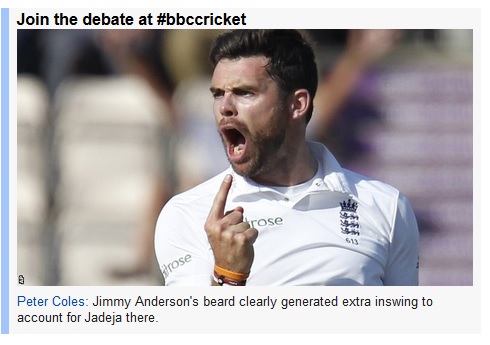
My own vote went to Jimmy Anderson, a remark on whose performance yesterday by me on Twitter also led to me featuring on the BBC Sports Website:
Today is the 4th Day and England have just declared on 205-4, leaving India to score 445 to win in approximately 132 overs…
..and India close on 112-4. The ball is starting to turn and with another 331 to win off 90 overs (3.67 an over) the odds are firmly on England’s side.
UPDATE: And so it came to pass that England took India’s last 6 wickets for 66 runs in the first session of the final day to win by 266 runs.
Beard Liberation Front
Press release 29th July contact Keith Flett 07803 167266
Jimmy Anderson & Moeen split hairs in England Cricket Team Beard Index
The Beard Liberation Front, the informal network of beard wearers, has issued an update to its England cricket Beard Index which shows Moeen Ali and Jimmy Anderson tied with Ian Bell and Alastair Cook moving up the rankings
Hirsute England players have only recently been a significant factor in the team’s performance but the campaigners say that facial hair on the pitch can have several, sometimes combined, impacts:
1] Beards can add gravitas and presence. Moeen is known as ‘the beard that’s feared’
2] Beards can influence aerodynamics both with bat and ball as a movement of the facial hair can cause subtle changes to air currents
Beard Index [combining factors 1 & 2] out of 10
Moeen 9
Anderson 9
Bell 6
Cook 6
Broad…
View original post 40 more words
In between various tasks I had a look at the news and saw a story about opinion polls that encouraged me to make another quick contribution to my bad statistics folder.
The piece concerned (in the Independent) includes the following statement:
A ComRes survey for The Independent shows that the Conservatives have dropped to 27 per cent, their lowest in a poll for this newspaper since the 2010 election. The party is down three points on last month, while Labour, now on 33 per cent, is up one point. Ukip is down one point to 17 per cent, with the Liberal Democrats up one point to eight per cent and the Green Party up two points to seven per cent.
The link added to ComRes is mine; the full survey can be found here. Unfortunately, the report, as is sadly almost always the case in surveys of this kind, neglects any mention of the statistical uncertainty in the poll. In fact the last point is based on a telephone poll of a sample of just 1001 respondents. Suppose the fraction of the population having the intention to vote for a particular party is 


A little bit of mathematics involving the binomial distribution yields an answer for the uncertainty in this estimate of p in terms of the sampling error:
For the sample size given, and a value 

If you don’t believe my calculation then you could use ComRes’ own “margin of error calculator“. The UK electorate as of 2012 numbered 46,353,900 and a sample size of 1001 returns a margin of error of 3.1%. This figure is not quoted in the report however.
Looking at the figures quoted in the report will tell you that all of the changes reported since last month’s poll are within the sampling uncertainty and are therefore consistent with no change at all in underlying voting intentions over this period.
A summary of the report posted elsewhere states:
A ComRes survey for the Independent shows that Labour have jumped one point to 33 per cent in opinion ratings, with the Conservatives dropping to 27 per cent – their lowest support since the 2010 election.
No! There’s no evidence of support for Labour having “jumped one point”, even if you could describe such a marginal change as a “jump” in the first place.
Statistical illiteracy is as widespread amongst politicians as it is amongst journalists, but the fact that silly reports like this are commonplace doesn’t make them any less annoying. After all, the idea of sampling uncertainty isn’t all that difficult to understand. Is it?
And with so many more important things going on in the world that deserve better press coverage than they are getting, why does a “quality” newspaper waste its valuable column inches on this sort of twaddle?
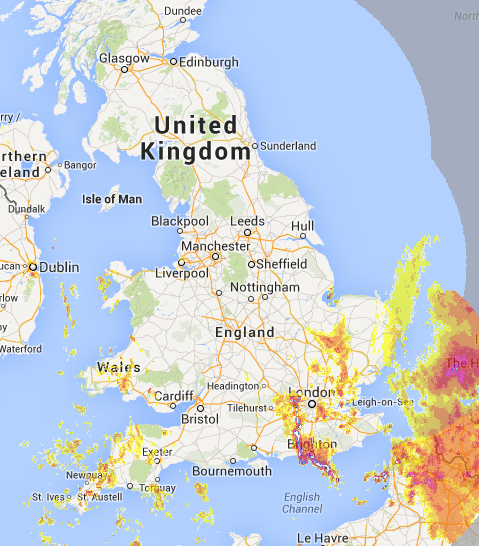
Follow @telescoperA while before 6am this morning I was woken up by the sound of fairly distant thunder to the West of my flat. I left the windows open – they’ve been open all the time in this hot weather – and dozed while rumblings continued. Just after six there was a terrifically bright flash and an instantaneous bang that set car alarms off in my street; lightning must have struck a building very close. Then the rain arrived. I got up to close the windows against the torrential downpour, at which point I noticed that water was coming in through the ceiling. A further inspection revealed another leak in the cupboard where the boiler lives and another which had water dripping from a light fitting. A frantic half hour with buckets and mops followed, but I had to leave to get to work so I just left buckets under the drips and off I went into the deluge to get soaked.
Here is the map of UK rain at 07:45 am, with Brighton in the thick of it:
I made it up to campus (wet and late); it’s still raining but hopefully will settle down soon. This is certainly turning into a summer of extremes!
Follow @telescoperAs someone who has spent his fair share of time traveling backwards and forwards on the First Great Western railway line between Cardiff (or Swindon) and London, it seems appropriate to note that the environs of Didcot Parkway station (which lies on the main line) will look rather different next time I do that journey. In the early hours of this morning, three of the six enormous cooling towers came tumbling down:
I gather the other three are also scheduled for demolition, although I doubt I’ll be able to attend that event in person either!
Follow @telescoperNight hath no wings to him that cannot sleep;
And Time seems then not for to fly, but creep;
Slowly her chariot drives, as if that she
Had broke her wheel, or crack’d her axletree.
Just so it is with me, who list’ning, pray
The winds to blow the tedious night away,
That I might see the cheerful peeping day.
Sick is my heart; O Saviour! do Thou please
To make my bed soft in my sicknesses;
Lighten my candle, so that I beneath
Sleep not for ever in the vaults of death;
Let me thy voice betimes i’ th’ morning hear;
Call, and I’ll come; say Thou the when and where:
Draw me but first, and after Thee I’ll run,
And make no one stop till my race be done.
by Robert Herrick (1591-1674)
Follow @telescoper
Interesting post, one of a series about the Philosophy of science by Alan Sokal (of the famous hoax). The other posts in the series are well worth reading, too…


 In the Dark