The Busyness of Examination Time

Posted in Biographical, Education with tags , , , , , on June 12, 2014 by telescoper

Just time this evening for the briefest of brief posts. This is probably the busiest week of the year at the University of Sussex, and it’s not over yet. The main reason for this busyness is the business of examinations, assessment and degree classification.

This morning we had our meeting of the School Progression and Award Board for Years 3 and 4 at which, among other things, we sorted out the classification for honours of our graduating students. This involves distilling the marks gained over several years of assessments down to a final “Grand Mean”. It’s not a trivial process but I’m glad to say it went off very smoothly.

The pass lists have now gone to be officially signed off by the University administration. They will be posted tomorrow at noon, at which time we’ll have a celebratory drink or several ready for those getting their results.

One of my duties as Head of School is to chair this meeting, but I don’t take credit for the successful running of the meeting because all the hard work of preparation was done by our excellent office staff, especially Oonagh and Chrystelle.

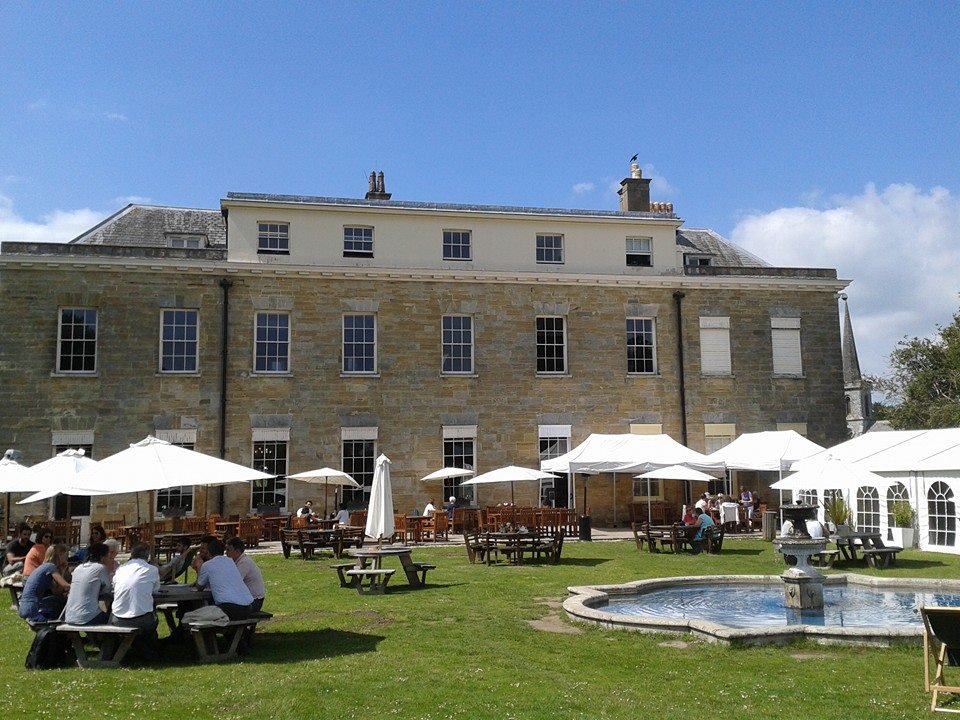
That done there was time for a quick sandwich lunch before heading off to Stanmer House for a teaching “away afternoon” for the Department of Physics & Astronomy, at which we discussed ideas for improvements to the way we teach and assess students.

Stanmer

I’m actually in the group sitting under the parasol in the left foreground.

Stanmer House is set in beautiful parkland just a short walk from Sussex University. I took the more strenuous route over the hill, but am glad I did so because the view was so nice in the glorious sunshine and it made be realise I don’t make as much of the opportunity for walking around the campus as I should.

Tomorrow is going to be another busy day but, if you’ll excuse me, I’m now going to have a glass of chilled white wine and a bite to eat.

Changing the framework for industrial policy

Posted in Finance, Science Politics with tags , , , on June 11, 2014 by telescoper

Here’s another one of the showcases of research from Sussex University. This one features Professor Mariana Mazzucato who debunks the myth of the state as a bureaucratic nanny that stifles creativity in industry, and instead recognizes the vital role of state-led investment in driving innovation and shaping and creating new markets from the internet to biotech to clean tech.

For what it’s worth this gives me an excuse to a view that I’ve expressed before that “commercially useful” research should not be funded by the taxpayer through research grants. If it’s going to pay off in the short term it should be funded by private investors or venture capitalists of some sort. Dragon’s Den, even. When the public purse is so heavily constrained, it should only be asked to fund those things that can’t in practice be funded any other way. That means long-term, speculative, curiosity driven research. You know, things like science…

This is pretty much the opposite of what the Treasury thinks. It wants to concentrate public funds in projects that can demonstrate immediate commercial potential. Taxpayer’s money used in this way ends up in the pockets of entrepreneurs if the research succeeds and, if it doesn’t, the grant will have been wasted if the research does not have any long-term fundamental significance. My proposal, therefore, is to phase out research grants for groups that want to concentrate on commercially motivated research and replace them with research loans. If the claims they make to secure the advance are justified they should have no problem repaying it from the profits they make from patent income or other forms of exploitation. If not, then they will have to pay back the loan from their own funds (as well as being exposed as bullshit merchants). In the current economic situation the loans could be made at very low interest rates and still save a huge amount of the current research budget for higher education. Indeed after a few years – suggest the loans should be repayable in 3-5 years, it would be self-financing. I think a large fraction of research in the Applied Sciences and Engineering should be funded in this way.

The money saved by replacing grants to commercially driven research groups with loans could be re-invested in those areas where public investment is really needed, such as pure science and medicine. Here grants are needed because the motivation for the research is different. Much of it does, in fact, lead to commercial spin-offs, but that is accidental and likely to appear only in the very long term. The real motivation of doing this kind of research is to enrich the knowledge base of the UK and the world in general. In other words, it’s for the public good. Remember that?

If it’s fair to ask students to contribute to their teaching, it’s fair to ask commercial companies to pay for the research that they exploit. Just as student grants should be re-introduced for certain disciplines, so should research loans be introduced for others. You know it makes sense.

However, if you want to tell me why it doesn’t, via the comments box, please feel free!

Träume

Posted in Music with tags , , , on June 11, 2014 by telescoper

I know this old record is a bit crackly, but just listen to the voice! This is the wondrous Kirsten Flagstad, recorded in 1948 with Gerald Moore on piano, singing Träume, the last of the five Wesendonck Lieder by Richard Wagner.

As a person Wagner was definitely a complete shit, but you have to admit he wrote some beautiful music. Perhaps there really is some good in every person…

The Theatre – by Rik Mayall

Posted in Poetry with tags , , on June 10, 2014 by telescoper

Rest in Peace, Rik Mayall (1958-2014).

Mathematics and Meningococcal Meningitis

Posted in Education, Science Politics with tags , , , , on June 9, 2014 by telescoper

Last week I attended a very enjoyable and informative event entitled Excellence with Impact that showcased some of the research that the University of Sussex submitted to the 2014 Research Excellence Framework. One of the case studies came from the Department of Mathematics which is part of the School of Mathematical and Physical Sciences (of which I am Head) so I thought I would showcase it here too:

The description from Youtube reads

Meningococcal meningitis is a debilitating and deadly disease, causing an estimated 10,000 deaths annually in endemic areas of sub-Saharan Africa. A novel mathematical model developed by Sussex researcher Dr Konstantin Blyuss and colleagues has helped explain the patterns of the dynamics of meningococcal meningitis in endemic areas. This model is now being used by epidemiologists and clinical scientists to design and deliver efficient public-health policies to combat this devastating disease.

You can find out more by following this link.

Dialogues des Carmélites

Posted in Opera with tags , , , , , on June 8, 2014 by telescoper

I don’t usually blog about Opera unless it’s to do with a performance I’ve actually attended in person, but I couldn’t resist posting something about the live broadcast from the Royal Opera House in Covent Garden of Dialogues des Carmélites by Francis Poulenc that I heard last night on BBC Radio 3.

I’m basically a complete ignoramus when it comes to the music of Poulenc. With the exception of a few small chamber pieces of his that I’ve heard (and very much liked) I don’t know much about him as a composer at all. Last night’s performance however has inspired me to rectify that omission. To that end I’d be grateful of any recommendations through the comments box.

Anyway, back to Dialogues des Carmélites. This is based on the true story of the martyrdom of sixteen Carmelite nuns during the French Revolution. Not knowing what to expect I was completely stunned by the music, much more melodic than I had expected, and beautifully played by the Orchestra of the Royal Opera House under the direction of Sir Simon Rattle. There are so many references to other composers in this piece that my head was spinning, but the strongest influence I could hear was Giacomo Puccini. Indeed, at times it sounded more like Puccini than Puccini ever did! I was gripped by the whole performance, but the ending, with the nuns singing the Salve Regina as they walk one by one to the scaffold, the dread sound of the guillotine repeatedly falling was utterly horrific and utterly compelling. In fact it was such a powerful experience I was trembling at the finish. Perhaps the fact that it was an audio broadcast only made it even more intense, precisely because so much was left to the imagination. It wasn’t exactly easy listening, but as a piece of music drama it was a triumph.

The entire performance is available for the next seven days on the BBC iPlayer in High Definition sound via this link. If you make time to listen to it, I promise you won’t regret it – although the ending might give you nightmares!

Another thing worth mentioning was that this was the largest cast ever to appear on the stage of the Royal Opera House; no less than 167 people altogether. Among those involved were members of Streetwise Opera, a charitable organization quite new to me, which uses music to help homeless people make positive changes in their lives. This is such a brilliant idea that I sent a donation to support their work. I urge you to do likewise.

The Logistics of Scientific Growth in the 21st Century

Posted in Science Politics, The Universe and Stuff with tags , , on June 8, 2014 by telescoper

Interesting piece that argues that the recent growth in STEM PhD and postdocs is not sustainable.

caseybergman's avatarAn Assembly of Fragments

ResearchBlogging.org

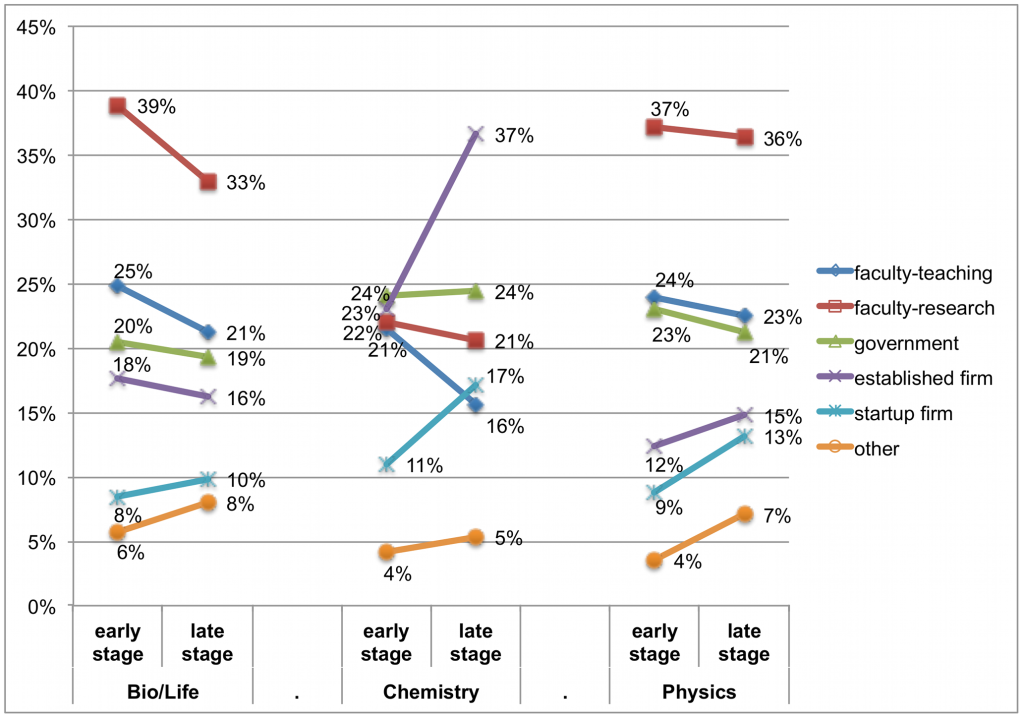
Over the last few months, I’ve noticed a growing number of reports about declining opportunities and increasing pressure for early stage academic researchers (Ph.D. students, post-docs and junior faculty). For example, the Washington Post published an article in early July about trends in the U.S. scientific job market entitled “U.S. pushes for more scientists, but the jobs aren’t there.” This post generated over 3,500 comments on the WaPo website alone and was highly discussed in the twittersphere. In mid July, Inside Higher Ed reported that an ongoing study revealed a recent, precipitous drop in the interest of STEM (Science/Technology/Engineering/Mathematics) Ph.D. students wishing to pursue an academic tenure-track career. These results confirmed those published in PLoS ONE in May that showed the interest to pursue an academic career of STEM students surveyed in 2010 showed evidence of a decline during the course of Ph.D. studies:

Figure 1. Percent of…

View original post 1,620 more words

Windows is shutting down

Posted in Poetry with tags , , on June 7, 2014 by telescoper

Windows is shutting down, and grammar are
On their last leg. So what am we to do?
A letter of complaint go just so far,
Proving the only one in step are you.

Better, perhaps, to simply let it goes.
A sentence have to be screwed pretty bad
Before they gets to where you doesnt knows
The meaning what it must of meant to had.

The meteor have hit. Extinction spread,
But evolution do not stop for that.
A mutant languages rise from the dead
And all them rules is suddenly old hat.

Too bad for we, us what has had so long
The best seat from the only game in town.
But there it am, and whom can say its wrong?
Those are the break. Windows is shutting down.

by Clive James (b 1939)

The Fallen Project

Posted in Art, History with tags , , , on June 6, 2014 by telescoper

It’s not known exactly how many people died on D-Day 6th June 1944 when the Normandy landings took place, but a  fairly conservative estimate is about 9000 (including about 3000 French civilians).

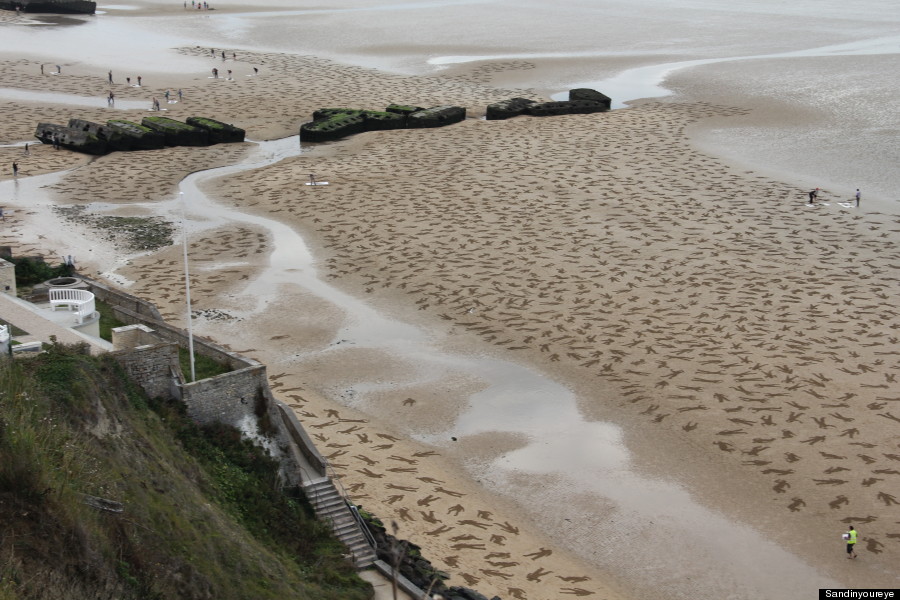
In September last year, the beach at Arromanches (code-named Gold ) was the site of a remarkable art installation called The Fallen 9000 during which hundreds of volunteers stencilled images of 9000 fallen soldiers into the sand.


o-FALLEN-900

It’s a moving image, not least because the figures were soon to be washed away by the incoming tide. Let’s hope the courage and self-sacrifice of the soldiers who gave their lives that day are not forgotten too. Seventy years on, fascism is apparently once again on the rise in Europe. We should not forget where that road has led in the past.

Lest we forget.

Has BICEP2 bitten the dust?

Posted in The Universe and Stuff with tags , , , , , , , , , , on June 5, 2014 by telescoper

Time for yet another update on twists and turns of the ongoing saga of  BICEP2 and in particular the growing suspicion that the measurements could be accounted for by Galactic dust rather than primordial gravitational waves; see various posts on this blog.

First there is a Nature News and Views article by Paul Steinhardt with the title Big Bang blunder bursts the multiverse bubble. As the title suggests, this piece is pretty scathing about the whole affair, for two main reasons. The first is to do with the manner of the release of the result via a press conference before the results had been subjected to peer review. Steinhardt argues that future announcements of “discoveries” in this area

should be made after submission to journals and vetting by expert referees. If there must be a press conference, hopefully the scientific community and the media will demand that it is accompanied by a complete set of documents, including details of the systematic analysis and sufficient data to enable objective verification.

I also have reservations about the way the communication of this result was handled but I wouldn’t go as far as Steinhardt did. I think it’s quite clear that the BICEP2 team have detected something and that they published their findings in good faith. The fact that the media pushed the result as being a definitive detection of primordial gravitational waves wasn’t entirely their fault; most of the hype was probably down to other cosmologists (especially theorists) who got a bit over-excited.

It is true that if it turns out that the BICEP2 signal is due to dust rather than primordial gravitational waves then the cosmology community will have a certain amount of egg on its face. On the other hand, this is actually what happens in science all the time. If we scientists want the general public to understand better how science actually works we should not pretend that it is about absolute certainties but that it is a process, and because it is a process operated by human beings it is sometimes rather messy. The lesson to be learned is not about hiding the mess from the public but about communicating the uncertainties more accurately and more honestly.

Steinhardt’s other main point is one with which I disagree very strongly. Here is the core of his argument about inflation:

The common view is that it is a highly predictive theory. If that was the case and the detection of gravitational waves was the ‘smoking gun’ proof of inflation, one would think that non-detection means that the theory fails. Such is the nature of normal science. Yet some proponents of inflation who celebrated the BICEP2 announcement already insist that the theory is equally valid whether or not gravitational waves are detected. How is this possible?

The answer given by proponents is alarming: the inflationary paradigm is so flexible that it is immune to experimental and observational tests.

This is extremely disingenuous. There’s a real difference between a theory that is “immune to experimental and observational tests” and one which is just very difficult to test in that way. For a start, the failure of a given experiment to detect gravitational waves  does not prove that gravitational waves don’t exist at some level; a more sensitive experiment might be needed. More generally, the inflationary paradigm is not completely specified as a theory; it is a complex entity which contains a number of free parameters that can be adjusted in the light of empirical data. The same is also true, for example, of the standard model of particle physics. The presence of these adjustable degrees of freedom makes it much harder to test the hypothesis than would be the case if there were no such wiggle room. Normal science often proceeds via the progressive tightening of the theoretical slack until there is no more room for manoeuvre. This process can take some time.

Inflation will probably be very difficult to test, but then there’s no reason why we should expect a definitive theoretical understanding of the very early Universe to come easily to us. Indeed, there is almost certainly a limit to the extent that we can understand the Universe with “normal science” but I don’t think we’ve reached it yet. We need to be more patient. So what if we can’t test inflation with our current technology? That doesn’t mean that the idea is unscientific. It just means that the Universe is playing hard to get.

Steinhardt continues with an argument about the multiverse. He states that inflation

almost inevitably leads to a multiverse with an infinite number of bubbles, in which the cosmic and physical properties vary from bubble to bubble. The part of the multiverse that we observe corresponds to a piece of just one such bubble. Scanning over all possible bubbles in the multi­verse, every­thing that can physically happen does happen an infinite number of times. No experiment can rule out a theory that allows for all possible outcomes. Hence, the paradigm of inflation is unfalsifiable.

This may seem confusing given the hundreds of theoretical papers on the predictions of this or that inflationary model. What these papers typically fail to acknowledge is that they ignore the multiverse and that, even with this unjustified choice, there exists a spectrum of other models which produce all manner of diverse cosmological outcomes. Taking this into account, it is clear that the inflationary paradigm is fundamentally untestable, and hence scientifically meaningless.

I don’t accept the argument that “inflation almost inevitably leads to a multiverse” but even if you do the rest of the argument is false. Infinitely many outcomes may be possible, but are they equally probable? There is a well-defined Bayesian framework within which one could answer this question, with sufficient understanding of the underlying physics. I don’t think we know how to do this yet but that doesn’t mean that it can’t be done in principle.

For similar discussion of this issue see Ted Bunn’s Blog.

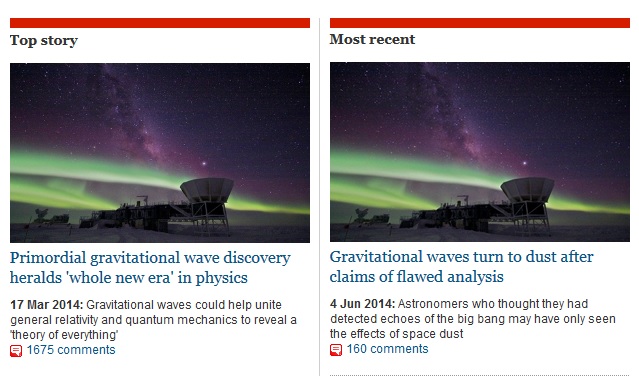
Steinhardt’s diatribe was accompanied  yesterday by a sceptical news piece in the Grauniad entitled Gravitational waves turn to dust after claims of flawed analysis. This piece is basically a rehash of the argument that the BICEP2 results may be accounted for by dust rather than primordial gravitational waves, which definitely a possibility, and that the BICEP2 analysis involved a fairly dubious analysis of the foregrounds. In my opinion it’s an unnecessarily aggressive piece, but mentioning it here gives me the excuse to post the following screen grab from the science section of today’s Guardian website:
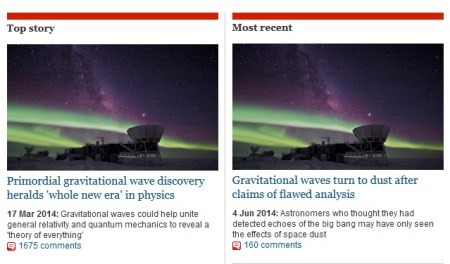
BICEP_thenandnow

Aficionados of Private Eye will probably think of the Just Fancy That section!

Where do I stand? I can hear you all asking that question so I’ll make it clear that my view hasn’t really changed at all since March. I wouldn’t offer any more than even money on a bet that BICEP2 has detected primordial gravitational waves at all and I’d offer good odds that, if the detection does stand, the value of the tensor-to-scalar ratio is significantly lower than the value of 0.2 claimed by BICEP2.  In other words, I don’t know. Sometimes that’s the only really accurate statement a scientist can make.