The Open Journal for Astrophysics – Update and Request

Posted in Open Access, The Universe and Stuff with tags , , , , , on August 22, 2013 by telescoper

I’ve been getting quite a few questions about my modest proposal The Open Journal for Astrophysics. I don’t want to give too much away before the site is revealed, but I can say that after a very positive meeting in London last week the project is right on track and will go live pretty soon for beta testing. We have an Editorial Board (names to be revealed in due course), a very nice website, a web team, and an excellent interface for editors and reviewers which, in my opinion, is far better than any offered by a “professional” journal. When the site does go live I’ll explain in more detail how it works and introduce all the people whose contributions enabled this project to get off the ground.

We are going to test everything extensively before the OJFA goes public, however, so please be patient. We will be testing the site initially using papers in a relatively restricted area of astrophysics (largely extragalactic astrophysics and cosmology), but hope to expand by the addition of other members to the Editorial Board. In anticipation of this future expansion, volunteers in areas of astrophysics outside this specialism are welcome!

That’s the update. Now time for the request. Although not essential for the initial testing phase of the project, we do think that it would benefit from a distinctive layout for the papers, which would be easily achieved by having our own Latex style. This came up in discussion some time ago when I first floated the idea of this project and somebody emailed me offering to design an appropriate Latex package. Unfortunately, however, in transit from Cardiff to here I appear to have lost the email and can’t remember who sent it. I’m therefore going to enlist the help of the blogosphere to remedy this act of incompetence. Is there anybody out there among the interwebs who is sufficiently keen and has the necessary expertise to construct a latex style for our new journal? If so please contact me, either through the comments or via email. I can’t do it myself because I have never had any sense of style…

Please pass this on via Twitter, etc.

Magic Beard

Posted in Beards with tags , on August 21, 2013 by telescoper

I just couldn’t resist posting this….

Marsh Flowers

Posted in Music, Poetry with tags , , , on August 21, 2013 by telescoper

I heard a reading of this poem on BBC Radio 3 last night and couldn’t resist posting it here. It’s by Suffolk poet George Crabbe and it came up in the context of a programme about poetry and the music of Benjamin Britten. That gives me the opportunity to plug an anthology of the poems Britten set to music, which is available from the excellent Carcanet Press. Last time I plugged one of their books on here they sent me a free copy. Fingers crossed.

Crabbe is probably most famous for his lengthy work The Borough, part of which features a character called Peter Grimes. It was that work that inspired Britten to write the opera of that name, a true masterpiece if ever there was one.

I didn’t know until yesterday evening that Britten had written other pieces based on Crabbe’s poetry, so it was a pleasant surprise to hear this one, which became one of the Five Flower Songs (Op. 47). It stands on its own, however, as a wonderfully dry piece of comic verse, the plodding meter perfectly conveying the uninspiring nature of the fenland flora described by the text. It’s also full of clever touches, such as the alliteration in Line 4 “sickly scent is seen”.

Here the strong mallow strikes her slimy root,
Here the dull nightshade hangs her deadly fruit:

On hills of dust the henbane’s faded green,
And pencil’d flower of sickly scent is seen.

Here on its wiry stem, in rigid bloom,
Grows the salt lavender that lacks perfume.

At the wall’s base the fiery nettle springs
With fruit globose and fierce with poison’d stings;

In every chink delights the fern to grow,
With glossy leaf and tawny bloom below;

The few dull flowers that o’er the place are spread
Partake the nature of their fenny bed.

These, with our sea-weeds rolling up and down,
Form the contracted Flora of our town.

by George Crabbe (1754-1832).

The Balcombe Speech, from King Lear

Posted in Literature with tags , on August 20, 2013 by telescoper

Not many people know that William Shakespeare was an enthusiastic supporter of  hydraulic fracturing with scant regard for those who protest against it. His views are most clearly represented in the famous Balcombe speech in Act III, Scene 2 of King Lear:

Go drills and frack for weeks! rage! blow!
You cataracts and hurricanoes, spout
Till you have drench’d our lentils, drown’d the spliffs!
You sulphurous and thought-executing fires,
Vaunt-couriers to tree-hugging dunderheads,
Singe my dread locks! And thou, all-shaking thunder,
Strike flat the thick rotundity o’ the world!
Frack nature’s moulds, all toxins spill at once
That make ingrateful man!

Science, Fracking and the Balcombization of the Left

Posted in Politics with tags , , , , on August 19, 2013 by telescoper

Well, here’s a find. A rare, peer-reviewed scientific article about hydraulic fracturing. And it’s not behind a paywall! The abstract of the paper, which I’m passing (as with my earlier post) on in the (probably forlorn) hope that it will introduce some rationality into the so-called “fracking” debate, reads:

The widespread use of hydraulic fracturing (HF) has raised concerns about potential upward migration of HF fluid and brine via induced fractures and faults. We developed a relationship that predicts maximum fracture height as a function of HF fluid volume. These predictions generally bound the vertical extent of microseismicity from over 12,000 HF stimulations across North America. All microseismic events were less than 600 m above well perforations, although most were much closer. Areas of shear displacement (including faults) estimated from microseismic data were comparatively small (radii on the order of 10 m or less). These findings suggest that fracture heights are limited by HF fluid volume regardless of whether the fluid interacts with faults. Direct hydraulic communication between tight formations and shallow groundwater via induced fractures and faults is not a realistic expectation based on the limitations on fracture height growth and potential fault slip.

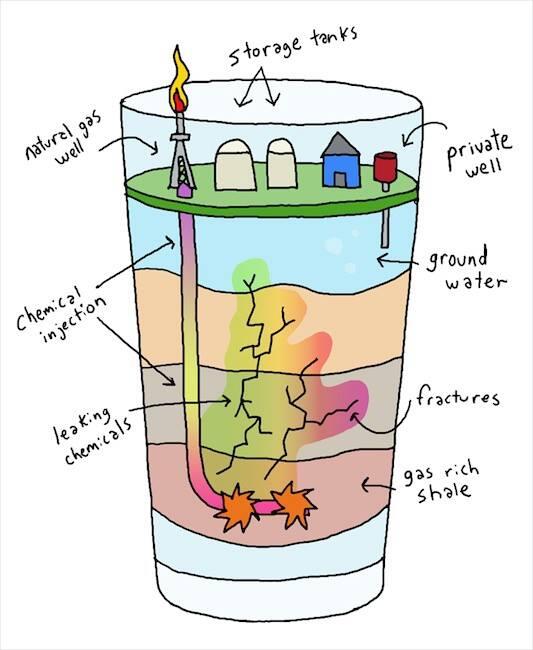
It would be nice if either the media or the protestors at Balcombe made some attempt to discuss the actual science behind fracking, but that seems a forlorn hope. The best I could come up with from the latter is this picture, offered by someone who thinks that anyone in possession of a set of crayons is qualified as a geologist:

BR-KG0SCAAAkSIu

In the interest of balance, here is a link to a blog post on fracking in the USA, the first paragraph of which reads:

For some time now, proponents of the controversial practice of hydraulic fracturing or “fracking” have claimed there was little or no evidence of real risk to groundwater. But as the classic saying goes: “the absence of evidence is not evidence of absence” of a problem. And the evidence that fracking can contaminate groundwater and drinking water wells is growing stronger with every new study.

I encourage you to read it, but if you do please carry on to the comments where you will see detailed counter-arguments.

I do not have a strong opinion either way on fracking. I’d prefer to make a decision as a result of an informed debate based on evidence, but there are clearly people who don’t want that to happen and are instead intent on scaremongering to suit their own ends. It seems to me that the legitimate concerns of sensible people have yet again been hijacked by the small but vociferous mob of “against everything” anarchists who see protest as an end in itself. It’s all so depressingly puerile. There’s no fracking going on in Balcombe anyway!

Why does the Green movement – and the left generally for that matter – have to be so comprehensively anti-scientific? As long as it remains that way it will never be taken seriously.

Trivial Hirsute

Posted in Beards, Biographical with tags , , , , on August 18, 2013 by telescoper

There’s been a lot going on in the world of beards recently. There’s the  Daily Fail story about how “hipster beards” are threatening the razor industry.  I don’t think it will be long before they run a story about the effect of facial hair on house prices. Then of course there’s the fuss about Jeremy Paxman’s appearance on Newsnight with a beard, which unleashed a storm of pogonophobia. Looking on the bright side, this served to generate some very positive publicity for the Beard Liberation Front, regular updated from which you can find on Keith Flett’s Blog.

Of course the Beard Liberation Front is essentially light-hearted in nature, but it does underline some rather serious points about the society we live in. First, is the obvious one. With so much terrible news going on in the world, who cares whether the presenter has a beard or not? In other words, it’s symptomatic of the superficiality of our celebrity-obsessed culture.

But there’s more than that. On the rare occasions I’ve been involved in media work I overheard many conversations about how such-and-such a scientist was no go for television because he had a beard. Why should that be? I think part of the answer can be found in Howard Jacobson’s piece in Saturday’s Independent: in that beards generally make their wearers look older. Nowadays, that, by definition ,means “unsuitable for TV”. You may have wisdom and gravitas, but if you don’t look like you belong in a boy band you’re just a beardy-weirdy and therefore out of contention.

Incidentally, I was of course clean-shaven when I had a few brief encounters with television, but my big chance for fame and fortune lapsed when I did a screen-test for the BBC, only to be told that I “lacked gravitas”. I doubt if a beard would have helped.

Back to my point.  I think I’ve established that bPogonophobia clearly has a significant overlap with ageism. Moreover, because it’s about jumping to conclusions about people based on their appearance  it also overlaps with racial prejudice. Men with beards are of not of course a persecuted minority, which is why the Beard Liberation Front can afford to engage in so much humorous self-parody, but it still succeeds in holding up a mirror to other, more sinister, forms of discrimination.

As for myself, I have no aspiration to become a hipster. I am far too old for that anyway. But I have always hated the chore of shaving in the mornings (and again later if I have to go out in the evening). I have frequently gone as far as growing a goatee beard, only to get rid of it because I didn’t like it much. The first time I grew a full beard was last summer. It wasn’t planned, but a consequence of a fairly long period of ill-health during a large part of which, for various reasons, I was unable to shave. When I began to recover, I shaved off the growth not so much because I disliked the beard in itself, but because it was an unwelcome reminder of what I’d been through. I wanted a fresh start. Having avoided any major recurrence this summer, I decided to have a go at growing a full beard again and am quite pleased with the result. At least it’s more convincing than Paxman’s.

Although not as grey, it has turned out rather similar in style to that of Ernest Hemingway as he is seen in this famous photograph by Yousuf Karsh:

yousufKarsh-ErnstHemingway-large

I have to admit, though, that the opinions of others are mixed. The best comment I got was from a work colleague who said that she liked my beard very much, only to add, with immaculate timing, “because it covers half of your face”. I guess I’ll just have to hope that Beard Power eventually carries me through to wider acceptance.

PS. For the physicists among my readers here is an old post of mine about the role of beards in the development of thermodynamics.

Sippie Wallace

Posted in Jazz with tags , , , , on August 17, 2013 by telescoper

I’ve been meaning to post this fabulous old record for a while but for some reason never got around to it. Until know. This is the great Sippie Wallace  who sings and plays piano in the company of Johnny Dodds (clarinet), Honore Dutrey (trombone) and Natty Dominique (cornet), on a 78rpm disc made in 1929 for the Victor label.

Sippie Wallace was born Beulah Thomas on 1st November 1896; she died on her 88th birthday in 1986. Between 1926 and 1929 she made around 40 records for the Okeh label in Chicago and may have made this record while she was still under contract with them. That reminds me of the famous story about Louis Armstrong who performed on some records for another label while on a supposedly exclusive contract with Okeh; he was hauled up in front of the manager at the Okeh label and accused of playing on these other tracks.  Of course it was him – his playing was instantly recognizable – but Satchmo is always alleged to have said “It wasn’t me, boss, but I won’t do it again”. ..

As was the case with Bessie Smith, most of Sippie Wallace’s repertoire was a bit on the raunchy side and this is no exception, but, boy, could she sing the blues. This wonderful performance is entitled I’m a Mighty Tight Woman….

Physics and Statistics

Posted in Bad Statistics, Education with tags , , , on August 16, 2013 by telescoper

Predictably, yesterday’s newspapers and other media  were full of feeble articles about the A-level results, and I don’t just mean the gratuitous pictures of pretty girls opening envelopes and/or jumping in the air.  I’ve never met a journalist who understood the concept of statistical significance, which seems to account for the way they feel able to write whatever they like about any numbers that happen to be newsworthy without feeling constrained by mathematical common-sense.  Sometimes it’s the ridiculous over-interpretation of opinion polls (which usually have a sampling uncertainty of ±3 %), sometimes its league tables. This time it’s the number of students getting the top grades at A-level.

The BBC, for example, made a lot of fuss about the fall in the % of A and A* A-level grades, to  26.3% this year from 26.6% last year. Anyone with a modicum of statistical knowledge would know, however, that whether this drop means anything at all depends on how many results were involved: the sampling uncertainty depends on size N approximately as √N. For a cohort of 300000 this turns into a percentage uncertainty of about 0.57%, which is about twice as large as the reported fall.  The result is therefore “in the noise” – in the sense that there’s no evidence that it was actually harder to get a high grade this year compared with last year – but that didn’t prove a barrier to those editors intent on filling their newspapers and websites with meaningless guff.

Almost hidden among the bilge was an interesting snippet about Physics. It seems that the number of students taking Physics A-level this year has exceeded 35,000 in 2013.  That was set as a government target for 2014, so it has been reached a year early.  The difference between the number that took Physics this year (35,569) and those who took it in 2006 (27,368) is certainly significant. Whether this is the so-called Brian Cox effect or something else, it’s very good news for the future health of the subject.

On the other hand, the proportion of female Physics students remains around 20%. Over the last three years the proportion has been 20.8%, 21.3% and 20.6% so numerically this year is down on last year, but the real message in these figures is that despite strenuous efforts to increase this fraction, there is no significant change.

As I write I’m formally still on Clearing business, sitting beside the telephone in case anyone needs to talk to me. However, at close of play yesterday the School of Mathematical and Physical Sciences had exceeded its recruitment target by quite a healthy margin.  We’re still open for Clearing, though, as our recent expansion means we can take a few more suitably qualified students. Physics and Astronomy did particularly well, and we’re set to welcome our biggest-ever intake into the first year in September 2013. I’m really looking forward to meeting them all.

While I’m on about statistics, here’s another thing. When I was poring over this year’s NSS results, I noticed that only 39 Physics departments appeared in the survey. When I last counted them there were 115 universities in the UK. This number doesn’t include about 50 colleges and other forms of higher education institutions which are also sometimes included in lists of universities. Anyway, my point is that at most about a third of British universities have a physics department.

Now that is a shocking statistic…

Advice for Students on Clearing

Posted in Education, The Universe and Stuff with tags , , , , on August 15, 2013 by telescoper

1-dont-panic

We still have places in the School of Mathematical & Physical Sciences at the University of Sussex. No other Physics & Astronomy department in the UK scored more highly in the latest NSS survey than ours, so whether you’re interested in Physics, Astrophysics, Astronomy or Mathematics (or even a combination of those subjects), why not just take a look at the University’s Clearing Page and give us a ring.?

As a matter of fact, I’ll be there myself from 8am this morning to talk to interested students.

11.30 UPDATE. I finished my first shift at 11am. I’ll be going back at 5pm for the last session, until the lines close at 7pm. During the last hour a minimum of 20 overs must be bowled. Or something.  The main call centre (which has fifty phone lines) is next door to where we were sitting and is operated by admissions experts and student helpers who are processing the queries and, if necessary, routing them through to academics (i.e. people like me) to provide further information or to answer specific questions. You can take a peep behind the scenes here. Some of the calls were from very anxious prospective students, and it’s a very nice feeling being able to help them sort out their course! Now back to other things until I start again this evening.


19.30 UPDATE. Phew. Finally been stood down, but I’ll be back on duty tomorrow afternoon. It’s been a very interesting day which has gone very well for us. Lines stay open until 8pm tonight and re-open at 8 in the morning and we’re still in business to see if we can give just a few more students the opportunity to study in the School next academic year. Now I’m off home to chill, probably over a glass or two of wine!

A Three-dimensional Map of the Early Universe

Posted in The Universe and Stuff with tags , , , , on August 14, 2013 by telescoper

I found this video via a web page describing the FastSound project, which is surveying galaxies in the Universe which are at such a huge distance that we are seeing them as they were over nine billion years ago. Using the Subaru Telescope‘s impressive new Fiber Multi-Object Spectrograph (FMOS). This project is “work in progress”. The survey so far contains only 1,100 galaxies, but while that is small by the standards of a modern redshift survey, and will in fact still only comprise about 5000 galaxies when complete, what is amazing about it is that the galaxies are at such enormous distances. Even using a telescope with an 8.2 metre primary mirror, this survey will take another year or so to be completed.

A survey of a representative region of the Universe at such high redshift allows astrophysicists to test theories of the growth of the large-scale structure of the Universe. In the standard cosmology, these form by a process of gravitational instability: small irregularities in the distribution of matter get amplified by the action of gravity to become large structures such as galaxies and galaxy clusters. Comparing the level of clustering at early times with that observed around us today allows us to check whether this growth matches theoretical predictions. There should be much less clumpiness earlier on if the theoretical picture is right.

I began my PhD DPhil at the University of Sussex in 1985, working on the large-scale structure of the Universe. Coincidentally, the largest redshift survey available at that time, the CfA1 Survey, also contained 1,100 galaxies – as displayed in the famous “stick man map”:

cfa2.n30

The galaxies mapped out in that survey, however, are all (relatively speaking) in our back yard: none is further than a few hundred million light years away…