An Evening of Edgar Allen Poe

Posted in Film with tags , , , , , on August 20, 2012 by telescoper

I chanced upon this the other day and couldn’t resist posting it here.  It’s a short (52-minute) film featuring the wonderful Vincent Price in  a one-man show consisting of dramatic recitations of stories by Edgar Allen Poe: “The Tell-Tale Heart“, “The Sphinx“, “The Cask of Amontillado” and “The Pit and the Pendulum“. As a huge fan of both Price and Poe I don’t really understand why I’ve never seen this before. This film was made in 1972, by which time his acting roles were largely self-parodying, playing  camp villains in hammy horror films, roles I might add that he played with matchless gusto despite the often low quality of the scripts. But in this movie, filmed in front of a live audience, reminds us what a fine actor he was, his theatricality perfectly appropriate for Poe’s writing.

The whole movie’s a bit longer than I’d usually post in a blog item, but at least watch all of the first story which starts

TRUE! –nervous –very, very dreadfully nervous I had been and am; but why will you say that I am mad? The disease had sharpened my senses –not destroyed –not dulled them. Above all was the sense of hearing acute. I heard all things in the heaven and in the earth. I heard many things in hell. How, then, am I mad?

Hmm.

Anyway, they just don’t make them like Vincent Prince any more…

Kuhn the Irrationalist

Posted in Bad Statistics, The Universe and Stuff with tags , , , , , , , , , , , , on August 19, 2012 by telescoper

There’s an article in today’s Observer marking the 50th anniversary of the publication of Thomas Kuhn’s book The Structure of Scientific Revolutions.  John Naughton, who wrote the piece, claims that this book “changed the way we look at science”. I don’t agree with this view at all, actually. There’s little in Kuhn’s book that isn’t implicit in the writings of Karl Popper and little in Popper’s work that isn’t implicit in the work of a far more important figure in the development of the philosophy of science, David Hume. The key point about all these authors is that they failed to understand the central role played by probability and inductive logic in scientific research. In the following I’ll try to explain how I think it all went wrong. It might help the uninitiated to read an earlier post of mine about the Bayesian interpretation of probability.

It is ironic that the pioneers of probability theory and its application to scientific research, principally Laplace, unquestionably adopted a Bayesian rather than frequentist interpretation for his probabilities. Frequentism arose during the nineteenth century and held sway until relatively recently. I recall giving a conference talk about Bayesian reasoning only to be heckled by the audience with comments about “new-fangled, trendy Bayesian methods”. Nothing could have been less apt. Probability theory pre-dates the rise of sampling theory and all the other frequentist-inspired techniques that many modern-day statisticians like to employ.

Most disturbing of all is the influence that frequentist and other non-Bayesian views of probability have had upon the development of a philosophy of science, which I believe has a strong element of inverse reasoning or inductivism in it. The argument about whether there is a role for this type of thought in science goes back at least as far as Roger Bacon who lived in the 13th Century. Much later the brilliant Scottish empiricist philosopher and enlightenment figure David Hume argued strongly against induction. Most modern anti-inductivists can be traced back to this source. Pierre Duhem has argued that theory and experiment never meet face-to-face because in reality there are hosts of auxiliary assumptions involved in making this comparison. This is nowadays called the Quine-Duhem thesis.

Actually, for a Bayesian this doesn’t pose a logical difficulty at all. All one has to do is set up prior probability distributions for the required parameters, calculate their posterior probabilities and then integrate over those that aren’t related to measurements. This is just an expanded version of the idea of marginalization, explained here.

Rudolf Carnap, a logical positivist, attempted to construct a complete theory of inductive reasoning which bears some relationship to Bayesian thought, but he failed to apply Bayes’ theorem in the correct way. Carnap distinguished between two types or probabilities – logical and factual. Bayesians don’t – and I don’t – think this is necessary. The Bayesian definition seems to me to be quite coherent on its own.

Other philosophers of science reject the notion that inductive reasoning has any epistemological value at all. This anti-inductivist stance, often somewhat misleadingly called deductivist (irrationalist would be a better description) is evident in the thinking of three of the most influential philosophers of science of the last century: Karl Popper, Thomas Kuhn and, most recently, Paul Feyerabend. Regardless of the ferocity of their arguments with each other, these have in common that at the core of their systems of thought likes the rejection of all forms of inductive reasoning. The line of thought that ended in this intellectual cul-de-sac began, as I stated above, with the work of the Scottish empiricist philosopher David Hume. For a thorough analysis of the anti-inductivists mentioned above and their obvious debt to Hume, see David Stove’s book Popper and After: Four Modern Irrationalists. I will just make a few inflammatory remarks here.

Karl Popper really began the modern era of science philosophy with his Logik der Forschung, which was published in 1934. There isn’t really much about (Bayesian) probability theory in this book, which is strange for a work which claims to be about the logic of science. Popper also managed to, on the one hand, accept probability theory (in its frequentist form), but on the other, to reject induction. I find it therefore very hard to make sense of his work at all. It is also clear that, at least outside Britain, Popper is not really taken seriously by many people as a philosopher. Inside Britain it is very different and I’m not at all sure I understand why. Nevertheless, in my experience, most working physicists seem to subscribe to some version of Popper’s basic philosophy.

Among the things Popper has claimed is that all observations are “theory-laden” and that “sense-data, untheoretical items of observation, simply do not exist”. I don’t think it is possible to defend this view, unless one asserts that numbers do not exist. Data are numbers. They can be incorporated in the form of propositions about parameters in any theoretical framework we like. It is of course true that the possibility space is theory-laden. It is a space of theories, after all. Theory does suggest what kinds of experiment should be done and what data is likely to be useful. But data can be used to update probabilities of anything.

Popper has also insisted that science is deductive rather than inductive. Part of this claim is just a semantic confusion. It is necessary at some point to deduce what the measurable consequences of a theory might be before one does any experiments, but that doesn’t mean the whole process of science is deductive. He does, however, reject the basic application of inductive reasoning in updating probabilities in the light of measured data; he asserts that no theory ever becomes more probable when evidence is found in its favour. Every scientific theory begins infinitely improbable, and is doomed to remain so.

Now there is a grain of truth in this, or can be if the space of possibilities is infinite. Standard methods for assigning priors often spread the unit total probability over an infinite space, leading to a prior probability which is formally zero. This is the problem of improper priors. But this is not a killer blow to Bayesianism. Even if the prior is not strictly normalizable, the posterior probability can be. In any case, given sufficient relevant data the cycle of experiment-measurement-update of probability assignment usually soon leaves the prior far behind. Data usually count in the end.

The idea by which Popper is best known is the dogma of falsification. According to this doctrine, a hypothesis is only said to be scientific if it is capable of being proved false. In real science certain “falsehood” and certain “truth” are almost never achieved. Theories are simply more probable or less probable than the alternatives on the market. The idea that experimental scientists struggle through their entire life simply to prove theorists wrong is a very strange one, although I definitely know some experimentalists who chase theories like lions chase gazelles. To a Bayesian, the right criterion is not falsifiability but testability, the ability of the theory to be rendered more or less probable using further data. Nevertheless, scientific theories generally do have untestable components. Any theory has its interpretation, which is the untestable baggage that we need to supply to make it comprehensible to us. But whatever can be tested can be scientific.

Popper’s work on the philosophical ideas that ultimately led to falsificationism began in Vienna, but the approach subsequently gained enormous popularity in western Europe. The American Thomas Kuhn later took up the anti-inductivist baton in his book The Structure of Scientific Revolutions. Initially a physicist, Kuhn undoubtedly became a first-rate historian of science and this book contains many perceptive analyses of episodes in the development of physics. His view of scientific progress is cyclic. It begins with a mass of confused observations and controversial theories, moves into a quiescent phase when one theory has triumphed over the others, and lapses into chaos again when the further testing exposes anomalies in the favoured theory. Kuhn adopted the word paradigm to describe the model that rules during the middle stage,

The history of science is littered with examples of this process, which is why so many scientists find Kuhn’s account in good accord with their experience. But there is a problem when attempts are made to fuse this historical observation into a philosophy based on anti-inductivism. Kuhn claims that we “have to relinquish the notion that changes of paradigm carry scientists ..closer and closer to the truth.” Einstein’s theory of relativity provides a closer fit to a wider range of observations than Newtonian mechanics, but in Kuhn’s view this success counts for nothing.

Paul Feyerabend has extended this anti-inductivist streak to its logical (though irrational) extreme. His approach has been dubbed “epistemological anarchism”, and it is clear that he believed that all theories are equally wrong. He is on record as stating that normal science is a fairytale, and that equal time and resources should be spent on “astrology, acupuncture and witchcraft”. He also categorised science alongside “religion, prostitution, and so on”. His thesis is basically that science is just one of many possible internally consistent views of the world, and that the choice between which of these views to adopt can only be made on socio-political grounds.

Feyerabend’s views could only have flourished in a society deeply disillusioned with science. Of course, many bad things have been done in science’s name, and many social institutions are deeply flawed. One can’t expect anything operated by people to run perfectly. It’s also quite reasonable to argue on ethical grounds which bits of science should be funded and which should not. But the bottom line is that science does have a firm methodological basis which distinguishes it from pseudo-science, the occult and new age silliness. Science is distinguished from other belief-systems by its rigorous application of inductive reasoning and its willingness to subject itself to experimental test. Not all science is done properly, of course, and bad science is as bad as anything.

The Bayesian interpretation of probability leads to a philosophy of science which is essentially epistemological rather than ontological. Probabilities are not “out there” in external reality, but in our minds, representing our imperfect knowledge and understanding. Scientific theories are not absolute truths. Our knowledge of reality is never certain, but we are able to reason consistently about which of our theories provides the best available description of what is known at any given time. If that description fails when more data are gathered, we move on, introducing new elements or abandoning the theory for an alternative. This process could go on forever. There may never be a “final” theory, and scientific truths are consequently far from absolute, but that doesn’t mean that there is no progress.

The Day at Lord’s

Posted in Cricket with tags , , , , on August 19, 2012 by telescoper

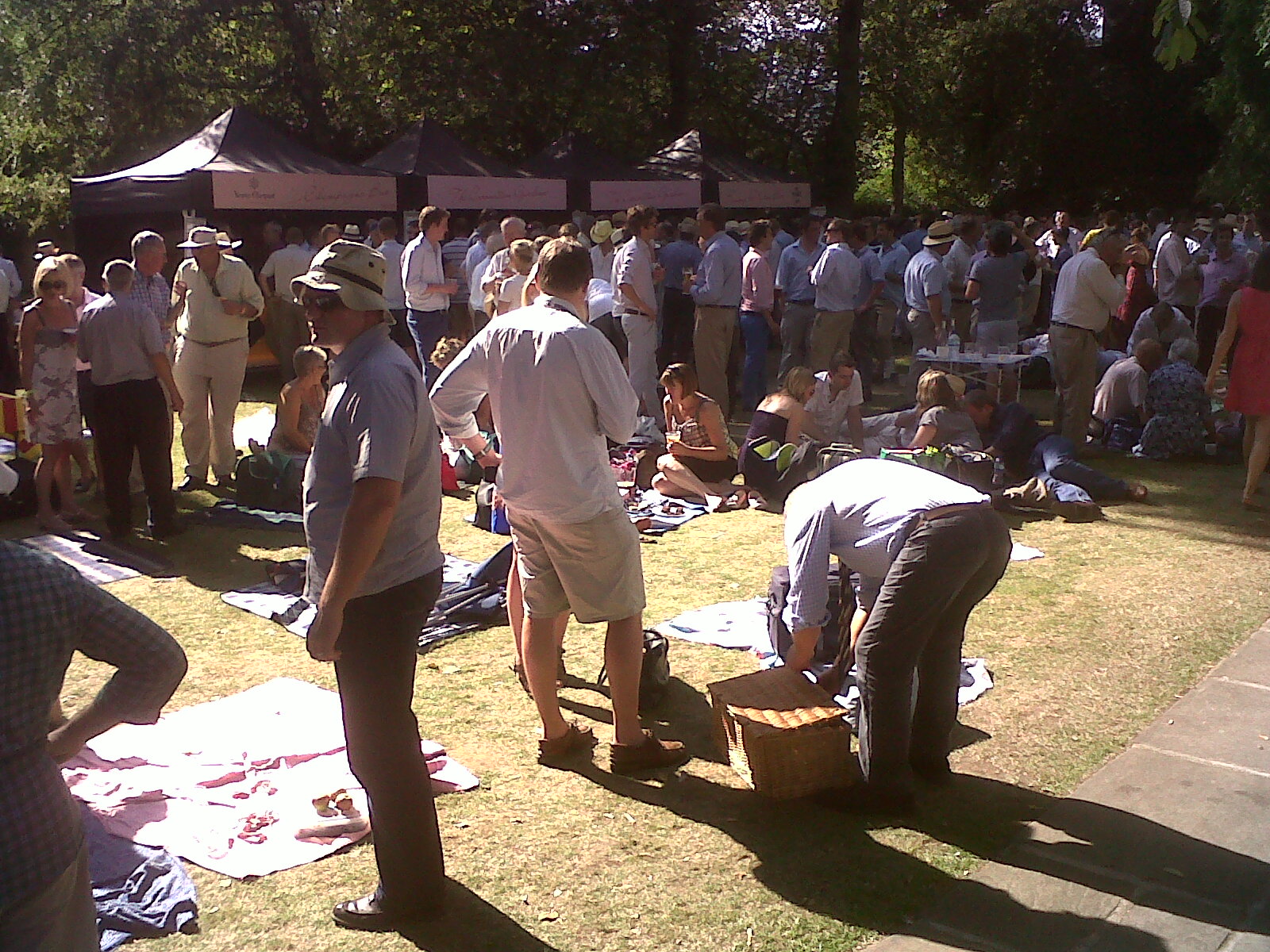
Just time for a quick post to record the fact that yesterday I made my annual pilgrimage to Lord’s to watch the third day’s play of the third Test between England versus South Africa. I had to get up at 5.30 to catch an early morning train to London, hence yesterday’s “full many a glorious morning have I seen” post. That choice was motivated more by the forecast than immediate reality, however, because it was raining in Cardiff when I set out. I did however, take a sun hat and shades with me, which turned out to be a wise move as there was bright sunshine when I arrived in London. Lord’s is conveniently situated a relatively short walking distance from Paddington, but even at 9.30 in the morning I could feel the heat, so there was a glorious morning after all…

Once again, courtesy of my old friend Anton I found myself among the member’s guests in the Warner Stand, with an excellent view of the proceedings, from a position a few rows back in the direction of fine leg for a batsman at the Pavilion End. There was a bit of high cloud early on, but it soon cleared. We had warm and sunny conditions for the duration, and a full day’s cricket ensued.

England resumed on 208-5, chasing South Africa’s first innings total of 309. Bairstow and Prior started pretty well. Mindful of the match situation they played carefully and scored quite slowly. Then, after 9 overs, South Africa took the new ball, a dangerous moment in any innings, so I expected the England batsman to play even more carefully. Prior, however, had a mad moment against the very first delivery with the new ball, played an awful shot at a wide ball and departed. England were on 221-6, and hopes of them reaching South Africa’s total were fading fast. Bairstow batted well, but when he got into the 90s nerves clearly got the better of him. He was becalmed on 95 for what seemed like an eternity, and then fell. A fine innings, and such a pity he didn’t get a maiden Test century at Lord’s. At 264-8 it looked certain South Africa would get a first innings lead, but Swann and Finn added 32 for the last wicket and England eventually closed after lunch on 315 all out, just 6 runs in front.

To have any chance of winning the match, England needed to take South African wickets quickly with the new ball. Unfortunately, that didn’t happen. Indeed, Swann was the only bowler who looked really threatening. Although England tried hard, the South African batting is very strong and the bowlers just couldn’t put enough pressure on them consistently to break through. South Africa finished the day on 145-3.

My prediction, I’m afraid, is that South Africa (who only need to draw this game to win the series and displace England at the top of the world rankings) will bat England out of the game today. If they can reach a score over 300, which seems very likely, and the weather remains good, I think they’ll win this game. But I’m not complaining. I think South Africa have outplayed England this summer, and thoroughly deserve their success.

Not many runs were scored in the day, but it was absorbing stuff. There’s nothing to match the ebb and flow of Test cricket. But anyone who has ever been to a Test match at Lord’s knows that it’s not just about the cricket. Few people remain in their seats for the whole day; you can easily pop out for some refreshment, stroll around the various shops and other facilities, or even just sit down and have a picnic.

Unfortunately, the combination of the heat and excessive consumption of “refreshments” was too much for one gentleman I saw flaked out as I stretched my legs. The stewards and the police between them were politely suggesting that it was time for him to go home…

Sonnet No. 33

Posted in Poetry with tags , , on August 18, 2012 by telescoper


Full many a glorious morning have I seen
Flatter the mountain-tops with sovereign eye,
Kissing with golden face the meadows green,
Gilding pale streams with heavenly alchemy;
Anon permit the basest clouds to ride
With ugly rack on his celestial face,
And from the forlorn world his visage hide,
Stealing unseen to west with this disgrace:
Even so my sun one early morn did shine
With all triumphant splendor on my brow;
But out, alack! he was but one hour mine;
The region cloud hath mask’d him from me now.
Yet him for this my love no whit disdaineth;
Suns of the world may stain when heaven’s sun staineth.


Sonnet No.33 , by William Shakespeare (1564-1616)

The Racism of H.P. Lovecraft

Posted in Poetry with tags , , , on August 17, 2012 by telescoper

From time to time I’ve posted bits of poetry on this blog by H.P. Lovecraft, an author of fantasy, horror and science fiction stories that I discovered as a teenager and which made a big and lasting impression on me.

I never thought Lovecraft was a great writer, actually. At times his prose style is truly excruciating. But he was clearly a person with a remarkable imagination and he did write some genuinely frightening stories. He also had a big influence on many subsequent horror writers and film-makers.

It was only in later life that I started to read collections of his poetry, which is also uneven in quality but among which there are many gems. They’ve proved quite popular when I’ve posted them on here too, perhaps because quite a few of the followers of this blog also know Lovecraft’s stories.

But last night I came across this revolting poem, which reveals a side of H.P. Lovecraft’s character of which I was previously unaware.  Its charming title is On the Creation of Niggers:

When, long ago, the gods created Earth
In Jove’s fair image Man was shaped at birth.
The beasts for lesser parts were next designed;
Yet were they too remote from humankind.
To fill the gap, and join the rest to Man,
Th’Olympian host conceiv’d a clever plan.
A beast they wrought, in semi-human figure,
Filled it with vice, and called the thing a Nigger.

I don’t think any further comment is necessary.

You’re Driving Me Crazy

Posted in Jazz with tags , , , on August 16, 2012 by telescoper

At the end of a long, trying (and rather muggy) day what better than a bit of Cool Jazz from the West Coast of the US of A. This lovely track was recorded in 1957; it features singer Marilyn Moore, who clearly based her vocal style very closely on that of Billie Holiday, and an arrangement by tenor saxophonist Al Cohn who in turn based his style very closely on that of the great Lester Young. Come to think of it, Marilyn Moore and Al Cohn sound more like Billie Holliday and Lester Young than Billie Holliday and Lester Young ever managed to on any of the many great records they made together…

Open for Clearing in Physics and Astronomy

Posted in Education with tags , , , , , , , , on August 16, 2012 by telescoper

It being A-level results day, I thought I’d try a little experiment and use this blog to broadcast an unofficial announcement that, owing to additional government funding for high-achieving subjects, the School of Physics and Astronomy at Cardiff University is able to offer extra places on all undergraduate courses starting this September for suitably qualified students.

An institutional review of intake numbers by HEFCW (Higher Education Funding Council for Wales) resulted in the award of extra funded places for undergraduate entry in 2012. Of particular benefit are those STEM (science, technology, engineering and mathematics) subjects seen as strategically important by the UK government. Therefore, the School of Physics and Astronomy is pleased to announce acceptance of late UCAS applications from those candidates expected to achieve our entrance requirements.

Those current applicants who have already applied through the standard UCAS procedure and who have been offered places need not be concerned as these new places are IN ADDITION to those we were expecting to fill.

Applications can be made through Clearing on UCAS after discussions with the Admissions Team.

Course codes (for information)

BSc Physics (F300) and BSc Astrophysics (F511)

MPhys Physics (F303) and MPhys Astrophysics (F510)

BSc Physics with professional placement (F302)

BSc Theoretical and Computational Physics (F340)

BSc Physics with Medical Physics (F350)

Course enquiries can be made to Dr Carole Tucker, Undergraduate Admissions Tutor, via email to Physics-ug@cardiff.ac.uk or call the admissions teams on 029 2087 4144 / 6457.

Good luck!

A Martian Sends A Postcard Home

Posted in Poetry with tags , , on August 15, 2012 by telescoper

Caxtons are mechanical birds with many wings
and some are treasured for their markings –

they cause the eyes to melt
or the body to shriek without pain.

I have never seen one fly, but
sometimes they perch on the hand.

Mist is when the sky is tired of flight
and rests its soft machine on ground:

then the world is dim and bookish
like engravings under tissue paper.

Rain is when the earth is television.
It has the property of making colours darker.

Model T is a room with the lock inside –
a key is turned to free the world

for movement, so quick there is a film
to watch for anything missed.

But time is tied to the wrist
or kept in a box, ticking with impatience.

In homes, a haunted apparatus sleeps,
that snores when you pick it up.

If the ghost cries, they carry it
to their lips and soothe it to sleep

with sounds. And yet they wake it up
deliberately, by tickling with a finger.

Only the young are allowed to suffer
openly. Adults go to a punishment room

with water but nothing to eat.
They lock the door and suffer the noises

alone. No one is exempt
and everyone’s pain has a different smell.

At night when all the colours die,
they hide in pairs

and read about themselves –
in colour, with their eyelids shut.

by Craig Raine (b. 1944).

A Flight Through the Universe

Posted in The Universe and Stuff with tags , , on August 15, 2012 by telescoper

Today I’m taking a flight back from Copenhagen to London, a flight through a very small part of the Universe, so it seems apt to put it in perspective by posting this nice video produced on behalf of the the Sloan Digital Sky Survey. I’ve even had the nerve to copy the blurb:

This animated flight through the universe was made by Miguel Aragon of Johns Hopkins University with Mark Subbarao of the Adler Planetarium and Alex Szalay of Johns Hopkins. There are close to 400,000 galaxies in the animation, with images of the actual galaxies in these positions (or in some cases their near cousins in type) derived from the Sloan Digital Sky Survey (SDSS) Data Release 7. Vast as this slice of the universe seems, its most distant reach is to redshift 0.1, corresponding to roughly 1.3 billion light years from Earth. SDSS Data Release 9 from the Baryon Oscillation Spectroscopic Survey (BOSS), led by Berkeley Lab scientists, includes spectroscopic data for well over half a million galaxies at redshifts up to 0.8 – roughly 7 billion light years distant – and over a hundred thousand quasars to redshift 3.0 and beyond.

Click here for more information about BOSS and the latest data release.

The Impact X-Factor

Posted in Bad Statistics, Open Access with tags , , on August 14, 2012 by telescoper

Just time for a quick (yet still rather tardy) post to direct your attention to an excellent polemical piece by Stephen Curry pointing out the pointlessness of Journal Impact Factors. For those of you in blissful ignorance about the statistical aberration that is the JIF, it’s basically a measure of the average number of citations attracted by a paper published in a given journal. The idea is that if you publish a paper in a journal with a large JIF then it’s in among a number of papers that are highly cited and therefore presumably high quality. Using a form of Proof by Association, your paper must therefore be excellent too, hanging around with tall people being a tried-and-tested way of becoming tall.

I won’t repeat all Stephen Curry’s arguments as to why this is bollocks – read the piece for yourself – but one of the most important is that the distribution of citations per paper is extremely skewed, so the average is dragged upwards by a few papers with huge numbers of citations. As a consequence most papers published in a journal with a large JIF attract many fewer citations than the average. Moreover, modern bibliometric databases make it quite easy to extract citation information for individual papers, which is what is relevant if you’re trying to judge the quality impact of a particular piece of work, so why bother with the JIF at all?

I will however copy the summary, which is to the point:

So consider all that we know of impact factors and think on this: if you use impact factors you are statistically illiterate.

  • If you include journal impact factors in the list of publications in your cv, you are statistically illiterate.
  • If you are judging grant or promotion applications and find yourself scanning the applicant’s publications, checking off the impact factors, you are statistically illiterate.
  • If you publish a journal that trumpets its impact factor in adverts or emails, you are statistically illiterate. (If you trumpet that impact factor to three decimal places, there is little hope for you.)
  • If you see someone else using impact factors and make no attempt at correction, you connive at statistical illiteracy.

Statistical illiteracy is by no means as rare among scientists as we’d like to think, but at least I can say that I pay no attention whatsoever to Journal Impact Factors. In fact I don’t think many people in in astronomy or astrophysics use them at all. I’d be interested to hear from anyone who does.

I’d like to add a little coda to Stephen Curry’s argument. I’d say that if you publish a paper in a journal with a large JIF (e.g. Nature) but the paper turns out to attract very few citations then the paper should be penalised in a bibliometric analysis, rather like the handicap system used in horse racing or golf. If, despite the press hype and other tedious trumpetings associated with the publication of a Nature paper, the work still attracts negligible interest then it must really be a stinker and should be rated as such by grant panels, etc. Likewise if you publish a paper in a less impactful journal which nevertheless becomes a citation hit then it should be given extra kudos because it has gained recognition by quality alone.

Of course citation numbers don’t necessarily mean quality. Many excellent papers are slow burners from a bibliometric point of view. However, if a journal markets itself as being a vehicle for papers that are intended to attract large citation counts and a paper published there flops then I think it should attract a black mark. Hoist it on its own petard, as it were.

So I suggest papers be awarded an Impact X-Factor, based on the difference between its citation count and the JIF for the journal. For most papers this will of course be negative, which would serve their authors right for mentioning the Impact Factor in the first place.

PS. I chose the name “X-factor” as in the TV show precisely for its negative connotations.