Dirge without Music

Posted in Poetry with tags , , on March 5, 2012 by telescoper

I am not resigned to the shutting away of loving hearts in the hard ground.
So it is, and so it will be, for so it has been, time out of mind:
Into the darkness they go, the wise and the lovely. Crowned
With lilies and with laurel they go; but I am not resigned.
Lovers and thinkers, into the earth with you.
Be one with the dull, the indiscriminate dust.
A fragment of what you felt, of what you knew,
A formula, a phrase remains,–but the best is lost.
The answers quick and keen, the honest look, the laughter, the love, —
They are gone. They are gone to feed the roses. Elegant and curled
Is the blossom. Fragrant is the blossom. I know. But I do not approve.
More precious was the light in your eyes than all the roses in the world.
Down, down, down into the darkness of the grave,
Gently they go, the beautiful, the tender, the kind;
Quietly they go, the intelligent, the witty, the brave.
I know. But I do not approve. And I am not resigned.

by Edna St Vincent Millay (1892-1950)

Death by Management

Posted in Education with tags , , , on March 4, 2012 by telescoper

I thought I’d do a quick post before I go out to pass on a story from the latest Times Higher. The news won’t come as a shock to anyone who actually works in a University, but it appears that the number of  “managers” working in Higher Education is growing rapidly:

Data released by the Higher Education Statistics Agency reveal there were 15,795 managers in higher education in December 2010 – up by almost 40 per cent on the 11,305 employed in the 2003-04 academic year.

That was compared to the 19.2 per cent increase in academics since 2003-04. It means there is now a manager for every 9.2 academics compared with a ratio of one to 10.8 seven years earlier.

It’s tempting to take the usual easy shot at “managers”, but I’m not going to do that, at least not immediately, because I’m not at all sure precisely how they define a “manager” in the context of this survey. In my School we have a School Manager, who looks after budgets and runs the School Office which carries out a large number of complex administrative tasks related to research grants, undergraduate and postgraduate admissions, student records, and so on. People like this are indispensible because if we didn’t have them these tasks would have to be done by academics, which would be a distraction from their proper business of teaching and research, and which they would almost certainly do extremely badly. Managers who work alongside academic staff and understand the realities of University life are therefore a good thing to have. They actually help.

The problem I have is that, as it seems to me, much of the growth in numbers of “managers” does not involve people in this sort of job at all. The greater part of the increase is in centralised administrative divisions or, as they’re called in Cardiff, “Directorates”. In fact Cardiff is nowhere near as bad in this respect as some other universities I’ve either worked in or heard about from colleagues, but it is an issue even here.

The problem we find with such folk is that they are so remote that they seem to have no idea what people working in  academic Schools and Departments actually do. For one thing they seem to think we just loaf around all day waiting for the chance to fill in some new forms or attend a some allegedly vitally important meeting at short notice (usually in teaching term, and usually mid-morning when lectures are in progress). In fact, there isn’t a day of the week when I don’t have teaching of some sort going on in teaching term. That’s not unusual for an academic in my Schoo, so it’s extremely difficult to attend such events at the drop of a hat without jeopardising teaching. The frequent requests to do so mean that I’d be surprised, in fact, if most of these managers actually knew when teaching term was.  Meetings scheduled outside term of course eat into research time, but given that managers think “doing research” means “having a holiday”, you might be surprised we don’t have more meetings during the student vacations. Of course the real reason for this is that they don’t want us to attend (see below).

Another result of the increase in administrative staff is a plethora of badly thought out “initiatives”, similar initiatives even arising from several directorates simulaneously as managers compete with each other to weigh down academics with forms to fill in. The worst of these involve idiotic schemes in which Schools have to prepare lengthy documents to bid for minuscule amount of money from the central University coffers, the cost in staff time  of administering such procedures far exceeding the financial or other benefits they can possibly deliver.

Worse, these central units are sometimes so badly run that they mess up the basic administrative tasks that they should be carrying out.  Schools are thus forced to duplicate the work that should be done by someone else to make sure that it’s done properly. The idea that centralised administration leads to greater efficiency rarely works in practice. In contrast to the staff in individual Schools, most of whom actually care deeply about what they do because they work directly with the people involved, to the administrators are sometimes – not always, by any means, but definitely sometimes – too remote to care.

So in the end I am going to take a cheap shot at creeping managerialism, but only insofar as it relates to the invasion of universities by people who have no understanding of the core activities of a higher education institution, but who think they have the right to dictate to people who do. Instead of meaningful cooperation with academics, we have phoney “consultations”: meetings usually scheduled in such a way that academics can’t attend (see above) or documents requiring a response with absurdly short deadlines. This kind of management does not lead to a more “professional” institution, it just leads to alienation. In short, these people don’t help at all, they’re a positive hindrance.

Over the last decade, the burden of red tape has steadily increased for all kinds of institutions, but only the NHS vies with Universities in taking the fetish of managerialism to absurd levels. Academics will soon have to take courses in management-speak before they can be employed at a University as the influx of business types continues to accelerate.

The greatest irony of all this is that in the UK universities (with some notable exceptions) are generally regarded by the wider world as examples of international excellence, whereas British businesses (again with some notable exceptions) are seen by those abroad to epitomize incompetence and failure….

Waltz of the Demons

Posted in Jazz with tags , , on March 3, 2012 by telescoper

I stumbled across this on Youtube; it’s in 3/4 time and I’ve never been very good at waltzing. I thought I’d post it on here because it features Booker Little, fabulous trumpet player who sadly died very young (at the age of 23) in 1961. He was an inspired improviser with a highly individual sense of phrasing, and an amazing ability to articulate complex ideas at fast tempi. Listening to him playing makes you wonder into what new directions he might have taken jazz had he lived even just a few years longer.

The band was led by alto saxophonist Frank Strozier, and the excellent rhythm section of Wynton Kelly (piano), Paul Chambers (bass) and Jimmy Cobb (drums) will be familiar to fans of Miles Davis. This track is called Waltz of the Demons..

Tanks for the Memory

Posted in Biographical with tags , , , , on March 3, 2012 by telescoper

I was walking into work yesterday morning, quietly minding my own business, but when I turned arrived at Queen Street I was suddenly confronted by a scary-looking armoured vehicle.

I’m not really up on this sort of thing, though there’s no doubt someone out there in internetshire who can tell me not only what kind of tank it is but what regiment it belongs to. Anyway, once I realised it wasn’t aiming its gun at me, I calmed down and figured it was probably taking part in some sort of display somewhere in Cardiff rather than heading towards the Senedd to participate in an imminent Coup D’Etat.

Tanks make me uncomfortable. A worse example than this happened when I used to live in Nottingham. Returning by train from somewhere or other I missed the connection at Derby and was stuck there late at night for the best part of an hour waiting for the next train home. As I sat there waiting there was a rumbling in the distance, and locomotive approached very slowly along the track pulling what must have been dozens of tanks perched on flat railway trucks. It was quite an impressive sight, but also a bit alarming. Where were they going? What were they up to? Is it really so unthinkable that one day vehicles like this will be used against civilians, as they have been in, say, the Middle East?

Although the thought of violent repression bothers me a little, it’s not the main reason why tanks make me nervous. Years ago – and I mean 20+ years ago – I was a long-term visitor in Copenhagen and during the course of my stay there was invited to a party in Christiania, a self-proclaimed autonomous region of the city. Things have probably changed a lot since then, but in those days it was quite a wild place and the drug-fuelled party I went to was definitely on the far side of out. Unbeknownst to me, someone spiked my drink with some sort of psychedelic substance (probably acid) and the subsequent trip was one of the worst experiences of my life. Terrified by grotesque hallucinations, I ran out of the house and was confronted in the street by dozens of (imaginary) tanks.

I woke up the next day under a bench in a public park, with no idea of where I was or how I’d got there. Presumably I had thought that the hiding place was so good that the tanks wouldn’t find me. Maybe one day they will…

When shall we three meet again?

Posted in Uncategorized with tags , , on March 2, 2012 by telescoper

Fairytale Physics

Posted in The Universe and Stuff with tags , on March 1, 2012 by telescoper

It’s been far too long since I last posted an example from the Vault of Vixra, but I’m glad that my research students are keeping sufficiently up to date with developments that they’ve got time to pass on news of particularly exciting papers.

Today Geraint drew my attention to this one, with the following promising-looking abstract:

Answers to ten simple questions reveals that the standard theory of physics defies logic or reason similar to the fairy tales.

Here’s an example question:

Q02: What actually happens when heavy atom was split into two lighter atoms in fission?
Ans: Fission is splitting the atom of a heavy element into the atoms of lighter elements. The underlying process expands the uranium nucleus; as a result a certain amount of energy will be released. Expansion of the matter releases the energy and the resultant products measure less mass. Compressed material contains more energy and measures more gravity. We observe the effect of mass deficit only when an object expands in size [1, 2].

Hmmm. The other 9 are almost as good. You can download the whole paper here.

Coincidentally, I gave a lecture this morning about nuclear fission. If only I’d known then that the standard theory was so wrong I wouldn’t have been forced to spend the best part of an hour struggling to find a whiteboard marker that worked.

St David’s Day Poem

Posted in Poetry with tags , , , on March 1, 2012 by telescoper

Dydd Gŵyl Dewi Hapus!

As has become traditional on this blog, I’ve decided to mark St David’s Day (Dydd Gŵyl Dewi) by posting a poem by R.S. Thomas. This one is called To a Young Poet, but  if you change “poet” to “physicist” it’s not far off the mark either. Perhaps there is more than one young physicist that this speaks to!

For the first twenty years you are still growing
Bodily that is: as a poet, of course,
You are not born yet. It’s the next ten
You cut your teeth on to emerge smirking
For your brash courtship of the muse.
You will take seriously those first affairs
With young poems, but no attachments
Formed then but come to shame you,
When love has changed to a grave service
Of a cold queen.

From forty on
You learn from the sharp cuts and jags
Of poems that have come to pieces
In your crude hands how to assemble
With more skill the arbitrary parts
Of ode or sonnet, while time fosters
A new impulse to conceal your wounds
From her and from a bold public,
Given to pry.

You are old now
As years reckon, but in that slower
World of the poet you are just coming
To sad manhood, knowing the smile
On her proud face is not for you.


Posted in Open Access with tags , , on February 29, 2012 by telescoper

Just a quick reblogged post to update an old post of mine and passing on the news that racketeering publishing giant Elsevier have withdrawn their support for the Research Works Act.


Mike Taylor's avatarSauropod Vertebra Picture of the Week

Well, I’ve had most of the day now to digest the news that Elsevier have withdrawn their support of the Research Works Act; and a few hours to get used to the idea that the Act itself is now dead.  I’ve had some time to think about what it all means.

My first reaction was to be really delighted: the banner headline suggested a genuine change of direction from Elsevier, such as I had challenged them about a few weeks ago.  I hoped that this was the first step on a path towards real change, leading to reconciliation with all the authors, editors and reviewers that they’d alienated.

Unfortunately, a close reading of Elsevier’s statement [cached copy] doesn’t support that interpretation.  It’s apparent that this is a strategic manoeuvre rather than a a fundamental shift.  That’s clear from language like the following:

While we continue…

View original post 967 more words

Petition: VAT on e-publications

Posted in Uncategorized with tags , , , on February 28, 2012 by telescoper

I’ve been asked by Prof. Monica Grady to pass on the following message and urge you to sign the petition to which it refers. I am happy to do so, for reasons which should be obvious. I’ve even signed it myself!

–0–

Universities and colleges are currently obliged to pay VAT at the full standard rate, currently 20%, on their subscriptions to electronic academic journals, books, newspapers and magazines. Printed versions of these resources are zero-rated in the UK; in the rest of the EU VAT is applied at the reduced rate, currently 5%.

E-publications are greener, save valuable storage space and offer increased availability for the majority of users. They should be treated in the same way for VAT as printed publications. This VAT burden means that libraries have less to spend on electronic publications and makes it very difficult for them to move towards e-provision.

We urge our government to do one of two things:

1. Introduce zero-rated VAT on electronic academic publications or

2. If it is not feasible to add electronic publications to the list of zero-rated goods then to follow other European countries and apply VAT at the reduced rate now and consider reducing this to 0% as soon as possible.

A minimum 100,000 signatures are needed for the topic to be considered for debate in the House of Commons. Any British Citizen or UK resident can sign: you will need to provide your name, address and email address.

Sign by clicking  here. The full link in case you wish to copy it and send it to friends or colleagues is:

http://epetitions.direct.gov.uk/petitions/28226

You can follow the campaign on Twitter #fairVAT4epubs

STFC Team Selection

Posted in Football, Science Politics with tags , on February 27, 2012 by telescoper

It’s been such a busy day today I almost missed a seemingly unimportant message on Twitter from the Science and Technology Facilities Council about its new management structure. Only when I got home this evening did I read it carefully and discover that it’s not really as innocuous as I’d assumed. In fact it looks like the Chief Executive has been busy during the recent transfer window.

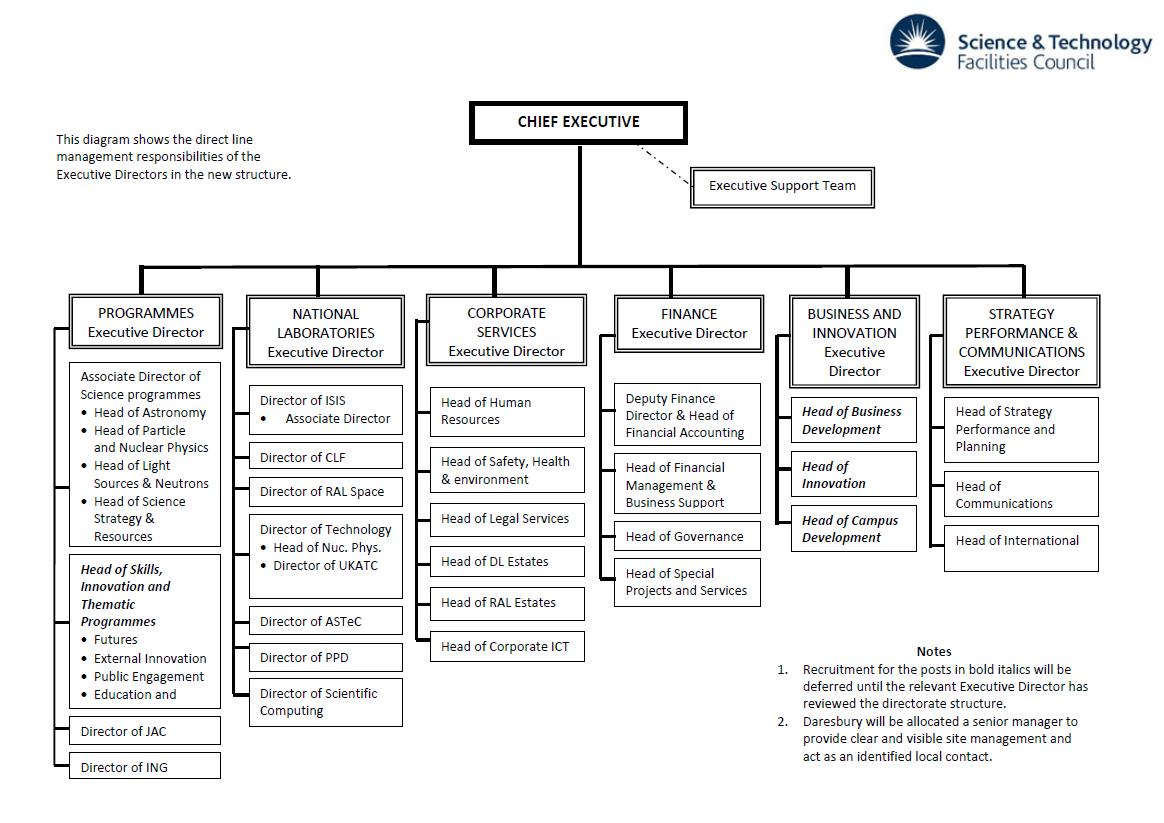
The new team at STFC will line up like this

It doesn’t look all that different from the old one, except it’s a slightly more compact  formation with less width in the wide areas, and perhaps fewer clichés in the final third.

The controversy however comes with ashen-faced manager Ron John Womersley’s team selection. As per the announcement:

Following staff input, and Council approval, I have conducted an internal selection process to fill the new senior positions in the structure and can now announce the following appointments from 1 April 2012:

    • Executive Director National Laboratories: Dr Andrew Taylor
    • Executive Director Business and Innovation: Dr Tim Bestwick
    • Executive Director Corporate Services: Mr Gordon Stewart
    • Executive Director Strategy, Performance and Communications: Dr Sharon Cosgrove

In addition, Mrs Jane Tirard will continue in her role with the new title of Executive Director Finance, and Dr Janet Seed will extend her acting stewardship of the programmes area as Acting Executive Director Programmes pending an open recruitment exercise for the position.

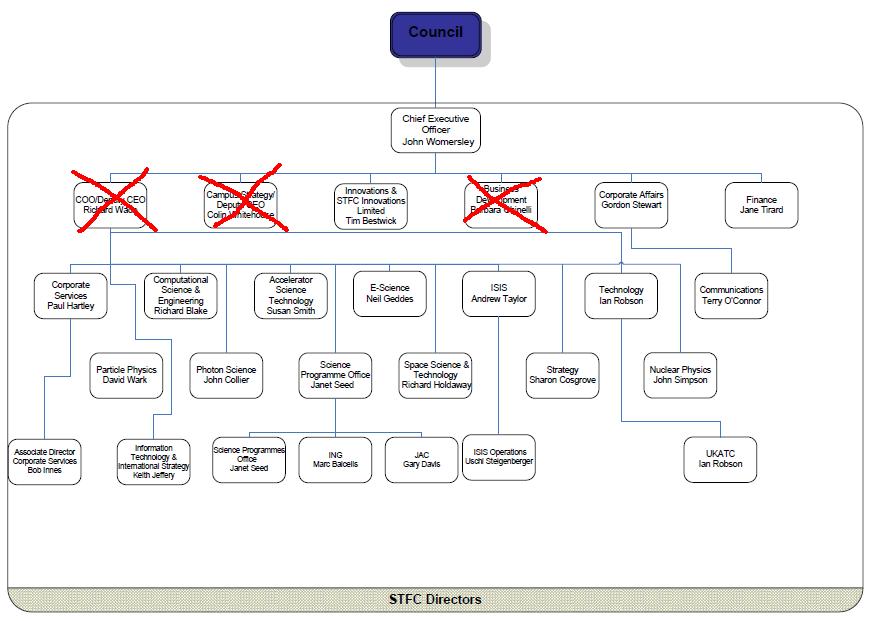
So three prominent members of the previous line-up are no longer part of the team:

For example, out goes hard-tackling wide man and own-goal specialist, Richard Wade, who apparently leaves on a free transfer. Or is he just on the subs’ bench for the time being?  According to the diagram, Tim Bestwick stays but will move from a central position to the right side, roughly changing position with Gordon Stewart who also keeps his place in the team. Andrew Taylor, formerly in midfield, moves to an inside forward role where, as Director of the National Laboratories, he will sometimes be “in the hole” (i.e. Didcot).

Most pundits reckon the new-look STFC will deploy a Diamond-Light Source shaped midfield aimed at closing down the opposition, as opposed to the old team which concentrated more on closing down its own facilities. It looks like the reorganization was made with  one eye on European challenges, but Womersley remains committed to the national game, as last week’s scouting trip to the University of Neasden makes clear.

The STFC supporters’ club  (Sid and Doris Bonkers) expressed delight with the team changes, but former manager Keith Mason remains bound and gagged in the basement of UKSA was unavailable for comment.

Harry Redknapp is 97.

P.S. The STFC statement describes the staff departures thus:

STFC has benefited from the very significant personal contributions of the existing senior management team. They have helped develop STFC into a successful workplace as recognised by the recent Investor in People accreditation (Silver status), and our positive Comprehensive Spending Round outcome. However, the changing dynamics of STFC mean that it is time for a change and not all senior managers will continue with the organisation.

Do I detect a note of insincerity?