The Snow Man

Posted in Poetry with tags , , on February 2, 2012 by telescoper

One must have a mind of winter
To regard the frost and the boughs
Of the pine-trees crusted with snow;

And have been cold a long time
To behold the junipers shagged with ice,
The spruces rough in the distant glitter

Of the January sun; and not to think
Of any misery in the sound of the wind,
In the sound of a few leaves,

Which is the sound of the land
Full of the same wind
That is blowing in the same bare place

For the listener, who listens in the snow,
And, nothing himself, beholds
Nothing that is not there and the nothing that is.

by Wallace Stevens  (1879-1955).

Is there only one electron in the Universe?

Posted in The Universe and Stuff with tags , , , , , , , , on February 1, 2012 by telescoper

I started teaching Nuclear and Particle Physics to the 3rd year Physics students today. I decided to warm up with a few basics about elementary particles and their properties – all pretty standard stuff and no hairy mathematics. Cue pretty picture:

This doesn’t show the whole picture, of course, because for every particle there is an antiparticle, so there are antiquarks and antileptons. The existence of these was first suggested by Paul Dirac in 1928 based on his investigations into relativistic quantum theory, basically because invariance of special relativity is compatible with the existence of both positive and negative energy states, i.e.

E^2 = p^2c^2 +m^2 c^4

has two sets of solutions, one with E>0 and the other with E<0. Instead of simply assuming the latter set were physically unrealistic, Dirac postulated that they might be real, but completely filled in “empty” space; these filled negative-energy states are usually called the “Dirac Sea”. Injection of an appropriate amount of energy can promote something from a negative state into a positive one, leaving behind a kind of hole (very similar to what  happens in the case of semiconductor). This process creates a pair consisting of a (positive energy) particle and a (negative energy) antiparticle (i.e. a hole in the Dirac Sea). In the case of electrons, the hole is called a positron.

The alternative, and even wackier, explanation of antimatter I usually mention in these lectures derives, I think, from Feynam who noted that in quantum (wave) mechanics the time evolution of particles involves things like

\exp(i\omega t)=\exp(i Et/\hbar),

which have the property that changing E into -E has the same effect as changing t into -t. This is, in essence, the reason why, in Feynman diagrams, antiparticles are usually represented as particles travelling backwards in time…

This is a useful convention from the point-of-view of using such diagrams in calculations, but it allows one also to raise the wacky bar to a higher level still, to a suggestion that, coincidentally, was  doing the rounds very recently – namely whether it is possible that there may really be only one electron in the entire Universe:

….I received a telephone call one day at the graduate college at Princeton from Professor Wheeler, in which he said, “Feynman, I know why all electrons have the same charge and the same mass” “Why?” “Because, they are all the same electron!” And, then he explained on the telephone, “suppose that the world lines which we were ordinarily considering before in time and space—instead of only going up in time were a tremendous knot, and then, when we cut through the knot, by the plane corresponding to a fixed time, we would see many, many world lines and that would represent many electrons, except for one thing. If in one section this is an ordinary electron world line, in the section in which it reversed itself and is coming back from the future we have the wrong sign to the proper time—to the proper four velocities—and that’s equivalent to changing the sign of the charge, and, therefore, that part of a path would act like a positron.”
—Feynman, Richard, Nobel Lecture December 11, 1965

In other words, a single electron can appear in many different places simultaneously if it is allowed to travel backwards and forwards in time…

I think this is a brilliant idea, especially if you like science fiction stories, but there’s a tiny problem with it in terms of science fact. In order for it to work there should be as many positrons in the Universe as there are electrons. Where are they?

Di Provenza

Posted in Opera with tags , , on February 1, 2012 by telescoper

It’s a cold and gloomy morning as befitting the first of February, so I thought you might appreciate a touch of the warmth of the South of France. This is Germont’s Aria Di Provenza il mar, il suol from La Traviata by Giuseppi Verdi. The recording – made, incredibly, in 1907 – provides a rare chance to hear the magnificent baritone of the legendary Titta Ruffo whose nickname, appropriately enough, was Voce del Lione “Voice of the Lion”. Despite the limitations of the recording, which required the aria to be cut down to fit within 3 minutes, this is still a stunning performance which makes most modern-day baritones sound like a wet weekend. If you listen carefully right at the end you’ll hear someone say “bravo”…

Academic Interactions

Posted in The Universe and Stuff with tags , on January 31, 2012 by telescoper

I’ve spent nearly all day getting my notes ready to start teaching Accidental Raunchy Slippers  Nuclear and Particle Physics tomorrow to the massed ranks of Third-Year Physics students here in the School of Physics & Astronomy at Cardiff University. I’ve drawn so many Feynman diagrams in the last couple of days that I’ve started to see them everywhere I look, even in entirely unexpected contexts, as in this example from the excellent PHD Comics

Out, Mad Colleague!

Posted in Uncategorized with tags , on January 30, 2012 by telescoper

In order to develop further the problem-solving skills of students in the School of Physics & Astronomy at Cardiff University, it has been decided to list the entries in the Spring Semester module catalogue in the form of anagrams.

For example, here is the list for third year students doing basic courses in physics SHY PICS

PX3206      A CHEMIST’S TACTICAL SIN

PX3211       VASTLY DIMMED CAPACITANCE HASH

PX3226      MEDIC’S CROUTONS

PX3233      CRISPY HASSLE

PX3235      AN ANARCHY, SO MINDLESS NOTES

PX3237      ACCIDENTAL RAUNCHY SLIPPERS

while those taking courses involving ROMAN TOYS also have

PX3231       POSY ALCOHOLIC’S GYM

PX3212       SLITHERY SCALPS

Students doing  SCUM I also get to do

PX3214       SHUTS NOISY DENS

and DECIMAL students have

PX3234        A RUNT CALLED SODIUM

Students also have to do their JET CROP, of course…

Oh, and  I forgot that 3rd year students can also take

PX4215      PITY CHERISHES SAGGY HORN

I hope this clarifies the situation.

Take a stand against Elsevier

Posted in Open Access with tags , , , on January 29, 2012 by telescoper

My views about the academic journal racket are on record. Of all the profiteering outfits out there, the commercial publisher Elsevier  is one of the worst offenders, for the following reasons:

  1. They charge exorbitantly high prices for their journals.
  2. They sell journals in very large “bundles,” so libraries must buy a large set with many unwanted journals, or none at all. Elsevier thus makes huge profits by exploiting their essential titles, at the expense of other journals.
  3. They support measures such as SOPA, PIPA and the Research Works Act, that aim to restrict the free exchange of information.

I believe the business practices of Elsevier are detrimental to the open exchange of information on which scientific progress depends, so I have added my name to the list here of academics who refuse to publish in, referee for, or do editorial work on behalf of any Elsevier journal. If you wish to add your name to the list you can do so here.

A list of journals published by Elsevier can be found here.

I Don’t Like Chocolate

Posted in Uncategorized on January 29, 2012 by telescoper

I was beginning to think I’m the only person in the Universe who doesn’t like chocolate, so I’m grateful to this blogger for showing me I’m not alone!

Yesterday Cadbury were “promoting” their revolting “Creme Eggs” on Twitter. These are particularly vile: sickly sugar-soaked globules of a mixture of pus and mucus, encased in solidified baby poo. Eat one and puke.

I don’t like them, you see.

The H-index is Redundant…

Posted in Bad Statistics, Science Politics with tags , , , , , on January 28, 2012 by telescoper

An interesting paper appeared on the arXiv last week by astrophysicist Henk Spruit on the subject of bibliometric indicators, and specifically the Hirsch index (or H-index) which has been the subject of a number of previous blog posts on here. The author’s surname is pronounced “sprout”, by the way.

The H-index is defined to be the largest number H such that the author has written at least H papers having H citations. It can easily be calculated by looking up all papers by a given author on a database such as NASA/ADS, sorting them by (decreasing) number of citations, and working down the list to the point where the number of citations of a paper falls below the number representing position in the list. Normalized quantities – obtained by dividing the number of citations a paper receives by the number of authors of that paper for each paper – can be used to form an alternative measure.

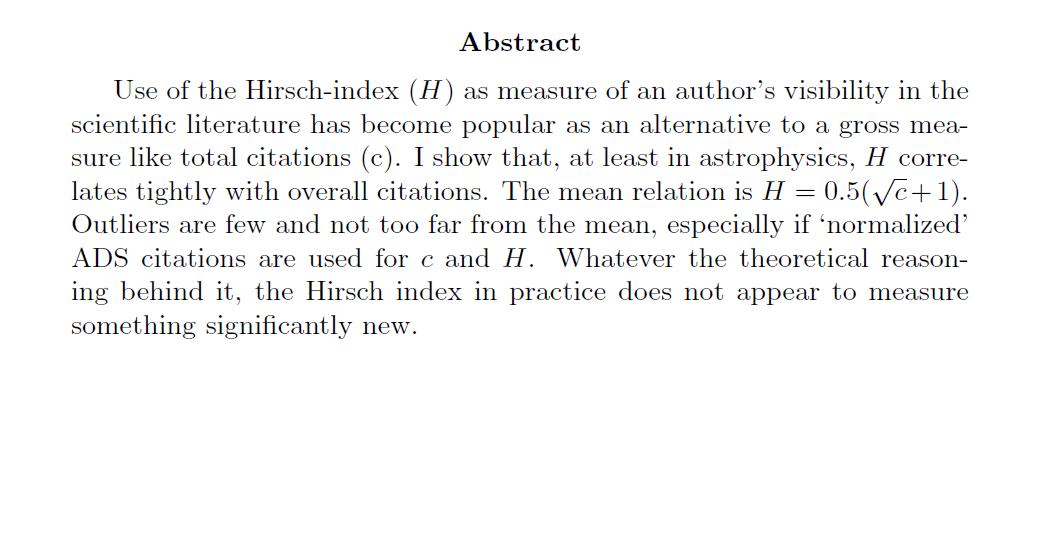
Here is the abstract of the paper:

Here are a couple of graphs which back up the claim of a near-perfect correlation between H-index and total citations:

The figure shows both total citations (right) and normalized citations (left); the latter, in my view, a much more sensible measure of individual contributions. The basic problem of course is that people don’t get citations, papers do. Apportioning appropriate credit for a multi-author paper is therefore extremely difficult. Does each author of a 100-author paper that gets 100 citations really deserve the same credit as a single author of a paper that also gets 100 citations? Clearly not, yet that’s what happens if you count total citations.

The correlation between H index and the square root of total citation numbers has been remarked upon before, but it is good to see it confirmed for the particular field of astrophysics.

Although I’m a bit unclear as to how the “sample” was selected I think this paper is a valuable contribution to the discussion, and I hope it helps counter the growing, and in my opinion already excessive, reliance on the H-index by grants panels and the like. Trying to condense all the available information about an applicant into a single number is clearly a futile task, and this paper shows that using H-index and total numbers doesn’t add anything as they are both measuring exactly the same thing.

A very interesting question emerges from this, however, which is why the relationship between total citation numbers and h-index has the form it does: the latter is always roughly half of the square-root of the former. This suggests to me that there might be some sort of scaling law describing onto which the distribution of cites-per-paper can be mapped for any individual. It would be interesting to construct a mathematical model of citation behaviour that could reproduce this apparently universal property….

Gershwin, Adams & Rachmaninov

Posted in Music with tags , , , , , , , , on January 28, 2012 by telescoper

Yesterday (Friday) being the last day of (relative) freedom before teaching resumes on Monday I took the opportunity to go to a concert by the Orchestra of Welsh National Opera at the splendid St David’s Hall in Cardiff. I had been looking forward to it for some time, as the programme featured two favourite pieces of mine, George Gershwin’s Rhapsody in Blue and John Adams’ The Chairman Dances (A Foxtrot for Orchestra), plus one longer piece that I’ve never heard live before, Symphony No. 2 (in E minor) by Sergei Rachmaninov.

There was a good crowd in St David’s last night, not surprisingly given the popularity of the pieces being performed. Conductor for the evening was Frédéric Chaslin, who led the orchestra from the piano during the opening number, Rhapsody in Blue. This is a very famous piece, and is played so often that it is in danger of becoming a bit of a cliché, especially when classical orchestras try too hard to sound like jazz musician; the piece was originally written for Paul Whiteman’s Orchestra. A case in point is the opening clarinet solo, which is often played like a ham-fisted parody. Not last night, though. Principal clarinettist of WNO Leslie Craven gave a very characterful rendition of the notoriously tricky opening, which seemed to inspire the orchestra into an excellent all-round performance. I particularly enjoyed seeing the cello section slapping the strings of their instruments much as a jazz-era double-bass player would.

Chaslin gave an idiosyncratic account of the piano part, to the extent that in the final solo passage before the finale he departed from the script entirely and interpolated an improvised section all of his own. Not everyone in the audience approved – there were a few tuts behind me – but it’s a piece undoubtedly inspired by jazz, so I don’t see anything wrong with doing this. I thought his ad-libbing was charming, and very witty. What I wasn’t so happy about were the changes in tempo, which were too exaggerated. I suppose conducting from the piano means you can do whatever you want, but I think he took the rubato too far. Some sections rely on strict rhythm for their sense of urgency, and I felt he got bogged down a bit in places. Still, on balance, it was very refreshing to hear an orchestra trying to do something different. Nothing hackneyed about last night’s performance, that’s for sure.

Next one up was The Chairman Dances by John Adams. This isn’t actually in the opera Nixon in China, which is what a lot of people seem to think. It was composed at the same time, but cut out and developed as a standalone concert piece. I posted a recording of this yesterday, so won’t say too much today, except that I thoroughly enjoyed my first live experience of this work. So did the orchestra by the look of it! It’s a hugely entertaining piece and had many in the audience tapping their feet along with it. As a matter of fact, I wouldn’t have minded getting up and dancing along myself..

Special mention has to go the percussion section of the orchestra for doing such an excellent job. The four xylophones were  a delight to listen to, and the drums, temple blocks, triangles and assorted ironmongery coped brilliantly with the intricate polyrhythms.

Then it was the interval, and a glass of wine before returing to savour the main piece of the evening, Rachmaninov’s Second Symphony. It’s a remarkable work because it’s not only a “proper” symphony in its construction and development but also the best part of an hour of one glorious melody after another. Rachmaninov’s music is not really very much like Mozart, but they certainly had a similar ear for the Big Tune! I particularly loved the third movement (Adagio), but I thought it was a magnificent performance throughout, not least because you could see how much both conductor and orchestra were enjoying themselves.

The end of the concert was met with rapturous applause from the (normally rather reticent) St Davids audience. Now I have to find the best recording I can of Rachmaninov’s Second Symphony so I can enjoy it again. Any suggestions?

Foxtrot for Orchestra

Posted in Music with tags , on January 27, 2012 by telescoper

Sitting in the office at the end of a long week, and looking forward to going to an interesting-sounding concert at St David’s Hall later on. I may get the chance to review it over the weekend, but in the meantime I thought I’d put up this version of one of the pieces I’m going to hear later. I think it’s great but I’ve never heard it live…