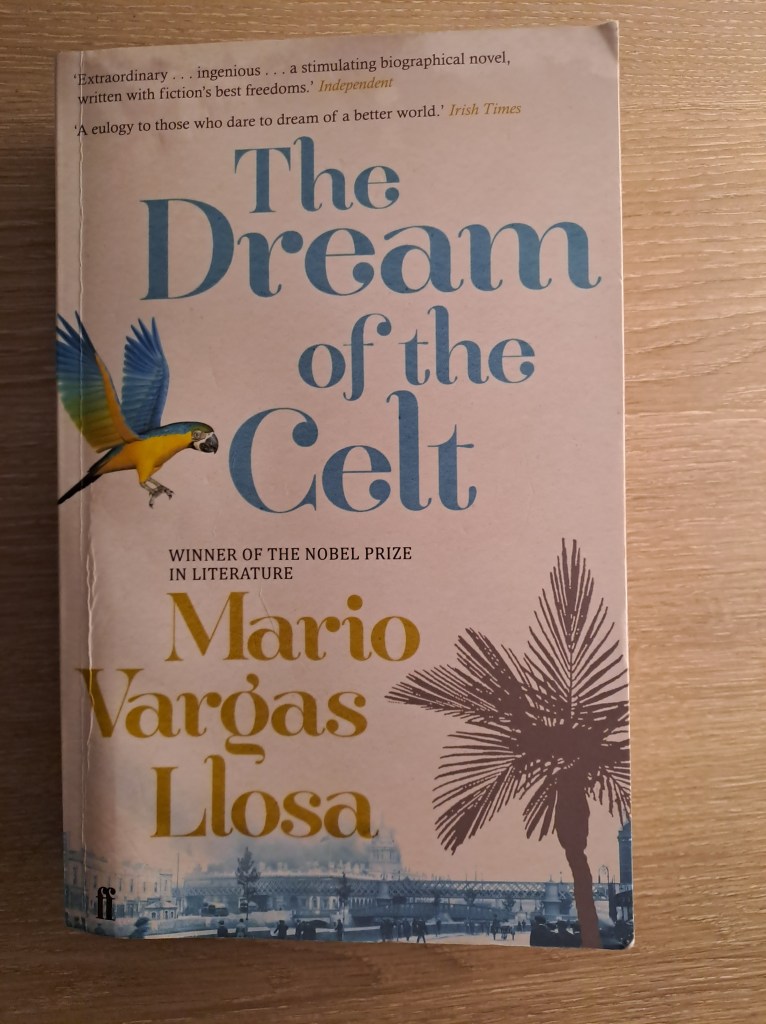
Knowing that I would be spending even less time watching TV while in Barcelona than I would back in Maynooth, I packed a number of books from the substantial pile that I haven’t yet got around to. The first I’ve finished is The Dream of the Celt by Peruvian author Mario Vargos Llosa which tells the fascinating but ultimately tragic story of Roger Casement using a mixture of thoroughly researched journalistic reportage and fictionalized extrapolations that try to bring this enigmatic character to life.
Roger Casement was born in Sandycove, Dublin, but spent some of his childhood in England. He served with great distinction as a diplomat, and a fierce advocated of human rights, first in the Congo, where he compiled a devastating report of the brutal exploitation of indigenous people, and then in Peru where he exposed even worse cruelty being exacted on native men women and children who were used as forced labour in the rubber plantations. He was knighted in 1911 for his humanitarian efforts.
When he first started out in the diplomatic service, Casement apparently believed that colonization would be a civilizing influence, bringing free trade, the rule of law, and Christianity instead of repression and violence. His bitter experience changed his view entirely, and he became increasingly associated with the cause of England’s first colony, and became a fervent advocate of Irish nationalism. He found himself travelling to Germany during the First World War to procure arms for an Irish rebellion and to raise an Irish Regiment from Irish prisoners of war captured fighting for the British. In the latter he was not successful – he persuaded only about 50 POWs to join the cause. He did succeed in obtaining weapons but the ship smuggling them to Ireland was intercepted and scuttled to avoid the weapons falling into British hands.
Incidentally, Casement was against the Easter Rising of 1916. He thought it would be futile unless it could be combined with a German attack on England. Ireland was not sufficiently important geopolitically for the Kaiser to mount such an operation. The other leaders of the Rising wanted Casement to stay in Germany as it proceeded but he travelled to Ireland in a submarine, was captured, tried for high treason, found guilty, and hanged at Pentonville Prison on 3rd August 1916. He was 51. His executioner later remarked that he was ‘‘the bravest man it fell to my unhappy lot to execute.’
W.B. Yeats wrote a poem about Roger Casement, the last verse of which is:
Come speak your bit in public
That some amends be made
To this most gallant gentleman
That is in quicklime laid.
Leading up to Casement’s execution there was a concerted campaign for clemency, i.e. the commutation of his death sentence, as had happened with some involved directly in the rebellion. But then came the Black Diaries. Parts of these, describing in Casement’s own words his many sexual adventures with men and boys, were leaked to the press by British intelligence services. At a time when homosexuality was still a crime, that effectively ended any hope of avoiding the gallows. The Black Diaries are of questionable authenticity, and many who believe they were genuine think Casement was merely writing about fantasies rather than reality. Maybe writing about things he couldn’t do was a way for him to relieve sexual tension? We’ll never know for sure.
After his execution Casement’s body was subject to a rectal examination to ascertain whether he had had anal sex as described in the books. He was buried in an unmarked grave and it wasn’t until 1965 that his remains were returned to Ireland to be interred at Glasnevin cemetery.
The author tells this story by interspersing Casement’s last weeks and months in Pentonville with flashbacks to his time in the Congo, the Peru, Germany and Ireland. The protagonist did write extensive notes on his travels but they are somewhat disorganized, so he had to make reasonable guesses to fill in the gaps. The conversations with other characters are imagined to make it seem more like a novel than a straight historical biography. This approach makes for a fascinating read, although I did find it somewhat repetitive in places.
Sir Roger Casement, as reconstructed in this book, is a fascinating character, but how close the account is to how he really was as a person is something we’ll never know. In a strange way, that mystery is part of the appeal.


 In the Dark