Archive for archaeology

Proto, by Laura Spinney

Posted in History, Irish Language with tags , , , , , , , , on September 24, 2025 by telescoper

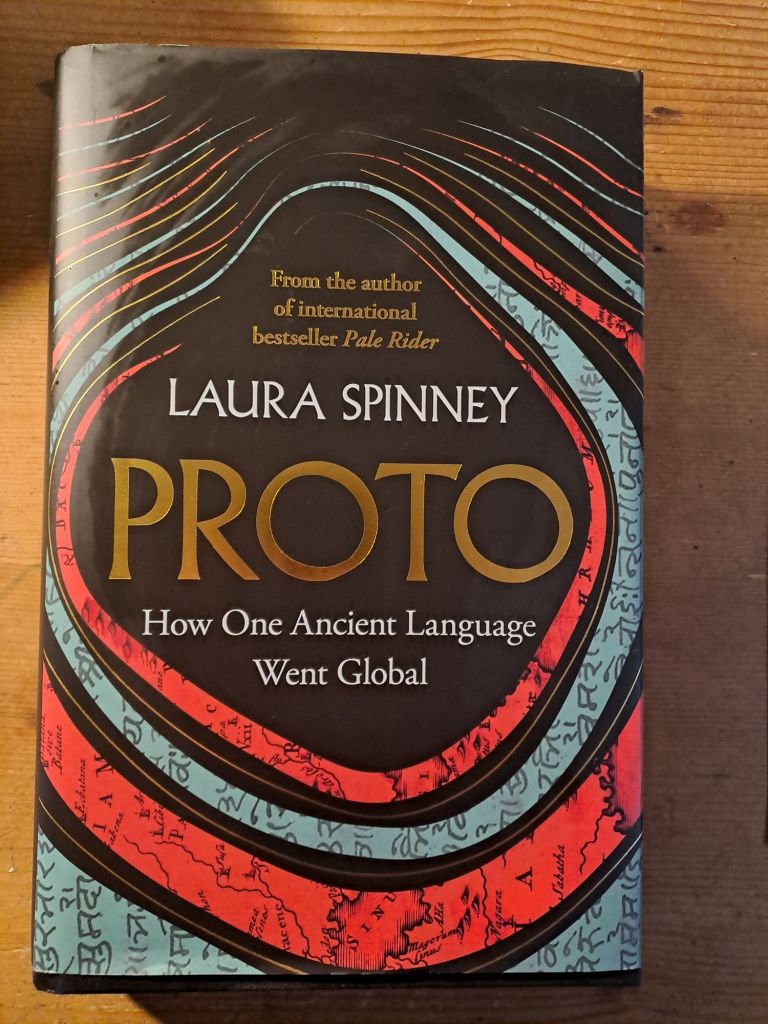
I interrupted the sequence of novels I’ve been reading recently to absorb a non-fiction book, Proto by Laura Spinney (left). I find linguistics a fascinating subject and when I saw a review of this recently and couldn’t resist. I’m glad I bought it because it’s absolutely fascinating. It is the story – or at least a very plausible account of the story of the lost ancestor of the Indo-European languages, the methods that have been used to reconstruct “Proto”, and why it was the spark that generated so many other languages across Europe, Eurasia and India.

The topic is very complex and I won’t attempt to describe it all in depth here; each chapter could be a book in itself because each family of languages within the Indo-European group – including lost ones such as Tocharian – has its own fascinating story. There are chapters focussing on the origins of language itself, the possibilities surround Proto (a language that was never written and probably exists in many dialects), Anatolian, Tocharian, Celtic, Germanic and Italic, the Indo-Iranian group (based on Sanskrit), Baltic and Slavic, and Albanian, Armenian and Greek. The last of these is fascinating because it used a method of writing borrowed from a  non-Indo-European source that became the origin of the European alphabet.

The story of which all these are subplots begins around the Black Sea shortly after end of the last Ice Age. In this area there lived mesolithic hunter-gatherers who had survived the ice who interacted with farmers moving up from the direction of modern day Syria. Their languages would have merged in some way to allow them to describe things that their neighbours had that they didn’t. Hunter-gatherers would not have words for, e.g., ploughing or barley while farmers would have fewer words for spears and other hunting equipment. Into this mix, the argument goes, came a third group, a fully nomadic culture called the Yamnaya people. These people and their successors subsequently underwent vast migrations from the steppes across the continent and were responsible for spreading the Proto-Indo-European languages. That’s a hypothesis, not a proven fact, but it is plausible and has a reasonable amount of evidence in its favour.

Recent progress in this field has been driven not only by linguists but also by archaeologists and geneticists, with each aspect of this triangulation vital. It was reading about archaeology in this book that prompted me to write a post about the Nebra Sky Disc. There are some fascinating snippets from palaeogenetics, too. Full DNA sequences are now known for about 10,000 individuals who lived in prehistoric times.

One extraordinary find involves two burials of individuals who both lived about 5,000 years ago. Their DNA profiles match so well that they were probably second cousins or first cousins once removed. The thing is that one of them was buried in the Don Valley, north-east of Rostov in modern-day Russian, while the other was found 3,000 km away in the Altai mountains. Assuming they were both buried where they died, the implications for the distance over which people could move in a lifetime are remarkable.

Another fascinating genetic snippet applies to Irish, a Celtic language. The Celtic languages derive from a proto-Celtic source that probably arose about 1000 BC. Around 2450 BC one of the cultures preceding the Celts arrived in Britain and Ireland, now called the Bell Beaker People because of their taste in pottery. The genetic record shows that the DNA of the Beaker folk replaced about 90% of the previous local gene pool, and all of the Y chromosomes; for some reason men of the earlier culture stopped fathering children. A similar change happened in Ireland, about 200 years later.One possible inference is that there was a violent conquest involving the erasure of the male population, but we don’t know for sure that it was sudden and catastrophic.

Whatever language the Beaker people brought with them was not Celtic (though it may have been Indo-European). The fascinating conundrum is that when Celtic languages arrived in Ireland whoever brought them left not a trace in the genetic record. This is unlike any of the similar changes in language use throughout European pre-history. Either the population responsible has not been identified or the language was spread through communication (e.g. for trade) rather than settlement. Irish may be a Celtic language, but there is little evidence of significant numbers of Celts settling here and bringing it with them.

Some time ago I wrote a post about the Celtic languages, which you might want to look at if you’re interested in this topic. A lot of that post I now realize to be very simplistic, but to add one other snippet I should mention that the name of Turkish football team Galatasaray translates to “Palace of the Celts” after the Celtic-speaking people who settled in Anatolia; these were the Galatians to whom Paul addressed his Epistle.

I thoroughly recommend this fascinating book. It made me want to find out more about so many things. It also gacve me additional motivation to pursue an idea I had a while ago to do a Masters in Linguistics wehn I retire from physics…
The Nebra Sky Disc

Posted in Art, History, The Universe and Stuff with tags , , , , on September 19, 2025 by telescoper
By Frank Vincentz – Public Domain, https://commons.wikimedia.org/w/index.php?curid=117229202

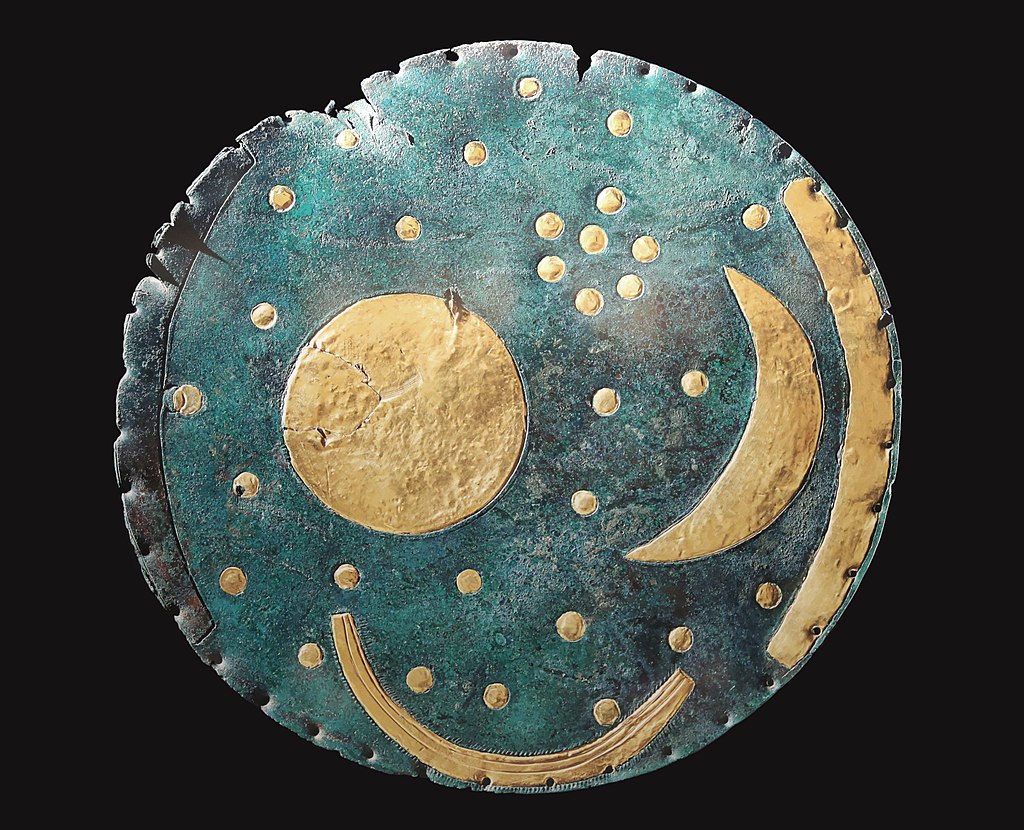
This remarkable object is made of bronze, is around 30 cm diameter and weighs about 2.2 kg. It has a blue-green patina and is inlaid with gold symbols, usually interpreted as the full moon, a lunar crescent, and stars, including a cluster of seven stars, thought to represent the Pleiades. The gold arc on the right probably represents the Sun’s path between the solstices; the angle subtended by the arc (82°) is the correct angle sunrise at the summer and winter solstices and at the latitude of the discovery site (Mittelberg, near Nebra, in Germany); there was probably another such arc on the other side of the disk (now lost). Remarkably, the tin used in making the bronze from which it is formed has been traced by metallurgical analysis to Cornwall.

The Nebra disc has been dated to c. 1800–1600 BCE (Bronze Age) which makes it the oldest (certain) depiction of celestial phenomena known from anywhere in the world. In November 2021, a replica of the Nebra Sky Disc was taken by German astronaut Matthias Maurer to the International Space Station.

Old Blue Eyes

Posted in History, Television with tags , , , , , , on April 19, 2021 by telescoper

Yesterday I watched the concluding episode of a fascinating two-part documentary series called The Burren: Heart of Stone, an extraordinary region of glaciated limestone klarst in County Clare. The landscape has a distinctly other-worldly look to it, yet humans have lived and farmed on it for at least 8,000 years.

Episode 1 was largely about the geology and ecology of the Burren which explained how the motion of glaciers across the area scraped away upper layers and revealed the limestone deposits formed by the bones and shells of ancient marine creatures who lived there tens of millions of years ago. The present-day Burren is windswept and rainy but is home to a rich ecosystem of plants, insects, birds and animals. Despite the heavy rainfall there are no rivers to be seen, but water flows underground through a complex network of tunnels and caves.

The first programme was interesting enough but Episode 2 was about the history of human habitation in the Burren, incorporating recent genetic discoveries, and that was absolutely fascinating.

The oldest population for which DNA sequencing has been possible were the mesolithic hunter- gatherers who lived in Ireland at least 8,000 years ago. Studies of the available remains show that these people had dark skin and blue eyes.

I only found out recently that the genetic mutation required for blue eyes arose in a single individual about 10,000 years ago; before that happened no humans had blue eyes. Having blue eyes myself, and in light of a recent discovery that I have a different mutation that arose more recently, I find that very intriguing.

Being hunter-gatherers these folk lived on the margins of the forests that covered most of Ireland, fishing and hunting animals as well as gathering nuts and berries. Their settlements were primarily impermanent affairs made of wood, so these people did not leave lasting impression on the landscape. Ireland probably couldn’t sustain a large population of these folk either, but the next people to arrive were the neolithic people who were the first farmers in Ireland. Their genetic profiles suggest they originated somewhere around modern-day Turkey and were also somewhat dark-skinned. They cleared the forests and set up permanent habitations involving stone structures, including the famous megalithic sites such as the tomb at Poulnabrone, which is at least 6,000 years old:

The Burren could have been popular with these people because, with its thin topsoil, it was much easier for them to get rid of the trees and start farming. They built stone walls to divide fields, and it is said that the walls which criss-cross the present-day Burren follow the line of these prehistoric structures.

Genetics reveal that these neolithic people and the mesolithic people intermingled and interbred, though the circumstances that led to this are of course unknown. It is hard to believe that a huge influx of people chopping down trees and clearing the land for farming would have caused no friction with the previous inhabitants. There may well have been violent struggles.

The neolithic culture survived and flourished in relative isolation until the arrival of Bronze Age settlers somewhere around 4000 years ago. These came originally from the Steppes of Russia, who took over many of the neolithic sites and adapted them for their own use before they were eventually abandoned. Evidence from the Burren suggests that the massive deforestation, combined with a climate downturn, led to catastrophic soil erosion; farming became impossible and the culture collapsed.

Incidentally, DNA studies of the Bronze Age people of Ireland are heavily mixed with neolithic genes but show no relic of the mesolithic population. Presumably these were diluted too much, as the neolithic culture sustained a much bigger population, probably around 200,000 in number.

All this was centuries before any Celtic people arrived in these shores, which was around 500 BC.

A fascinating programme, well worth watching if you can get to see it. There was a twist in the tail too: recent discoveries of apparent human activity on animal bones dated back to around 30,000 years ago, show evidence of a population of people in Ireland before the most recent Ice Age began.

Fascinating stuff!

The New Henge at Newgrange

Posted in History with tags , , , , on July 26, 2018 by telescoper

Following on from a post last week, and thanks to this website, here is an amazing aerial video, shot from a drone, of a new archaeological discovery at the Newgrange site in County Meath that has been revealed through parch marks in the ground following the recent period of very dry weather.

Newgrange is already established as major prehistoric site, most famous for a neolithic burial mound (which means that it was built before Stonehenge or the pyramids at Giza in Egypt). More recent studies, including a passage tomb found at Dowth, also in County Meath, show that the area around Newgrange, in the Boyne valley near Drogheda, was of major importance in the neolithic era.

You can read much more about the new henge at Newgrange and its place in Irish prehistory here.

Back to the Drawing Board

Posted in Art, Education, The Universe and Stuff with tags , , , , , , , , , on August 30, 2011 by telescoper

I came across a press release this morning which contains the following

More should be done to encourage students to use their drawing skills in science education, researchers at The University of Nottingham say.

In a paper being published in Science this week, academics say that although producing visualisations is key to scientific thinking, pupils are often not encouraged to create their own drawings to develop and demonstrate their understanding.

In the paper the authors, led by Dr Shaaron Ainsworth in the University’s School of Psychology and Learning Sciences Research Institute, said: “Scientists do not use words only but rely on diagrams, graphs, videos, photographs and other images to make discoveries, explain findings, and excite public interest.

In the light of this I thought it would be topical to post an updated version of an old piece I wrote on the theme of sketching. This is quite a strange subject for me to have picked pick because drawing is something I’m completely useless at, but I hope you’ll bear with me and hopefully it will make some sense in the end. I always thought that drawing was an important and neglected aspect of education, but I hadn’t until today any solid research to back it up!

-0-

What  spurred me on to think about this subject was the exhibit I was  involved with for the  Architecture Biennale in Venice as part of a project called Beyond Entropy organized by the Architectural Association School of Architecture. In the course of researching this project I came across this image of the Moon as drawn by Galileo

This led to an interesting discussion about the role of drawings like this in science. Of course  the use of sketches for the scientific representation of images has been superseded by photographic techniques, initially using film and more recently by digital techniques. The advantage of these methods is that they are quicker and also more “objective”. However, there are still many amateur astronomers who make drawings of the Moon as well as objects such as Jupiter and Saturn (which Galileo also drew). Moreover there are other fields in which experienced practioners continue to use pencil drawings in preference to photographic techniques. Archaeology provides many good examples, e.g.

The reason sketching still has a role in such fields is not that it can compete with photography for accuracy or objectivity but that there’s something about the process of sketching that engages the sketcher’s brain in a  way that’s very different from taking a photograph. The connection between eye, brain and hand seems to involve a cognitive element that is extremely useful in interpreting notes at a later date. In fact it’s probably their very subjectivity that makes them useful.  A thicker stroke of the pencil, or deliberately enhanced shading, or leaving out seemingly irrelevant detail, can help pick out  features that seem to the observer to be of particular significance. Months later when you’re trying to write up what you saw from your notes, those deliberate interventions against objectivity will take you back to what you  saw with your mind, not just with your eyes.

It doesn’t even matter whether or not you can draw well. The point isn’t so much to explain to other people what you’ve seen, but to record your own interaction with the object you’ve sketched in a way that allows you to preserve something more than a surface recollection.

You might think this is an unscientific thing to do, but I don’t think it is. The scientific process involves an interplay between objective reality and theoretical interpretation and drawing can be a useful part of this discourse. It’s as if the pencil allows the observer to interact with what is observed, forming a closer bond and probably a deeper level of understanding patterns and textures. I’m not saying it replaces a purely passive recording method like photography, but it can definitely help it.

I have not a shred of psychological evidence to back this up, but I’d also assert that sketching is very good for the learning process too.  Nowadays we tend to give out handouts of diagrams involved in physics, whether they relate to the design of apparatus or the geometrical configuration of a physical system. There’s a reason for doing this – they take a long time to draw and there’s a likelihood students will make mistakes copying them down. However, I’ve always  found that the only way to really take in what a diagram is saying is to try to draw it again myself. Even if the level of draftsmanship is worse, the level of understanding is undoubtedly better.Merely looking at someone else’s representation of something won’t give your brain as a good a feeling for what it is trying to say  as you would get if you tried to draw it yourself.

Perhaps what happens is that simply looking at a diagram only involves the connection between eye and brain. Drawing a copy requires also the connection between brain and hand. Maybe  this additional connection brings in additional levels of brain functionality. Sketching iinvolves your brain in an interaction that is different from merely looking.

The problem with excessive use of handouts – and this applies not only to figures  but also to lecture notes – is that they turn teaching into a very passive process. Taking notes in your own hand, and supplementing them with your own sketches – however scribbly and incomprehensible they may appear to other people – is  a much more active way to learn than collecting a stack of printed notes and meticulously accurate diagrams. And if it was good enough for Galileo, it should good enough for most of us!

The Sketch Process

Posted in Art, Education, The Universe and Stuff with tags , , , , , , , , , on August 25, 2010 by telescoper

It’s pouring with rain so, rather than set off home and get drenched, I thought I’d spend a few minutes on the blog and hope that the deluge dies down before I leave. Knowing my luck it will probably get worse.

Anyway, I thought I’d put together a short item on the theme of sketching. This is quite a strange subject for me to pick because drawing is something I’m completely useless at, but I hope you’ll bear with me and hopefully it will make some sense in the end.

What  spurred me on to think about it was the exhibit I’ve been involved with for the forthcoming Architecture Biennale in Venice as part of a project called Beyond Entropy organized by the Architectural Association School of Architecture. Unfortunately, although I’d originally planned to attend I can’t be there for the opening Symposium, but I hope it turns out to be as successful event as it promises to be!

Anyway, in the course of this project I came across this image of the Moon as drawn by Galileo

This led to an interesting discussion about the role of drawings like this in science. Of course  the use of sketches for the scientific representation of images has been superseded by photographic techniques, initially using film and more recently by digital techniques. The advantage of these methods is that they are quicker and also more “objective”. However, there are still many amateur astronomers who make drawings of the Moon as well as objects such as Jupiter and Saturn (which Galileo also drew). Moreover there are other fields in which experienced practioners continue to use pencil drawings in preference to photographic techniques. Archaeology provides many good examples, e.g.

The reason sketching still has a role in such fields is not that it can compete with photography for accuracy or objectivity but that there’s something about the process of sketching that engages the sketcher’s brain in a  way that’s very different from taking a photograph. The connection between eye, brain and hand seems to involve a cognitive element that is extremely useful in interpreting notes at a later date. In fact it’s probably their very subjectivity that makes them useful.  A thicker stroke of the pencil, or deliberately enhanced shading, or leaving out seemingly irrelevant detail, can help pick out  features that seem to the observer to be of particular significance. Months later when you’re trying to write up what you saw from your notes, those deliberate interventions against objectivity will take you back to what you  saw with your mind, not just with your eyes.

It doesn’t even matter whether or not you can draw well. The point isn’t so much to explain to other people what you’ve seen, but to record your own interaction with the object you’ve sketched in a way that allows you to preserve something more than a surface recollection.

You might think this is an unscientific thing to do, but I don’t think it is. The scientific process involves an interplay between objective reality and theoretical interpretation and drawing can be a useful part of this discourse. It’s as if the pencil allows the observer to interact with what is observed, forming a closer bond and probably a deeper level of understanding patterns and textures. I’m not saying it replaces a purely passive recording method like photography, but it can definitely help it.

I have not a shred of psychological evidence to back this up, but I’d also assert that sketching is very good for the learning process too.  Nowadays we tend to give out handouts of diagrams involved in physics, whether they relate to the design of apparatus or the geometrical configuration of a physical system. There’s a reason for doing this – they take a long time to draw and there’s a likelihood students will make mistakes copying them down. However, I’ve always  found that the only way to really take in what a diagram is saying is to try to draw it again myself. Even if the level of draftsmanship is worse, the level of understanding is undoubtedly better.Merely looking at someone else’s representation of something won’t give your brain as a good a feeling for what it is trying to say  as you would get if you tried to draw it yourself.

Perhaps what happens is that simply looking at a diagram only involves the connection between eye and brain. Drawing a copy requires also the connection between brain and hand. Maybe  this additional connection brings in additional levels of brain functionality. Sketching iinvolves your brain in an interaction that is different from merely looking.

The problem with excessive use of handouts – and this applies not only to figures  but also to lecture notes – is that they turn teaching into a very passive process. Taking notes in your own hand, and supplementing them with your own sketches – however scribbly and incomprehensible they may appear to other people – is  a much more active way to learn than collecting a stack of printed notes and meticulously accurate diagrams. And if it was good enough for Galileo, it should good enough for most of us!

Now it’s stopped raining so I’m off home!


Share/Bookmark