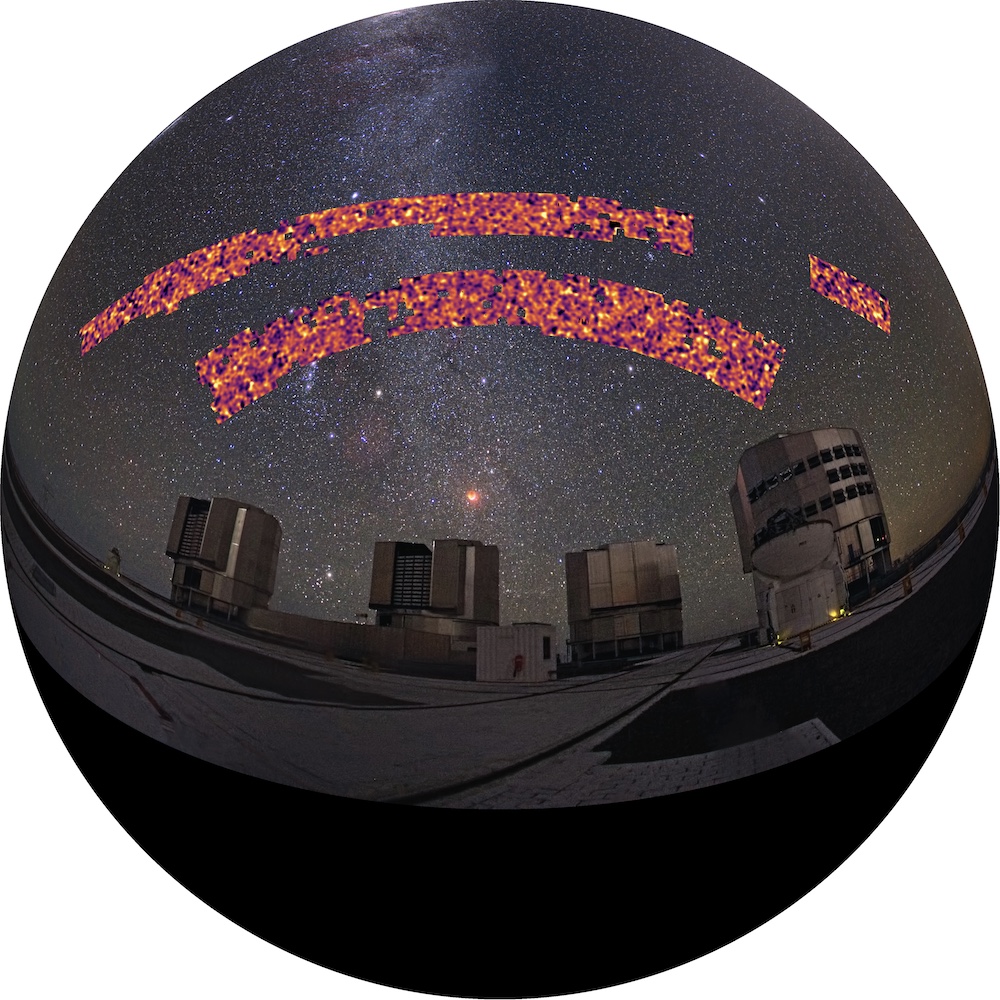
The above image is from the Kilo Degree Survey, performed using the OmegaCAM instrument on the European Southern Observatory’s VST Survey Telescope at Cerro Paranal in Northern Chile. I got it by googling `Pictures of KiDS’, which was probably unwise.
Here’s another picture, of part of the survey region.
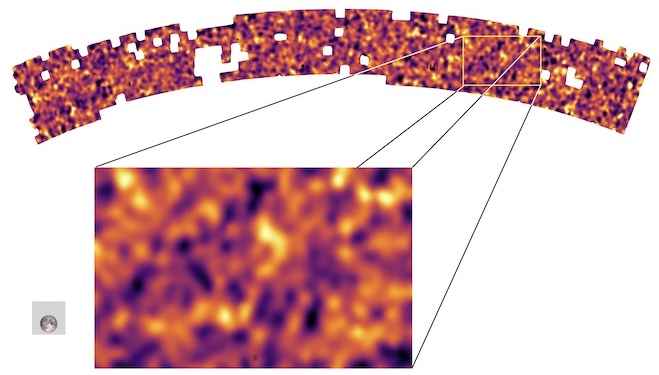
A few people have asked me why I didn’t post about the new results from KiDs which came out last week. The answer is simply that I’ve been a bit busy, but here we go now with a post on the blog about the new KiDs papers. These appear as a bunch of five on the arXiv:
KiDS-1000 catalogue: weak gravitational lensing shear measurements
KiDS-1000 catalogue: Redshift distributions and their calibration
KiDS-1000 Cosmology: Cosmic shear constraints and comparison between two point statistics
The result that stands out from the latest release is the suggestion that the Universe is about 8% less clumpy than the standard cosmological model suggests. The level of clumpiness is quantified by the parameter S8 which, according to Planck, has a value 0.832 ± 0.013 whereas KiDS gives 0.776 (+0.020/-0.014), a discrepancy of about 3σ. It’s not only the Hubble constant that is causing a bit of tension in cosmological circles!
Follow @telescoper

 In the Dark