Archive for astronomy

The Waiting Game

Posted in Science Politics with tags , , on November 4, 2010 by telescoper

I thought I’d briefly don my “community service” hat and send a message to any astronomers reading this who have “responsive mode” grant applications currently under review by the Science and Technology Facilities Council (STFC).

Obviously I can’t discuss any details here (or anywhere else for that matter), but I’ve had a few email enquiries about when the results are likely to be known. I’m sure the chair of the Astronomy Grants Panel, Andy Lawrence (aka the e-astronomer) has had even more. It seems worth posting a brief message to make the situation as clear as possible to anyone waiting for news.

The current situation is that all the rolling grant specialist panel presentations have now finished, but the full AGP has to reconvene later in November to complete the process of assigning a final ranking to all the applications.

The process is, therefore, ongoing. It would be even if it were not for the fact that the Comprehensive Spending Review results were only announced on 20th October. It will therefore still be some time before STFC knows its budget for the next few years, and only when it knows that can it produce a delivery plan that stipulates how much of its funding will be available for research grants. And only after that is done will the Astronomy Grants Panel be able to determine its final proritisation, after which STFC will decide precisely which proposals will be funded and which don’t make the cut. In an ideal world this process would be finished by the end of this calendar year, but I’m afraid there’s quite a lot of evidence that we don’t live in an ideal world, especially as science funding is concerned.

So there you have the situation as clear as I can make it, which isn’t very clear at all. You’ll all just have to wait. The most important thing is not to assume that it’s going to be bad news if you hear nothing quickly…

Diem noctis exspectatione perdunt, noctem lucis metu.

(Seneca, De Brevitate Vitae)


Share/Bookmark

Rapture

Posted in Art, The Universe and Stuff with tags , , on November 1, 2010 by telescoper

Glorious video of timelapse photography by, Tom Lowe, the winner of the 2010 Astronomy Photographer of the Year award.


Share/Bookmark

The Great Escape? Not yet.

Posted in Finance, Politics, Science Politics with tags , , , , , on October 20, 2010 by telescoper

I expected to wake up this morning with the blues all round my bed, about the results of the Comprehensive Spending Review about to be announced today, but news appearing in the Guardian and the BBC websites last night suggested that the UK Science budget may, repeat may, be spared the worst of the cuts.

This news has been greeted with euphoria in the science community, as we were expecting much worse than the settlement suggested by the news. The RCUK budget, it seems, will be fixed in cash terms around £3.5 billion per annum for four years, as will the approximately £1bn distributed for research through HEFCE’s QR mechanism. This translates into a real terms cut that depends on what figure you pick for inflation over this period. The Treasury suggests it will corresponding to a 10% reduction figured that way, but inflation has defied predictions and remained higher than expected over the past three years so things could be different. Also important to note is that this budget (amounting to around £4.6 billion) is to be ring-fenced within RCUK.

So why the apparent change of heart? Well, I don’t know for sure, but I think the Science is Vital campaign played a very big part in this. Huge congratulations are due to Jenny Rohn and the rest of the team for doing such a fantastic job. The Guardian makes this clear, stating that science is usually a non-issue for the Treasury, but this time it was

high on the political radar because strong representations have been made by the scientific community about what they have described as “long term and irreversible” damage to the UK economy if there are deep cuts to research funding.

That means everyone who wrote to their MP or lobbied or went on the demo really did make a difference. Give yourselves a collective pat on the back!

BUT (and it’s a very big BUT) we’re by no means out of the woods yet, at least not those of us who work in astronomy and particle physics. As the BBC article makes clear, the level cash settlement for RCUK comes with an instruction that “wealth creation” be prioritised. The budget for RCUK covers all the research councils, who will now have to make their pitch to RCUK for a share of the pie. It’s unlikely that it will be flat cash for everyone. There will be winners and losers, and there’s no prize for guessing who the likely losers are.

The performance of the STFC Executive during the last CSR should also be born in mind. STFC did very poorly then at a time when the overall funding allocation for science was relatively generous, and precipitated a financial crisis that STFC’s management still hasn’t properly come to grips with. The track-record doesn’t inspire me with confidence. Moreover, at a town meeting in London in December 2007 at which the Chief Executive of STFC presented a so-called delivery plan to deal with the crisis he led his organisation into, he confidently predicted a similarly poor settlement in the next CSR. Talk about a self-fulfilling prophecy. Let’s hope they get their act together better this time.

Taking all this together it remains by no means improbable that the STFC budget could be squeezed until the pips squeak in order to liberate funds to spend elsewhere within RCUK on things that look more likely to generate profits quickly. The nightmare scenario I mentioned a few days ago is still on the cards.

As we all know, STFC’s budget is dominated by large fixed items so its science programme is especially vulnerable. As the BBC puts it

So any cut in [STFC’s] budget will be greatly magnified and it is expected that it will have to withdraw from a major programme. Alternatively, it would have to cutback or close one of its research institutes.

We could have to wait until December to find out the STFC budget, so the anxiety is by no means over. However, the ring-fencing of RCUK’s budget within BIS may bring that forward a bit as it would appear to suggest one level of negotations could be skipped. We might learn our fate sooner than we thought.

Overall, this is a good result in the circumstances. Although it’s a sad state of affairs when a >10% real terms cut is presented as a success, it’s far less bad than many of us had expected. But I think STFC science remains in grave danger. It’s not an escape, just a stay of execution.

But there is one important lesson to be learned from this. When the STFC crisis broke three years ago, reaction amongst scientists was muted. Fearful of rocking the boat, we sat on our hands as the crisis worsened. I hope that the success of the Science is Vital campaign has convinced you that keeping quiet and not making a fuss is exactly the wrong thing to do.

If only we’d been braver three years ago.


Share/Bookmark

STFC Budget 2010-11

Posted in Finance, Science Politics with tags , , on October 14, 2010 by telescoper

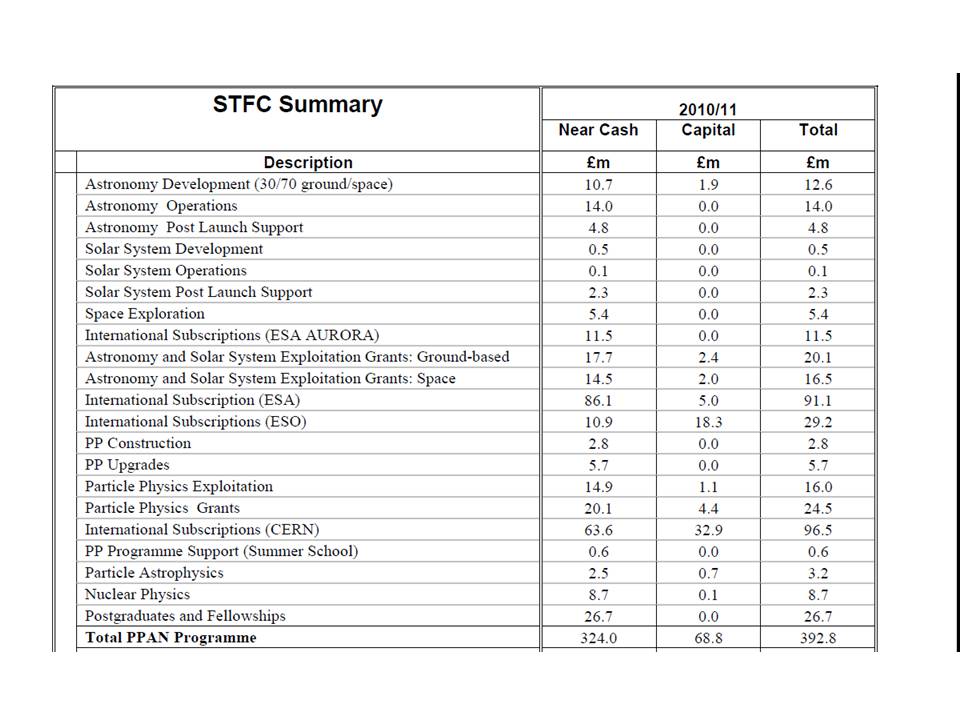
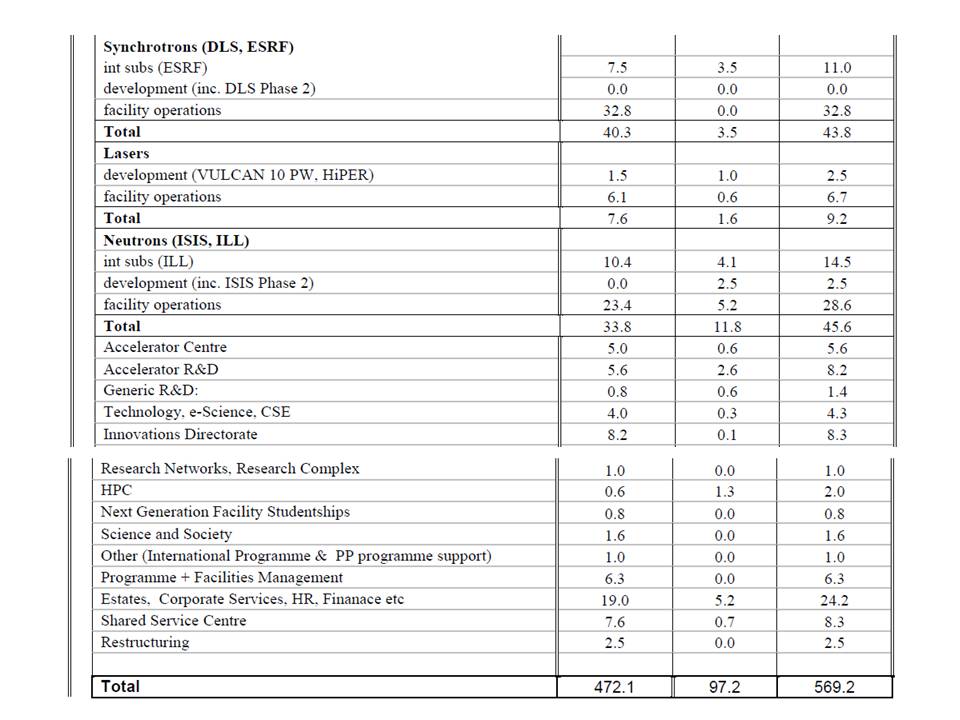
Just a quick post to point out that the Science and Technology Facilities Council have released a reasonably complete breakdown of their current budget. I’m sure many readers working in astronomy and particle physics will find it interesting reading, though others will probably find it incredibly boring.

Here it is, for easy reference, in bits, generated by a clumsy cut-and-paste-technique wholly unbefitting the hi-tech nature of STFC, starting with the PPAN Programme:

and now the rest

For those of you not up with the accounting lingo, “near cash” means assets investments and other things that could in principle be exchanged for cash in a relatively short period of time.

These are, of course, the figures before the impending cuts take place….

There’s a much more legible version of the whole thing here.


Share/Bookmark

(Guest Post) STFC – It isn’t just about money

Posted in Science Politics with tags , , , , , , on October 4, 2010 by telescoper

The following piece was written by Professor George Efstathiou, FRS, who is Professor of Astrophysics at the University of Cambridge and Director of the Kavli Institute for Cosmology. The views expressed therein are George’s own, but I’m not saying that out of a desire to distance myself from his opinions. As a matter of fact, I was one of the people who signed the petition he describes in the article…

–o–

As Peter has reported on this site, physicists around the country are anxiously awaiting the results of the forthcoming Comprehensive Spending Review. Scientists whose research is supported by the Science and Technology Facilities Council (STFC)  are particularly anxious.  Since its creation, STFC has gone through two difficult scientific prioritisation exercises. Many excellent projects have been cancelled and grants supporting University groups have been cut savagely, by about 35%. STFC science has already descended into the Royal Society’s ‘game over‘ scenario. All of this has happened before the consequences of the economic crisis have hit the science budget. STFC has left itself uniquely poorly placed amongst the Research Councils to absorb further reductions following the CSR.

It is for this reason, that I and a few others organised a petition expressing a loss of confidence in the Chief Executive of STFC. The petition was signed by 916 researchers, including 162 Professors and 18 Fellows of the Royal Society. It was formally submitted to the STFC Chair (Michael Sterling) on 1st July together with an explicit request that STFC Council should review its role in this loss of confidence.

People will have had many different reasons for signing the petition. I made my views public well in advance (see my Letter to Lord Drayson). In all of my letters to ministers and others concerning the STFC ‘crisis’, I have never asked for more money. More money would help, of course, but this is utterly unrealistic in the current economic circumstances. No, over the last three years I have been lobbying for good governance. The strutural difficulties with STFC were easy to identify and I believe that with good governance the STFC programme could have been managed without such a catastrophic loss of science. Over three years, STFC have failed to establish a compelling narrative, strategy and constructive engagement with its science community. When one bears in mind that about 40 % of Physics staff work in areas for which STFC is the primary funding source, the consequences of the STFC crisis for University Departments, and the rest of the science base, are indeed serious.

So, whatever the outcome of the CSR, there are governance issues that we should be concerned about. There are three that I would like to raise here:

1. Fellowships and grants. Senior scientists from outside the UK point to the Fellowships and Rolling Grants as two of the most effective features of the UK funding system. Both are now under threat. I was responsible for making the case for the current 5 year system to PPARC Council. In addition to the evident benefits of continuity and reduction in peer review, Council need to understand that recruitment for postdocs involves a substantial lead time. If we are to compete for the best postdocs around the world (and not lose our best post docs), grant funds must be committed four years in advance. The 5 year rolling grant system, even with tapers, allows groups to advertise posts on an international timetable and to vire funds to maximise science output. Any move to responsive mode 3 year grants is guaranteed to deliver less science for a fixed amount of money. I would vigorously defend the Fellowships. Fellowships encourage scientific independence and provide a valuable “bottom-up” correction to the increasingly narrow “top-driven” science programme of STFC. Attacks on Fellowships and Rolling Grants will inevitably lead to a more introspective and less internationally competitive science programme.

2. The Composition of STFC Council. STFC Council, with a minority of leading research scientists, differs from other Research Councils. I have had several vigorous discussions with Michael Sterling concerning this issue and, in particular, the recent decision by BIS to appoint three new non-academic members to STFC. This led me to write a long letter to Adrian Smith (Director General of the Research Councils) reproduced here. Professor Smith replied that he approved of the present balance of Council and thought that it was compatible with the recommendations of previous reviews. I will leave readers to decide whether they agree. This is not a minor point. My experience on PPARC Council was that `lay members’ can often provide interesting perspectives on problems, but if they lack understanding of the science (sometimes alarmingly so) they will tend to accept the recommendations of the Executive. STFC needs a scientifically strong Council. Competent management is not enough. It is easy to keep within budget – you can be tough about cutting things. It is much harder to maximise the amount of science that you can do on a fixed budget. For that you need a scientific strategy and scientific judgement.

3. The New CEO. The search has begun for a new Chief Executive. There is one school of thought that a suitable candidate may be found from the corporate sector. Someone who may not understand the science, but would be a capable manager and communicator. I think that this would be a disaster. In my view, it is essential that a new CEO have an understanding of the science programme at STFC and should be prepared to act as an enthusiastic advocate for STFC science. We need a CEO who can engage constructively with the academic community and, when times are tough, articulate a strategy to limit the loss of science rather than gloat at our misfortune.

It would be great to have more money for STFC science. But money isn’t everything – we need to pay attention to governance issues as well. If we had been braver back in 2008 and openly challenged the Executive, we might not be in such a weak position now. We should not be so reticent in the future.


Share/Bookmark

Star-gazer

Posted in Poetry, The Universe and Stuff with tags , , on September 11, 2010 by telescoper

Forty-two years ago (to me if to no one else
The number is of some interest) it was a brilliant starry night
And the westward train was empty and had no corridors
So darting from side to side I could catch the unwonted sight
Of those almost intolerably bright
Holes, punched in the sky, which excited me partly because
Of their Latin names and partly because I had read in the textbooks
How very far off they were, it seemed their light
Had left them (some at least) long years before I was.

And this remembering now I mark that what
Light was leaving some of them at least then,
Forty-two years ago, will never arrive
In time for me to catch it, which light when
It does get here may find that there is not
Anyone left alive
To run from side to side in a late night train
Admiring it and adding noughts in vain.

(written in 1963, by Louis MacNeice)


Share/Bookmark

Astronomy Photographer of the Year

Posted in Art, The Universe and Stuff with tags , , , on September 10, 2010 by telescoper

Amidst the doom and gloom of spending cuts and Ministerial incompetence we’re sometimes liable to forget what it’s all about. Last night provided us with a reminder, in the form of the Astronomy Photographer of the Year competition held at the National Maritime Museum (site of the Royal Observatory at Greenwich). There’s a varied selection of gorgeous entries on today’s Guardian, but this stunning image by Tom Lowe was the overall winner. Congratulations to him!


Share/Bookmark

STFC Grants Consultation

Posted in Science Politics with tags , , , , on August 31, 2010 by telescoper

I thought I’d put my community service badge on today and draw the attention of any astronomers or particle physicists reading this blog that the Science and Technology Facilities Council (STFC) is consulting on proposed changes to the ways it funds research grants. I can hardly over-emphasize the importance of this issue, especially for those of us working in University departments who rely on grant funding in order to carry out our research.

There is a consultation form on which you can post comments on the alternatives outlined in the accompanying document.

Regrettably, only three options are offered. In brief, they are

  1. All grants to be 3-year “standard” grants (i.e. no more “rolling” grants at all)
  2. Some (a small number?) of 6-year “core” grants introduced, mainly to cover the cost of technical support staff.
  3. The status quo (i.e. mixture of 3-year “standard” and 5-year “rolling” grants).

I’m not going to comment on these here, as my intention is just to draw your attention to the fact that this consultation is open and that the deadline is very soon: Monday 6th September 2010, at 4pm. I would have thought it’s probably a good idea for groups to submit collective responses where possible, but I’m sure all feedback would be welcomed.

We don’t know how much of a grant programme will remain after the forthcoming Comprehensive Spending Review, but it’s even more important to make the system as efficient and fair as possible when we know money is going to be tight.


Share/Bookmark

No Science Please, We’re British

Posted in Education, Politics, Science Politics with tags , , , , , , , , , on August 27, 2010 by telescoper

The time is getting closer when the Condem government’s hatchet men announce the detailed plans for spending cuts over the next few years. Those of us scientists working in British universities face an anxious few weeks waiting to see how hard the axe is going to fall. Funds for both teaching and research seem likely to be slashed and there’s fear of widespread laboratory closures across the sector, particularly in “pure” science that doesn’t satisfy the current desire for a rapid return on investment.

The mood is pretty accurately summarised by an article in the Guardian, in which John Womersley (who is the Director of Science Programmes at the Science and Technology Facilities Council) pointed out the very real possibility that the UK might be forced to mothball expensive national facilities such the recently built Diamond Light Source and/or withdraw from international collaborations such as CERN (which would also entail pulling out of the Large Hadron Collider). Astronomers also fear that cuts to STFC might force us to withdraw from the European Southern Observatory, which would basically destroy our international competitiveness in a field which for so long we have been world-leading. Withdrawal from CERN would similarly ensure the end of particle physics in Britain.

As well as the loss of facilities and involvement in ongoing international research programmes, big cuts in science funding – especially at STFC – will also lead to a “lost generation” of young scientists having little or no opportunity to carry out their research here in Britain. In fact the process of throwing away the UK’s future as a scientific nation has already begun and is likely to accelerate even without further cuts this year.

The STFC budgets for training young scientists at both postgraduate and postdoctoral levels were slashed even before the General Election because STFC was formed in 2007 with insufficient funds to meet its commitments. The total funding for research grants in astronomy – which is how many postdoctoral researchers are trained has been squeezed by an unsustainable level of 40% already. Many young scientists, whose contracts have been terminated with virtually no notice, have not unreasonably decided that the UK can offer them nothing but a kick in the teeth and gone abroad, taking their expertise (which was developed thanks to funding provided by the UK taxpayer) to one of our competitors in the global economy.

Some say the previous funding crisis was due to downright incompetence on behalf of the STFC Executive, some say it was part of a deliberate policy at the RCUK level to steer funding away from pure science towards technology-related areas. Either way the result is clear. Opportunities for young British scientists to do scientific research have been severely curtailed. Another round of cuts to STFC of the 25% being talked about by the new government will certainly lead to wholesale closures of labs and observatories, the withdrawal from international commitments such as CERN and ESO, and the loss of irreplaceable expertise to other countries.

On top of this, it seems not only STFC but also other research councils (such as EPSRC) are talking about clawing back funds they have already granted, by reneging on contracts they have already signed with Universities to fund research by scientists carried out there. If this does happen, there will be a catastrophic breakdown of trust between University-based scientists and the government government that will probably never be healed.

This government risks destroying the foundations of scientific excellence that have taken over 300 years to build, and all for what level of saving? The annual subscription the UK pays to CERN is about £70 million, a couple of pounds per British taxpayer per year, and a figure that most bankers would regard as small change. It would be madness to throw away so much long-term benefit to save so little in terms of short-term cost.

In the Guardian article, John Womersley is quoted as saying

Our competitor nations such as Germany and the US are investing in science and engineering right now because they recognise that they stimulate economic growth and can help to rebalance the economy. It is pretty obvious that if the UK does the exact opposite, those companies will look elsewhere. That would deepen the deficit – in a recession you need to invest in science and engineering to reap the benefits, not cut back.

Of course we don’t know how the Comprehensive Spending Review will turn out and there may be still time to influence the deliberations going on in Whitehall. I hope the government can be persuaded to see sense.

I’m trying very hard to be optimistic but, given what happened to STFC in 2007, I have to say I’m very worried indeed for the future of British science especially those areas covered by STFC’s remit. The reason for this is that STFC’s expenditure is dominated by the large facilities needed to do Big Science, many of which are international collaborations.

In order to be active in particle physics, for example, we have to be in CERN and that is both expensive and out of STFC’s control. The cost of paying the scientists to do the science is a relatively small add-on to that fixed cost, and that’s the only bit that can be cut easily. If we cut the science spend there’s no point in being in CERN, but we can’t do the science without being in CERN. The decision to be made therefore rapidly resolves itself into whether we do particle physics or not, a choice which once made would be irreversible (and catastrophic). It’s the same logic for ESO and ground-based astronomy. There’s a real possibility in a few years time that the UK will have killed off at least one of these immensely important areas of science (and possibly others too).

A decade ago such decisions would have been unthinkable, but now apparently they’re most definitely on the cards. I don’t know where it all went wrong, but given the (relatively) meagre sums involved and the fact that it started before the Credit Crunch anyway, it’s difficult to escape the conclusion that it’s a deliberate stitch-up by senior mandarins. All I can say is that the future looks so grim I’m glad I’m no longer young.

Share/Bookmark