Archive for astronomy

The Distribution of Cauchy

Posted in Bad Statistics, The Universe and Stuff with tags , , , , , on April 6, 2016 by telescoper

Back into the swing of teaching after a short break, I have been doing some lectures this week about complex analysis to theoretical physics students. The name of a brilliant French mathematician called Augustin Louis Cauchy (1789-1857) crops up very regularly in this branch of mathematics, e.g. in the Cauchy integral formula and the Cauchy-Riemann conditions, which reminded me of some old jottings aI made about the Cauchy distribution, which I never used in the publication to which they related, so I thought I’d just quickly pop the main idea on here in the hope that some amongst you might find it interesting and/or amusing.

What sparked this off is that the simplest cosmological models (including the particular one we now call the standard model) assume that the primordial density fluctuations we see imprinted in the pattern of temperature fluctuations in the cosmic microwave background and which we think gave rise to the large-scale structure of the Universe through the action of gravitational instability, were distributed according to Gaussian statistics (as predicted by the simplest versions of the inflationary universe theory).  Departures from Gaussianity would therefore, if found, yield important clues about physics beyond the standard model.

Cosmology isn’t the only place where Gaussian (normal) statistics apply. In fact they arise  fairly generically,  in circumstances where variation results from the linear superposition of independent influences, by virtue of the Central Limit Theorem. Thermal noise in experimental detectors is often treated as following Gaussian statistics, for example.

The Gaussian distribution has some nice properties that make it possible to place meaningful bounds on the statistical accuracy of measurements made in the presence of Gaussian fluctuations. For example, we all know that the margin of error of the determination of the mean value of a quantity from a sample of size n independent Gaussian-dsitributed varies as 1/\sqrt{n}; the larger the sample, the more accurately the global mean can be known. In the cosmological context this is basically why mapping a larger volume of space can lead, for instance, to a more accurate determination of the overall mean density of matter in the Universe.

However, although the Gaussian assumption often applies it doesn’t always apply, so if we want to think about non-Gaussian effects we have to think also about how well we can do statistical inference if we don’t have Gaussianity to rely on.

That’s why I was playing around with the peculiarities of the Cauchy distribution. This distribution comes up in a variety of real physics problems so it isn’t an artificially pathological case. Imagine you have two independent variables X and Y each of which has a Gaussian distribution with zero mean and unit variance. The ratio Z=X/Y has a probability density function of the form

p(z)=\frac{1}{\pi(1+z^2)},

which is a Cauchy distribution. There’s nothing at all wrong with this as a distribution – it’s not singular anywhere and integrates to unity as a pdf should. However, it does have a peculiar property that none of its moments is finite, not even the mean value!

Following on from this property is the fact that Cauchy-distributed quantities violate the Central Limit Theorem. If we take n independent Gaussian variables then the distribution of sum X_1+X_2 + \ldots X_n has the normal form, but this is also true (for large enough n) for the sum of n independent variables having any distribution as long as it has finite variance.

The Cauchy distribution has infinite variance so the distribution of the sum of independent Cauchy-distributed quantities Z_1+Z_2 + \ldots Z_n doesn’t tend to a Gaussian. In fact the distribution of the sum of any number of  independent Cauchy variates is itself a Cauchy distribution. Moreover the distribution of the mean of a sample of size n does not depend on n for Cauchy variates. This means that making a larger sample doesn’t reduce the margin of error on the mean value!

This was essentially the point I made in a previous post about the dangers of using standard statistical techniques – which usually involve the Gaussian assumption – to distributions of quantities formed as ratios.

We cosmologists should be grateful that we don’t seem to live in a Universe whose fluctuations are governed by Cauchy, rather than (nearly) Gaussian, statistics. Measuring more of the Universe wouldn’t be any use in determining its global properties as we’d always be dominated by cosmic variance

Preparing for a PhD Interview in Physics

Posted in Biographical, Education, The Universe and Stuff with tags , , , on February 1, 2016 by telescoper

The other day I was chatting to a group of our 4th-year MPhys students about the process for applying  (and hopefully being interviewed) for a PhD. This is the time when students in the UK have started to apply and are awaiting decisions on whether they have to go for an interview. Final decisions are usually made by the end of March so those with interviews have a busy couple of months coming up.

I actually quite enjoy doing PhD interviews, because that involves giving excellent young scientists their first step on the ladder towards a research career. I’m sure it’s not so pleasant for the candidates though. Nerves sometimes get the better of the students in these interviews, but experienced interviewers can calibrate for that. And if you’re nervous, it means that you care…

Anyone reading this who is nervous about doing a PhD interview (or has experienced nerves in one they’ve already had) might reflect on my experience when I was called to interview for a PhD place in Astronomy at the University of Manchester way back in 1985. I was very nervous before that, and arrived very early for my grilling. I was told to wait in a sort of ante-room as the previous interview had only just started. I started to read a textbook I had brought with me. About five minutes later, the door of the interview room opened and the interviewers, Franz Kahn and John Dyson, both of whom are sadly no longer with us, carried out the unconscious body of the previous candidate. It turned out that, after a couple of friendly preliminary questions, the two Professors had handed the candidate a piece of chalk and told him to go to the blackboard  to work something out, at which point said candidate had fainted. When it was my turn to be handed the chalk I toyed with the idea of staging a mock swoon, but resisted the temptation.

The question, in case you’re interested, was to estimate the angle through which light  is deflected by the Sun’s gravity. I hadn’t done any general relativity in my undergraduate degree, so just did it by dimensional analysis which is easy because an angle is dimensionless. That gets you within a factor of a two of the correct answer which, in those days, was pretty goood going for cosmology. That seemed to go down well and they offered me a place … which I turned down in favour of Sussex.

In those days, before detailed information about research in University departments was available online, the interview generally consisted of a discussion of the various projects available and a few odd questions about Physics (and possible Astronomy) to see if the candidate was able to think on their feet (i.e. without fainting).

Nowadays it’s a bit different. You can still expect a bit of questioning about undergraduate material but that is normally preceded by the chance to talk about your final-year project. One reason for that is that selectors are interested in project work because it can provide evidence of an aptitude for research. The other is simply that it gives the candidate a chance to get over any initial nerves by talking about something that they hopefully know well, as they will have been working on it for some time.

My first piece advice for students who have been offered an interview, therefore, is to prepare a short (~10 minute) verbal summary of your project work so you’re not wrong-footed if asked to talk about it.

Students nowadays are also expected to know a bit more about the thesis topic in advance, so my second tip is to  read up a bit of background so you can talk reasonably intelligently about the proposed research. If, for example, you have decided to work on Dark Energy (as many seem to these days), you won’t come across very well if you don’t know what the main issues are. What’s the observational evidence? What kind of theories are there? What are the open questions? Same goes for other fields. It also will do no harm if you read a couple of recent papers by your prospective supervisor, for reasons of flattery if nothing else.

Anyway, I think those are the two main things. If anyone has other advice to offer prospective PhD students, please feel free to add via the comments box.


A Question of Magnitude

Posted in Cute Problems, Education, The Universe and Stuff with tags , , , on January 30, 2016 by telescoper

A frequent complaint raised by students of Astronomy is that astronomers insist on using funny units. Chief among them is the use of magnitudes to quanitify the brightness of an object. Why not use the observed intensity (or brightness or flux) of the light from the star, which can be expressed straightforwardly in SI units, instead of faffing around with a clunky logarithmic measure? The reason we use the magnitude scale is primarily historical and based on the fact that the eye’s response to light is more-or-less logarithmic and that in the days before calculators it was easier to deal with very large and very small numbers using logarithms.Most relevant calculations involve divisions and multiplications which become subtractions and additions when you use logarithmic quantities.

It was Norman Pogson who first suggested that a magnitude scale be defined such that a difference of five magnitudes should correspond to a factor of 100 in actual brightess. This was because the brightest naked-eye stars – those of first magnitude – are about 100 times brighter than the faintest naked-eye stars, which are of sixth magnitude. That was in 1856 and we’ve been stuck with it ever since!

Although the magnitude system may appear strange, it’s not really that hard to use when you get used to it. A beginner really just needs to know a few key things:

  1.  Bright things have lower magnitudes (e.g. first magnitude stars are brighter than second magnitude stars);
  2.  If two stars have apparent magnitudes m_1 and m_2 respectively then m_2-M_1=2.5\log_{10} (I_1/I_2) where I_1 and I_2 are respectively the fluxes received from the two stars;
  3. The intensity of light falls off with the square of the distance from the source;
  4.  The absolute magnitude is the apparent magnitude a star would have if it were 10 parsecs from the observer;
  5. Most stars have roughly black-body spectra so their total intrinsic luminosity depends on the product of their surface area (i.e. on the square of the radius) and the fourth power of the surface temperature.

Got it?

To test your understanding you could try these little problems. To warm up you might look at I posted the first of them a while ago. Anyway, here we go:

  1. A binary system at a distance of 100 pc has such a small separation between its component stars that it is unresolved by a telescope. If the apparent visual magnitude of the combined image of the system is 10.5, and one star is known to have an absolute visual magnitude of 9.0, what is the absolute visual magnitude of the other star?
  2. Two stars are observed to have the same surface temperature, but their apparent visual magnitudes differ by 5. If the fainter star is known to be twice as far away as the brighter one, what is the ratio of the radii of the two stars?
  3. A binary system consists of a red giant star and a main-sequence star of the same intrinsic luminosity. The red giant has a radius 50 times that of the main-sequence star. (i) If the main-sequence star has a surface temperature of 10,000 K, what is the surface tempature of the red giant star? (ii) If the two stars can’t be resolved the combined system has an apparent magnitude of 12, what are the apparent magnitudes the two component stars would have if they could be observed separately?

Answers through the comments box please! The first correct entry wins a year’s free subscription to the Open Journal of Astrophysics…


UPDATE: Apologies for having forgotten about this post for ages. The answers are:

  1. Absolute magnitude 5.54 (apparent magnitude 10.54)
  2. 5:1
  3. (i) ~1400K (ii) 12.75, 12.75


Statistics in Astronomy

Posted in Bad Statistics, The Universe and Stuff with tags , , , , , , , , , on August 29, 2015 by telescoper

A few people at the STFC Summer School for new PhD students in Cardiff last week asked if I could share the slides. I’ve given the Powerpoint presentation to the organizers so presumably they will make the presentation available, but I thought I’d include it here too. I’ve corrected a couple of glitches I introduced trying to do some last-minute hacking just before my talk!

As you will inferfrom the slides, I decided not to compress an entire course on statistical methods into a one-hour talk. Instead I tried to focus on basic principles, primarily to get across the importance of Bayesian methods for tackling the usual tasks of hypothesis testing and parameter estimation. The Bayesian framework offers the only mathematically consistent way of tackling such problems and should therefore be the preferred method of using data to test theories. Of course if you have data but no theory or a theory but no data, any method is going to struggle. And if you have neither data nor theory you’d be better off getting one of the other before trying to do anything. Failing that, you could always go down the pub.

Rather than just leave it at that I thought I’d append some stuff  I’ve written about previously on this blog, many years ago, about the interesting historical connections between Astronomy and Statistics.

Once the basics of mathematical probability had been worked out, it became possible to think about applying probabilistic notions to problems in natural philosophy. Not surprisingly, many of these problems were of astronomical origin but, on the way, the astronomers that tackled them also derived some of the basic concepts of statistical theory and practice. Statistics wasn’t just something that astronomers took off the shelf and used; they made fundamental contributions to the development of the subject itself.

The modern subject we now know as physics really began in the 16th and 17th century, although at that time it was usually called Natural Philosophy. The greatest early work in theoretical physics was undoubtedly Newton’s great Principia, published in 1687, which presented his idea of universal gravitation which, together with his famous three laws of motion, enabled him to account for the orbits of the planets around the Sun. But majestic though Newton’s achievements undoubtedly were, I think it is fair to say that the originator of modern physics was Galileo Galilei.

Galileo wasn’t as much of a mathematical genius as Newton, but he was highly imaginative, versatile and (very much unlike Newton) had an outgoing personality. He was also an able musician, fine artist and talented writer: in other words a true Renaissance man.  His fame as a scientist largely depends on discoveries he made with the telescope. In particular, in 1610 he observed the four largest satellites of Jupiter, the phases of Venus and sunspots. He immediately leapt to the conclusion that not everything in the sky could be orbiting the Earth and openly promoted the Copernican view that the Sun was at the centre of the solar system with the planets orbiting around it. The Catholic Church was resistant to these ideas. He was hauled up in front of the Inquisition and placed under house arrest. He died in the year Newton was born (1642).

These aspects of Galileo’s life are probably familiar to most readers, but hidden away among scientific manuscripts and notebooks is an important first step towards a systematic method of statistical data analysis. Galileo performed numerous experiments, though he certainly didn’t carry out the one with which he is most commonly credited. He did establish that the speed at which bodies fall is independent of their weight, not by dropping things off the leaning tower of Pisa but by rolling balls down inclined slopes. In the course of his numerous forays into experimental physics Galileo realised that however careful he was taking measurements, the simplicity of the equipment available to him left him with quite large uncertainties in some of the results. He was able to estimate the accuracy of his measurements using repeated trials and sometimes ended up with a situation in which some measurements had larger estimated errors than others. This is a common occurrence in many kinds of experiment to this day.

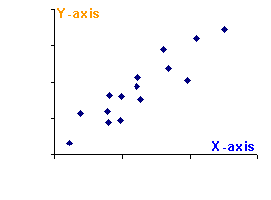
Very often the problem we have in front of us is to measure two variables in an experiment, say X and Y. It doesn’t really matter what these two things are, except that X is assumed to be something one can control or measure easily and Y is whatever it is the experiment is supposed to yield information about. In order to establish whether there is a relationship between X and Y one can imagine a series of experiments where X is systematically varied and the resulting Y measured.  The pairs of (X,Y) values can then be plotted on a graph like the example shown in the Figure.
XY

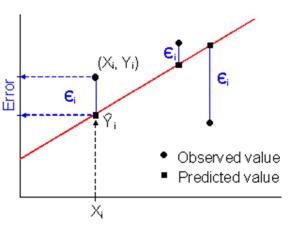
In this example on it certainly looks like there is a straight line linking Y and X, but with small deviations above and below the line caused by the errors in measurement of Y. This. You could quite easily take a ruler and draw a line of “best fit” by eye through these measurements. I spent many a tedious afternoon in the physics labs doing this sort of thing when I was at school. Ideally, though, what one wants is some procedure for fitting a mathematical function to a set of data automatically, without requiring any subjective intervention or artistic skill. Galileo found a way to do this. Imagine you have a set of pairs of measurements (xi,yi) to which you would like to fit a straight line of the form y=mx+c. One way to do it is to find the line that minimizes some measure of the spread of the measured values around the theoretical line. The way Galileo did this was to work out the sum of the differences between the measured yi and the predicted values mx+c at the measured values x=xi. He used the absolute difference |yi-(mxi+c)| so that the resulting optimal line would, roughly speaking, have as many of the measured points above it as below it. This general idea is now part of the standard practice of data analysis, and as far as I am aware, Galileo was the first scientist to grapple with the problem of dealing properly with experimental error.
error

The method used by Galileo was not quite the best way to crack the puzzle, but he had it almost right. It was again an astronomer who provided the missing piece and gave us essentially the same method used by statisticians (and astronomy) today.
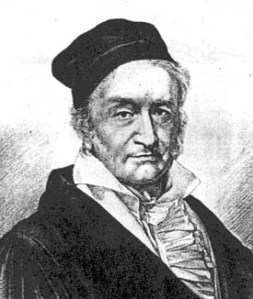
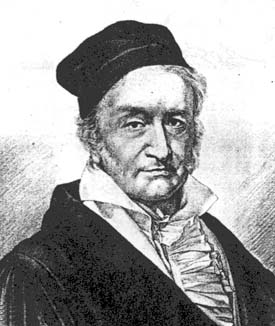
Gauss_11Karl Friedrich Gauss (left) was undoubtedly one of the greatest mathematicians of all time, so it might be objected that he wasn’t really an astronomer. Nevertheless he was director of the Observatory at Göttingen for most of his working life and was a keen observer and experimentalist. In 1809, he developed Galileo’s ideas into the method of least-squares, which is still used today for curve fitting.

This approach involves basically the same procedure but involves minimizing the sum of [yi-(mxi+c)]2 rather than |yi-(mxi+c)|. This leads to a much more elegant mathematical treatment of the resulting deviations – the “residuals”.  Gauss also did fundamental work on the mathematical theory of errors in general. The normal distribution is often called the Gaussian curve in his honour.

After Galileo, the development of statistics as a means of data analysis in natural philosophy was dominated by astronomers. I can’t possibly go systematically through all the significant contributors, but I think it is worth devoting a paragraph or two to a few famous names.

I’ve already written on this blog about Jakob Bernoulli, whose famous book on probability was (probably) written during the 1690s. But Jakob was just one member of an extraordinary Swiss family that produced at least 11 important figures in the history of mathematics.  Among them was Daniel Bernoulli who was born in 1700.  Along with the other members of his famous family, he had interests that ranged from astronomy to zoology. He is perhaps most famous for his work on fluid flows which forms the basis of much of modern hydrodynamics, especially Bernouilli’s principle, which accounts for changes in pressure as a gas or liquid flows along a pipe of varying width.
But the elder Jakob’s work on gambling clearly also had some effect on Daniel, as in 1735 the younger Bernoulli published an exceptionally clever study involving the application of probability theory to astronomy. It had been known for centuries that the orbits of the planets are confined to the same part in the sky as seen from Earth, a narrow band called the Zodiac. This is because the Earth and the planets orbit in approximately the same plane around the Sun. The Sun’s path in the sky as the Earth revolves also follows the Zodiac. We now know that the flattened shape of the Solar System holds clues to the processes by which it formed from a rotating cloud of cosmic debris that formed a disk from which the planets eventually condensed, but this idea was not well established in the time of Daniel Bernouilli. He set himself the challenge of figuring out what the chance was that the planets were orbiting in the same plane simply by chance, rather than because some physical processes confined them to the plane of a protoplanetary disk. His conclusion? The odds against the inclinations of the planetary orbits being aligned by chance were, well, astronomical.

The next “famous” figure I want to mention is not at all as famous as he should be. John Michell was a Cambridge graduate in divinity who became a village rector near Leeds. His most important idea was the suggestion he made in 1783 that sufficiently massive stars could generate such a strong gravitational pull that light would be unable to escape from them.  These objects are now known as black holes (although the name was coined much later by John Archibald Wheeler). In the context of this story, however, he deserves recognition for his use of a statistical argument that the number of close pairs of stars seen in the sky could not arise by chance. He argued that they had to be physically associated, not fortuitous alignments. Michell is therefore credited with the discovery of double stars (or binaries), although compelling observational confirmation had to wait until William Herschel’s work of 1803.

It is impossible to overestimate the importance of the role played by Pierre Simon, Marquis de Laplace in the development of statistical theory. His book A Philosophical Essay on Probabilities, which began as an introduction to a much longer and more mathematical work, is probably the first time that a complete framework for the calculation and interpretation of probabilities ever appeared in print. First published in 1814, it is astonishingly modern in outlook.

Laplace began his scientific career as an assistant to Antoine Laurent Lavoiser, one of the founding fathers of chemistry. Laplace’s most important work was in astronomy, specifically in celestial mechanics, which involves explaining the motions of the heavenly bodies using the mathematical theory of dynamics. In 1796 he proposed the theory that the planets were formed from a rotating disk of gas and dust, which is in accord with the earlier assertion by Daniel Bernouilli that the planetary orbits could not be randomly oriented. In 1776 Laplace had also figured out a way of determining the average inclination of the planetary orbits.

A clutch of astronomers, including Laplace, also played important roles in the establishment of the Gaussian or normal distribution.  I have also mentioned Gauss’s own part in this story, but other famous astronomers played their part. The importance of the Gaussian distribution owes a great deal to a mathematical property called the Central Limit Theorem: the distribution of the sum of a large number of independent variables tends to have the Gaussian form. Laplace in 1810 proved a special case of this theorem, and Gauss himself also discussed it at length.

A general proof of the Central Limit Theorem was finally furnished in 1838 by another astronomer, Friedrich Wilhelm Bessel– best known to physicists for the functions named after him – who in the same year was also the first man to measure a star’s distance using the method of parallax. Finally, the name “normal” distribution was coined in 1850 by another astronomer, John Herschel, son of William Herschel.

I hope this gets the message across that the histories of statistics and astronomy are very much linked. Aspiring young astronomers are often dismayed when they enter research by the fact that they need to do a lot of statistical things. I’ve often complained that physics and astronomy education at universities usually includes almost nothing about statistics, because that is the one thing you can guarantee to use as a researcher in practically any branch of the subject.

Over the years, statistics has become regarded as slightly disreputable by many physicists, perhaps echoing Rutherford’s comment along the lines of “If your experiment needs statistics, you ought to have done a better experiment”. That’s a silly statement anyway because all experiments have some form of error that must be treated statistically, but it is particularly inapplicable to astronomy which is not experimental but observational. Astronomers need to do statistics, and we owe it to the memory of all the great scientists I mentioned above to do our statistics properly.

Software Use in Astronomy

Posted in Education, The Universe and Stuff with tags , , , , on July 21, 2015 by telescoper

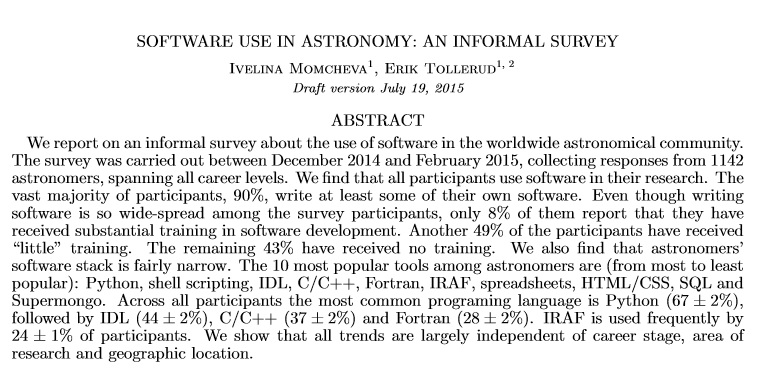
I just saw an interesting paper which hit the arXiv last week and thought I would share it here. It’s called Software Use in Astronomy: An Informal Survey and the abstract is here:

softwareA couple of things are worth remarking upon. One concerns Python. Although I’m not surprised that Python is Top of the Pops amongst astronomers – like many Physics & Astronomy departments we actually teach it to undergraduates here at the University of Sussex – it is notable that its popularity is a relatively recent phenomenon and it’s quite impressive how rapidly it has caught on.

Another interesting thingis the continuing quite heavy use of Fortran. Most computer scientists would consider this to be an obsolete language, and is presumably mainly used because of inertia: some important and well established codes are written in it and presumably it’s too much effort to rewrite them from scratch in something more modern. I would have thought that Fortran would have been used primarily by older academics, i.e. old dogs who can’t learn new programming tricks. However, that doesn’t really seem to be the case based on the last sentence of the abstract.

Finally, it’s quite surprising that over 40% of astronomers claim to have had no training in software development. We do try to embed that particular skill in graduate programmes nowadays, but it seems that doesn’t always work!

Anyway, do read the paper yourself. It’s very interesting. Any further comments through the box below please, but please ensure they compile before submitting them…


(Almost) Fifty Years of Astronomy at Sussex

Posted in Education, History with tags , on June 19, 2015 by telescoper

I came across this booklet earlier this morning, whereupon I realised that Thirty is about to turn into Fifty…

Astronomy_30

The date on the front of the booklet is November 1996, but inside it explains that the content is based on a seminar given at Sussex about a year earlier. In fact the first MSc students in Astronomy started in October 1965. However, they were all part-time students (they were all staff at the Royal Greenwich Observatory which at that time was in Herstmonceux, Sussex) and none graduated until 1967. The 40th anniversary of that graduation was recognized with an event in 2007. The first full-time staff astronomer arrived in 1966, along with the first full-time MSc students. The first MSc students to graduate did so in 1967.

In fact I joined the Astronomy Centre at Sussex as a DPhil student in October 1985, 20 years after the arrival of the first cohort.

It’s interesting to note that originally astronomy existed at Sussex only as a postgraduate course. The attitude in most Universities in those days was that students should learn all the necessary physics before applying it to astronomy. Over the years this has changed, and most departments offer some astronomy right from Year 1. I think this change has been for the better because I think the astronomical setting provides a very exciting context to learn physics. If you want to understand, say, the structure of the Sun you have to include atomic physics, nuclear physics, gravity, thermodynamics, radiative transfer and hydrostatics all at the same time. This sort of thing makes astrophysics a good subject for developing synthetic skills while more traditional physics teaching focusses almost exclusively on analytical skills.

Anyway, I’m now left with a quandary. Should Fifty Years of Astronomy at Sussex be celebrated in 2015, 2016 or 2017?

Answers on a postcard please….

Gay Astronomers – At Last Some Data!

Posted in Biographical, LGBTQ+, Science Politics with tags , , , , , , on June 1, 2015 by telescoper

Some time ago I wrote a blog post entitled Where are all the LGBT Astrophysicists. I wrote that piece when I accidentally discovered that somebody had recently written a blog post (about Einstein’s Blackboard) which mentions me. I used to look after this famous relic when I was in Nottingham many years ago, you see.

There’s a sentence in that post that says

Professor Coles is one of the few out gay astrophysicists in the UK.

Well, it all depends by what you mean by “few” but at the time I wrote that  I thought there are more gay (or lesbian or bisexual or transgendered) astrophysicists out there than most people probably think. I know quite a large number personally- dozens in fact- most of whom are “out”. It’s a safe bet that there are many more who aren’t open about their sexuality too. However, it is probably the case that LGBT scientists are much less visible as such through their work than colleagues in the arts or humanities. Read two research papers, one written by a straight astrophysicist and one by an LGBT astrophysicist, and I very much doubt you could tell which is which. Read two pieces of literary criticism, however, and it’s much more likely you could determine the sexual orientation of the writer.

You might ask why it matters if an astrophysicist or astronomer is straight or gay? Surely what is important is whether they are good at their job? I agree with that, actually. When it comes to career development, sexual orientation should be as irrelevant as race or gender. The problem is that the lack of visibility of LGBT scientists – and this doesn’t just apply to astrophysics, but across all science disciplines – could deter young people from choosing science as a career in the first place.

Anyway, at last we have some evidence as to whether this might be the case. In 2014 the Royal Astronomical Society (of which I am a Fellow) carried out a demographic survey of its membership. This happens from time to time but this one was the first to include a question about sexual orientation. The Institute of Physics did a similar survey about Physics about a decade ago, but did not include sexual orientation among its question, so this is the first time I’ve seen any data about this from a systematic survey. The results are quite interesting. About 7% of UK respondents (from a total of around a thousand) refused to answer the sexual orientation question but, among those who did, 3% identified themselves as bisexual and 4% as gay men. Both these proportions are significantly higher than the figures for the general UK population reported by the Office of National Statistics. The fraction of respondents in the RAS Survey declaring themselves to be heterosexual was 84%, whereas the corresponding figure from the ONS Survey was 93.5%. The number of UK respondents in the RAS Survey identifying as lesbian was only 0.2%; the proportion of respondents identifying themselves as male was 77.5% versus 21.3% female, which accounts for only some of the difference between gay and lesbian proportions.

So, according to the survey, gay men are actually significantly over-represented in the Royal Astronomical Society compared to the general population. That confirms the statement I made earlier that there are more gay astronomers than you probably think.  It also shows that there is no evidence that gay men are deterred from becoming astronomers. In fact, it seems to be quite the opposite. It’s a different story when it comes to other demographics, however. The RAS membership is older, less ethnically diverse, and more male-dominated than the the general population, so there’s a lot of work to be done redressing the balance there.

On the other hand, next time the Royal Astronomical Society is looking to elect a President it will naturally want to find someone who is representative of its membership, which means an ageing white gay male. I rest my case.


A scientific paper with 5000 authors is absurd, but does science need “papers” at all?

Posted in History, Open Access, Science Politics, The Universe and Stuff with tags , , , , , , , , , on May 17, 2015 by telescoper

Nature News has reported on what appears to be the paper with the longest author list on record. This article has so many authors – 5,154 altogether – that 24 pages (out of a total of 33 in the paper) are devoted just to listing them, and only 9 to the actual science. Not, surprisingly the field concerned is experimental particle physics and the paper emanates from the Large Hadron Collider; it involves combining data from the CMS and ATLAS detectors to estimate the mass of the Higgs Boson. In my own fields of astronomy and cosmology, large consortia such as the Planck collaboration are becoming the rule rather than exception for observational work. Large ollaborations  have achieved great things not only in physics and astronomy but also in other fields. A for  paper in genomics with over a thousand authors has recently been published and the trend for ever-increasing size of collaboration seems set to continue.

I’ve got nothing at all against large collaborative projects. Quite the opposite, in fact. They’re enormously valuable not only because frontier research can often only be done that way, but also because of the wider message they send out about the benefits of international cooperation.

Having said that, one thing these large collaborations do is expose the absurdity of the current system of scientific publishing. The existence of a paper with 5000 authors is a reductio ad absurdum proof  that the system is broken. Papers simply do not have 5000  “authors”. In fact, I would bet that no more than a handful of the “authors” listed on the record-breaking paper have even read the article, never mind written any of it. Despite this, scientists continue insisting that constributions to scientific research can only be measured by co-authorship of  a paper. The LHC collaboration that kicked off this piece includes all kinds of scientists: technicians, engineers, physicists, programmers at all kinds of levels, from PhD students to full Professors. Why should we insist that the huge range of contributions can only be recognized by shoe-horning the individuals concerned into the author list? The idea of a 100-author paper is palpably absurd, never mind one with fifty times that number.

So how can we assign credit to individuals who belong to large teams of researchers working in collaboration?

For the time being let us assume that we are stuck with authorship as the means of indicating a contribution to the project. Significant issues then arise about how to apportion credit in bibliometric analyses, e.g. through citations. Here is an example of one of the difficulties: (i) if paper A is cited 100 times and has 100 authors should each author get the same credit? and (ii) if paper B is also cited 100 times but only has one author, should this author get the same credit as each of the authors of paper A?

An interesting suggestion over on the e-astronomer a while ago addressed the first question by suggesting that authors be assigned weights depending on their position in the author list. If there are N authors the lead author gets weight N, the next N-1, and so on to the last author who gets a weight 1. If there are 4 authors, the lead gets 4 times as much weight as the last one.

This proposal has some merit but it does not take account of the possibility that the author list is merely alphabetical which actually was the case in all the Planck publications, for example. Still, it’s less draconian than another suggestion I have heard which is that the first author gets all the credit and the rest get nothing. At the other extreme there’s the suggestion of using normalized citations, i.e. just dividing the citations equally among the authors and giving them a fraction 1/N each. I think I prefer this last one, in fact, as it seems more democratic and also more rational. I don’t have many publications with large numbers of authors so it doesn’t make that much difference to me which you measure happen to pick. I come out as mediocre on all of them.

No suggestion is ever going to be perfect, however, because the attempt to compress all information about the different contributions and roles within a large collaboration into a single number, which clearly can’t be done algorithmically. For example, the way things work in astronomy is that instrument builders – essential to all observational work and all work based on analysing observations – usually get appended onto the author lists even if they play no role in analysing the final data. This is one of the reasons the resulting papers have such long author lists and why the bibliometric issues are so complex in the first place.

Having thousands of authors who didn’t write a single word of the paper seems absurd, but it’s the only way our current system can acknowledge the contributions made by instrumentalists, technical assistants and all the rest. Without doing this, what can such people have on their CV that shows the value of the work they have done?

What is really needed is a system of credits more like that used in the television or film. Writer credits are assigned quite separately from those given to the “director” (of the project, who may or may not have written the final papers), as are those to the people who got the funding together and helped with the logistics (production credits). Sundry smaller but still vital technical roles could also be credited, such as special effects (i.e. simulations) or lighting (photometic calibration). There might even be a best boy. Many theoretical papers would be classified as “shorts” so they would often be written and directed by one person and with no technical credits.

The point I’m trying to make is that we seem to want to use citations to measure everything all at once but often we want different things. If you want to use citations to judge the suitability of an applicant for a position as a research leader you want someone with lots of directorial credits. If you want a good postdoc you want someone with a proven track-record of technical credits. But I don’t think it makes sense to appoint a research leader on the grounds that they reduced the data for umpteen large surveys. Imagine what would happen if you made someone director of a Hollywood blockbuster on the grounds that they had made the crew’s tea for over a hundred other films.

Another question I’d like to raise is one that has been bothering me for some time. When did it happen that everyone participating in an observational programme expected to be an author of a paper? It certainly hasn’t always been like that.

For example, go back about 90 years to one of the most famous astronomical studies of all time, Eddington‘s measurement of the bending of light by the gravitational field of the Sun. The paper that came out from this was this one

A Determination of the Deflection of Light by the Sun’s Gravitational Field, from Observations made at the Total Eclipse of May 29, 1919.

Sir F.W. Dyson, F.R.S, Astronomer Royal, Prof. A.S. Eddington, F.R.S., and Mr C. Davidson.

Philosophical Transactions of the Royal Society of London, Series A., Volume 220, pp. 291-333, 1920.

This particular result didn’t involve a collaboration on the same scale as many of today’s but it did entail two expeditions (one to Sobral, in Brazil, and another to the Island of Principe, off the West African coast). Over a dozen people took part in the planning,  in the preparation of of calibration plates, taking the eclipse measurements themselves, and so on.  And that’s not counting all the people who helped locally in Sobral and Principe.

But notice that the final paper – one of the most important scientific papers of all time – has only 3 authors: Dyson did a great deal of background work getting the funds and organizing the show, but didn’t go on either expedition; Eddington led the Principe expedition and was central to much of the analysis;  Davidson was one of the observers at Sobral. Andrew Crommelin, something of an eclipse expert who played a big part in the Sobral measurements received no credit and neither did Eddington’s main assistant at Principe.

I don’t know if there was a lot of conflict behind the scenes at arriving at this authorship policy but, as far as I know, it was normal policy at the time to do things this way. It’s an interesting socio-historical question why and when it changed.

I’ve rambled off a bit so I’ll return to the point that I was trying to get to, which is that in my view the real problem is not so much the question of authorship but the idea of the paper itself. It seems quite clear to me that the academic journal is an anachronism. Digital technology enables us to communicate ideas far more rapidly than in the past and allows much greater levels of interaction between researchers. I agree with Daniel Shanahan that the future for many fields will be defined not in terms of “papers” which purport to represent “final” research outcomes, but by living documents continuously updated in response to open scrutiny by the community of researchers. I’ve long argued that the modern academic publishing industry is not facilitating but hindering the communication of research. The arXiv has already made academic journals virtually redundant in many of branches of  physics and astronomy; other disciplines will inevitably follow. The age of the academic journal is drawing to a close. Now to rethink the concept of “the paper”…

Astronomy and Forensic Science – The Herschel Connection

Posted in History, The Universe and Stuff with tags , , , , , , on April 27, 2015 by telescoper

When I was in Bath on Friday evening I made a point of visiting the Herschel Museum, which is located in the house in which Sir William Herschel lived for a time, before moving to Slough.
image

Unfortunately I got there too late to go inside. It did remind me however of an interesting connection between astronomy and forensic science, through a certain William Herschel..

When I give popular talks about Cosmology,  I sometimes look for appropriate analogies or metaphors in detective fiction or television programmes about forensic science. I think cosmology is methodologically similar to forensic science because it is generally necessary in both these fields to proceed by observation and inference, rather than experiment and deduction: cosmologists have only one Universe;  forensic scientists have only one scene of the crime. They can collect trace evidence, look for fingerprints, establish or falsify alibis, and so on. But they can’t do what a laboratory physicist or chemist would typically try to do: perform a series of similar experimental crimes under slightly different physical conditions. What we have to do in cosmology is the same as what detectives do when pursuing an investigation: make inferences and deductions within the framework of a hypothesis that we continually subject to empirical test. This process carries on until reasonable doubt is exhausted, if that ever happens.

Of course there is much more pressure on detectives to prove guilt than there is on cosmologists to establish the truth about our Cosmos. That’s just as well, because there is still a very great deal we do not know about how the Universe works. I have a feeling that I’ve stretched this analogy to breaking point but at least it provides some kind of excuse for mentioning the Herschel connection.

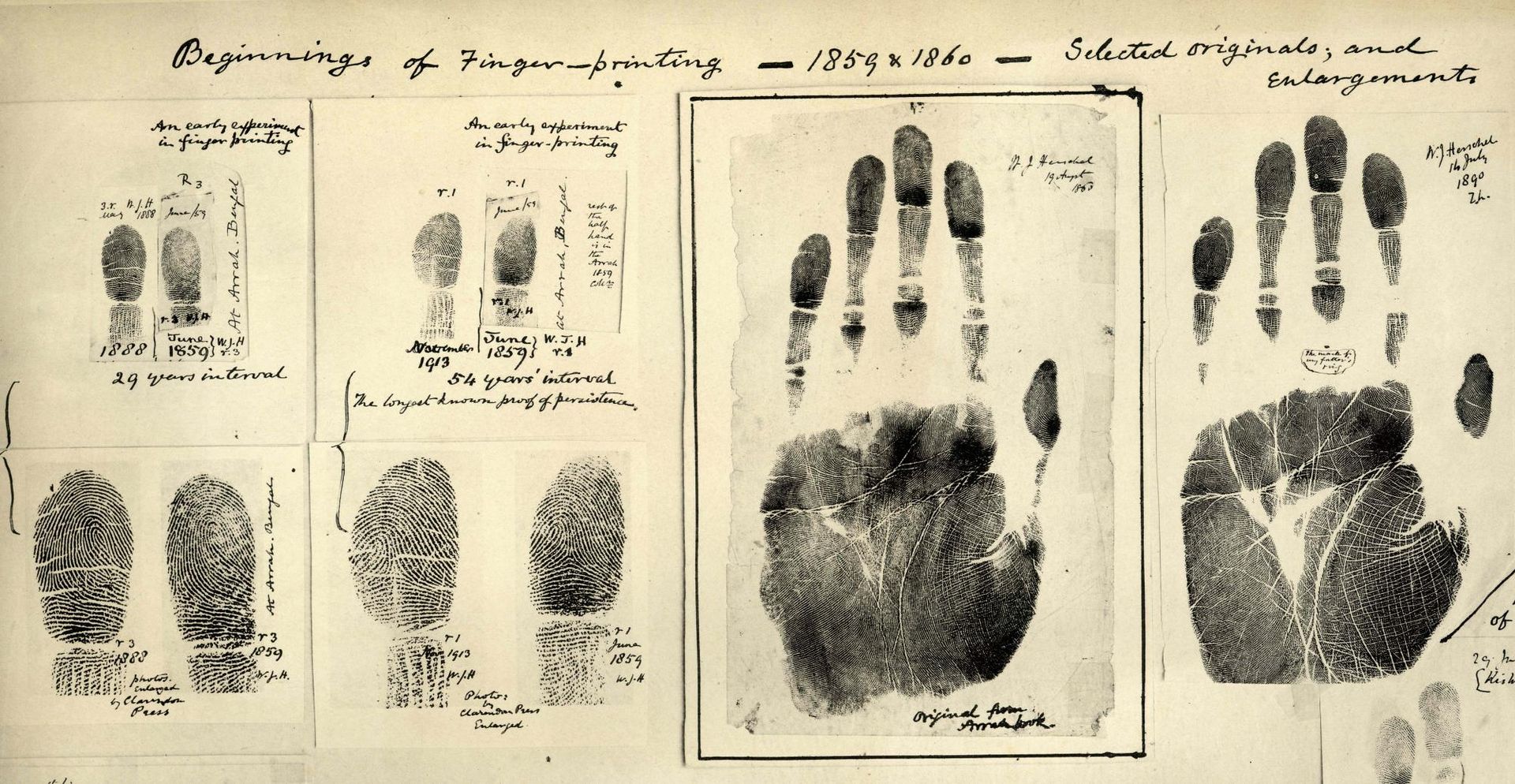
In fact the Herschel connection comes through William James Herschel, the grandson of William Herschel and the eldest son of John Herschel, both of whom were eminent astronomers. William James Herschel was not an astronomer, but an important figure in the colonial establishment in India. In the context relevant to this post, however, his claim to fame is that he is credited with being the first European to have recognized the importance of fingerprints for the purposes of identifying individuals. William James Herschel started using fingerprints in this way in India in 1858; some examples are shown below (taken from the wikipedia page).

Fingerprints_taken_by_William_James_Herschel_1859-1860

Later,  in 1877 at Hooghly (near Calcutta) he instituted the use of fingerprints on contracts and deeds to prevent the then-rampant repudiation of signatures and he registered government pensioners’ fingerprints to prevent the collection of money by relatives after a pensioner’s death. Herschel also fingerprinted prisoners upon sentencing to prevent various frauds that were attempted in order to avoid serving a prison sentence.

The use of fingerprints in solving crimes was to come much later, but there’s no doubt that Herschel’s work on this was an important step.

An Einstein Ring – Courtesy of ALMA

Posted in Uncategorized with tags , , , , , , , on April 8, 2015 by telescoper

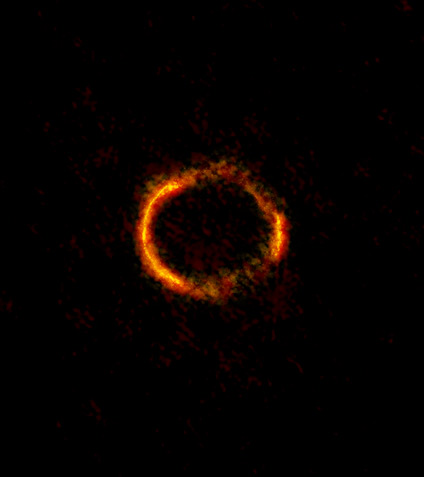
Just back from a short Easter holiday, I thought I’d resume blogging activities by showing you this remarkable image.


SDP81_ALMA3bands

What you see is a near-perfect example of an Einstein Ring which is a result of a chance alignment between a background galaxy and a foreground concentration of mass, sometimes a cluster of galaxies but in this case another galaxy. A more usual effect is the formation of a number of bright arcs; here there are two bright segments, but there is enough detail to see the rest of the circle. The lensed galaxy has a redshift about 3, so that light from it was emitted when the Universe was about one-quarter its current size, about 12 billion years in the past.

This object, codenamed SDP81, was initially detected as a potential lens system by the Herschel Space Observatory, which turned out to be superb at identifying gravitational lenses. I posted about this here, in fact. Working in the far-infrared makes it impossible to resolve the detailed structure of lensed images with Herschel – even with a 3.5m mirror in space, λ/D isn’t great for wavelengths of 500 microns! However, the vast majority of sources found during the Herschel ATLAS survey with large fluxes at this wavelengths can be identified as lenses simply because their brightness tells us they’ve probably been magnified by a lens. Candidates can then be followed up with other telescopes on the ground. A quick look during the Science Demonstration Phase of Herschel produced the first crop of firmly identified gravitational lens systems published in Science by Negrello et al. This one was followed up last year by the Atacama Large Millimetre Array (ALMA), itself a remarkable breakthrough in observational technology; the image was actually made in an extended configuration during the commissioning tests of ALMA’s long-baseline interferometric capability, which gives it stunning resolving power of about 23 milli-arcseconds. It’s absolutely amazing to see such detail in an image made in the submillimetre region of the spectrum.

The press release accompanying this can be found here and the full scientific paper by Vlahakis et al. is already on the arXiv here.

For the specialists the abstract of the journal paper reads:

We present initial results of very high resolution Atacama Large Millimeter/submillimeter Array (ALMA) observations of the z=3.042 gravitationally lensed galaxy HATLAS J090311.6+003906 (SDP.81). These observations were carried out using a very extended configuration as part of Science Verification for the 2014 ALMA Long Baseline Campaign, with baselines of up to 15 km. We present continuum imaging at 151, 236 and 290 GHz, at unprecedented angular resolutions as fine as 23 milliarcseconds (mas), corresponding to an un-magnified spatial scale of ~180 pc at z=3.042. The ALMA images clearly show two main gravitational arc components of an Einstein ring, with emission tracing a radius of ~1.5″. We also present imaging of CO(10-9), CO(8-7), CO(5-4) and H2O line emission. The CO emission, at an angular resolution of ~170 mas, is found to broadly trace the gravitational arc structures but with differing morphologies between the CO transitions and compared to the dust continuum. Our detection of H2O line emission, using only the shortest baselines, provides the most resolved detection to date of thermal H2O emission in an extragalactic source. The ALMA continuum and spectral line fluxes are consistent with previous Plateau de Bure Interferometer and Submillimeter Array observations despite the impressive increase in angular resolution. Finally, we detect weak unresolved continuum emission from a position that is spatially coincident with the center of the lens, with a spectral index that is consistent with emission from the core of the foreground lensing galaxy.

ALMA will only work in long baseline mode for a small fraction of its time, and it is bound to be in very heavy demand, so it’s not clear how many of the hundreds of candidate lenses flagged up by Herschel will ever be mapped in such detail, but this is definitely one for the album!