Archive for astronomy

Countdown to GAIA

Posted in The Universe and Stuff with tags , , , on December 18, 2013 by telescoper

Just a quick post to point out that tomorrow morning at 9.12am GMT will see the launch of the European Space Agency’s Gaia mission.  You can watch the launch live here from about 8.50 GMT. I’ll be in a meeting at 9am tomorrow morning, so I’m probably going to miss it.

Gaia arrives on the Launchpad at Kourou, French Guyana, on 13th December

Gaia arrives on the Launchpad at Kourou, French Guyana, on 13th December

I remember first hearing about Gaia about 15 years ago when I was on a PPARC advisory panel and was simultaneously amazed  by the ambition of its objectives and sceptical that it would ever get off the ground. Now its almost ready to go, so fingers crossed for a successful launch tomorrow.

Coincidentally, Gaia is among the various telescopes and observatories featured in the STFC Roadshow we put on  viewfor an Astronomy Master Class we have been putting on for local schools over the last couple of days here at the University of Sussex:

IMG-20131218-00248

Gaia is a global space astrometry mission, which will make the largest, most precise three-dimensional map of our Galaxy by surveying more than a thousand million stars. In some sense it is the descendant of the Hipparcos mission launched in 1989, but it’s very much more than that. Gaia will monitor each of its target stars about 70 times over a five-year period. It is expected to discover hundreds of thousands of new celestial objects, such as extra-solar planets and brown dwarfs, and observe hundreds of thousands of asteroids within our own Solar System. The mission is also expected to yield a wide variety of other benefits, including new tests of the  General Theory of Relativity.

Gaia will create an extraordinarily precise three-dimensional map of more than a thousand million stars throughout our Galaxy (The Milky Way) and beyond, mapping their motion, luminosity, temperature and chemical composition as well as any changes in such properties. This huge stellar census will provide the data needed to tackle an enormous range of important problems related to the origin, structure and evolutionary history of our Galaxy. Gaia will do all this by repeatedly measuring the positions of all objects down to an apparent magnitude of 20. A thousand million stars is about 1% of the entire stellar population of the Milky Way.

For the brighter objects, i.e. those brighter than magnitude 15, Gaia will measure their positions to an accuracy of 24 microarcseconds, comparable to measuring the diameter of a human hair at a distance of 1000 km. Distances of relatively nearby stars will be measured to an accuracy of 0.001%. Even stars near the Galactic Centre, some 30 000 light-years away, will have their distances measured to within an accuracy of 20%.

It’s an astonishing mission that will leave an unbelievably rich legacy not only for the astronomers working on the front-line operations of Gaia but for generations to come. I have a feeling that there might be  a few sleepless nights tonight waiting for the launch, but I suppose astronomers should be used to that!

UPDATE: 19/12/2013 Success! Launch went smoothly, separation of the Gaia spacecraft achieved. Now we have to wait for a month or so for it to get to L2, settle itself down, and then start doing science. The first data release isn’t due for 22 months…Bon Voyage!

Doctor Who at 50

Posted in Biographical, Music, Television, The Universe and Stuff with tags , , , , , on November 23, 2013 by telescoper

Today is the official 50th birthday celebration of Doctor Who and, since The Doctor and myself are of the same vintage, I thought I’d repeat an old post about the show. I just listened to the original theme music again before posting this and I still think it sounds amazingly fresh.

–0–

As a Professor of Astrophysics I am often asked “Why on Earth did you decide to make a career out of such a crazy subject?”

I guess many astronomers, physicists and other scientists have to answer this sort of question. For many of them there is probably a romantic reason, such as seeing the rings of Saturn or the majesty of the Milky Way on a dark night. Others will probably have been inspired by TV documentary series such as The Sky at Night, Carl Sagan’s Cosmos or even Horizon which, believe it or not, actually used to be quite good but which is nowadays uniformly dire. Or it could have been something a bit more mundane but no less stimulating such as a very good science teacher at school.

When I’m asked this question I’d love to be able to put my hand on my heart and give an answer of that sort but the truth is really quite a long way from those possibilities. The thing that probably did more than anything else to get me interested in science was a Science Fiction TV series or rather not exactly the series but the opening titles.

The first episode of Doctor Who was broadcast in the year of my birth, so I don’t remember it at all, but I do remember the astonishing effect the credits had on my imagination when I saw later episodes as a small child. Here is the  opening title sequence as it appeared in the very first series featuring William Hartnell as the first Doctor.

To a younger audience it probably all seems quite tame, but I think there’s a haunting, unearthly beauty to the shapes conjured up by Bernard Lodge. Having virtually no budget for graphics, he experimented in a darkened studio with an old-fashioned TV camera and a piece of black card with Doctor Who written on it in white. He created the spooky kaleidoscopic patterns you see by simply pointing the camera so it could see into its own monitor, thus producing a sort of electronic hall of mirrors.

What is so fascinating to me is how a relatively simple underlying concept could produce a rich assortment of patterns, particularly how they seem to take on an almost organic aspect as they merge and transform. I’ve continued to be struck by the idea that complexity could be produced by relatively simple natural laws which is one of the essential features of astrophysics and cosmology. As a practical demonstration of the universality of physics this sequence takes some beating.

As well as these strange and wonderful images, the titles also featured a pioneering piece of electronic music. Officially the composer was Ron Grainer, but he wasn’t very interested in the commission and simply scribbled the theme down and left it to the BBC to turn it into something useable. In stepped the wonderful Delia Derbyshire, unsung heroine of the BBC Radiophonic Workshop who, with only the crudest electronic equipment available, turned it into a little masterpiece. Ethereal yet propulsive, the original theme from Doctor Who is definitely one of my absolute favourite pieces of music and I’m glad to see that Delia Derbyshire is now receiving the acclaim she deserves from serious music critics.

It’s ironic that until earlier this year I used to live  in Cardiff, where the newer episodes of Doctor Who and its spin-off, the anagrammatic Torchwood, are made. One of the great things about the early episodes of Doctor Who was that the technology simply didn’t exist to do very good special effects. The scripts were consequently very careful to let the viewers’ imagination do all the work. That’s what made it so good. I’m pleased that the more recent incarnations of this show also don’t go overboard on the visuals. Perhaps that’s a conscious attempt to appeal to people who saw the old ones as well as those too young to have done so. It’s just a pity the modern opening title music is so bad…

Anyway, I still love Doctor Who after all these years. It must sound daft to say that it inspired me to take up astrophysics, but it’s truer than any other explanation I can think of. Of course the career path is slightly different from a Timelord, but only slightly.

At any rate I think The Doctor is overdue for promotion. How about Professor Who?

Sussex Astronomy Research – The Videos!

Posted in The Universe and Stuff with tags , , , , , , , , on November 19, 2013 by telescoper

As autumn turns to winter the thoughts of many an undergraduate turn to the task of applying for PhDs. Nowadays this involves a lot of trawling through webpages looking for interesting projects and suitable funding opportunities.

In order to help prospective postgraduates this year, the Astronomy Centre at the University of Sussex has produced a number of videos to give some information about the available projects. To start with, here are four examples, covering topics in theoretical, computational and observational astrophysics:

For information, we’re expecting to offer at least six PhD studentships in Astronomy for September 2014 entry. Also there’s a University-wide postgraduate open day coming up on December 4th..

Why is Astronomy Important?

Posted in The Universe and Stuff with tags , , , , on November 5, 2013 by telescoper

There’s an interesting and unusual article on the arXiv today entitled Why is Astronomy Important? Here is the abstract:

For a long time astronomers and other scientists believed that the importance of their work was evident to society. But in these difficult days of financial austerity, even the most obvious benefits of science have to undergo careful scrutiny. Eradicating poverty and hunger is a worldwide priority, and activities that do not directly attempt to resolve these issues can be hard to justify and support. However, several studies have told us that investing in science education, research and technology provides a great return not only economically, but culturally and indirectly for the population in general and has helped countries to face and overcome crises. The scientific and technological development of a country or region is closely linked to its human development index a statistic that is a measure of life expectancy, education and income.

The full text of the paper can be found on the IAU website here.

The article focusses on matters relating to the transfer of technology between astronomy and, e.g. industry, aerospace, and medicine, its effect on technology we are familiar with in everyday life, on astronomy as an exemplar of international collaboration and on its wider cultural and philosophical impact. Many of the points made in this article can also be found in the Royal Astronomical Society‘s free publication Beyond the Stars: Why Astronomy Matters which is available for free online here.

I recommend you read the full article and make your own mind up about why astronomy is important. I have just two comments, which are partly questions. The first is that I’ve always had a bit of a problem with the interpretation of correlations like that mentioned in the last sentence of the abstract (between technological development and the human development index). The issue is the basic one that correlation of two phenomena does not necessarily imply that one causes the other. Is it really possible to establish rigorously a causal link between spending money on astronomy and wider societal benefits? I’m not saying that there isn’t such a link, just that it’s difficult to interpret evidence which is dependent on so many factors. Could one not argue instead that more developed countries spend more money on astronomy because they can afford to?

The other thing that troubles me with arguments of the type presented in the paper is that there is a danger that  emphasizing the transfer of knowledge to other disciplines as the rationale for funding astronomy implicitly negates the argument that astronomy has intrinsic worth of its own. In other words, answering the question “Why is Astronomy important?” seems to accept at the outset that it isn’t.  If it is indeed the case that we can only justify astronomy because it has produced spin-offs in, e.g., medicine, why not just spend more money on medicine and forget the astronomy?

I’m not saying that the technology transfer arguments carry no weight, just that they are definitely double-edged and should be used with caution. For the record, I think we should fund Astronomy (and other sciences) primarily because they are an essential part of the fabric of our culture and civilization; all the rest is icing on the cake. In other words, I support state funding for the sciences for very much the same reasons as for the arts.  I’m fully aware, however, that this unlikely to persuade the powers that be as effectively as an appeal to economic benefits; that’s why science funding has fared so much better than arts funding in this age of austerity.

Introduction to the PhD for Physics or Astronomy students

Posted in Education with tags , , , , , , on October 22, 2013 by telescoper

It’s the time of year when final-year students start to think about the possibility of doing a PhD after they have graduated, so I I thought I’d jot down here a few general remarks that might be useful to people who are thinking of taking the plunge. I’ve posted on such matters before, but this is something that comes around every year so I hope you’ll excuse the repeat. I’m aiming this primarily at UK students applying for places in the UK; special considerations apply for students wanting to do graduate research abroad.

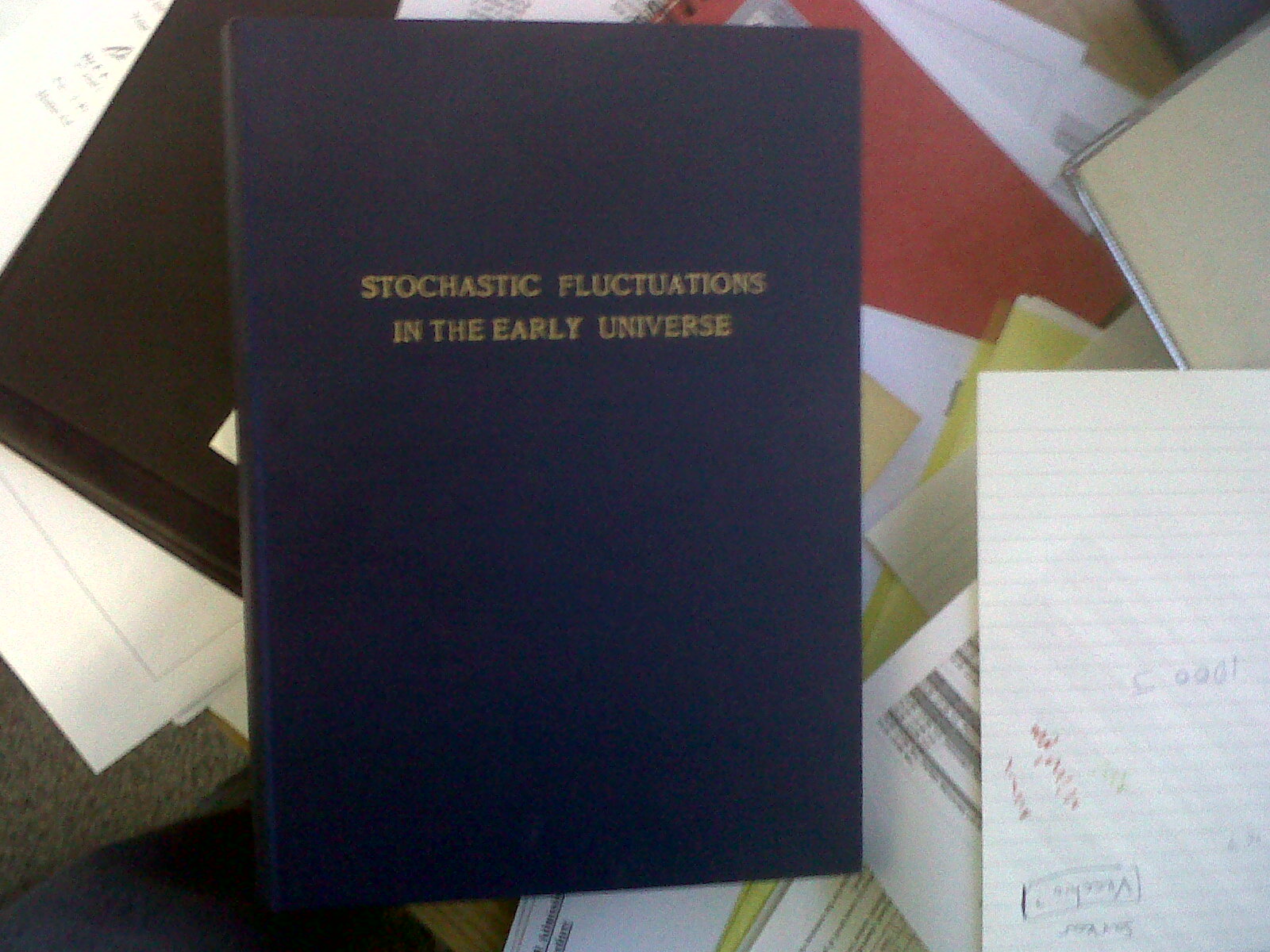
What is a PhD? The answer to that is relatively easy; it’s a postgraduate research degree. In order to obtain a PhD you have to present a thesis like that shown on the left (which happens to be mine, vintage 1988), typically in the range 100-250  pages long. A thesis has to satisfy two conditions for the award of the degree: it should contain original research, which is publishable in an academic journal; and it should present a coherent discussion of that original work within the context of ongoing work in the area of study. In Physics & Astronomy, the PhD is pretty much a prerequisite for any career in academic research, and it usually takes between 3 and 4 years to complete. After submission of the thesis you will have to undergo a viva voce examination conducted by two examiners, one internal and one external. This is quite a tough test, which  can last anywhere between about 2 and about 6 hours, during which you can be asked  detailed questions about your research and wide-ranging questions about the general area.

The Money Side. In the UK most PhDs are supported financially by the research councils, either EPSRC (most physics) or STFC (nuclear & particle physics, astronomy). These generally award quotas of studentships to departments who distribute them to students they admit. A studentship will cover your fees and pay a stipend, currently £13590 pa. That doesn’t sound like a lot, but you should at least remember that it is a stipend rather than a wage; it is therefore not taxed and there is no national insurance payable.

How do I choose a PhD? During the course of a postgraduate degree you are expected to become an expert in the area in which you specialize. In particular you should reach the point where you know more about that specific topic than your supervisor does. You will therefore have to work quite a lot on your own, which means you need determination, stamina and enthusiasm. In my view the most important criterion in your choice of PhD is not the institution where you might study but the project. You need to be genuinely excited by the topic in order to drive yourself to keep through the frustrations (of which there will be many). So, find an area that interests you and find the departments that do active research in that area by looking on the web. Check out the recent publications by staff in each department, to ensure that they are active and to have something to talk about at interview!

Qualifications. Most universities have a formal requirement that candidates for admission to the PhD should have a “good honours degree”, which basically means at least an Upper Second Class Honours degree. Some areas are more competitive than others, however, and in many disciplines you will find you are competing with a great many applicants with First Class degrees.

How to apply successfully. The application procedure at most universities is quite simple and can be done online. You will need to say something about the area in which you wish to do research (e.g. experiment/theory, and particular field, e.g. cosmology or star formation). You’ll also need a CV and a couple of references. Given the competition, it’s essential that you prepare. Give your curriculum vitae some attention, and get other people (e.g. your personal tutor) to help you improve it. It’s worth emphasizing particular skills (e.g. computing). If you get the chance, make use of your summer vacations by taking on an internship or other opportunity to get a taste of research; things like that will undoubtedly give your CV an edge.

The Interview. Good applicants will be invited for an interview, which is primarily to assess whether you have the necessary skills and determination, but also to match applicants to projects and supervisors. Prepare for your interview! You will almost certainly be asked to talk about your final-year project, so it will come across very badly if you’re not ready when they ask you. Most importantly, mug up about your chosen field. You will look really silly if you haven’t the vaguest idea of what’s going on in the area you claimed to be interested in when you wrote your  application!

Don’t be shy! There’s nothing at all wrong with being pro-active about this process. Contact academic staff at other universities by email and ask them about research, PhD opportunities. That will make a good impression. Also, don’t be afraid to ask for advice. Although we’re all keen to recruit good PhD students for our own departments, we academics are  conscious that it is also our job to give impartial advice. Ask your tutor’s opinion.

How many places should I apply for? Some research areas are more fashionable than others so the level of competition varies with field. As a general rule I would advise applying for about half-a-dozen places, chosen because they offer research in the right area. Apply to fewer than that and you might lose out to the competition. Apply to many more and you might not have time to attend the interviews.

What’s the timetable?  Most applications come in early in the new year for entry to the PhD in the following October. The Christmas break is therefore a pretty good time to get your applications sorted out. Interviews are normally held in February or March, and decisions made by late March. STFC runs a deadline system whereby departments can not force students to accept or decline offers before the end of March, so there should be ample time to visit all your prospective departments before having to make any decisions.

Here are some of the slides I used for a talk on such matters a year or so ago, which you might find useful.

That’s all I can think of for now. I hope at least some of these comments are useful to undergraduates anywhere in the UK thinking of applying for a PhD. If there are any further questions, please feel free to ask through the comments box. Likewise if I’ve missed anything important, please feel free to suggest additions in the same manner…

How do physicists and astronomers team up to write research papers?

Posted in Science Politics with tags , on October 16, 2013 by telescoper

Busy busy today so just time to reblog this, an interesting article about the irresistible rise of the multi-author paper. What fraction of the “authors” actually play any role at all in writing these papers? Am I the only one that thinks this has very profound implications for the way we interpret bibliometric analyses?

Augusto Carballido's avatarMoonshot

The way in which physicists and  astronomers team up to write technical papers has changed over the years, and not only is it interesting to look at this behavior for its own sake, but by analyzing the data it may be possible to better understand what role, if any, does the number of authors  have on the scientific impact of a paper. Likewise, such an analysis can allow physics and astronomy journals to make decisions about their publishing policies.

I was curious about the trends in the number of authors per refereed astronomy paper, so I set out to write an R script that would read in data from the NASA Astrophysics Data System, an online database of both refereed and non-refereed academic papers in astronomy and physics. The script counts the monthly number of refereed astronomy and physics papers between January 1967 and September 2013, as well as…

View original post 670 more words

Whither The Sky at Night?

Posted in Television, The Universe and Stuff with tags , , on September 24, 2013 by telescoper

According to rumours flying around on Twitter, the BBC has decided to axe the long-running astronomy programme The Sky at Night.  There’s been a predictable outcry from fans of the show and a petition has been organized.  What I’ve heard is that the series will end in December, but that a new astronomy programme will be launched in April next year.

I’ve long felt it was inevitable that The Sky at Night would cease to be when Patrick Moore died. The programme was so much Patrick’s programme that it would be very difficult to find another presenter to fill the role in the unique way that he did. Moreover, although there’s no doubt that it is an important vehicle for UK astronomy, many feel that the format has become very tired and uninspiring. As for myself, I can’t really comment. I don’t watch television very much at all and in any case, The Sky at Night is on way past my bedtime.

Way back in 1996 I was involved with a show at the NEC in Birmingham called Tomorrow’s World Live. This involved all the regular presenters of Tomorrow’s World, but wasn’t broadcast, but performed in a small theatre with a live audience. My contribution was to talk a little bit about the Hubble Space Telescope and then answer questions from the audience.  We did four such shows a day for three days. It was tiring and a bit nerve-wracking, but a lot of fun.

Typically for the BBC the contributors such as myself were paid a negligible fee, but we did get our meals paid for. At dinner one evening I chatted to a well-known TV Producer who was involved with the live event. After a while the conversation turned to The Sky at Night. The person concerned explained that he thought the show was well past its prime and was actually holding back astronomy programming on TV: it was too old-fashioned and had a tiny audience yet while it existed it was impossible to make the case to the Beeb to commission other astro-related shows. On the other hand, while Patrick was still around, and undoubtedly a National Institution, the outcry would be so intense if they cancelled The Sky at Night that nobody had the nerve to do it. Impasse.

Of course now, 17 years later, Patrick Moore has passed away and there’s now a chance to change things. It is promising that that the BBC seems to be going to launch a new programme next year. But any new show will have to tread very carefully. The Sky at Night was followed by thousands of dedicated amateur astronomers who know a great deal about their subject and would not be interested in the simple-minded gee-whizzery that plagues so many so-called Science Programme (e.g. Horizon). These people are very important for UK astronomy, because without them UK astronomy would not have the unique role that it has in our scientific and cultural landscape. We professional astronomers would be funded anything like as well as we are either.  On the other hand, there is at least the possibility of coming up with a format that reaches a new audience as well as retaining the interest of those already enthused about astronomy.

But how to ensure that this happens? Answers on a postcard, or through the comments box!

Meanwhile here’s a little poll to gauge the strength of opinion:

Welcome to Astronomy (unless you’re female)

Posted in Biographical, Education with tags , , , , , on September 14, 2013 by telescoper

I’m here on campus preparing to attend a series of receptions at the start of Freshers’ Week to welcome new students to the University of Sussex. Over the next few days I’m going to be involved in a lot of events aimed at helping all our new undergraduate students settle in, before teaching starts properly. There’ll also be events for our new postgraduates, at both Masters and Doctoral levels.

Every year the Science and Technology Facilities Council (STFC) funds an Introductory Summer School for new postgraduate research students in Astronomy. It’s held at a different university each year and is a long-running tradition. I attended such a School at Durham University way back in 1985, long before STFC was invented! We organized and ran one at Nottingham while I was there and last year the corresponding fixture was held at Sussex University, though that was before my time here and I wasn’t involved in it at all. This year, the Introductory Summer School was held at Queen Mary, University of London (often abbreviated to QMUL).

I spent eight happy years at Queen Mary (from 1990-98) so it pains me to have to criticize my friends and former colleagues there, but I really feel that I have to. Look at the programme for the Summer School. You will see that 18 (eighteen) lecturers were involved, covering virtually all areas of current research interest in the field. There is not a single female lecturer among them.

Yesterday I blogged about the invisibility of LGBT astrophysicists, but this is a glaring example of the problems facing female scientists embarking on a career in the same discipline. What message does a male-only programme send to aspiring female astronomers and astrophysicists? The lack of female speakers probably wasn’t deliberate, but was clearly thoughtless. Discrimination by omission is real and damaging. I mean no disrespect at all to the lecturers chosen, but looking through the topics covered I could easily have picked a female alternative who would have done just as good a job, if not better.

I think this is a scandal. I’ll be writing a letter of complaint to STFC myself, and I encourage you to do likewise if you agree. It’s too late to do anything about this year’s School, of course, but STFC must make sure that nothing like this happens again.

Where are all the LGBT astrophysicists?

Posted in Biographical, LGBTQ+, Science Politics with tags , , , , , on September 13, 2013 by telescoper

Having scoffed my lunchtime pasty in record time today, I seem to have a few spare minutes to spend writing a brief blog post on a question which popped into my mind when I accidentally discovered that somebody had recently written a blog post (about Einstein’s Blackboard) which mentions me. I used to look after this famous relic when I was in Nottingham many years ago, you see.

There’s a sentence in the post that says

Professor Coles is one of the few out gay astrophysicists in the UK.

Well, it all depends by what you mean by “few” but I think there are more gay (or lesbian or bisexual or transgendered) astrophysicists out there than most people probably think. I know quite a large number personally, dozens in fact, most of whom are “out”. It’s a safe bet that there are many more who aren’t open about their sexuality too. However, it is probably the case that LGBT scientists are much less visible as such through their work than colleagues in the arts or humanities. Read two research papers, one written by a straight astrophysicist and one by an LGBT astrophysicist, and I very much doubt you could tell which is which. Read two pieces of literary criticism, however, and it’s much more likely you could determine the sexual orientation of the writer.

There have been attempts to raise the profile of, e.g., LGBT astronomers through such initiatives as The Outlist, but only a very small fraction of the LGBT astronomers I know have their names on it. I’m not on it myself, although I used to be. It seems I’ve been struck off.

You might ask why it matters if an astrophysicist is straight or gay? Surely what is important is whether they are good at their job? I agree with that, actually. When it comes to career development, sexual orientation should be as irrelevant as race or gender. The problem is that the lack of visibility of LGBT scientists – and this doesn’t just apply to astrophysics, but across all science disciplines – could deter young people from choosing science as a career in the first place.

It has always annoyed me that the Independent newspaper’s annual “Pink List” of the UK’s most influential LGBT people never – and I mean never – has a single LGBT scientist on it, despite the immense amount they do not only in research, but also in teaching and outreach. It’s very sad that this work is largely unacknowledged and even sadder that a great many potential role models are hidden.

The effect of this invisibility is to reinforce the perception that science just isn’t something that LGBT people do. I have known gay students in physics or astrophysics who were on the verge of quitting because of this. I think it’s important for established scientists to be as open as possible about their sexual orientation to counter this. I really don’t think the consequences of coming out are as frightening as people think. This is not to say that homophobia doesn’t exist, but that straight colleagues are much more likely to be supportive than not and (with a few exceptions) most workplaces nowadays won’t tolerate discrimination or bullying based on sexual orientation.

But that brings us to the question of why we should care about whether LGBT students might be deterred from becoming scientists. This is much the same issue as to why we should worry that there are so few female physics students. The obvious answer is based on notions of fairness: we should do everything we can to ensure that people have equal opportunity to advance their career in whatever direction appeals to them. But I’m painfully aware that there are some people for whom arguments based on fairness simply don’t wash. For them there’s another argument that may work better. As scientists whose goal is – or should be – the advancement of knowledge, the message is that we should strive as hard as possible to recruit the brightest and most creative brains into our subject. That means ensuring that the pool from which we recruit is as large and as diverse as possible. The best student drawn from such a pool is likely to be better than the best student from a smaller and more restricted one.

Big companies haven’t become gay-friendly employers in recent years out of a sudden urge for altruism. They’ve done it because they know that they’d be discouraging many excellent employees from joining them. It’s exactly the same way for research.

At Sussex University we will soon be welcoming well over a hundred new students about to start their degree programmes in the Department of Physics & Astronomy. It’s a reasonable estimate than one in ten of these will be an LGBT student. The same will be true for many other departments around the country. So, regardless of your own orientation, if you’re reading this and you’re involved in teaching science just try not to assume, just because you’re talking to a science student, that you must be talking to a straight student. That shouldn’t be be too hard, should it?

Advice for Students on Clearing

Posted in Education, The Universe and Stuff with tags , , , , on August 15, 2013 by telescoper

1-dont-panic

We still have places in the School of Mathematical & Physical Sciences at the University of Sussex. No other Physics & Astronomy department in the UK scored more highly in the latest NSS survey than ours, so whether you’re interested in Physics, Astrophysics, Astronomy or Mathematics (or even a combination of those subjects), why not just take a look at the University’s Clearing Page and give us a ring.?

As a matter of fact, I’ll be there myself from 8am this morning to talk to interested students.

11.30 UPDATE. I finished my first shift at 11am. I’ll be going back at 5pm for the last session, until the lines close at 7pm. During the last hour a minimum of 20 overs must be bowled. Or something.  The main call centre (which has fifty phone lines) is next door to where we were sitting and is operated by admissions experts and student helpers who are processing the queries and, if necessary, routing them through to academics (i.e. people like me) to provide further information or to answer specific questions. You can take a peep behind the scenes here. Some of the calls were from very anxious prospective students, and it’s a very nice feeling being able to help them sort out their course! Now back to other things until I start again this evening.


19.30 UPDATE. Phew. Finally been stood down, but I’ll be back on duty tomorrow afternoon. It’s been a very interesting day which has gone very well for us. Lines stay open until 8pm tonight and re-open at 8 in the morning and we’re still in business to see if we can give just a few more students the opportunity to study in the School next academic year. Now I’m off home to chill, probably over a glass or two of wine!