It’s a cold and rainy day and I’m lacking the inspiration to do anything energetic before making dinner, so I thought I’d pick something to blog about. Looking back over the past three months or so, I realise I’ve at least mentioned most things that I’m interested in, at least those that I’m willing to write about on here. But there is one other thing I haven’t covered yet and which I spend a lot of my spare time doing (especially during seminars) and that is solving cryptic crossword puzzles. In fact I simply can’t put a crossword down until I’ve solved all the clues, behaviour which I admit is bordering on the pathological. Still, I think of it as a kind of mental jogging, forcing your brain to work in unaccustomed ways is probably good for its fitness for other more useful things.
I can’t remember when I first started doing these, or even how I learned to do them. But then people can learn languages simply by picking them up as they go along so that’s probably how I learned to do crosswords.
If you’ve never done one of these puzzles before, you probably won’t understand the clues at all even if you know the answer and I can’t possibly explain them in a single post. In a nutshell, however, they involve clues that usually give two routes to the word to be entered in the crossword grid. One is a definition of the solution word and the other is a subsidiary cryptic allusion to it. Usually the main problem to be solved involves the identification of the primary definition and secondary cryptic part, which are usually heavily disguised.
The secondary clue can be of many different types. The most straightforward just exploits multiple meanings. For example, take
Fleeces, things often ordered by men of rank [6]
The answer to this is RIFLES which is defined by “fleeces” in one sense, but “men of rank” (soldiers) also order their arms hence giving a different meaning. Other types include puns, riddles, anagrams, hidden words, and so on. Many of these involve an operative word or phrase instructing the solver to do something with the letters in the clue, e.g.
Port’s apt to make you steer it erratically [7]
has the solution TRIESTE, which is an anagram of STEER+IT, port being the definition.
Most compilers agree however that the very best type of clue is of the style known as “&lit” (short for “and literally what it says”). Such clues are very difficult to construct and really beautiful when they work because both the definition and cryptic parts comprise the same words read in different ways. Here’s a simple example
The ultimate of turpitide in Lent [5]
which is FEAST. Here we have “e” as the last letter of turpitude in “fast” (lent) giving “feast” but a feast is exactly what the clue says too. Nice.
Some clues involve more than one element of this type and some defy further explanation altogether, but I hope this at least gives you a clue as to what is involved.
Cryptic crosswords like the ones you find in British newspapers were definitely invented in the United Kingdom, although the crossword itself was probably born in the USA. The first great compiler of the cryptic type used the pseudonym Torquemada in the Observer. During the 1930s such puzzles became increasingly popular with many newspapers, including famously The Times, developing their own distinctive style. People tend to assume that The Times crossword is the most difficult, but I’m not sure. I don’t actually buy that paper but whenever I’ve found one lying around I’ve never found the crossword particularly hard or, more importantly, particularly interesting.
As a Guardian reader, I have to say I enjoy their crosswords best, primarily because each day brings a different setter each of which has a different style to the others. Unlike some other newspapers they are not anonymous, but identified by a weird and wonderful collection of pseudonyms (Janus, Rufus, Shed, Logodaedalus, Gordius, Chifonie, Paul, Quantum, Brummie, etc). The best of them is the great Araucaria (whose name comes from the Monkey-Puzzle tree) and who is revered by crossword fans the length and breadth of the country for the brilliance of his clues. Araucaria is such a witty compiler that his clues often have you laughing out loud when you see how they fall into place. He is, in fact, a retired clergyman called John Graham who has been setting clues for the Guardian and other newspapers and magazines for over forty years. In fact, the Financial Times has a compiler called Cinephile who is the same person. (CINEPHILE is an an anagram of CHILE PINE, which is another word for the Monkey-Puzzle tree).
As it happens, today’s Guardian prize crossword was by Araucaria and, as usual, it was fun although it wasn’t as difficult as many of his. He followed a common tactic of connecting several clues together but as soon as you realise that
Writers’ relation to 10, maybe [6]
is BRONTE (note the position of the apostrophe indicating several writers with the same name, cryptic part is “bro” for relation and an anagram of “ten”) then the various references to the Brontes were straightforward. The only really difficult other clue is
Picture rhyme for MC in MND [10]
the answer to which is ILLUSTRATE (MND is Midsummer Night’s Dream, which explains the rhyme reference to PHILOSTRATE, a character in that play).
I also like to do the bi-weekly crossword set by Cyclops in Private Eye which has clues which are not only clever but also laced with a liberal helping of lavatorial humour and topical commentary which is right up my street. Many of the answers (“lights” in crossword parlance) are quite rude, such as
Local energy source of stress for Bush [5]
which is PUBES (“pub” from “local”+ E for energy +S for “source of stress”; Bush is the definition).
On Saturdays the Guardian crossword involves a prize so I religiously send my completed grid in the post. There are many hundreds of correct entries per week so it’s quite unlikely to win – the winner is drawn “at random” from all the correct entries. I’ve won the prize nine times over the years, an average of once every two years or so, with the result that I now have more dictionaries than I know what to do with. I don’t actually think a dictionary is a very good prize for a crossword puzzle, as surely every solver has one already! A few years ago The Guardian used to offer fancy fountain pens and watches, which are more like it. I also won a digital radio from the Financial Times puzzle, but I’ve got out of the habit of doing that one nowadays. The same is true for Salamanca in the New Statesman, which I won a couple of times years ago but have stopped doing since I lost interest in the rest of the magazine. I send off the answers to the Eye crossword every time but have never won it yet. That one has a cash prize of £100.
Anyway, Torquemada, who I mentioned above, was eventually followed as the Observer’s crossword compiler by the great Ximenes (real name D.S. Macnutt) who wrote a brilliant book called the Art of the Crossword which I heartily recommend if you want to learn more about the subject.
One of the nice stories in his book concerns the fact that crossword puzzles of the cryptic type were actually used to select recruits for British Intelligence during the Second World War, but this had a flip side. In late May 1944 the chief crossword setter for the Daily Telegraph was paid a visit by some heavies from MI5. It turned out that in a recent puzzle he had used (quite innocently and by sheer coincidence) the words MULBERRY, PLUTO, NEPTUNE and OVERLORD all of which were highly confidential code words to be used for the forthcoming D-Day invasion…
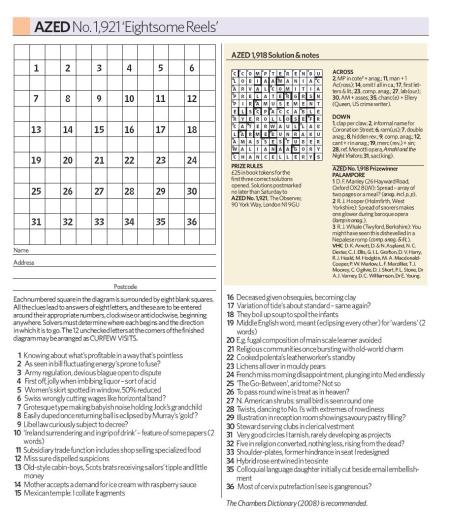
The current Observer crossword setter is the estimable Azed (real name Jonathan Crowther) who follows in the footsteps of his predecessor Ximenes. On balance I think this is consistently the best crossword I have ever done, although it is often a source of total frustration because it is quite convoluted and idiosyncratic. It is a bit different from other puzzles because it doesn’t involve any black squares like you would find in the standard `Everyman’ type of grid. This makes a very dense and intricate task for the solver, but does have the advantage that clues intersect more frequently than in the usual type. The problem with solving Azed is usually getting started as the clues are quite difficult and the words often very obscure. The one concession is that all answers are usually in the Chambers dictionary, and if they aren’t the compiler gives another hint. I’ve been tackling Azed for so long now that the Chambers has become in my mind a much more definitive dictionary than the OED. I also have several copies at home in different rooms, and one in my office at work.
Solving the Azed puzzle is hard enough, but for the special competition puzzles every four weeks one also has to supply a clue of one’s own. The winners of this competition are selected by Azed himself and there is an archive on the web of successful clues. As well as the winner of each competition, there is an annual prizewinner who produces the most good clues over the set of 13 competitions each year, and a roll of honour of all contributed clues that are deemed worthy. I’ve gradually clawed my way up this league table from 118th in 2006-7 to 46th in 2007-8 and, after four of the thirteen rounds this year, I’m currently in 28th place. I have to admit though that I am envious of the talents of many of the other competitors who routinely produce brilliant clues that even my best ones can’t compete with. For the same reasons that I don’t really enjoy setting examination questions, I don’t really like writing clues as much as solving them. My position in the roll of honour belies the fact that I’ve never produced a single clue that has won any of the individual competitions. I’m always the bridesmaid. You can find some of my more successful clues on the archive here.
Among those who have done exceedingly well in this competition over the years are the novelist Colin Dexter (in the form of N.C. Dexter) and a chap called C.J. Morse who is in fact the man that provided the name Dexter used for the crossword-loving chief Inspector in his famous detective novels. In turns out that C.J. Morse recently had his eightieth birthday and, as a special present, last Sunday’s Azed puzzle included some of his competition clues, which are real crackers. I won’t repeat them here though as you can find them all on the archive. However, solvers were invited to submit a clue to the word MORSE for the purposes of the competition, so at least I can tell you what my attempt was. Here we go:
His signal art no astronomer can comprehend [5]
By way of explanation, anagram of “astronomer” can give “morse” plus “art no”; comprehend is used in the slightly unusual sense of “comprise”; signal in the sense of “remarkable” plus reference to Morse system of signals. In the context of this puzzle, to celebrate the skills of Mr Morse, I also think this overall qualifies as an “&lit”.
I doubt if it competes with the best of the entries but I’m still quite proud of it.


 In the Dark