Archive for Balcombe

Science, Fracking and the Balcombization of the Left

Posted in Politics with tags , , , , on August 19, 2013 by telescoper

Well, here’s a find. A rare, peer-reviewed scientific article about hydraulic fracturing. And it’s not behind a paywall! The abstract of the paper, which I’m passing (as with my earlier post) on in the (probably forlorn) hope that it will introduce some rationality into the so-called “fracking” debate, reads:

The widespread use of hydraulic fracturing (HF) has raised concerns about potential upward migration of HF fluid and brine via induced fractures and faults. We developed a relationship that predicts maximum fracture height as a function of HF fluid volume. These predictions generally bound the vertical extent of microseismicity from over 12,000 HF stimulations across North America. All microseismic events were less than 600 m above well perforations, although most were much closer. Areas of shear displacement (including faults) estimated from microseismic data were comparatively small (radii on the order of 10 m or less). These findings suggest that fracture heights are limited by HF fluid volume regardless of whether the fluid interacts with faults. Direct hydraulic communication between tight formations and shallow groundwater via induced fractures and faults is not a realistic expectation based on the limitations on fracture height growth and potential fault slip.

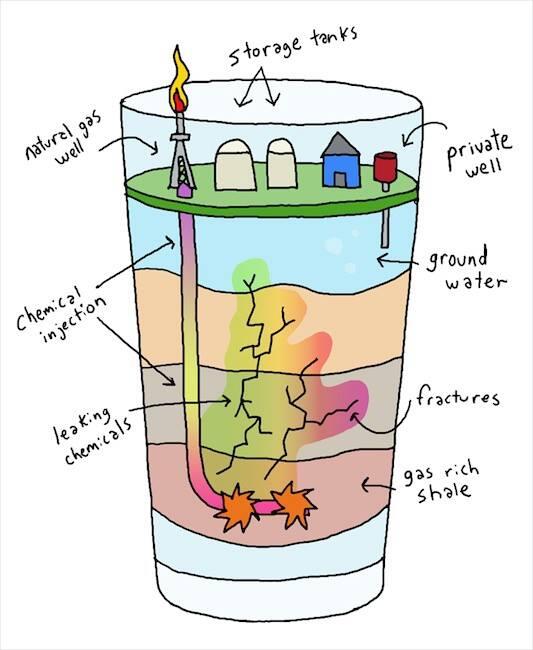
It would be nice if either the media or the protestors at Balcombe made some attempt to discuss the actual science behind fracking, but that seems a forlorn hope. The best I could come up with from the latter is this picture, offered by someone who thinks that anyone in possession of a set of crayons is qualified as a geologist:
BR-KG0SCAAAkSIu

In the interest of balance, here is a link to a blog post on fracking in the USA, the first paragraph of which reads:

For some time now, proponents of the controversial practice of hydraulic fracturing or “fracking” have claimed there was little or no evidence of real risk to groundwater. But as the classic saying goes: “the absence of evidence is not evidence of absence” of a problem. And the evidence that fracking can contaminate groundwater and drinking water wells is growing stronger with every new study.

I encourage you to read it, but if you do please carry on to the comments where you will see detailed counter-arguments.

I do not have a strong opinion either way on fracking. I’d prefer to make a decision as a result of an informed debate based on evidence, but there are clearly people who don’t want that to happen and are instead intent on scaremongering to suit their own ends. It seems to me that the legitimate concerns of sensible people have yet again been hijacked by the small but vociferous mob of “against everything” anarchists who see protest as an end in itself. It’s all so depressingly puerile. There’s no fracking going on in Balcombe anyway!

Why does the Green movement – and the left generally for that matter – have to be so comprehensively anti-scientific? As long as it remains that way it will never be taken seriously.

Fracking Confusion

Posted in Politics, Science Politics, The Universe and Stuff with tags , , , , , , on August 12, 2013 by telescoper

The news on the radio this morning featured a story about the Prime Minister wanting the UK to “get behind” hydraulic fracturing (or “fracking” as it is known for short) , a means of  liberating shale gas that offers the prospect of boosting the UK’s energy supply.

There’s not much sign any “getting behind” happening up the road from here in Balcombe, where a sizable anti-fracking protest has been going on for some time. There’s actually no fracking going on in Balcombe at the moment; the company involved, Cuadrilla Resources, is doing exploratory drilling to look for oil but may apply for a licence to pursue hydraulic fracturing if that is unsuccessful.

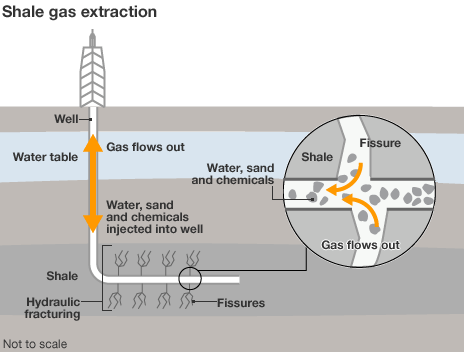
There’s a simple graphic on the BBC website that illustrates how fracking works:

_65309507_shale_gas_extraction464

In simple terms it involves pumping a mixture of water, sand and chemicals into a deposit of shale ato fracture the solid material contained therein and thus liberate the gas. Environmentalists argue that this technique might cause earth tremors and/or contamination of the water supply; advocates of fracking dispute these claims. I’m not sufficiently expert to be able to comment usefully on the arguments about the possible environmental dangers associated with it, so I’d be glad to receive comments via the box below.

One thing I will comment on, though, is the very poor quality of the media reporting on this issue. I’ve yet to see any meaningful attempt to comment on the science involved when surely that’s the key to whether we should “get behind” fracking or not? It struck me that quite a few readers might also be interested but ill-informed about this issue to, so for them I’d recommend reading the Beddington Report, the key findings of which were:

  • The health, safety and environmental risks can be managed effectively in the UK. Operational best practices must be implemented and enforced through strong regulation. Fracture propagation is an unlikely cause of contamination.
  • The risk of fractures propagating to reach overlying aquifers is very low provided that shale gas extraction takes place at depths of many hundreds of metres or several kilometres. Even if fractures reached overlying aquifers, the necessary pressure conditions for contaminants to flow are very unlikely to be met given the UK’s shale gas hydrogeological environments.
  • Well integrity is the highest priority. More likely causes of possible contamination include faulty wells. The UK’s unique well examination scheme was set up so that independent, specialist experts could review the design of every offshore well. This scheme must be made fit for purpose for onshore activities.
  • Robust monitoring is vital. Monitoring should be carried out before, during and after shale gas operations to detect methane and other contaminants in groundwater and potential leakages of methane and other gases into the atmosphere.
  • An Environmental Risk Assessment (ERA) should be mandatory. Every shale gas operation should assess risks across the entire lifecycle of operations, from water use through to the disposal of wastes and the abandonment of wells.
  • Seismic risks are low. Seismicity should be included in the ERA.Seismicity induced by hydraulic fracturing is likely to be of smaller magnitude than the UK’s largest natural seismic events and those induced by coal mining.
  • Water requirements can be managed sustainably. Water use is already regulated by the Environment Agency. Integrated operational practices, such as recycling and reusing wastewaters where possible, would help to minimise water requirements further. Options for disposing of wastes should be planned from the outset. Should any onshore disposal wells be necessary in the UK, their construction, regulation and siting would need further consideration.
  • Regulation must be fit for purpose. Attention must be paid to the way in which risks scale up should a future shale gas industry develop nationwide. Regulatory co-ordination and capacity must be maintained.
  • Policymaking would benefit from further research. The carbon footprint of shale gas extraction needs further research. Further benefit would also be derived from research into the public acceptability of shale gas extraction and use in the context of the UK’s energy, climate and economic policies.

I’m not sure how many anti-fracking activists, or others involved in the Balcombe protest, have read this report.

Anyway, in an attempt to gauge the mood of my totally unrepresentative readership, I thought I’d try a little poll:

And if you have strong opinions, please feel free to use the comments box.