Last night I went with some friends to the Wales Millennium Centre in sunny Cardiff Bay; not, this time, for an Opera but to see a movie. Well, not just to see a movie but to listen to the soundtrack performed live at the same time. It turned out to be a fascinating and memorable evening, enjoyed by a very large audience.
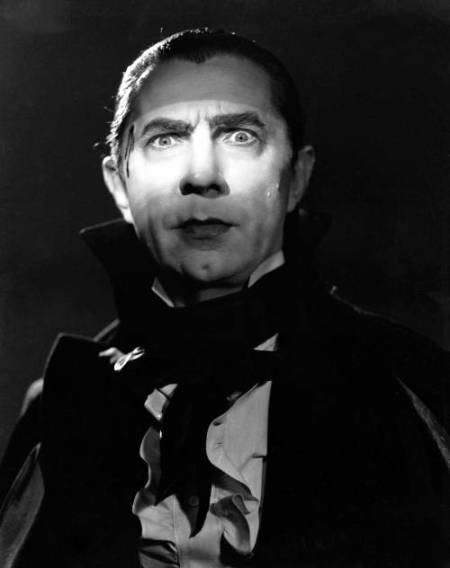
The film was the classic 1931 version of Bram Stoker’s Dracula, starring the great Bela Lugosi as the Count. This version – the first of many variations on the theme – was based very closely on the 1927 Broadway play in which Lugosi also played the title role. The music we heard was specially composed to accompany Dracula by Philip Glass, and the man himself was there to perform it. Philip Glass, I mean, not Count Dracula. The musicians numbered six in total, actually, as Philip Glass was joined by the Kronos Quartet and together they were directed by Michael Riesman, who sat with his back to the audience watching the film on the big screen.
Although the musicians started a bit ropily, they soon pulled themselves together and it became obvious that the music was going to bring a significant new dimension to this pioneering old horror movie. In fact, as a very early “talkie” the original film had no musical score at all and very few sound effects of any kind. The music composed by Philip Glass brings extra dramatic intensity to some of the movie’s iconic sequences, such as the battle of wills when Dracula tries to mesmerise Professor van Helsing. The insistent repetition which is characteristic of Glass’ minimalist approach adds urgency where needed, but there are also contrasting passages of relaxed beauty. The score is also beautifully understated where it needs to be, simple enough not to distract attention away from the screen.
The passing years have not been particularly kind to the film. The effects are often unconvincing (to say the least), especially the bats-on-strings, some of the acting very hammy, and the audio quality was so poor that the dialogue was often so muffled as to be barely audible (and not helped by bad mixing with the music).
Once you look past these superficial aspects, however, it’s not difficult to understand why this film is regarded as such a classic, because it is a highly original piece of work. It’s a far cry from a modern gore-fest, of course. The horror is implied rather than made explicit; all the actual blood-sucking happens out of shot. But the unsettlingly disjointed narrative, full of unexpected changes of scene and unexplained goings-on, gives it a dream-like feel and conjures up a unique sense of atmosphere. Although it it is now extremely dated, it doesn’t take that much imagination to understand why it created a sensation way back in 1931, with people apparently fainting in shock in the cinema. It also made a huge amount of money at the box office.
Vampire movies are replete with their own set of clichés – the crucifixes, the absent reflections, the bats, etc etc – but this is the daddy of them all. The one thing that surprised me was the lack of garlic; the favoured protection against this particular member of the Undead is Wolfsbane (a member of the Aconite family of attractive yet lethally poisonous flowering plants; I used to grow a variety called Monk’s-Hood in my garden when I lived in Nottingham).
In the end, however, Dracula owes it all to the mesmerising screen presence of Bela Lugosi. This film made his name, and he was to spend most of the rest of his career typecast as a horror villain. His later years represented a downward spiral. Trouble with sciatica led doctors to prescribe him with opiates, on which he became hooked. His drug addiction made him notoriously unreliable and work dried up. His career dwindled away into obscure bit parts in poor quality B-movies.
Although Bela Lugosi had his limitations as an actor, he didn’t deserve his fate. I’ve said before on here that I think people should be judged by their best work rather than by their worst, and so it is with Bela Lugosi. He was, and remains, the Count Dracula.


 In the Dark