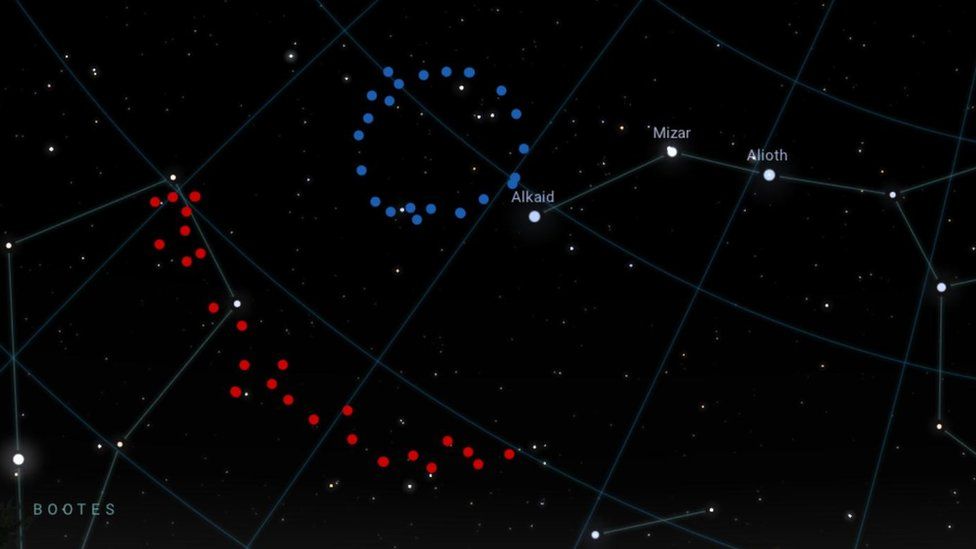
Archive for Big Ring

Big Things in the Universe

Posted in Bad Statistics, The Universe and Stuff with tags , , , , on February 7, 2025 by telescoper

About a year ago I wrote a couple of articles (here and here) in response to the discovery of a very large structure (“The Big Ring“) and claims that this structure and others – such as a Giant Arc – were inconsistent with the standard model of cosmology; the work concerned was later submitted as a preprint to arXiv. In my first post on the Big Ring I wrote

To assess the significance of the Big Ring or other structures in a proper scientific fashion, one has to calculate how probable that structure is given a model. We have a standard model that can be used for this purpose, but to simulate very structures is not straightforward because it requires a lot of computing power even to simulate just the mass distribution. In this case one also has to understand how to embed Magnesium absorption too, something which may turn out to trace the mass in a very biased way. Moreover, one has to simulate the observational selection process too, so one is doing a fair comparison between observations and predictions.

Well on today’s arXiv there is a preprint by Sawala et al. with the title aims to assess the significance of structures comparable to the Giant Arc. The title of the paper is The Emperor’s New Arc: gigaparsec patterns abound in a ΛCDM universe from which you can guess the conclusions. The abstract is

Recent discoveries of apparent large-scale features in the structure of the universe, extending over many hundreds of megaparsecs, have been claimed to contradict the large-scale isotropy and homogeneity foundational to the standard (ΛCDM) cosmological model. We explicitly test and refute this conjecture using FLAMINGO-10K, a new and very large cosmological simulation of the growth of structure in a ΛCDM context. Applying the same methods used in the observations, we show that patterns like the “Giant Arc”, supposedly in tension with the standard model, are, in fact, common and expected in a ΛCDM universe. We also show that their reported significant overdensities are an algorithmic artefact and unlikely to reflect any underlying structure.

arXiv:2502.03515

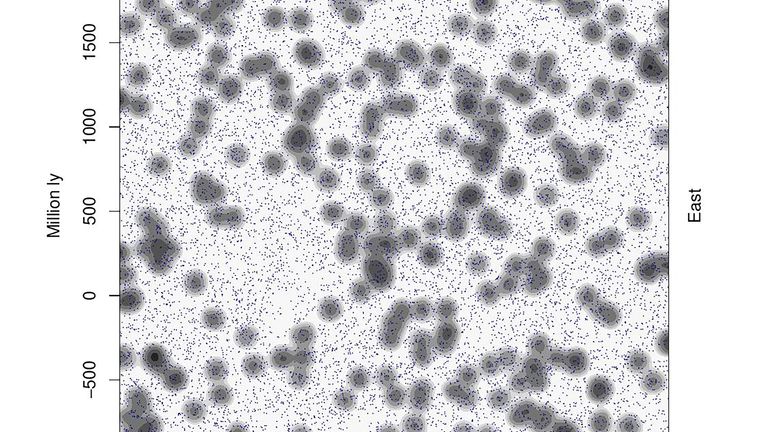
Here’s a picture of a large structure (a “Giant Arc”) taken from a gallery of such objects found in the simulations


I quote from the conclusions:

We hope that our results will dispel the misconception that no inhomogeneity can be found in the standard model Universe beyond some finite size. Instead, any given realisation of the isotropic universe comprises a time- and scale-dependent population of structures from which patterns can be identified on any scale.

I have nothing to add.
Big Ring Questions and Answers

Posted in Astrohype, The Universe and Stuff with tags , , , , , on February 14, 2024 by telescoper

A month ago I wrote a piece about observations of an apparent “Big Ring” of absorption systems that was claimed to be inconsistent with the Cosmological Principle and hence with the standard cosmological model. At the time there was no paper describing the results, but a preprint has now appeared on arXiv. I haven’t read it carefully yet, but at a cursory reading it confirms my prior expectation that it does not contain a comparison of the observations with predictions of the standard model. I’ll say more after I’ve had a chance to digest the paper.

One of the things that irked me at the time of the announcement of this “discovery” was that there was no way to scrutinize the claims because they hadn’t been written up. Another was that the media covering the Big Ring did not appear to want to present balancing opinions.

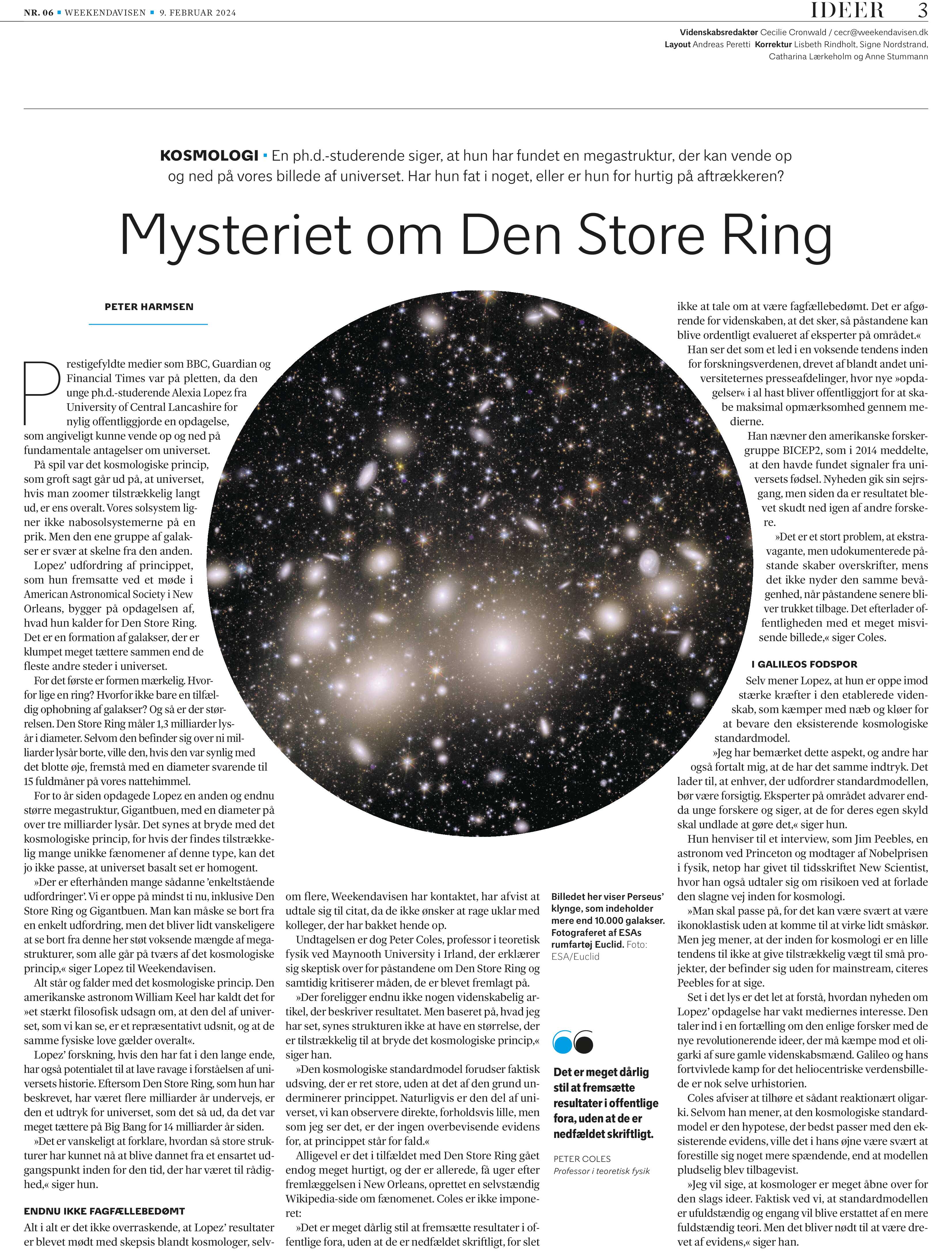
An exception was Danish journalist Peter Harmsen who writes for the weekly broadsheet Weekendavisen who asked me for an interview after seeing my sceptical blog post. The results appeared in an article that came out yesterday (13th February). It’s behind a paywall but here’s a screengrab to give you an idea (if you can read Danish):

The word “store” in Danish means “big” or “large”; it comes up quite often if you want to buy a beer in Denmark. The key quote of mine is

Det er meget dårlig stil at fremsætte resultater i offentlige fora, uden at de er nedfældet skriftligt

Weekendavisen, 13th February 2024

I actually kept a transcript of the interview which I thought it might be useful to share here in the form of questions and answers. You will find the original English version of the above quote in my response to the last question.

Fundamentally, do you think that the cosmological principle still stands or is in need of adjustment or even replacement?The Cosmological Principle, in the form used in the standard cosmological model, requires the Universe to be sufficiently homogeneous and isotropic on large scales that its behaviour can be described by relatively simple solutions of Einstein’s equations called the Friedman equations. We know the Universe is not exactly​ homogenous and isotropic, and the standard model predicts actually fluctuations on rather large scales that do not violate it.  Of course the part of the Universe we have actually observed directly is relatively small, but as I see it there is no compelling evidence that the Cosmological Principle is violated. 
Specifically regarding the research on the so-called Big Ring, is the jury still out on whether the people behind the research are on to something, pending publication of a peer-reviewed paper, or is it your assessment, based on what has been made public so far, that it is probably not the breakthrough that it has been made out to be in some reports?I am sceptical of the claims made about the Big Ring because there is no scientific paper describing the result. Based on what I have seen, however, just like other claims of arcs and filaments, the structure described does not seem to be on a sufficiently large scale to violate the cosmological principle. A careful comparison of the results with simulations would be required to draw more definite conclusions. I am not aware that the authors have done that.
The PhD student credited with the research is quoted in the Financial Times as making the following remark: “Lots of people are excited but, having said that, you do get this [resistant] attitude in cosmology that you don’t generally find elsewhere in science… Good science should be about pushing back and testing our fundamental assumptions but there are clearly people who want to protect the Standard Model.” What is your comment on this? Is cosmology stifled by a scientific community resistant to change?Science is – or should be – based on evidence. In my view the weight of evidence supporting the standard model is substantial, but that does not mean that it is proven to be true; it is a working hypothesis. If anyone does come up with evidence that shows it to be wrong then that would be the most exciting thing possible. I don’t see such evidence here. There are of course many people working on alternative theories , for example involving different forms of gravitational theory. I’d say cosmologists are very open to such ideas. Indeed we know that the standard model is incomplete and will eventually be replaced by a more complete theory. That has to be driven by evidence.
You describe in your blog “an increasing tendency for university press offices to see themselves entirely as marketing agencies.” Have there been other recent examples of universities being a little too eager to sell their scientific advances to the public?There’s quite a lot of this about, and I have to say that scientists, sadly, are often willing participants. A famous example  from some years ago was the BICEP2 “discovery” concerning the cosmic microwave background, which made headlines around the world but was later shown to be false. More recently there have been many claims that very distant galaxies observed with JWST are incompatible with the standard cosmology. In that case some of the observations turned out to be incorrect and the theoretical interpretation misleading. Very high redshift galaxies would indeed be difficult to account for in the standard model, but we haven’t seen enough evidence yet. 
The narrative of a young scholar proposing revolutionary new ideas despite resistance from established science seems to resonate with the public and has echoes of Galilei and Darwin. Are we, the lay public, too easy victims of such dramatic story-telling, and does it give us a wrong idea about how science actually works?I think the public don’t really understand how science really works for a number of reasons. I think many people expect scientists to be  certain about things, when really it’s about dealing with statistical evidence in as careful and rational a way as possible. Earlier you asked me about the Cosmological Principle. If you asked me if the Cosmological Principle is valid I would answer “I don’t know, but as a working hypothesis it accounts very well for the reliable data”. That sort of statement, however, does not make headlines.  A significant problem is that extravagant unsubstantiated claims make headlines, but subsequent retractions don’t. This presents a very misleading picture to the public.
In your blog, you write that headline-hunting without the presence of even a pre-print is “not the sort of thing PhD supervisors should be allowing their PhD students to do.” Is it because it is harmful to science as a whole, or because there is a risk of derailing a young scientist’s career before it has even begun due to an early debacle?My objection is more that I think it is very bad form to present in public results which have not even been written up, let alone subject to proper peer review. It’s essential for science that this happens, so that the claims can be properly evaluated by experts in the field. Bypassing this is potentially extremely damaging to the proper public understanding of this subject.
Q&A about the Big Ring

The Big Ring Circus

Posted in Astrohype, Bad Statistics, The Universe and Stuff with tags , , , , on January 15, 2024 by telescoper

At the annual AAS Meeting in New Orleans last week there was an announcement of a result that made headlines in the media (see, e.g., here and here). There is also a press release from the University of Central Lancashire.

Here is a video of the press conference:

I was busy last week so didn’t have time to read the details so refrained from commenting on this issue at the time of the announcement. Now that I am back in circulation, I have time to read the details, but unfortunately was unable to find even a preprint describing this “discovery”. The press conference doesn’t contain much detail either so it’s impossible to say anything much about the significance of the result, which is claimed (without explanation) to be 5.2σ (after “doing some statistics”). I see the “Big Ring” now has its own wikipedia page, the only references on which are to press reports, not peer-reviewed scientific papers or even preprints.

So is this structure “so big it challenges our understanding of the universe”?

Based on the available information it is impossible to say. The large-scale structure of the Universe comprises a complex network of walls and filaments known as the cosmic web which I have written about numerous times on this blog. This structure is so vast and complicated that it is very easy to find strange shapes in it but very hard to determine whether or not they indicate anything other than an over-active imagination.

To assess the significance of the Big Ring or other structures in a proper scientific fashion, one has to calculate how probable that structure is given a model. We have a standard model that can be used for this purpose, but to simulate very structures is not straightforward because it requires a lot of computing power even to simulate just the mass distribution. In this case one also has to understand how to embed Magnesium absorption too, something which may turn out to trace the mass in a very biased way. Moreover, one has to simulate the observational selection process too, so one is doing a fair comparison between observations and predictions.

I have seen no evidence that this has been done in this case. When it is, I’ll comment on the details. I’m not optimistic however, as the description given in the media accounts contains numerous falsehoods. For example, quoting the lead author:

The Cosmological Principle assumes that the part of the universe we can see is viewed as a ‘fair sample’ of what we expect the rest of the universe to be like. We expect matter to be evenly distributed everywhere in space when we view the universe on a large scale, so there should be no noticeable irregularities above a certain size.

https://www.uclan.ac.uk/news/big-ring-in-the-sky

This just isn’t correct. The standard cosmology has fluctuations on all scales. Although the fluctuation amplitude decreases with scale, there is no scale at which the Universe is completely smooth. See the discussion, for example, here. We can see correlations on very large angular scales in the cosmic microwave background which would be absent if the Universe were completely smooth on those scales. The observed structure is about 400 Mpc in size, which does not seem to be to be particularly impressive.

I suspect that the 5.2σ figure mentioned above comes from some sort of comparison between the observed structure and a completely uniform background, in which case it is meaningless.

My main comment on this episode is that I think it’s very poor practice to go hunting headlines when there isn’t even a preprint describing the results. That’s not the sort of thing PhD supervisors should be allowing their PhD students to do. As I have mentioned before on this blog, there is an increasing tendency for university press offices to see themselves entirely as marketing agencies instead of informing and/or educating the public. Press releases about scientific research nowadays rarely make any attempt at accuracy – they are just designed to get the institution concerned into the headlines. In other words, research is just a marketing tool.

In the long run, this kind of media circus, driven by hype rather than science, does nobody any good.

P.S. I was going to joke that ring-like structures can be easily explained by circular reasoning, but decided not to.