Further to my earlier post, I refer you to this much more detailed article by someone actually involved in the LIGO experiment, former Cardiff colleague Bernard Schutz..
Archive for Black hole merger
More on the 10th Anniversary of Gravitational Waves
Posted in The Universe and Stuff with tags Advanced LIGO, Bernard Schutz, Black hole merger, gravitational waves, GW Astronomy, GW150914 on September 14, 2025 by telescoperA Decade of Gravitational Waves
Posted in Biographical, The Universe and Stuff with tags Advanced LIGO, arXiv:2508.18082, Black hole merger, black holes, gravitational waves, GW150914, inspiral on September 14, 2025 by telescoperThis is just a quick post to mark the fact that it is now ten years to the day since the first detection of gravitational waves by Advanced LIGO. The acronym LIGO stands for Laser Interferometer Gravitational-wave Observatory, by the way. It wasn’t until February 11th 2016 that the result was announced at a press conference (which I blogged about here), but the signal itself arrived on 14th September 2015, exactly a decade ago; the name given to the event was GW150914.
Here are the plots for that first one:

That first signal corresponded to the coalescence of two black holes, of masses 29 and 36 times the mass of the Sun and produced a large response in the detectors very soon after Advanced LIGO was switched on. There’s synchronicity for you! The LIGO collaboration have done wondrous things getting their sensitivity down to such a level that they can measure such a tiny effect, but there still has to be an event producing a signal to measure. Collisions of two such massive black holes are probably extremely rare so it’s a bit of good fortune that one happened just at the right time. Actually it was during an engineering test.
There have been many subsequent detections and even more candidates waiting to be confirmed- here’s a full list. The official LIGO site states there are 90 confirmed detections, the 4th observational run (O4) (which is due to end in November 2025) has already found 200 candidates. The latest compilation of gravitational-wave transient sources can be found here.
Most of the detections have been binary black hole mergers, but I particularly remember the excitement in 2017 surrounding the first merger of a neutron star with a black hole. It was fun that rumours started to spread via this blog as people outside the LIGO/transient source community used a comments thread here to share information of what various telescopes were looking at. That was in August 2017, just over 8 years ago.
Anyway, here’s to the next decade. Assuming NSF does not follow Trump’s plan to slash the LIGO budget.
What kind of thing is GW190814?
Posted in The Universe and Stuff with tags black hole, Black hole merger, gravitational waves, LIGO, Merger, neutron star, Noise, VIRGO on June 24, 2020 by telescoperThere’s been a lot of interest in the past day or two over an event that occurred in the LIGO detectors last August, entitled GW190814. A paper has appeared declaring this to be “the observation of a compact binary coalescence involving a 22.2–24.3 M ⊙ black hole and a compact object with a mass of 2.50–2.67 M ⊙“. That would be interesting of course because the smaller object is smaller than the black holes involved in previous detections and its mass suggests the possibility that it may be a neutron star, although no electromagnetic counterpart has yet been detected. It’s a mystery.
I was quite excited when I saw the announcement about this yesterday but my enthusiasm was dampened a bit when I saw the data from the two LIGO detectors at Hanford and Livingston in the USA and the Virgo detector in Italy.
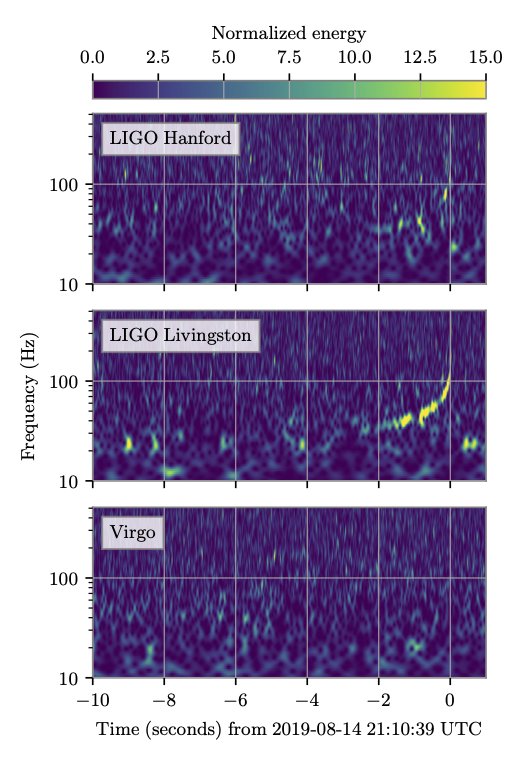
Visually, the Livingston detection seems reasonably firm, but the paper notes that there were thunderstorms in the area at the time of GW190814 which affected the low-frequency data. There doesn’t look like anything at all but noise in the Virgo channel. The Hanford data may show something but, according to the paper, the detector was “not in nominal observing mode at the time of GW190814” so the data from this detector require special treatment. What you see in the Hanford channel looks rather similar to the two (presumably noise) features seen to the left in the Livingston plot.
I know that – not for the first time – I’m probably going to incur the wrath of my colleagues in the gravitational waves community but I have to sound a note of caution. Before asking whether the event involves a black hole or a neutron star you have to be convinced that the event is an event at all. Fortunately, at least some of the data relating to this have been released and will no doubt be subjected to independent scrutiny.
Now I’m going to retreat into my bunker and hide from the inevitable comments…
And then there were five….
Posted in The Universe and Stuff with tags Advanced LIGO, Black hole merger, gravitational waves, GW170608, LIGO, Merging black holes, VIRGO on November 17, 2017 by telescoper…black hole mergers detected via gravitational waves, that is. Here are the key measurements for Number 5, codename GW170608. More information can be found here.

Here is the abstract of the discovery paper:
On June 8, 2017 at 02:01:16.49 UTC, a gravitational-wave signal from the merger of two stellar-mass black holes was observed by the two Advanced LIGO detectors with a network signal-to-noise ratio of 13. This system is the lightest black hole binary so far observed, with component masses 12+7-2 M⊙ and 7+2-2 M⊙ (90% credible intervals). These lie in the range of measured black hole masses in low-mass X-ray binaries, thus allowing us to compare black holes detected through gravitational waves with electromagnetic observations. The source’s luminosity distance is 340 +140-140Mpc, corresponding to redshift 0.07+0.03-0.03. We verify that the signal waveform is consistent with the predictions of general relativity.
This merger seems to have been accompanied by a lower flux of press releases than previous examples…

 In the Dark