The Department of Physics & Astronomy at the University of Sussex has been supporting some fantastic research into the accessibility of science education. Daniel Hajas, a blind second year physics undergraduate student has been working with Dr. Kathy Romer, Reader in Astrophysics, on a research project related to innovative assistive technology.
Daniel came up with the idea of an audio-tactile graphics display (TGD) that should allow representation of graphical information in audio and tactile modalities, mostly focusing on figures used in mathematical sciences such as graphs, geometric shapes etc. The TGD is a device with approximate dimensions of a tablet that can sit on a table top and can be connected with a PC using either a wired or wireless solution.
During the summer of 2014, Daniel wrote a research proposal, attended an assistive technology oriented conference and since the beginning of this academic year has been searching for partners/funding. Daniel and Kathy recently submitted an application to the Inclusive Technology Price (ITP).
Since October they have made contact with IT and cognitive science experts from the Sussex IT department and are also in contact with an LHC Sound project (CERN) team member to assist with sonification. Daniel and Kathy plan to establish collaboration with experts from various fields, find research partners and funding. Such an interdisciplinary research requires collaboration of various Sussex Departments if not other Universities from across the UK.
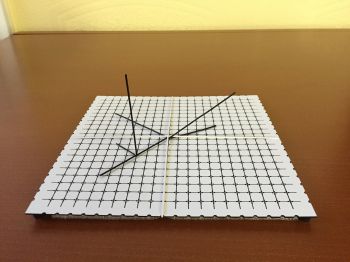
Daniel’s 3D Vector Board
Daniel has also been busy inventing the ‘3D vector board’, a small plastic board with two flexible rubber stripes perpendicular to each other which can be can moved around such that they show the axes of a coordinate system. The board has a grid on it with 1×1 cm squares. At the junctions four little holes are drilled in the corner of the squares. This allows the vectors (metal sticks of different length) to be fixed on the board. Since there are horizontal, diagonal and vertical sticks i.e. the sticks are either in the plane, perpendicular to or in an angle respect to the plane of the board 3D vector scenarios can be modelled easily.
Although Daniel intended to use the board solely for his own purposes, feedback suggests this relatively simple tool could be used efficiently in education for demonstrational purposes. Both visually impaired and sighted students could benefit from it. Sketches on paper or black boards only allow 2D representations. The 3D vector board might also work well in illustrating aims of the TGD project. Although the main goal is to develop a very advanced high-tech assistive device over a period of years, Daniel and Kathy might also come up with a number of low-tech ideas to improve accessibility of mathematical sciences for visually impaired students.
See Daniel’s project website for further details about his research.

 In the Dark