Archive for book-review

Murder before Evensong by The Reverend Richard Coles

Posted in Literature, Television with tags , , , , , , , , on July 19, 2024 by telescoper

The Reverend Richard Coles (no relation), former Communard, ordained priest, broadcaster and TV celebrity recently turned his hand to writing murder mysteries. I bought his first crime novel, Murder Before Evensong, featuring Canon Daniel Clement, a couple of years ago but only got around to reading it recently. It caught my eye for two reasons, one that I am quite partial to whodunnits, and the other that I read and enjoyed the first volume of the author’s autobiography, Fathomless Riches, which showed him to be a very good writer.

As you might have guessed, Murder Before Evensong, is a kind of homage to the old-school Agatha Christie village murder typical of the Miss Marple stories. Murder at the Vicarage came immediately to mind when I first saw the book, but the story is not set so far in the past – more eighties than thirties. Richard Coles is also far wittier than Agatha Christie, with a definite touch of PG Wodehouse in his style. When I got into the book it reminded me very much of the original Midsomer Murders novels written by Caroline Graham, which I think are excellent; with somewhat whimsical plots, and populated with somewhat eccentric characters; the long-running TV series has long since run out of ideas, and is now tired and formulaic, but the books on which it is based are very good indeed. Like the original Inspector Barnaby stories, Murder Before Evensong is very funny in places, but less of a parody and more of an affectionate tribute to the genre. Coles also writes movingly about grief, and its effect on a close-knit rural community, no doubt informed by his own personal life and experiences as a parish priest. Canon Clement obviously has a lot of Richard Coles in him, including a love of dachsunds.

It’s difficult to review a murder mystery without giving a way the plot, so I’ll just say that it is well constructed. I narrowed the list of possibilities down to two very early on, and was proven right, but I didn’t really get the motive right.

Anyway, it’s an enjoyable read and recommended for enthusiasts. I gather that more Canon Clement stories are on the way. That reminds me of a line in an episode of Midsomer Murders, when Barnaby is joined by a new Detective Sergeant, just up from London, who is immediately plunged into the investigation of a killing spree. He turns to his Chief Inspector and says words to the effect of ‘For a small village there are a lot of murders around here’ to which Barnaby raises an eyebrow and says ‘Yes, that has been remarked upon…’
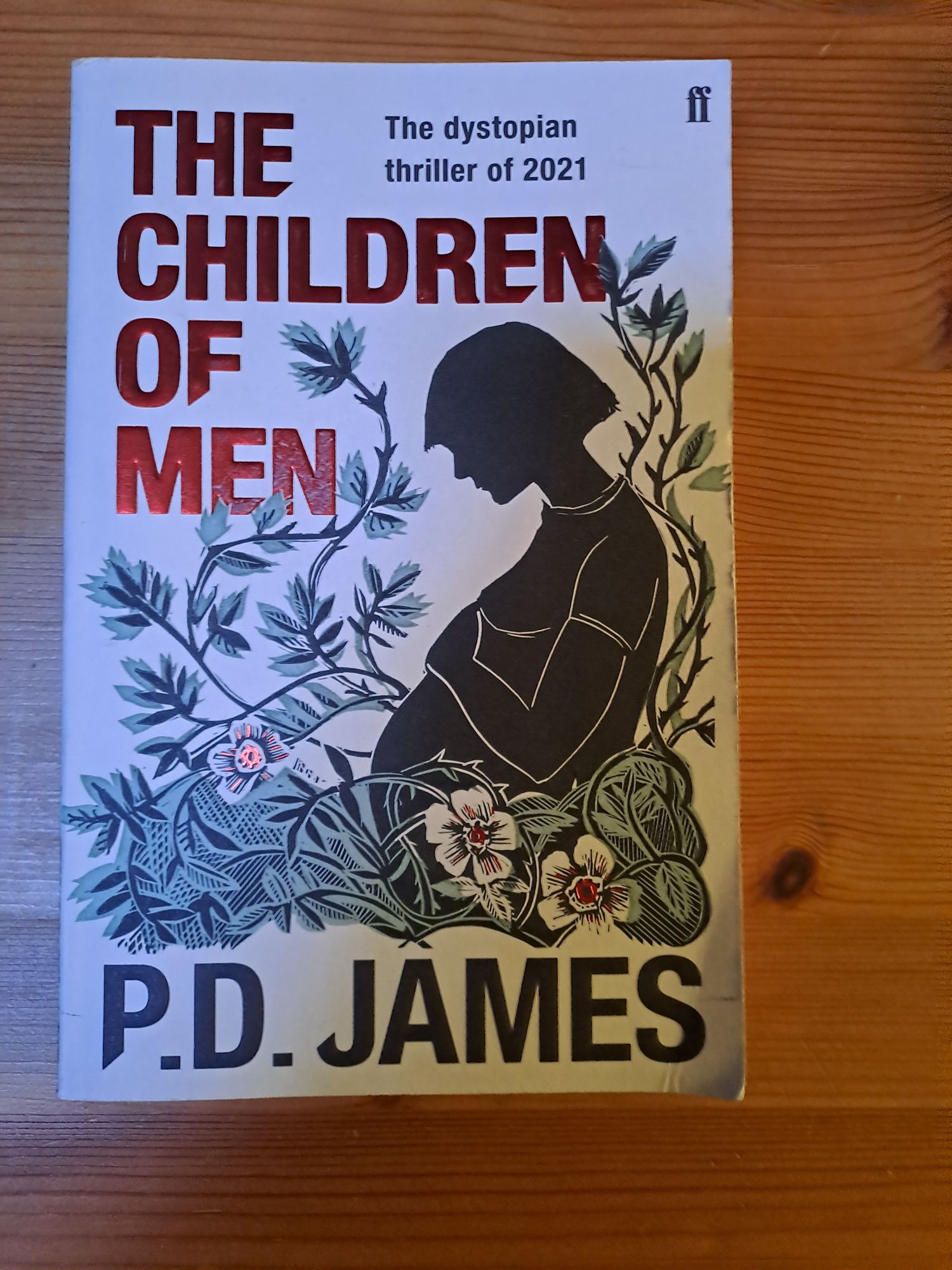
The Children of Men by P.D. James

Posted in Biographical, Literature with tags , , , , , , , on April 28, 2024 by telescoper

When I finished reading Death Comes to Pemberley by P.D. James I realized that there was one other book by the same author that I had never read, the dystopian thriller The Children of Men. I bought the above edition about five years ago, but the novel was first published in 1992.

The premise of this story, set in the (then future) 2021 is that, in 1995, for reasons unknown, the entire human race suddenly lost the ability to reproduce. The book makes no attempt to explain the origins of this mass infertility, and it is a conceit that I found very implausible, but I did manage to suspend my disbelief enough to engage with the author’s ideas about what a society without children might be like. That is basically what the first half of the book tries to do. It’s an interesting idea and what develops is not the kind of post-apocalyptic scenario that has been written about many times before.

In 2021 England is ruled by a dictator, called the Warden, by the name of Xan. He happens to be the cousin of the principal protagonist, Theo. The Powers That Be introduce the concept of a Quietus, at which elderly people are forced to commit mass suicide. A penal colony is set up on the Isle of Man where prisoners are dumped and left to fend for themselves. As the population ages, schools and colleges close, buildings are left to decay, and as numbers decrease people are forced to move to larger towns, the only places where services and utilities can be maintained.

One thing that struck me reading this in 2024 is that the author did not foresee any of the technological advances that were to occur between 1995 and 201. The existence of the internet or even mobile phones would have had significant implications for the plot.

The novel is split into two parts, Book 1 (Omega) and Book 2 (Alpha), and the first part is largely devoted to describing the decay and hopelessness of a society without children. I found it rather heavy-handed, with too much sermonizing. While Book 1 verges on a sort of allegory, no doubt inspired by the author’s own Christian faith, n Book 2 the story becomes a well-plotted thriller. After witnessing the horror of a Quietus, Theo joins a small group of dissidents based in Oxford who carry out a campaign to disrupt such events and think that Theo’s relationship to the Warden might be useful in effecting change at the top. As well as being Xan’s cousin, Theo used to work for Government as an adviser to the Warden.

The group is, however, rumbled and its members have to flee into the countryside. Along the way we find that one of their number, a woman by the name of Julian, is pregnant. Fortunately another member of the group, Miriam, is a midwife (although she obviously hasn’t practiced for 25 years). We learn the identify of the father of Julian’s child but not the reason why she has conceived when apparently nobody else on the planet can. Obviously the Alpha in the title of the second book refers to this child. I won’t say how it all finishes, except that the ending is ambiguous.

The fugitives-on-the-run part of the story in Book 2 is very well crafted and genuinely exciting, but the pregnancy adds yet another level of implausibility to a plot that seemed to me already very contrived. Although it is a page-turner I found it ultimately unsatisfying.

P.S. I understand there is a film based on the book, but I haven’t seen it.