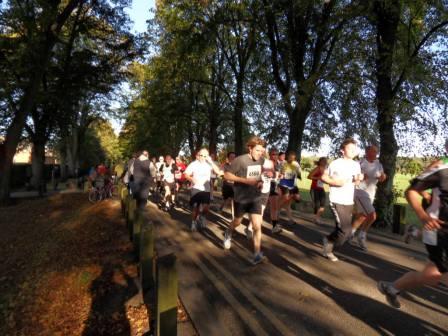
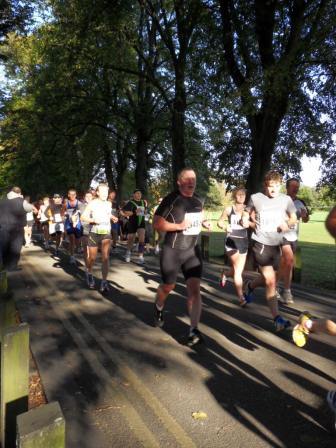
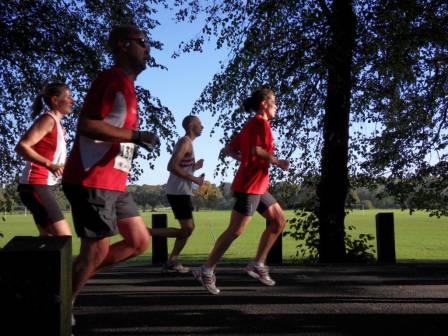
Just back from a walk in the park to watch the runners in this year’s Cardiff Half-Marathon. Quite a few people I know from the School of Physics & Astronomy – both staff and students – were participating so I was hoping to catch sight of them as they passed by. I nearly missed the event because of my own incompetence – I knew the route had changed since last year, but was still under the impression that it went along Cathedral Road. I was wrong. The route actually loops back inside Bute Park rather than down the main road outside, so I had to walk a bit further than anticipated to see the runners.
It was a beautiful bright morning for it, if a bit on the chilly side, and Bute Park was looking lovely in the autumn sunshine. I imagine the start, down in Cardiff Bay near the sea, must have been distinctly cold at 9am! Interestingly, the route this year also involved a section over the Cardiff Bay Barrage which must also be a bit “bracing” in October. The path the runners followed in Bute Park is relatively narrow at the spot I found, about 5 miles into the race, and the participants were consequently rather bunched. That, and the fact that they were moving rather quickly, made it difficult for me to pick out people I recognized let alone take a picture of them. I did see a few familiar faces, but alas couldn’t get any decent photographs.
Well done, everyone who completed the race, especially those who raised money for charity by doing so. Hats off to you all!
Here are a few random snaps I took while I was there.
I used to run quite a lot when I was younger (half-marathons and even a few full marathons), but I’ve had to give it up because of the condition of my knees. Watching these events makes me feel a mixture of jealousy and frustration, to such an extent that I’m sorely tempted to have a go at a half-marathon one last time, even if they have to bring me home in an ambulance…
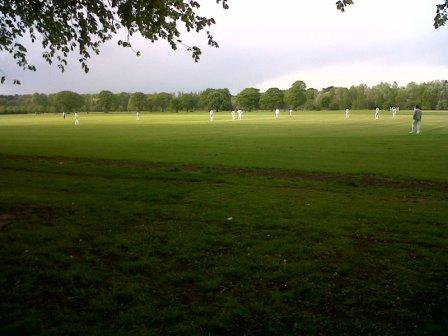
I was walking home a couple of weeks ago and noticed that there were several cricket matches going on in the Park, just over the road from my house in Cardiff. I stopped to watch a few overs, taking one or two experimental pictures with my phone, and was quite impressed at the standard of play. Two distinctly lively quick bowlers were causing the batsmen quite a few problems, though they were not just blocking but also taking every available opportunity to score. It was attritional, but absorbing stuff.
The use of these fields for cricket was interrupted in 2008 when the National Eisteddfod was held here in Cardiff, on this very spot. It tipped down with rain for the entire week and the fields turned to mud. It has taken the best part of two years for Cardiff City Council to repair the damage and get everything back to working order so that the many local clubs that use the fields here could resume their sporting activities. Of course they had nowhere to play for all that time, thanks to the fools at the Council who totally underestimated the time it would take, not to mention the amount it would cost. You can see in the foreground that some of the grass is still in need of attention.
Just a few hundred yards to the South (right in the picture) lies Sophia Gardens, and the SWALEC stadium home to Glamorgan Cricket Club, currently at the top of the Second Division of the County Championship. I hope the good weather stays with us long enough that I can actually get to see a decent amount of cricket once term finally finishes.
Incidentally, the view is roughly eastwards. The River Taff flows from left to right, concealed by the trees which are part of the landscaping performed by Capability Brown. They don’t show up too well in the photo, but they were clearly carefully chosen to provide a variety of colour and texture, especially in the changing light of the spring sunshine. Also hidden is a weir (Blackweir), where the Dock Feeder Canal is taken off the river to supply water to the docks at Cardiff Bay, and a small bridge. On the far side of the river is Bute Park and, further South, Cardiff Castle.
I may not have a very big garden, but it’s lovely having this beautiful park just a short walk from the house. I hope the Council learn their lesson and stop buggering about with it.
What could be nicer on lovely spring day than to take a walk through the local park? Even better if you live in the city of Cardiff, home to one of the largest areas of mature parkland in any urban setting, so you can take a stroll among lovely old trees and fields (landscaped by Capability Brown) in the shadow of a picturesque and historic castle.
At least that’s what it should be like. Unfortunately, Cardiff City Council has other ideas. Bute Park is currently being redeveloped by the Council in order to make it more accessible to lorries and other heavy vehicles. This is intended to allow more large-scale “Events” to take place on Coopers Fields, the area just behind Cardiff Castle. Further commercial exploitation of this area will no doubt ensue. Despite vigorous opposition to the plans by regular users of the Park, including myself, and widespread condemnation in the press (including the esteemed organ Private Eye) the Council last year granted itself planning permission (surprise, surprise) to construct a new road into the heart of this precious “green lung”.
I’m depressed to say that work on the new road has gathered pace during the early months of this year. Irreplaceable trees have been felled, and a hideous new bridge is being built over the Dock Feeder Canal. Needless to say, all this construction is accompanied by frequent movement of heavy vehicles in and out of the park. Large areas are now out of bounds for pedestrians, and those that do bravely venture along the footpaths elsewhere have to vie with the trucks. Many of the paths have been resurfaced to make them more suitable for motor vehicles and the signs denoting the speed limit, which used to be 5 mph throughout, have now all been removed. It’s no fun sharing a footpath with a juggernaut doing 30 mph, I can tell you. Still, I suppose we better get used to it. Bute Lorry Park it’s going to be from now on.
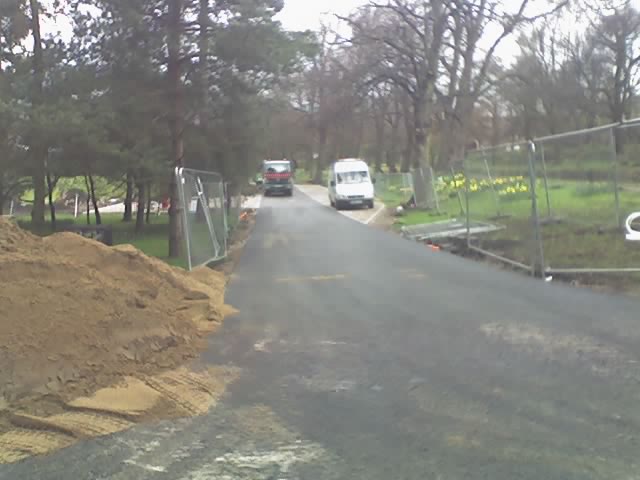
I’ve just got one of those new-fangled Blackberry things (which I don’t know how to work yet). However, a few days ago I did use the old one to take a few pictures of the devastation on view from my usual route into work. The first one shows the view looking North from just behind the castle.
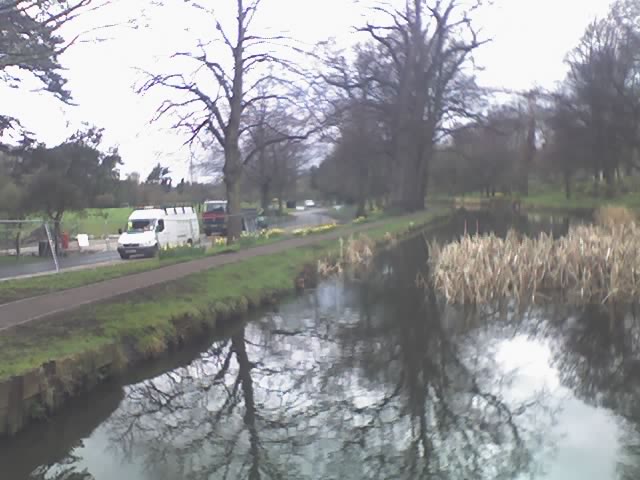
The Dock Feeder canal is just to the right. There used to be a relatively narrow trackway running along the route taken shown here, which the Council decided to replace to make it more suitable for heavy road vehicles. Coopers’ Fields lie to the left and this road is used to bring equipment, temporary buildings etc for use there. On the Council’s literature this work is described as “resurfacing”, but, as you can see from the picture, in addition to the new tarmac surface they have taken the opportunity to construct a sort of lay-by which more-or-less doubles the width of the path. Here’s another view, showing the new stretch of tarmac snaking its way along the side of the canal. You can see more clearly the area of grassland onto which lorries will be driving in ever-increasing numbers. It would be easier for them to tarmac over the whole thing and be done with it.
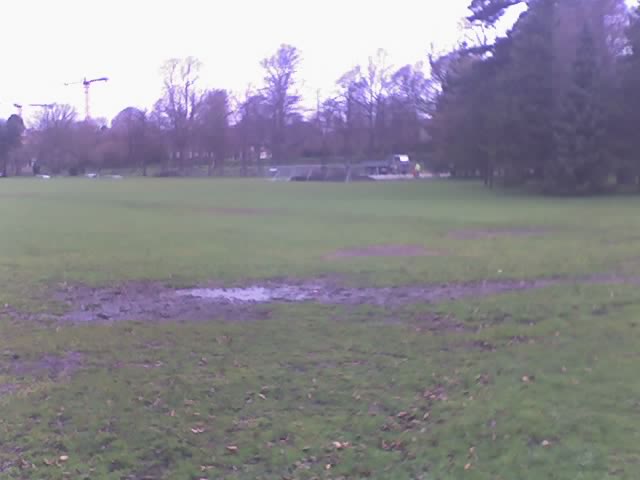
Two short but wide spurs to the left cut into the fields, presumably to allow vehicles easier access to the grass in order to churn it up into a quagmire. Here’s a view taken from a vantage point to the left of that in the first picture, showing the dire state of disprepair that Coopers Fields are in anyway, even before the new regime of rapacious commercial exploitation. The grass has been left in this damaged state since last September. No doubt it will be similarly neglected in those brief future periods in between being covered by temporary buildings and mobile entertainments of various sorts.
To the left of the above picture you can also see the cranes involved in construction work further North. I’ve stopped walking in that part of the park because it’s just too dangerous. A main road far worse than the one shown here, and complete with traffic lights, now enters from North Road and cuts deep into the park in order to reach the Council’s nursery facility – the type for plants, not children – which is right next to the River Taff (which lies to the East of the site shown in the pictures). At least the Council says its so lorries can reach the nursery. But how many lorries are going to need to get to the nursery every day such that they require a whole new road to be built? I know I’m not the only one who thinks this is just a cover. Phase 2 of the operation isn’t hard to guess: an extension of the road Eastwards across the River Taff via a new road bridge to Sophia Gardens, completely bisecting Bute Park and creating a major thoroughfare to relieve congestion to the West.
If you think the Council wouldn’t dare, and that they’d never get away with it, just look at what they have got away with already. And not just here. The idiotic Highways Department of Cardiff City Council has been responsible for monstrosity after monstrosity in this city. Only now are they turning their attention to beautiful Bute Park. They must be stopped.
I was sitting in the garden just now, doing the crossword, when I heard the unmistakeable sound of a World War II fighter aircraft flying overhead. I looked up and there it was, right over my house. A Spitfire no less. The outline was instantly recognisable, especially because it was flying so low, on account of its curious elliptical wing shape. It was also low enough for the extraordinary roar of the Rolls Royce engine powering this exceptional aircraft to shake the windows in my house!
I once had the chance to sit in the cockpit of a Spitfire, in an aircraft museum, not one that was flying! The thing that struck me most was how very small and cramped it was, and I’m not particularly tall (although I’m a bit wider than I used to be).
It turns out that the appearance of this aircraft in the skies over Cardiff was related to an event called Armed Forces Day which is happening in Bute Park, just a matter of yards from my house.
Seeing the plane reminded me of the 60th anniversary commemoration of the Battle of Britain in 2000 during which the newspapers reprinted contemporary accounts of the summer of 1940 during which Britain stood alone, and on the brink of the abyss. The thing that struck me most about the heroic pilots who saved this country from invasion was that they were all so young. The same age, in fact, as the students I teach. I wonder how many of todays 18-20s really understand the scale of the sacrifices made by the corresponding generation of 1940?
I had a friend – now long dead – who served in the RAF during the Battle of Britain and I once asked him about the tactics they used. He explained that they didn’t really have any tactics. When scrambled they were usually lucky if they managed to get to the right altitude before the enemy were on them. And if they did they just flew straight at them and tried to shoot them down. There was little point in attacking a big formation from behind with a handful of planes, which was the usual situation. You might pick off one or two but the bombers would carry on to their target. You had to attack from the front in order to scatter them. He added that on a good day, if you were feeling exceptionally brave, you might even keep your eyes open as you screamed into them at getting on for 400 mph.
The other thing that this event reminded me of was the film Battle of Britain. The movie is a bit dated now, largely because some of the special effects don’t really stand up to modern comparisons: no cgi when it was made, for example. The best thing about it for me, though, is the wonderful music written for the film by William Walton, especially in the following sequence where the dogfights are shown with only the music as soundtrack. This turns the shots of terrifying close-range combat into a something a lot more than an action movie. In fact, this is a real piece of art.
The context of this sequence is, as far as I know, historically accurate. Over the summer of 1940 the Luftwaffe had sent raid after raid over to attack Britain, these raids increasing in size as time went on. Hugh Dowding, Head of Fighter Command at that time, refused to let his planes be drawn into a huge battle against numerically superior forces and instead kept most of his planes in reserve, sending up only a squadron or half a squadron to meet the incoming planes. Thanks to the breaking of the German Air Force Enigma code, Dowding knew that the Luftwaffe pilots had been handing in grossly exaggerated reports of how many planes they had been shooting down. Convinced that the RAF was on the brink of collapse, the Germans launched an enormous air raid on September 15th 1940 intended to deliver the knockout blow and prepare the way for invasion.
Dowding knew that they were coming, and put every available plane at the RAFs disposal into the air. He staked everything on this battle. There were no reserves. When the Luftwaffe arrived over Britain they found the air filled with Spitfires and Hurricanes whose pilots, having been consistently outnumbered in the battles so far, relished the chance to fight for once with something close to numerical equality with the enemy. The RAF scored a decisive victory, convincing Hitler to abandon his plans for an invasion in 1940.
Since we’re in the middle of a heatwave I thought “Flaming June” would be a good title. I only just discovered, however, that it’s not as I thought some sort of folk expression or quotation from a poem, but the title of this Pre-Raphaelite painting by Frederic Leighton of a lady wearing what looks like a dress made out of old curtains. Apparently the oleander branch seen in the upper right symbolizes the fragile link between sleep and death. Or, in this weather, the fragile link between sleep and sunstroke.
Anyway, the year rolls on. The examination period is almost over, marking season is upon us and it will soon be time for examiners’ meetings, class lists and all the arcane business of academic life.
Yesterday I sat in the garden marking a third-year paper or, actually, only half a paper as I give the course jointly with another member of staff. After I’d finished I decided to go for a ride on my bicycle up the Taff Trail and around Bute Park. It was nice, but should have been nicer. Unfortunately, Cardiff City Council’s insane policy of organizing “events” all over the park, involving heavy vehicle movements and temporary buildings, has led to the wholesale destruction of the grass in many places. If the hot summer continues then this will get worse. The site of last year’s National Eisteddfod on Pontcanna Fields still hasn’t recovered; fifteen local sports fields have been completely ruined as you can see from this little video taken a couple of months ago.
Despite ongoing protests, the Council seems determined to press ahead with its plans to make Bute Park unfit as a place of quiet recreation by building a road so that more lorries can enter it.
Anyway, hordes of people were still about in the park yesterday, sunbathing, playing cricket, having barbecues, swimming in the Taff (illegally) and a few brave souls were jogging around, leaving trails of sweat on the footpaths.
This took me back to the occasion – the best part of twenty years ago – when I entered the Great North Run for the first time. Nowadays this race – the biggest mass participation half-marathon race in the world, with 50,000 competitors – is run in September, but in those days it was held in June. As it happened, there was also a heatwave the first time I did it. I remember lining up at 9.30 on a Sunday morning on the start grid (I was number eleven thousand and something) while the stewards went round pleading with all the participants to take plenty of water as they went around as it was going to be very hot indeed and they didn’t want people suffering from dehydration.
In those days I was quite a keen long-distance runner and was fairly fit. I wasn’t that concerned about the heat but took the advice to heart and determined to stop at all the water stations on the way from Newcastle to South Shields. When we started I also took care not to go off too fast over the first mile or so, which is basically all downhill from the Town Moor to the Tyne Bridge. Not that you could go fast anyway, as the track was so crowded with runners.
I remember the wonderful feeling as we emerged onto the Tyne Bridge and took in the splendid view of the bridges along the river. When we got to Gateshead the crowds were out in large numbers cheering everyone on and I felt completely elated. The first water station was near Gateshead athletics stadium, and I took a drink there as I did at the next, and the next. After Gateshead the route heads towards the Felling bypass at about 4-5 miles and then the runners can see a long climb in front of them. A large thermometer showed the temperature on the road to be about 45 Celsius. Fortunately the people living in houses either side of the road were out in their front gardens offering encouragement and sometimes had their hoses out to shower people as they went past. At one point there was a fire engine that had made an impromptu fountain by the side of the road too.
Unfortunately, as I near the ten mile mark I started to feel a bit strange. I had never actually taken on water while I was running before this race; I never felt the need for it when on training runs. My stomach wasn’t used to the water sloshing around while I was running. I felt quite sick by the time we got to the top of the climb but when I saw the sea and felt its breath on my face I cheered up and descended the steep downward slope towards the seafront near Marsden Rock.
There’s a good mile and a half along the seafront to the finish, however, and I was definitely struggling really badly by then. I could see the finish line but it felt like it wasn’t getting any closer. I slowed to a crawl but kept going, finally reaching the grandstand where a large crowd shouted encouragement. I must have looked dreadful because I heard several people shouting out my number along with “keep going, son” and “you’re nearly there”.
Eventually I got to the finish line but the feeder lanes were quite busy then – I was finishing at about the peak time of about 1hr 50 – so I was forced to slow right down because of the people in front of me.
As I crossed the line, I stopped running and was immediately overcome with nausea. I bent over, hands on my knees and emptied the contents of my stomach – mainly water – all over the grass. I felt absolutely dreadful but, after a quick check from the St John Ambulance crew who were on hand, I recovered and found my folks who were nearby. After we got home and I had a shower I felt fine.
About a week later, when I had returned to my flat in London a letter arrived for me. I opened it up and found a small passport-sized photograph, with the caption “YOUR MOMENT OF TRIUMPH”. It turns out there was an automatic camera near the finishing line that snapped everyone crossing it along with a shot of the digital clock showing their finishing time. The idea is that you could order a blow-up of the picture for £25 to put on your wall.
In my case, though, the picture showed not a moment of splendid athletic achievement, but a bedraggled creature puking uncontrollably while those around him looked on in disgust. I didn’t order the blow-up of my throw-up.
Over the years I did the Great North Run a number of times – six or seven, I don’t remember exactly – and a few marathons too, but the strain of running on the roads around London gradually told on my knees and I had to stop because of recurrent pain and swelling. Eventually, a few years ago I surrendered to the inevitable and had arthroscopic surgery to sort out the damage to my knee joints. That seems to have fixed the problem, but my running days are over.
As a subscriber to the esteemed organ Private Eye, I was delighted to see that the November 28th 2008 issue carried this article about Cardiff City Council’s disgraceful plans for Bute Park, and the bewildering behaviour of the Welsh Heritage Lottery Fund in supporting the proposal to increase the traffic of articulated lorries through it.
I understand there is to be a public meeting to discuss this on Friday December 12th, but the organizers are having some difficulty finding a representative of the Council who is willing to defend their conduct. I can’t say I’m surprised, but I also hope that it is not too late to persuade the Council to abandon their ridiculous scheme.
I have complained before about precisely the attitude noted in the Eye, namely that the Council sees its Parks mainly as venues for promotional events and other commercialised ventures, whereas I think a Park is best kept as a Park so people can enjoy a bit of Mother Nature in the middle of the City.
As it happens I walked through Bute Park this afternoon on my way back from Cardiff Bay where I had been paying the deposit and ordering wine for a forthcoming Christmas celebration in one of the restaurants down there. It wasn’t too cold (considering it is the last day of November) primarily because there was very little wind so I walked there and back from my house, doing a little shopping on the way.
The Council gardeners have been hard at work preparing the borders and plots for the winter so these look pretty bare at the moment. The brown fallen leaves blend with the green of the lawns to produce a variegated groundscape which is very beautiful. Enough colour remains amongst the trees because of the presence of evergreens of various types thoughtfully planted amongst the deciduous trees. On a bright day like this the lack of leaves on other trees really opens up the sightlines in the park so one gets a wonderful sense of space. The landscaping isn’t all that obvious when the woods are thick with greenery, but at this time of year through the minimal foliage the gentle undulations created by Capability Brown can be clearly seen. The Park is more spartan than in the summer, though not at all less enjoyable.
I love to see how Nature marks the passage of time like this. I would hate to live somewhere where the sun shines everyday and where the seasons offer no variety. With winter coming on there’s a sense of battening down the hatches and preparing for the tough times that might lie ahead, but also a reminder that eventually the cycle will begin again in the spring. There’s a sense of peace that comes from being attuned to this reality that is deeply therapeutic and which, in modern life, especially in cities, is an increasingly rare experience. Please, Council, don’t take this away from Cardiff!
As I walked into work this morning from Pontcanna across Bute Park I decided, just for a change, to take a slightly different route along the front of Cardiff’s splendid City Hall. When I got there I was forced to take a big detour. The path through the small park that lies in front of the City Hall is now inaccessible to pedestrians, as the Council has taken over this bit of ground in order to construct “Winter Wonderland” on it. This has involved covering the grass with temporary surfacing, emptying the pond and replacing it with a skating rink, and building a Ferris Wheel. On either side of the park there are now two large and very ugly white tents that look a bit like the mobile mortuaries used when a train crash or air disaster produces an excess of corpses. I gather that one of these is to be a bar, presumably so the local child molesters can enjoy a drink while they scan the crowds of skating children looking for their next victim.
Not only does the monstrosity that is Winter Wonderland completely hide the natural greenness of the park from view and prevent pedestrian access to it, it also completely obliterates one of the best sightlines in Cardiff and renders the City Hall invisible behind a pile of tacky garbage. I can only guess how long it will take the park to recover from the damage done to it by covering most of the grass and allowing heavy vehicles to plough up the rest. No doubt Winter Wonderland will be followed by Spring Swamp and Summer Sandpit.
The fair is sponsored by BMI Baby, an offshot of the airline BMI which has caused outrage for its enthusiastic support for the enforced deportation of asylum seekers, which gives yet another reason to boycott this eyesore.
If you’re still interested in trying out the skating, take plenty of money with you because it is £8.50 for an hour on the tiny open-air rink. Judging by the size of it, I bet you won’t have much of a mean free path.
Winter Wonderland hasn’t actually opened yet but its construction and associated disruption have been going on for weeks already and it looks like the gardens and City Hall will be blighted for months to come. When it has run its course it will no doubt take months for the park to recover, if it is allowed to do so before it is vandalised again for the next “Event”.
But I’m afraid this is by no means the worst excess perpetrated by Cardiff City Council and their notorious Events department. A tenth-rate pop concert held last summer in the same park as part of Cardiff’s “Big Weekend” led not only to obscene amounts of noise but also to heaps of litter.
Another example is their absurd decision to host this summer’s National Eisteddfod of Wales in Cardiff on Pontcanna Fields, to the north of Bute Park. There’s nothing absurd about the Eisteddfod of course – it’s an extremely important part of the Welsh cultural calendar. It was great having it in Cardiff, apparently for the first time in 30 years. But the location chosen for it by Cardiff City Council was totally unsuitable and so obviously so that one wonders what kind of harebrained fool thought the idea up in the first place.
For one thing, the area was covered by sports fields which had to be ploughed up to accommodate the temporary buildings in which the Eisteddfod was housed. For another, it is low-lying ground that forms part of the flood plain of the River Taff. In order to allow heavy vehicles access to the site to construct and supply the festival, huge areas of grass were smothered with gravel and new roads were built with sufficient strength to support articulated lorries. Months after the Eisteddfod has finished, the site is still a total wreck. The Council is facing a bill of at least £400,000 to clean it up. The heavy rain and flooding of late summer this year is likely to have set back the restoration of Pontcanna fields and it is unlikely the replacement sports fields will be ready for next season.
But even this isn’t the worst of the Council’s excesses. They have plans to develop Bute Park itself as a site for even more events and, to this end, have pushed through a proposal to build a new road into the heart of the park, wide enough to accommodate articulated lorries, and complete with traffic lights and a bridge over the feeder canal. Unsurprisingly, the Council voted to give itself planning permission despite furious objections from local residents who are protesting about the environmental damage (including the felling of trees) that will be caused during and after the construction of this grotesque intrusion into beautiful public space. Ironically, the Council’s own website describes the Bute Park as a “green lung” full of historical and wildlife interest. True, but it is a green lung that is about to receive a very painful wound.
Amazingly, the Council’s plans are supported and actively encouraged by the Heritage Lottery Fund, which has made future funding for the restoration of Bute Park contingent on the completion of this monstrous new road. How this squares with their commitment to “conserve the UK’s diverse heritage for present and future generations to experience and enjoy” is anyone’s guess. Since the Council has summarily dismissed ongoing petitions and representations against its plans, I’m also a bit confused about how this project relates to their desire to “help more people … take an active part in and make decisions about their heritage”.
The Battle for Bute Park is not over. For one thing, it’s by no means obvious that it belongs to the Council in the first place (it was actually presented to “the people of Cardiff” in 1947). For another, there are grave doubts about the procedures followed at the meeting at which planning consent was granted, opening up the possibility for legal intervention in the form of an appeal. Unless this plan is halted there will be a steadily accelerating destruction of green sites in Cardiff to make way for more vulgar money-grabbing “events” and associated disruption, noise and inconvenience. What happens to the proceeds of these commercial ventures? I wish I knew. But I bet we won’t be seeing a reduction in our Council Tax next year.
It seems that the Council will only be satisfied when its rapacious Events Department has violated every single square yard of Cardiff’s precious green land in a frantic quest to justify its own existence. Perhaps this will only stop when every tree in Cardiff is felled, every blade of grass trampled and every view blighted. Only then will we have reached the Event horizon.
P.S. The petition against lorries in Bute Park is still active, so please take the time to sign it if you think parks are for people and not for lorries.
The views presented here are personal and not necessarily those of my employer (or anyone else for that matter).
Feel free to comment on any of the posts on this blog but comments may be moderated; anonymous comments and any considered by me to be vexatious and/or abusive and/or defamatory will not be accepted. I do not necessarily endorse, support, sanction, encourage, verify or agree with the opinions or statements of any information or other content in the comments on this site and do not in any way guarantee their accuracy or reliability.



 Since we’re in the middle of a heatwave I thought “Flaming June” would be a good title. I only just discovered, however, that it’s not as I thought some sort of folk expression or quotation from a poem, but the title of this
  I remember the wonderful feeling as we emerged onto the Tyne Bridge and took in the splendid view of the bridges along the river. When we got to Gateshead the crowds were out in large numbers cheering everyone on and I felt completely elated. The first water station was near Gateshead athletics stadium, and I took a drink there as I did at the next, and the next. After Gateshead the route heads towards the Felling bypass at about 4-5 miles and then the runners can see a long climb in front of them. A large thermometer showed the temperature on the road to be about 45 Celsius. Fortunately the people living in houses either side of the road were out in their front gardens offering encouragement and sometimes had their hoses out to shower people as they went past. At one point there was a fire engine that had made an impromptu fountain by the side of the road too.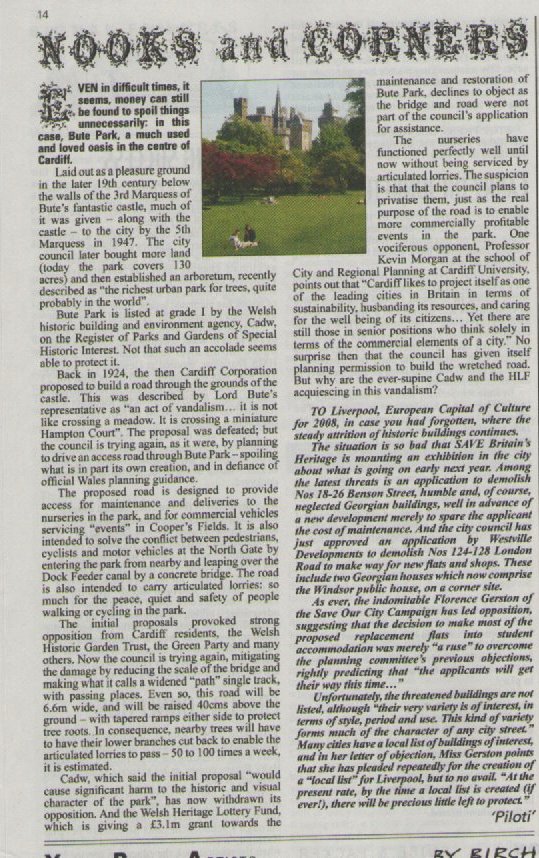

 In the Dark