Archive for Cardiff University

Cosmic Vision

Posted in Science Politics, The Universe and Stuff with tags , , , , , , , , , on February 20, 2010 by telescoper

It’s nice to have a bit of science stuff to blog about for a change. Just this week the European Space Agency (ESA) has  announced the results of its recent selection process for part of its Cosmic Visions programme, which represents ESA’s scientific activity for the period 2015-2025.

The selection process actually began in 2007, with over 50 proposals. This list was then whittled down so that there were six candidate missions under consideration for the so-called M-class launch slots (M meaning medium-sized), and three in the L-class list of larger missions. The latest exercise was to select three of the M-class missions for further study. They succeeded in selecting three, but have also kept another, much cheaper, mission in the frame.

As far as I understand it, only two M-class missions are actually envisaged so the race isn’t over yet, but the missions still in the running are:

PLATO.  The PLATO mission is planned to study planets around other stars. This would include terrestrial planets in a star’s habitable zone, so-called Earth-analogues. In addition, PLATO would probe stellar interiors by through stellar seismology. In some sense, this mission is the descendant of a previous proposal called Eddington. (PLATO stands for PLAnetary Transits and Oscillations of stars – I’ll give it 3/10 for quality of acronym).

EUCLID. Euclid would address key questions relevant to fundamental physics and cosmology, namely the nature of the mysterious dark energy and dark matter. Astronomers are now convinced that these substances dominate ordinary matter. Euclid would map the distribution of galaxies to reveal the underlying ‘dark’ architecture of the Universe. I don’t think this is meant to be an acronym, but I could be wrong. Perhaps it’s European Union Cosmologists Lost in Darkness?

SOLAR ORBITER. Disappointingly, this is neither an acronym nor a Greek person. It would take the closest look at our Sun yet possible, approaching to just 62 solar radii. It would deliver images and data that include views of the Sun’s polar regions and the solar far side when it is not visible from Earth.

These are the three main nominations, but the panel also decided to endorse another mission, SPICA, because it is much cheaper than the approximately 500 Million Euro price tag on the other contenders. SPICA would be an infrared space telescope led by the Japanese Space Agency JAXA. It would provide ‘missing-link’ infrared coverage in the region of the spectrum between that seen by the ESA-NASA Webb telescope and the ground-based ALMA telescope. SPICA would focus on the conditions for planet formation and distant young galaxies.

Many of Cardiff’s astronomers will be very happy if SPICA does end up being selected as it is the one most directly related to their interests and also their experience with Herschel which is, incidentally,  continuing to produce fantastic quality data. If SPICA is to happen, however, extra money will have to be found and that, in the current financial climate, is far from guaranteed.

Which of these missions will get selected in the end is impossible to say at this stage. There are dark mutterings going on about how realistic is the price tag that has been put on some of the contenders. Based on past experience, cost overruns on space missions are far from unlikely and when they happen they can cause a great deal of damage in budgets. Let’s hope the technical studies do their job and put realistic figures on them so the final selection will be fair.

Whatever missions fly in the end, I also hope that the Science and Technology Research Council (STFC) – or whatever replaces it – remembers that these are science missions, and its responsibility extends beyond the building of instruments to fly on them. Let’s to hope we can count on their support for research grants enabling us to answer the science questions they were designed to address.

Results and Transfer Gossip

Posted in Finance, Football, Science Politics, Uncategorized with tags , , on February 6, 2010 by telescoper

I had to skip the usual trip to the Poet’s Corner last night and go home early because the general state of fatigue I’ve been in suddenly morphed into a fever. I went home at 5, went straight to bed, and it was only Columbo’s frantic pawing that woke me up several hours later. I had not only missed a leaving party for Kate Isaak, who is now off to work for the European Space Agency, but also slept all the way through Newcastle United’s splendid 5-1 hammering of Cardiff City in last night’s Coca Cola Championship match at St James’ Park.

Despite home advantage, and the fact that Newcastle won the corresponding away fixture here in Cardiff, I thought this tie would be pretty difficult for Newcastle so I was overjoyed to see the result when I finally roused myself from feverish slumbers. It seems that Newcastle’s recent signings in the January transfer window actually came good, especially Wayne Routledge who gives the side a much-needed injection of pace down the wing. Cardiff City, on the other hand, didn’t buy any players at all because they need all the cash they’ve got to pay off an outstanding tax bill and thwart various winding-up orders that have been served on them. The turbulence behind the scenes seems to have worked its way onto the pitch: the blues are definitely the most erratic team in the division, winning 6-0 only a week or so ago and then getting thrashed 5-1 yesterday.

And just to make  my allegiances clear, I do have a soft spot for Cardiff City and do want to see them do well – except when they’re playing Newcastle. Once a Geordie, always a Geordie…

Results of a different kind were the topic of discussion around the School of Physics & Astronomy yesterday, as it was the official day for tutors to hand the results of the 1st semester exams to their tutees. It’s always great to see students leaving their tutor’s office with a big smile on their face, which happened rather a lot yesterday.  Some, of course, got more disappointing news, but to them I’d just say that it’s only half way through the year so there’s plenty of time to recover. Stick at it, and don’t let setbacks get you down.  I hope to see even more happy faces in June than I did yesterday….

Football teams like Cardiff City aren’t the only things to be enduring financial uncertainty these days, either. Even the Premiership clubs of the university sector are feeling the pinch. Many institutions around the country are planning departmental closures and redundancies, but you know it’s serious when it hits the big colleges in London. Last week University College (UCL) and Imperial both announced plans for large-scale layoffs, and this week they were joined by King’s College which plans to sack 205 academics, including 30 in the School of Physical Sciences and Engineering.

The background to all this is that the cuts announced by Lord Mandelson in December have now been officially passed on to English universities by HEFCE, but one suspects also that in some cases this is being used as a cover for other management decisions. Imperial, for example, is going ahead with the purchase of new property in Wood Lane for a cool £28 million at the same time as cutting academic positions costing a fraction of that.

Amid all the gloom, however, it is nice to be able to report some good news. Cardiff University was almost declared bankrupt in the 1980s when it failed to get to grips with the cuts imposed by Margaret Thatcher’s Conservative  government which were similar in scale to those being implemented by New Labour. It was brought back from the brink, however, and since then has managed its finances with almost excessive caution. Other universities have scored spectacular successes in the League tables by spending money freely on fancy research initiatives and overseas campuses, but in the new reality of austerity Britain these may turn out to have been risky ventures.

By contrast, “Safe and Steady” has long been the motto in Cardiff. We might not have done brilliantly in the RAE but the insitution has an extremely sound financial base that should put it in as good position as any to withstand these difficult times. Moreover, we’ve just heard that the University management has agreed that the School of Physics & Astronomy can go ahead and make  four new academic appointments, and that these will be accompanied by substantial startup packages with which the new appointees can begin to equip their own laboratories. This involves a considerable investment in the School from the University’s central coffers and I think it’s fantastic news. I doubt if many UK universities are going to be investing so heavily in physics at this time, so this is an extremely welcome development. It’s always nice to buck the trend.

The adverts will be going out pretty soon, so the transfer window is about to open.  I look forward to meeting our new signings in due course, and I’m confident that they’ll help us climb up the League.

If only I could say the same for Cardiff City…

Interesting Times

Posted in Biographical, Science Politics, The Universe and Stuff with tags , , , on December 14, 2009 by telescoper

The next few days promise to be extremely interesting, although there is more than a hint of the Chinese Curse in that statement! Today is the day of our annual departmental Christmas Lunch. That’s not itself the subject of any kind of curse, but if last year’s is anything to go by it may take several days to recover from it. I’m preparing myself for it mentality as I write.

Tomorrow, however, 15th December, is the date of the next meeting of the Council of the Science and Technology Facilities Council. On their agenda is the programme of cuts that is proposed as a result of the recent prioritisation exercises initiated to try to find a way out of their ongoing funding crisis. This programme has been through various committees before reaching the Council and, if the Council accepts it, the plans will be unveiled at a press conference on Wednesday 16th (at 2pm) and those about to die will be informed immediately. I’ll try to post a summary on here as soon as I get the facts.

I don’t have any particular inside information who is going to get the chop, but rumour suggests that there will be cuts right across the board. I think it’s going to be very grim news indeed, especially because there is an additional £600 million of savings to be found over the next few years on top of the current shortfall. It’s bound to be a terrible Christmas for those about to find out their contracts are being axed, and no happy New Years for a while either.

I’m not privy to the Council discussions or to the recommendations that have been passed to them so it’s not my place to say what they should do. However, in the unlikely event that anyone from STFC Council is reading this, I hope he/she at least bears in mind that it is not – or at least it shouldn’t be – the job of the Council simply to rubber stamp everything that is passed before it. I wonder, though, if the current Council has the guts to pass a vote of no confidence in the STFC Executive? I doubt it, because there’s been no reason to have confidence in them for the past two years and no such motion has been carried.

Ironically, later in the week there’s going to be a big jamboree in Madrid, at which the initial results of the Science Demonstration Phase of Herschel will be announced. Quite a few of the Cardiff crowd are going along and will be presenting some of the wonderful things that they’ve been working on for the past few weeks. I’ve seen quite a lot of the data from the SPIRE instrument and it’s truly amazing. At least there’s some (infrared) light among the darkness. However, it’s all covered by an ESA press embargo until Wednesday…

For Your Listening Pleasure…

Posted in The Universe and Stuff with tags , , , on November 12, 2009 by telescoper

Well, this is blogging made easy. I’ve just cut-and-pasted the following item directly from the School’s news page with very few alterations, but it’s all done for a good reason, so please read on:

A leading member of the School of Physics and Astronomy at Cardiff University, whose research helped create one of the most powerful and ambitious astronomical satellites ever made will feature in a two-part Radio 4 programme.

The Herschel Space Telescope is a two-part series to be aired on Radio 4 on Wednesday 18th November, 11:00-11:30am and Wednesday 25th November, 11:00-11:30am. BBC science reporter Jonathan Amos follows the engineers and scientists working on the SPIRE instrument for the European Space Agency’s Herschel satellite. Herschel is one of the most important missions in the history of European spaceflight and was launched successfully on May 14 this year.

The SPIRE instrument was built by an international team led by Professor Matt Griffin, School of Physics and Astronomy. The programme tells the story of the UK SPIRE team, including several members from Cardiff, as they prepared for the launch of Herschel and as the first results came in.

As well as Professor Griffin, other members of staff in the School of Physics and Astronomy who contributed to the project are also featured. They include: Professor Steve Eales, Dr Jon Davies, Dr Kate Isaak, and Dr Pete Hargrave as well as post-doctoral researchers Dr Jason Kirk, Dr Michael Pohlen, and Dr Luca Cortese.

Professor Matt Griffin

Herschel carries the biggest mirror ever sent to space and is already giving astronomers their best view yet of the Universe at far-infrared and sub-millimetre wavelengths. It can peer through obscuring clouds of dust to look at the early stages of star birth and galaxy formation; it can examine the composition and chemistry of comets and planetary atmospheres in the Solar System; and it is able to study the star-dust ejected by dying stars into interstellar space which forms the raw material for planets like the Earth.

Professor Griffin said: “With its big telescope and sophisticated and sensitive instruments, including SPIRE, Herschel is a very powerful observatory for many studies from our own solar system to the most distant galaxies. Already we can see that its results will reveal how stars like the Sun are forming in our own galaxy today, how planetary systems can develop from the dust and gas around young stars, and how the galaxies grew and evolved over cosmic time.

“Astronomers from Cardiff are at the forefront in making these exciting scientific discoveries – we are delighted that the work of Cardiff scientists will be featured in such an important radio programme.”

I should also point out that BBC Radio 4 programmes can be listened to online, and are available to download for a week after the broadcast from the BBC website (even to foreigners).

PS. I should also mention that today’s “Material World” (another Radio 4 programme) was a special edition from Cardiff University and also featured an astronomy item. If you missed it, or if you want to hear it again, you can listen to it here.


The League of Extraordinary Gibberish

Posted in Bad Statistics with tags , , , on October 13, 2009 by telescoper

After a very busy few days I thought I’d relax yesterday by catching up with a bit of reading. In last week’s Times Higher I found there was a supplement giving this year’s World University Rankings.

I don’t really approve of league tables but somehow can’t resist looking in them to see where my current employer Cardiff University lies. There we are at number 135 in the list of the top 200 Universities. That’s actually not bad for an institute that’s struggling with a Welsh funding  system that seriously disadvantages it compared to our English colleagues. We’re a long way down compared to Cambridge (2nd), UCL (4th), Imperial and Oxford (5th=) . Compared to places I’ve worked at previously we’re significantly below Nottingham (91st) but still above Queen Mary (164) and Sussex (166). Number 1 in the world is Harvard, which is apparently somewhere near Boston (the American one).

Relieved that we’re in the top 200 at all, I decided to have a look at how the tables were drawn up. I wish I hadn’t bothered because I was horrified at the methodological garbage that lies behind it. You can find a full account of the travesty here. In essence, however, the ranking is arrived at by adding six distinct indicators, weighted differently but with weights assigned for no obvious reason, each of which is arrived at by dubious means and which is highly unlikely to mean what it purports. Each indicator is magically turned into a score out of 100 before being added to all the other ones (with appropriate weighting factors).

The indicators are:

  1. Academic Peer Review. This is weighted 40% of the overall score for each institution and is obtained by asking a sample of academics (selected in a way that is not explained). This year 9386 people were involved; they were asked to name institutions they regard as the best in their field. This sample is a tiny fraction of the global academic population and it would amaze me if it were representative of anything at all!
  2. Employer Survey. The pollsters asked 3281 graduate employers for their opinions of the different universities. This was weighted 10%.
  3. Staff-Student Ratio. Counting 20%, this is supposed to be a measure of “teaching quality”! Good teaching = large numbers of staff? Not if most of them don’t teach as at many research universities. A large staff-student ratio could even mean the place is really unpopular!
  4. International Faculty. This measures the  proportion of overseas staff on the books. Apparently a large number of foreign lecturers makes for a good university and “how attractive an institution is around the world”. Or perhaps that it finds it difficult to recruit its own nationals. This one counts only 5%.
  5. International Students. Another 5% goes to the fraction of each of the student body that is from overseas.
  6. Research Excellence. This is measured solely on the basis of citations – I’ve discussed some of the issues with that before – and counts 20%. They choose to use an unreliable database called SCOPUS, run by the profiteering academic publisher Elsevier. The total number of citations is divided by the number of faculty to “give a sense of the density of research excellence” at the institution.

Well I hope by now you’ve got a sense of the density of the idiots who compiled this farrago. Even if you set aside the issue of the accuracy of the input data, there is still the issue of how on Earth anyone could have thought it was sensible to pick such silly ways of measuring what makes a good university, assigning random weights to them, and then claiming that they had achieved something useful. They probably got paid a lot for doing it too. Talk about money for old rope. I’m in the wrong business.

What gives the game away entirely is the enormous variance from indicator to another. This means that changing the weights slightly would produce a drastically different list. And who is to say that the variables should be added linearly anyway? Is a score of 100 really worth precisely twice as much as a score of 50? What do the distributions look like? How significant are the differences in score from one institute to another? And what are we actually trying to measure anyway?

Here’s an example. The University of California at Berkeley scores 100/100 for 1,2 and 4 and 86 for 5. However for Staff/Student ratio (3) it gets a lowly 25/100 and for (6) it gets only 34, which combine take it down to 39th in the table. Exclude this curiously-chosen proxy for teaching quality and Berkeley would rocket up the table.

Of course you can laugh these things off as unimportant trivia to be looked at with mild amusement over a glass of wine, but such things have increasingly found their way into the minds of managers and politicians. The fact that they are based on flawed assumptions, use a daft methodology, and produce utterly meaningless results seems to be irrelevant. Because they are based on numbers they must represent some kind of absolute truth.

There’s nothing at all wrong with collating and publishing information about schools and universities. Such facts should be available to the public. What is wrong is the manic obsession with  condensing disparate sets of conflicting data into a single number just so things can be ordered in lists that politicians can understand.

You can see the same thing going on in the national newspapers’ lists of University rankings. Each one uses a different weighting and different data and the lists are drastically different. They give different answers because nobody has even bothered to think about what the question is.

Cardiff University Christmas Lunch Special

Posted in Uncategorized with tags , , on October 7, 2009 by telescoper

The publication of Cardiff University’s new Alcohol and Drugs Policy recently circulated to staff as reported in last week’s Times Higher will require some changes to be made to forthcoming Christmas parties. In particular, we note that the new policy does not allow staff to

consume alcohol or illegal drugs while at work, except at approved functions where such consumption has been formally authorised by the Head of School / Directorate or nominee

so we regret that alcohol will no longer be served at staff Christmas lunches. However, thanks to special authorisation,  we can announce various enhancements to the menu, which will now be as follows:

Christmas Menu

—•—

Starters

—•—

Foie Grass

Garlic Magic Mushrooms

Quaalude Eggs

Thai Sticks

—•—

Main Courses

—•—

Coke au Vin

Pot au Foil

A Selection of Joints

(served with Greens, Beans and Herbs)

followed by

Cold Turkey

—•—

Desserts

—•—

Hash Brownies

Crystalmeth Pudding

—•—

Extras

—•—

Christmas Crackers (containing real Crack)

Dollies, Jellies, Candy and Ices

(with Munchies to follow)

Party Poppers

—•—

I hope the above menu proves satisfactory but if not please send your suggestions for additions through the comments box.

Da Capo

Posted in Biographical with tags , , on August 15, 2009 by telescoper

Last week was a most momentous week, a milestone in the continuing advance of my professional career. I have tasted power. Capo di Tutti Capi!

But only for three days.

Actually it wasn’t that great. All I had to do one sign one form, with the costings for a search grant for one of our physics professors. There was nothing to it. I didn’t even have to read it, and a pen was provided too.

The point is that almost everyone was away last week and, although I was off Monday and Tuesday touring with my folks, for the latter part of the week I was designated Head of School (in the absence of the actual Head, the Deputy Head, the Director of Undergraduate Studies, and the School Manager..). I’m clearly quite a long way down the line of inheritance.

One of the reasons everyone is taking their leave now is that the A-level results are due in next week and quite a few folks will have to be back for that, to deal with next academic year’s undergraduate admissions procedures. I’m not involved directly in this process but it’s very important for the School of course.

I always think the admissions system for Universities (UCAS) is very strange. If you were going to set up a system from scratch you certainly wouldn’t have made it the way it is. Universities are given quotas of students by the government (via the funding Councils) and this is passed on to each department as a recruitment target. The departments organize interviews, open days, and all the rest of the paraphernalia of admissions practice. They then make offers to selected students in terms of A-level grades. The students, for their part, do this for several universities, getting several offers, from which they accept one as their first-choice “Firm” offer and another, usually lower, as a second-choice  “Insurance”  offer. The students then wait for their A-level results to see if they get into either of their selected departments.

Although each department has a fixed target number to recruit, it is impossible to know exactly how many will make the grades that are offered. Departments generally make more offers than they have places because some will not make the grades. However, if the success rate is higher than expected (or, as the government would put it,  if educational standards continue to rise) the department has to take too many students in. If not enough students make their grades, near- misses might be accepted but generally it’s difficult to make up a shortfall at this late stage except by going into Clearing, a pool of applicants who didn’t make it into either of their two choices.

According to today’s Guardian, the government’s recent decision to put the brakes on university expansion, combined with an increased number of applicants for university places generated by the economic recession, means that many students are unlikely to get a place at all this year.

In physics nationally there has been a substantial increase in the number of applicants over the past few years, and my own department at Cardiff University is set to meet its quota quite comfortably and is unlikely to take any students from clearing. Applications are buoyant here, at least partly because Cardiff is such an interesting place to live and offers such a vibrant social scene for students. We’re also in a special position because we get many applications from prospective students inside Wales who want to remain here to study. Cardiff University is one of only three insitutions in Wales that offer physics degrees (Aberystwyth and Swansea being the other two).

We would like to be able to increase the number of students we recruit in order to finance expansion of our staff numbers, but given the freeze on funded places from the government we would have to take quota from other departments to do so. Whether the University will allow us to do this is not at all clear, although there are departments that struggle to fill their existing quotas. Whatever happens in future years, I hope there aren’t too many disappointments in store for prospective students next week when their A-level results land on their doormat.

Anyway, the fact that we’ve reached this time of year reminds me that the start of the new academic year is not far off, and the cycle of academic life is soon to start again.  Once more, from the top!

Graduandi Graduati

Posted in Biographical with tags , , , on July 15, 2009 by telescoper

Today was the day of the graduation ceremony for Cardiff  University‘s School of Physics & Astronomy, which took place in the fine surroundings of St David’s Hall. It’s a proud day for the students and their parents so, before anything else, let me offer my congratulations to all those who graduated today. Congratulations and well done to you all!

I put on my robes in the Green Room and was in the academic staff procession at the beginning and end of the ceremony. I also sat on stage during the conferment of degrees and the speech by the University’s President, Lord Kinnock. Some of the proceedings were conducted in Welsh – including the actual degree award – but it was comprehensible enough for all foreigners (even the English) to follow what was going on.

Graduation ceremonies are funny things. With all their costumes and weird traditions, they do seem a bit absurd. On the other hand, even in these modern times, we live with all kinds of  rituals and I don’t see why we shouldn’t celebrate academic achievement in this way.

Graduation is a grammatical phenomenon too. The word “graduation” is derived from the latin word gradus meaning a step, from which was eventually made the mediaeval latin verb graduare, meaning to take a degree. The past participle  of this is formed via the supine graduatus, hence the English noun “graduate” (i.e. one who has taken a degree). The word graduand, on the other hand, which is used before and during the ceremony to describe those about to graduate is from the  gerundive form graduandus meaning “to be graduated”. What really happens, therefore, is that students swap their gerundives for participles, although I suspect most participants don’t think of it in quite those terms…

The academic procession is quite colourful because staff wear the gown appropriate to their highest degree. Colours and styles vary greatly from one University to another even within the United Kingdom, and there are even more variations on show when schools contain staff who got their degrees abroad. Since I got my doctorate from the University of Sussex, which was created in the 1960s, the academic garb I have to wear on these occasions  is actually quite modern-looking. With its raised collar, red ribbons and capped shoulders it’s also more than a little bit camp. It often brings  a few comments when I’m in the procession, but I usually reply by saying I bought the outfit at Ann Summers.

Graduation of course isn’t just about education. It’s also a rite of passage on the way to adulthood and independence, so the presence of the parents at the ceremony adds another emotional dimension to the goings-on. Although everyone is rightly proud of the achievement – either their own in the case of the graduands or that of others in the case of the guests – there’s also a bit of sadness to go with the goodbyes. The new graduates were invited back to the School for a reception after this morning’s ceremony, along with parents and friends. That provided a more informal opportunity to say goodbye. Some, of course, are continuing their studies either at Cardiff or elsewhere so I’ll be seeing at least some of them again.

Although this was my first attendance at the Cardiff University graduation, I’ve been to  graduation ceremonies at several universities as a staff member. They differ in detail but largely follow the same basic format. Compared to others I’ve been at, the Cardiff version is very friendly and rather informal. For one thing, the Vice-Chancellor actually shakes hands with all the graduands as they cross the stage. At Nottingham University, for example, where I was before moving here, the V-C just sat there reading a book and occasionally nodded as they trooped across in front of him.

The venue for Cardiff’s graduation is also right in the city centre, so all day you can find students in their regalia wandering through the town (sometimes with their doting parents in tow). I like this a lot because it gives the University a much greater sense of belonging to the city than is the case when everything happens on a campus miles out of town.

The most remarkable thing  I noticed in the ceremony was not to do with Physics & Astronomy, but with Cardiff’s School of Psychology which is much larger and in which at least 90% of the graduates were female. In our School the proportions aren’t exactly reversed but are about 75% male to 25% female.

I’ve also been through two graduations on the other side of the fence, as it were. My first degree came from Cambridge so I had to participate in the even more archaic ceremony for that institution. The whole thing is done in Latin there (or was when I graduated) and involves each graduand holding a finger held out by their College’s Praelector and then kneeling down in front of the presiding dignitary, who is either the Vice-Chancellor ot the Chancellor. I can’t remember which. It’s also worth mentioning that although I did Natural Sciences (specialising in Theoretical Physics), the degree I got was Bachelor of Arts. Other than that, and the fact that the graduands walk to the Senate House from their College through the streets of Cambridge,  I don’t remember much about actual ceremony.

I was very nervous for my first graduation. The reason was that my parents had divorced some years before and my Mum had re-married. My Dad wouldn’t speak to her or her second husband. Immediately after the ceremony there was a garden party at my college, Magdalene, at which the two parts of my family occupied positions at opposite corners of the lawn and I scuttled between them trying to keep everyone happy. It was like that for the rest of the day and I have to say it was very stressful.

A few years later I got my doctorate (actually DPhil) from the University of Sussex. The ceremony in that case was in the Brighton Centre on the seafront. It was pretty much the same deal again with the warring factions, but I enjoyed the whole day a lot more that time. And I got the gown.

Post Mortem

Posted in Science Politics with tags , , , , on April 6, 2009 by telescoper

Finally the full details of the Physics panel’s deliberations during the 2008 Research Assessment Exercise have been published in the form of sub-profiles, showing the breakdown of the overall scores into various components, including the rating attached to “outputs” (i.e. papers), “environment” and “esteem”; for the jargon see the RAE guidelines for submissions.

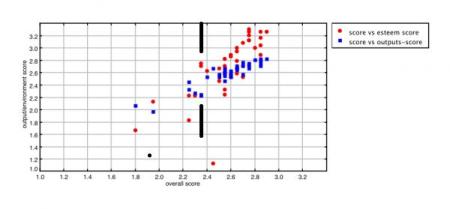
 I’ve blogged about the RAE results before: here, there, elsewhere, et cetera and passim. Andy Lawrence (e-astronomer) has now written a blog post about the latest publications from HEFCE  (commenting on the Cardiff situation with a generosity that contrasts with the offensive attitude displayed by one of my former colleagues).  Andy has also produced a graph which makes for very interesting reading:

rae_21

I’ve used my meagre graphical skills to indicate the location of Cardiff on the figure between the thick solid lines. Note the enormous gap between the panel’s assessment of our outputs (2.22) compared to the score for esteem (2.74).

I’ve mentioned before that apparently not a single one of the papers submitted by Cardiff’s excellent Astronomy Instrumentation Group was graded as 4* (world leading). Among the papers submitted by this group were several highly cited ones relating to an important Cosmic Microwave Background experiment called BOOMERANG. The panel probably judged that Cardiff hadn’t played a sufficiently prominent role in this collaboration to merit a 4*, which seems to be a completely perverse conclusion. The experiment wouldn’t have been possible at all without the Cardiff group.

Notwithstanding my disgruntlement at the particularly and peculiarly harsh assessment of Cardiff’s physics submission, there is also an indication of a more general problem. Notice how at the top right, a large number of departments has an output score seriously lagging their other score (by about 0.4 or more).

The counterexample to this trend is Loughborough, which has a very small but clearly good research activity in physics, and which scored 2.66 on its outputs but only 1.1 on environment. They are easily identified on the graph as an extreme outlier below the general trend.

Although there is no reason to expect a perfect correlation between the different elements of the overall assessment, it looks to me like the Physics panel decided to let the output score for the strong departments saturate at a level of about 2.8 whereas other panels were much more generous.

Why did they do this?

Answers on a postcard (or, better, via the comments box), please.

Physics Funding by Numbers

Posted in Science Politics with tags , , , , , on January 29, 2009 by telescoper

I just read today that HEFCE has decided on the way funds will be allocated for research following the 2008 Research Assessment Exercise. I have blogged about this previously (here, there and elsewhere), but to give you a quick reminder the exercise basically graded all research in UK universities on a scale from 4* (world-leading) to 1* (nationally recognized), producing for each department a profile giving the fraction of research in each category.

HEFCE has decided that English universities will be funded according to a formula that includes everything from 2* up to 4* but with a weighting 1:3:7.  Those graded 1* and unclassified get no funding at all. How they arrived at this formula is anyone’s guess. Personally I think it’s a bit harsh on 2* which is supposed to be internationally recognized research, but there you go.

Assuming there is also a multiplier for volume (i.e. the number of people submitted) we can now easily produce another version of the physics research league table which reveals the relative amount of money each will get. I don’t know the overall normalisation, of course.

The table shows the number of staff submitted (second column) and the overall fundability factor based on a 7:3:1 weighting of the published profile multiplied by the figure in column 2. This is like the “research power” table I showed here, only with a different and much steeper weighting (7,3,1,0) versus (4,3,2,1).

1. University of Cambridge 141.25 459.1
2. University of Oxford 140.10 392.3
3. Imperial College London 126.80 380.4
4. University College London 101.03 298.0
5. University of Manchester 82.80 227.7
6. University of Durham 69.50 205.0
7. University of Edinburgh 60.50 184.5
8. University of Nottingham 44.45 144.5
9. University of Glasgow 45.75 135.0
10. University of Warwick 51.00 130.1
11. University of Bristol 46.00 128.8
12. University of Birmingham 43.60 126.4
13. University of Southampton 45.30 120.0
14. Queen’s University Belfast 50.00 115.0
15. University of Leicester 45.00 114.8
16. University of St Andrews 32.20 104.7
17. University of Liverpool 34.60 96.9
18. University of Sheffield 31.50 92.9
19. University of Leeds 35.50 88.8
20. Lancaster University 26.40 88.4
21. Queen Mary, University of London 34.98 85.7
22. University of Exeter 28.00 77.0
23. University of Hertfordshire 28.00 72.8
24. University of York 26.00 67.6
25. Royal Holloway, University of London 27.96 67.1
26. University of Surrey 27.20 65.3
27. Cardiff University 32.30 64.6
28. University of Bath 20.20 63.6
29. University of Strathclyde 31.67 60.2
30. University of Sussex 20.00 55.0
31. Heriot-Watt University 19.50 51.7
32. Swansea University 20.75 48.8
33. Loughborough University 17.10 41.9
34. University of Central Lancashire 22.20 41.1
35. King’s College London 16.40 38.5
36. Liverpool John Moores University 16.50 35.5
37. Aberystwyth University 18.33 23.8
38. Keele University 10.00 18.0
39. Armagh Observatory 7.50 13.1
40. University of Kent 3.00 4.5
41. University of the West of Scotland 3.70 4.1
42. University of Brighton 1.00 1.8

It looks to me that the fraction of funds going to the big three at the top will probably be reduced quite significantly, although apparently there are  funds set aside to smooth over any catastrophic changes. I’d hazard a guess that things won’t change much for those in the middle.

I’ve left the Welsh and Scottish universities in the list for comparison, but there is no guarantee that HEFCW and SFC will use the same formula for Wales and Scotland as HEFCE did for England. I have no idea what is going to happen to Cardiff University’s funding at the moment.

Another bit of news worthing putting in here is that HEFCE has protected funding for STEM subjects (Science, Technology and Medicine) so that the apparently poor showing of some science subjects (especially physics) compared to, e.g., Economics will not necessarily mean that physics as a whole will suffer. How this works out in practice remains to be seen.

Apparently also the detailed breakdowns of how the final profiles were reached will go public soon. That will make for some interesting reading, although apparently everything relating to individual researchers will be shredded to prevent problems with the data protection act.