Archive for Cardiff University

Last Week of Term

Posted in Biographical, Education, The Universe and Stuff with tags , , , , , on March 26, 2012 by telescoper

So the glorious weather continues. Unfortunately, unlike most UK universities, we’re not finished for Easter yet; at Cardiff University we only get three weeks for the Easter recess instead of the four that colleagues over the border seem to enjoy.

One of the consequences of this is that the annual National Astronomy Meeting (NAM) often falls in Cardiff term time. This year NAM is taking place in the fine city of Manchester (which, for those of you unfamiliar with British geography, is in the Midlands). Many colleagues in the School of Physics & Astronomy are attending NAM, and most of my research group are either there already or travelling up today. I particularly wish Jo and Ian well when they give their talks; one of the excellent things about NAM is the opportunity it offers for younger researchers to talk about their work to a large audience. Nerve-wracking, no doubt, but invaluable experience.

I’m not going to NAM this year because I have too much to do back here at the ranch, including filling in a few lectures for staff who are away.  I’m always reluctant to cancel lectures during term-time, but in the current spell of good weather I doubt if any students would complain too much! I did a cosmology lecture this morning – only the second I’ve done here – and it the room was uncomfortably stuffy. A few of the students failed to fall asleep, however, so I regard that as a major success.

It’s strange how often good weather coincides with times of great stress for students. I recall that most of my undergraduate examinations took place in glorious sunshine, which seemed to have been laid on by some malevolent being to make us suffer. This week our students have project reports and presentations to worry about and other coursework to finish before term ends, as well as revision for the exams that take place in May; being couped up inside is no fun on days like this and I’m sure they’d prefer it to be raining outside so as not to distract them from the tasks in hand…

It’s so quiet around here today that it occurred to me now would be a good time to stage a Coup d’Etat. Come to thank of it, there’s a Staff Meeting  been called on Wednesday which may well amount to something pretty similar…

Anyway, those of us around today have a nice event this evening to look forward to, a lecture by Lord Rees followed by a nice dinner in Aberdare Hall. Here’s the invitation:
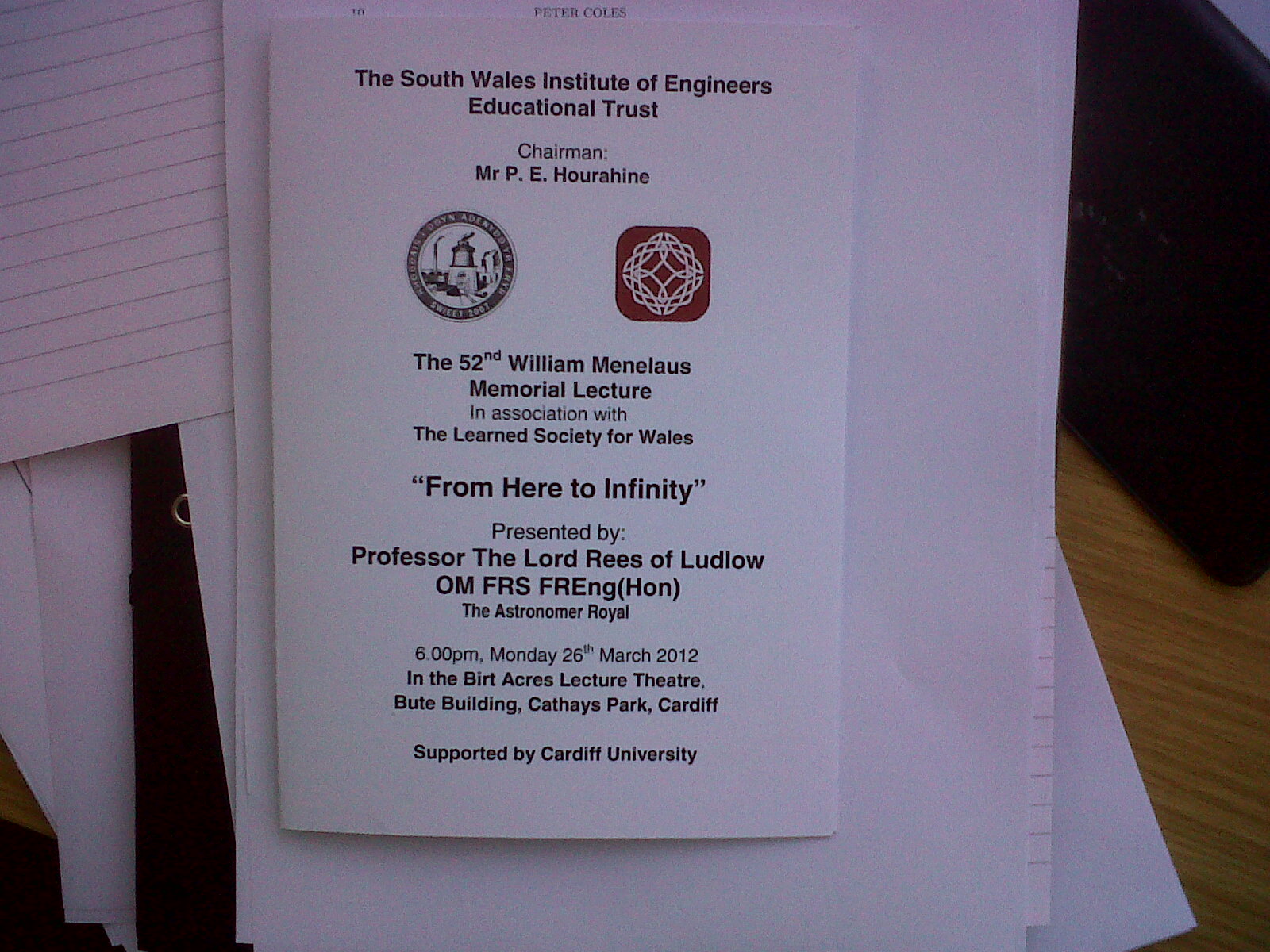
You’ll see that this is organized “in association with The Learned Society for Wales“, which I only just learned about when I saw it on the invitation!

Anyway, the prospect of a slap-up dinner persuaded me to just have a sandwich for lunch. Now that’s eaten methinks I’ll get back to work!

UPDATE: It was indeed a very interesting and entertaining lecture by Lord Rees; here he is, in action, watched by Prof. Disney…


Sêr Cymru

Posted in Science Politics with tags , , , on March 24, 2012 by telescoper

The Welsh Government’s vision for a world-leading science base in Wales was unveiled on Thursday 15 March during a keynote address by Wales’ Chief Scientific Officer, Professor John Harries, who delivered a public lecture at Cardiff University to reveal how he thinks this strategic agenda can steer Welsh science and engineering into the future.

Here is the lecture in its entirety

One the principal components this strategy is the Sêr Cymru (“Star Wales”) project which will involve expenditure of about £50 million over 5 years to attract research leaders to Wales. This announcement attracted quite a lot of local news coverage, e.g in the Western Mail, but it isn’t exactly a new proposal. In fact I blogged about it several months ago. Here is a summary of the points I made back then together with some new comments.

The basic point is that Welsh universities currently only attract about 3% of the UK’s total research funding whereas the famous Barnett formula allocates Wales about 5% of the total in other areas of public expenditure. Nobody involved in research would argue for funds to be allocated on any other basis than through quality, so there’s no clamour for having research funding allocated formulaically a là Barnett; the only way to improve the success rate is to improve the quality of applications. John Harries suggests that means poaching groups from elsewhere who’ve already got a big portfolio of research grants…

The problem with that strategy is that it’s not very easy to persuade such people to leave their current institutions, especially if they’ve already spend years acquiring the funding needed to equip their laboratories. It’s not just a question of moving people, which is relatively easy, but can involve trying to replace lots of expensive and delicate equipment. The financial inducements needed to fund the relocation of a major research group and fight off counter-offers from its present host are likely to be so expensive that the benefit gained from doing this takes years to accrue, even they are successful.

I agree with Prof. Harries that Welsh universities need to raise their game in research, but I don’t think this “transfer market” approach is likely to provide a solution on its own. I think Wales needs a radical restructuring of research, especially in science, across the whole sector, which I think is unacceptably complacent about the challenges ahead.

For a start, much more needs to be done to identify and nurture younger researchers, i.e. future research stars rather than present ones. Most football clubs nowadays have an “academy” dedicated to the development of promising youngsters, so why can’t we do a similar thing for research in Wales? Research groups in different Welsh universities also need to develop closer collaborations, and perhaps even full mergers, in order to compete with larger English institutions.

More controversially, I’d say that the problem is not being helped by Welsh universities continuing to be burdened by the monstrous bureaucracy and bizarre practices of the Research Excellent Framework, which allocates “QR” research funds according to priorities set by HEFCE in a way that reflects the thinking of the Westminster parliament. The distribution of QR funding in Wales, which is meant to supplement competitive grant income from UK funding bodies, should be decided by HEFCW in line with Welsh strategic priorities. Wales would be far better off withdrawing from the REF and doing its own thing under the auspices of the Welsh Assembly Government.

In fact there are dark rumours circulating that HEFCW will not have enough money to pay any QR funding anyway. If that’s true then the widening funding gap between Wales and England will do more damage than can possibly be remedied by importing a few big shots from elsewhere. The sum involved (£50 million) seems like a lot, but it won’t pay for more than a few groups around Wales if they are in experimental science or engineering technology, because the cost of setting up new labs and acquiring new equipment is considerable. Although buying in mercenaries might be of short-term benefit, what are the chances that they’ll take someone else’s dollar in the near future?

Wales needs a sustainable research base, so at very least I’d like to see a bottom-up project, encouraging younger researchers at PhD and PDRA level, perhaps through a system of national fellowships, to complement the “top-down” of the Star Wales project. Unless that happens, we might have leaders with no-one to follow them.

Planck Exclusive!

Posted in The Universe and Stuff with tags , , , , on January 25, 2012 by telescoper

I forgot to mention on this blog some important news about the Planck mission which many people here in the School of Physics & Astronomy at Cardiff University are heavily involved in.

Here is the official announcement from The Planck Science Team home page:

The High Frequency Instrument (HFI) on ESA’s Planck mission has completed its survey of the remnant light from the Big Bang. The sensor ran out of coolant on January 14 2012 as expected, ending its ability to detect this faint energy. Planck was launched in May 2009, and the minimum requirement for success was for the spacecraft to complete two whole surveys of the sky. In the end, Planck worked perfectly for 30 months, about twice the span originally required, and completed five full-sky surveys with both instruments. Able to work at slightly higher temperatures than HFI, the Low Frequency Instrument (LFI) will continue surveying the sky for a large part of 2012, providing even more data to improve the Planck final results.

For more details, see here. Basically, the HFI instrument consists of bolometers contained in a cryogenic system to keep them cool and thus suppress thermal noise in order to enable them to detect the very weak signals coming from the cosmic microwave background radiation. The helium required to maintain the low temperature is gradually lost as Planck operates, and has now run out. The HFI bolometers consequently warmed up, which makes them useless for cosmological work, so the instrument has been switched off. I’m sure you all understand how uncomfortable it is when your bolometers get too hot…

You can find a host of public information about Planck here but the scientific work is under strict embargo until early next year. However, as a Telescoper exclusive I am able to offer you a sneak preview of the top secret Planck data well in advance of official release. If you want to see what Planck scientists have been looking at for the last couple of years, just click here.

Serious Brain Power – a reminder!

Posted in Uncategorized with tags on January 22, 2012 by telescoper

I’ve posted already about this initiative, but there’s no harm doing a bit of re-advertising on behalf of Cardiff University’s new recruitment campaign which has the slogan Serious Brain Power.  A major initiative is under way to attract high quality researchers to Cardff (either at Chair level for established academics or at the level of a Fellowship for those earlier in their careers)  across a range of academic disciplines, including STEM subjects.

In the School of Physics & Astronomy we’ve already appointed four new lecturers in Physics over the last year, and will also be joined by a new Professor of Experimental Physics next year, all independently of this scheme, but it would be great if we could attract even more excellent new people into the School via the new initiative; for an advert see here.

At fellowship level the positions  provide a greater degree of independence than a normal postdoctoral research assistantship, including the possibility to direct one’s own research programme. The number of  similar positions funded by research councils  is  dwindling owing to cutbacks in the research council budgets, making such a post a particularly valuable and attractive proposition.

Although this is a personal blog, and therefore not officially part of the recruitment campaign, it occurred to me that readers of this blog might well be interested in these opportunities, hence the reason for posting this message. Applicants for astronomy and cosmology would be welcomed,  by me at any rate! It’s a rare opportunity to join a Physics department that’s actually growing in size…

To find out more about the Fellowships and Chairs, see here. Feel free to contact me informally if you have any questions, and  please also feel free to pass this on to anyone you think might be interested!

Away to Swansea

Posted in The Universe and Stuff with tags , , , , on January 11, 2012 by telescoper

Just time for a quick post this evening, primarily to make a note of an enjoyable event that took place this afternoon. I long since gave up keeping a proper journal so the old blog will have to play that role.

Today a small group of cosmologists from the School of Physics & Astronomy at Cardiff University made the short trip to Swansea to meet with members of the Physics department there. The idea of the meeting was to explore the possibilites of future research collaboration. For historical reasons there is a pretty strong separation in Wales between research in Particle Physics and Astronomy/Astrophysics; Swansea does the former and Cardiff does the latter. However, cosmology is an area in which there are possible overlaps between some of the – primarily theoretical – research going on at Swansea into, e.g., Quantum Gravity and what we do in Cardiff, e.g. inflationary cosmology.

Anyway we decided to get together for an afternoon of talks by members of both departments to see if anything emerged as potential research topics. In fact, a couple of interesting ideas were discussed and although the main focus of research differs substantially in the two institutions we’re definitely going to get together again to follow up these ideas.

Although I’ve been in Cardiff since 2007, I’d never visited Swansea University before which, considering that it’s only an hour away by train, is admittedly a bit pathetic. In fact I think it’s quite weird the two departments don’t collaborate more in other areas too. I’m certainly very keen to see more joint activities than we have now, so hopefully this is a move in that direction.

Anyway, I’d like to thank Graham Shore at Swansea for hosting us this afternoon and I very much look forward to the planned return leg which will be held in Cardiff in a couple of months.

Serious Brain Power

Posted in Uncategorized with tags on October 28, 2011 by telescoper

I can’t resist doing a bit of advertising on behalf of Cardiff University’s new recruitment campaign which has the slogan Serious Brain Power.  A major initiative is under way to attract high quality researchers to Cardff (either at Chair level for established academics or at the level of a Fellowship for those earlier in their careers)  across a range of academic disciplines, including STEM subjects.

In the School of Physics & Astronomy we’ve already appointed four new lecturers in Physics over the last year, and will also be joined by a new Professor of Experimental Physics next year, all independently of this scheme, but it would be great if we could attract even more excellent new people into the School via the new initiative; for an advert see here.

At fellowship level the positions  provide a greater degree of independence than a normal postdoctoral research assistantship, including the possibility to direct one’s own research programme. The number of  similar positions funded by research councils  is  dwindling owing to cutbacks in the research council budgets, making such a post a particularly valuable and attractive proposition.

Although this is a personal blog, and therefore not officially part of the recruitment campaign, it occurred to me that readers of this blog might well be interested in these opportunities, hence the reason for posting this message. Applicants for astronomy and cosmology would be welcomed,  by me at any rate! It’s a rare opportunity to join a Physics department that’s actually growing in size…

To find out more about the Fellowships and Chairs, see here. Feel free to contact me informally if you have any questions, and  please also feel free to pass this on to anyone you think might be interested!

A Big Idea

Posted in The Universe and Stuff with tags , , , on October 25, 2011 by telescoper

I thought I’d share this, part of the Big Ideas series produced by Cardiff University, because it features our own Haley Gomez:

In the video Haley explains how enormous quantities of dust have been found by astronomers in the School of Physics & Astronomy. We just can’t get the cleaning staff, you see. In fact more recently there have also been discoveries of damp, mould, crumbling ceilings and broken windows.

I don’t want to steal Haley’s thunder in any way, but I should mention that an even more startling discovery has recently been made elsewhere in the School of Physics & Astronomy at Cardiff University. In my office, in fact.  Not  dust, but anti-dust!

Reflective Practice

Posted in Education with tags , , on September 9, 2011 by telescoper

I’ve just taken a short break from reading grant applications and filling in forms to read through the stack of teaching questionnaires that arrived yesterday, along with a complicated statistical analysis which I won’t even try to explain – because I  don’t understand it.

These questionnaires are handed out during a lecture, filled in by the students (anonymously), and then sent off to be analysed by a team of elves.  Doing this during a lecture ensures a reasonable rate of return; in my case about 2/3 of the students returned completed questionnaires. The results are condensed into a “Figure of Merit” (FOM) using a mystic formula of some sort. If my FOM turned out badly I would probably try to work out what it means, but since it’s quite good I’ll just assume the algorithm is excellent.

Questions on the questionnaire are divided into questions about the module (we don’t have courses, we have modules),  e.g. is it easy, hard, interesting etc, and questions about the lecturer(s), e.g. was he/she audible, legible. Generally speaking, students seemed to enjoy this particular first-year module, Astrophysical Concepts, but also thought it was difficult. In fact it’s a generic outcome of this sort of analysis that modules that are considered to be easy don’t get the best student feedback – they don’t seem to  mind so much if the material is difficult, as long as it is interesting. I think that’s where astrophysics is a lot easier to score well than, say, solid state physics.

The only thing I was disappointed with was the score for the responses to the prompt “The lecturer wrote helpful comments on the marked homework“. In fact, I didn’t write anything at all on the marked homework because I didn’t mark it – that’s usually done by PhD students,  according to a mark scheme I provide. Nevertheless, I do post full worked solutions (on a system called Learning Central) along with the mark scheme after  the scripts have been returned to students so they can easily find out where they went wrong and how they lost marks. I though that, supplemented by the comments written by the markers on the scripts,  would be sufficient feedback. Obviously not. Heigh-ho.

More interesting than the statistical analysis (to me) are the individual comments written on the reverse of the questionnaire. Most don’t write anything at all here, but there’s an opportunity to massage one’s ego by reading things like “Best lecturer this term by a long, long way”. Actually, come to think of it, that was the only one that said that.

Occasionally, however, one comes across a disgruntled response. An example was

I think the homeworks should be on Blackboard. They never are. If you misplace a homework you can never get another!

Sigh. Actually, all the homeworks were put on Blackboard (the older name for Learning Central) at the same time that I handed them out. As a matter of fact, they’re all still there…along with the solutions in a folder marked Assignments.

Anyway, Astrophysical Concepts was fun to teach and popular with the students, so obviously it had to go. It’s now been discontinued and replaced in the first year by a module about Planets. But I think some of it will make a return in a new problem-solving class for 2nd year students…

PS. In case you’re not up with the jargon, “reflective practice” is “the capacity to reflect on action so as to engage in a process of continuous learning” and is “one of the defining characteristics of professional practice” that involves “paying critical attention to the practical values and theories which inform everyday actions, by examining practice reflectively and reflexively. This leads to developmental insight.”

In other words, thinking about the stuff you do in order to do it better.

A Healthy Increase

Posted in Education with tags , , , on August 25, 2011 by telescoper

Up early again this morning, I thought I’d do a quick post because I just remembered that there’s a bit of a loose end I’ve left dangling for a week or so owing to my recent indisposition.

I posted about 10 days ago about my week as “responsible person” for the School of Physics & Astronomy at Cardiff University owing to the absence of all the really responsible people on their respective vacations. By sheer coincidence my week in charge spanned the day that A-level results were announced and therefore the period during which we finalised this year’s UCAS admissions process. I had thought this might be quite a stressful time because rather late in the day we were given a significant increase in funded student numbers by the Higher Education Funding Council for Wales (HEFCW) which made it necessary for us to enter the clearing system to find the extra students.

As it turned out however the prospective students to whom we’d made offers paid back our confidence in them and a large fraction got the necessary grades. We did go into clearing, but only briefly, to pick up a relatively small number of unattached applicants who matched our criteria. I’m happy to report, therefore, that we’ve got a very healthy intake of 120 students this year, up by about 30 on last year. That’s exactly the increase we had planned for and we can cope with it without making drastic changes, such as increasing the size of tutorial groups, that would remove the personal touch that makes this such a pleasant School to work and, I hope, study in.

The hard work done all year round by admissions teams in University departments tends to be drastically undervalued, so I’d like to take this opportunity to thank Carole Tucker for doing such a great job for the School of Physics & Astronomy, ably supported by Nicola Hunt. Where we’d be without them I don’t know.

Modesty forbids me, of course, from pointing out who was acting Head of School while this all came to fruition, and who therefore really deserves the credit….

Stellar Research?

Posted in Education, Science Politics with tags , , , , on August 24, 2011 by telescoper

I heard today that  Chief Scientific Advisor to the Welsh Government, John Harries, has called for Welsh universities to be more “predatory” in attracting “star researchers” to Wales. At first sight I thought that sounded like good news for astronomy, but reading the article more closely I realise that’s not what he meant!

The point is that, according to the BBC article,  Welsh universities currently only attract about 3% of the UK’s research funding whereas the famous Barnett formula allocates Wales about 5% of the total in other areas of expenditure.  Nobody involved in research  would argue for funds to be allocated on any other basis than through quality, so there’s no clamour for having research funding allocated formulaically a là Barnett; the only way to improve the success rate is to improve the quality of applications. John Harries suggests that means poaching groups from elsewhere who’ve already got a big portfolio of research grants…

The problem with that strategy is that it’s not very easy to persuade such people to leave their current institutions, especially if they’ve already spend years acquiring the funding needed to equip their laboratories. It’s not just a question of moving people, which is relatively easy, but can involve trying to replace lots of expensive and delicate equipment. The  financial inducements needed to fund the relocation of a major research group and fight off counter-offers from its present host are likely to be so expensive that the benefit gained from doing this takes years to accrue, even they are successful.

I agree with Prof. Harries that Welsh universities need to raise their game in research, but I don’t think this “transfer market” approach is likely to provide a solution on its own. I think Wales needs a radical restructuring of research, especially in science, across the whole sector, which I think is unacceptably complacent about the challenges ahead.

For a start, much more needs to be done to identify and nurture  younger researchers, i.e. future research stars  rather than present ones.  Most football clubs nowadays have an “academy” dedicated to the development of promising youngsters, so why can’t we do a similar thing for research? Research groups in different Welsh universities also need to develop closer collaborations, and perhaps even full mergers, in order to compete with larger English institutions.

More controversially I’d say that the problem is not being helped by Welsh universities continuing to be burdened by the monstrous bureaucracy and bizarre practices of the Research Excellent Framework, which allocates “QR” research funds according to priorities set by HEFCE in a way that reflects the thinking of the Westminster parliament. The distribution of QR funding in Wales, which is meant to supplement competitive grant income from UK  funding bodies, should be decided by HEFCW in line with Welsh strategic priorities. Wales would be far better off withdrawing from the REF and doing its own thing under the auspices of the Welsh Assembly Government.

What I’m saying is that I’ve got nothing against Welsh universities trying to entice prominent research leaders here;  we’ve recently tried (unsuccessfully) to do it here in the School of Physics & Astronomy at Cardiff University, in fact. But in the current funding climate it’s not easy to persuade their current institutions to let them go. In any case,  I don’t think parachuting in a few high-profile individuals will in itself solve the deep-rooted problems of the Welsh university system. A longer term strategy needs to be found.

Scotland already punches above its weight in terms of research income for its universities and there’s no reason why, in the long run, Wales can’t do likewise.