I can’t think of a more appropriate form of official celebration for the Queen’s Diamond Jubilee than a show by the Lady Boys of Bangkok…

I can’t think of a more appropriate form of official celebration for the Queen’s Diamond Jubilee than a show by the Lady Boys of Bangkok…
Yesterday evening as I walked home through Bute Park I thought I’d take a few pictures with my phone to remind myself at a future date what beautiful weather we’re having and how splendid the trees and flowers are looking. It’s great to see so many people enjoying this beautiful park these days; fortunately the Council seems to have suspended the regular traffic of heavy vehicles along the paths, at least for the time being.
Unfortunately at around the time I took these pictures, something much less pleasant was happening a few hundred yards away near Cardiff Station. I’ve no idea what went on, but thankfully it looks like nobody received life-threatening injuries…
Anyway, neither Cherry nor May Blossom lasts very long – the Magnolias are already dropping their flowers – so let’s make the most of them while we can!

Cardiff Castle behind the trees


Even the Weeping Willow looks happy...although it's a bit of a concern that the water level in the Taff is so low...
Now here’s a question. Is it just me, or is the May Blossom appearing earlier nowadays than it used to? It’s definitely out now and it’s not even April yet…
Follow @telescoperI was walking into work yesterday morning, quietly minding my own business, but when I turned arrived at Queen Street I was suddenly confronted by a scary-looking armoured vehicle.
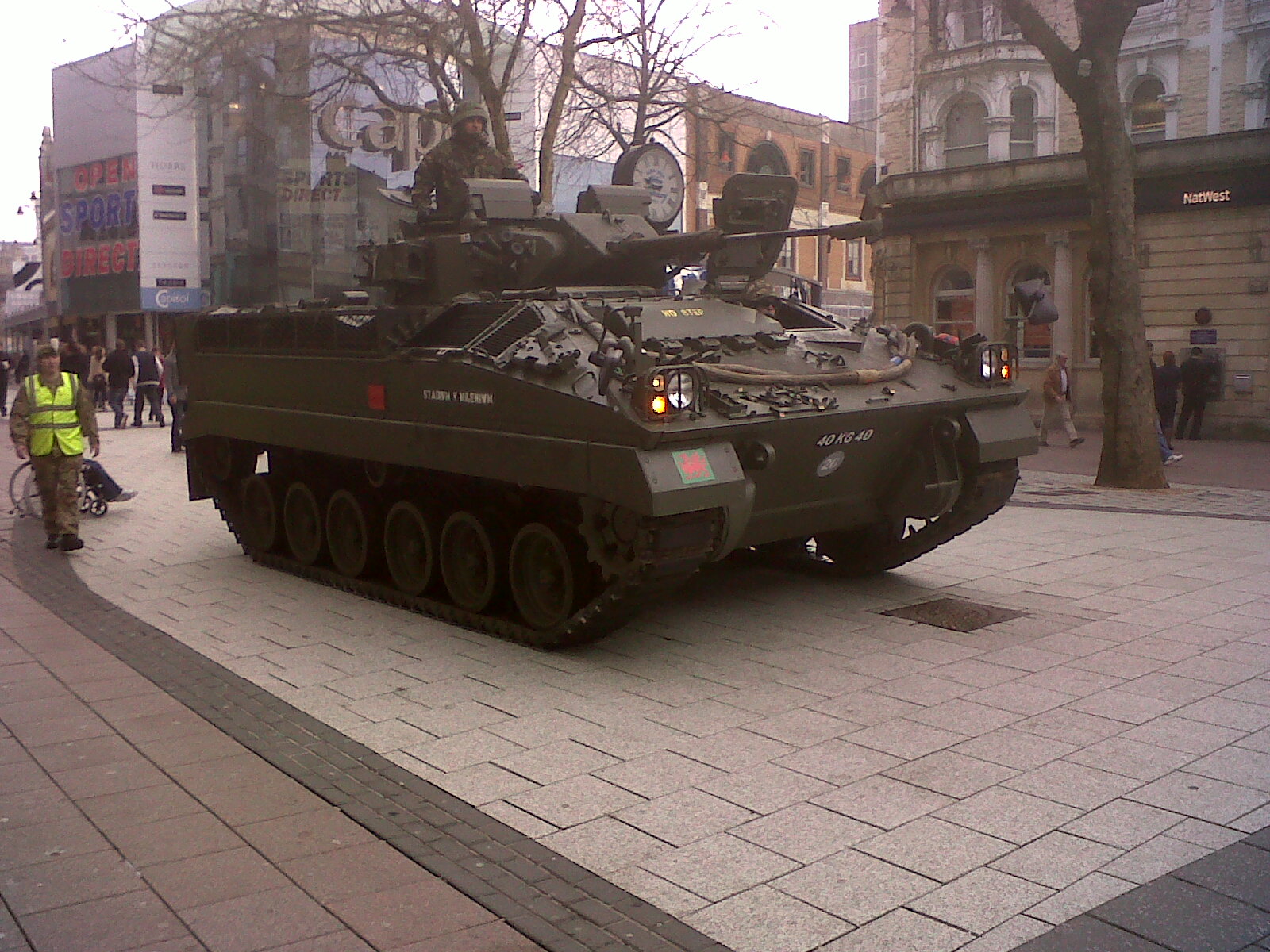
I’m not really up on this sort of thing, though there’s no doubt someone out there in internetshire who can tell me not only what kind of tank it is but what regiment it belongs to. Anyway, once I realised it wasn’t aiming its gun at me, I calmed down and figured it was probably taking part in some sort of display somewhere in Cardiff rather than heading towards the Senedd to participate in an imminent Coup D’Etat.
Tanks make me uncomfortable. A worse example than this happened when I used to live in Nottingham. Returning by train from somewhere or other I missed the connection at Derby and was stuck there late at night for the best part of an hour waiting for the next train home. As I sat there waiting there was a rumbling in the distance, and locomotive approached very slowly along the track pulling what must have been dozens of tanks perched on flat railway trucks. It was quite an impressive sight, but also a bit alarming. Where were they going? What were they up to? Is it really so unthinkable that one day vehicles like this will be used against civilians, as they have been in, say, the Middle East?
Although the thought of violent repression bothers me a little, it’s not the main reason why tanks make me nervous. Years ago – and I mean 20+ years ago – I was a long-term visitor in Copenhagen and during the course of my stay there was invited to a party in Christiania, a self-proclaimed autonomous region of the city. Things have probably changed a lot since then, but in those days it was quite a wild place and the drug-fuelled party I went to was definitely on the far side of out. Unbeknownst to me, someone spiked my drink with some sort of psychedelic substance (probably acid) and the subsequent trip was one of the worst experiences of my life. Terrified by grotesque hallucinations, I ran out of the house and was confronted in the street by dozens of (imaginary) tanks.
I woke up the next day under a bench in a public park, with no idea of where I was or how I’d got there. Presumably I had thought that the hiding place was so good that the tanks wouldn’t find me. Maybe one day they will…
Follow @telescoperJust time for a quick post while I eat my breakfast this morning about last night’s Scott Centenary Concert at St David’s Hall Cardiff. The concert was given by the City of London Sinfonia (conducted by Stephen Layton) and last night’s performance was actually the third date in a tour which takes them next to Cheltenham and then to the Cadogan Hall in London. I mentioned this concert in a post last week.
The main music for the evening was written by Vaughan Williams. The concert started with excerpts from his score for the 1948 film Scott of the Antarctic, interspersed with dramatic readings from Scott’s own diaries and letters, by actor Hugh Bonneville. Apparently Vaughan Williams found the subject matter of the film so compelling that he wrote a huge amount of music, most of it before even seeing the screenplay, and only a small part was actually used in the movie soundtrack. He later re-worked much of this material into a full symphony, The Sinfonia Antarctica, his 7th, which was performed in full after the interval. Musically speaking, therefore, the opening piece was really a taster for the full work, but the readings were deeply moving.
Scott kept full diaries all the way from the beginning to the end of the expedition so they describe the journey in remarkable detail, and with no little poignancy. The initial optimism gradually tempered turned to crushing disappointment when they discovered that Amundsen had beaten them to the South Pole. When they turned home to try to reach safety before the Antarctic winter closed in around them, Scott’s diary asks for the first time “I wonder if we’ll make it.” Passages describing the awful death of Petty Officer Evans and Captain Oates’ noble sell-sacrifice were included, and the last terrible days when, without food or fuel, the three remaining companions were entombed in their tent by a raging blizzard, were depicted by Scott’s increasingly fragmentary and heartbreaking notes. One can’t really imagine the depth of their suffering, of course, but the desolation of their last hours is obvious. Their bodies were not found until 8 months later.
Before the interval we heard a new commission, Seventy Degrees Below Zero, by Cecilia McDowell, featuring tenor Robert Murray. This was an orchestral setting of various parts of the scientific record of Scott’s Last Expedition. I have to say I didn’t really like the piece: the vocal lines lacked interest and the orchestral music lacked any real sense of variation or development. Robert Murray struggled to project, his rather thin tenor voice not really suited to the music.
After the interval we had a complete performance of the Sinfonia Antarctica. Although I enjoyed it very much, I’m still not sure how well this hangs together as a symphony. There’s no doubt, however, that it contains a number of strokes of genius. The opening theme, heard at various points later on in the piece, manages to conjure up the Antarctic landscape – not only the snow and ice but also its singular desert-like aridity – as well as a deep sense of tragedy. The second movement featuring soprano Katherine Watson and women’s voices from the Bath Camerata and Wells Cathedral School Chamber Choir in wordless singing produced a wonderful unearthly atmosphere. Later on, there’s a passage featuring an organ which gave me the chance to hear he magnificent organ at St David’s Hall for the first time.
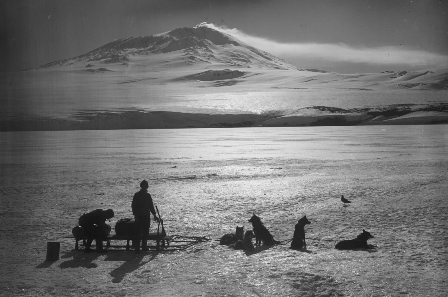
Projected above the orchestra throughout the performance were still photographs actually taken during the expedition. Some of these – like the one shown above – were stunning, but after a while I found them a bit of a distraction from the music.
Overall, an interesting concert rather than a brilliant one, which was well received by the (relatively small) audience at St David’s.
Follow @telescoperA very busy week for me ended with a very busy Friday including a postgraduate induction event followed by our annual postgaduate conference. It was actually a very enjoyable day with some really excellent talks by research students about their ongoing projects, but by the end of the afternoon I was definitely flagging.
Fortunately I’d planned a reward at the end of this week in the form of a concert at St David’s Hall, Cardiff, by the BBC National Orchestra of Wales and the BBC National Chorus of Wales with conductor Thierry Fischer. I bought a group of tickets for myself and some colleagues from work, hoping that it would prove an uplifting experience. We weren’t disappointed.
Before the interval (of which more anon) we heard On the Transmigration of Souls by John Adams. Written as a response to the events of September 11th 2001, this is an unusual composition involving orchestra, chorus, children’s choir, and pre-recorded tape. Opinions about this piece are generally pretty divided and that also proved to be the case with the half-a-dozen of us who attended last night. All thought the orchestral music was very good indeed, but some found the recorded bits intrusive and the text, which includes phrases from missing-persons posters and memorials posted around Ground Zero to be a mixture of the banal and the mawkish. I wasn’t as negative about these aspects as some seem to have been, but at the same time I didn’t feel the pre-recorded segments actually added very much and they did sometimes make it difficult to hear the subtle textures in the orchestra. And as for the text being “banal”, that seems to me to be entirely the point. It’s the everdayness of loss that makes grief so overwhelming.
Anyway, I thought it was a fascinating piece and it’s definitely the first time I’ve seen the violin section of an orchestra come on stage with two violins each. Some passages call for altered tunings, so they swapped instruments regularly throughout the performance. The orchestra played wonderfully well, I should say, and the performance was warmly received by the audience.
Then came the interval, during which the fire alarm went off and we had to evacuate the concert hall. Fortunately it was a sultry evening – we’re in the midst of an early autumn heatwave here – and it wasn’t at all unpleasant to get a bit of fresh air while they figured out what had caused the alarm.
When we got back in it became obvious that quite a few people had left, possibly because they thought the performance wouldn’t resume. Those that didn’t return missed an absolute treat.
I’m not even going to attempt a description of Beethoven’s “Choral” Symphony No. 9 in D Minor. Suffice to say that it’s one of the pinnacles of human achievement, made all the more remarkable by the fact that Beethoven was profoundly deaf when it was written. It’s a masterpiece of such dimensions that words are completely unnecessary to describe it, even if one could find words that were appropriate in the first place. Moreover, I think it’s a piece you really have to hear live for it to really live. Our seats were almost at the front of the stalls, very near the stage and close enough for me to to be able to feel the fortissimo passages through the soles of my feet. Perhaps that’s the only way Beethoven himself ever heard this piece?
And as for last night’s performance, what can I say? The first, Allegro, movement, an entire symphony in itself, found the orchestra at the very peak of its collective prowess. Their playing was passionate and vivid, yet tightly disciplined and the orchestra seemed to be pervaded by a sense that it was an absolute privilege to be playing an undisputed masterpiece. I was so carried away that at the end of that movement an involuntary tear fell from my eye.
I’ll just add one other observation about this piece, concerning the final movement, based around Beethoven’s setting of parts of Schiller’s poem Ode to Joy to which Beethoven himself added some material. This is so famous that I suspect it’s the only part of the symphony that many people have heard. Hearing it in the context of the entire work, however, makes it all the more dramatic and inspirational. It’s not just that you have to wait so long for the choir (who have been sitting patiently behind the orchestra for three movements) to let rip, but also that you’ve experienced so much wonderful music by the time you get there that the final is virtually guaranteed to leave you completely overwhelmed.
Sincerest thanks to Thierry Fischer and the BBC National Orchestra and Chorus of Wales for an absolutely unforgettable experience. Uplifting? Not half!
P.S. The performance was recorded for broadcast by BBC Radio 3 on October 3rd 2011 in Afternoon on 3 and will presumably be on iPlayer for a week after that. Do listen to it if you get the chance. Even if only a small fraction of the atmosphere inside St David’s Hall makes its way into the airwaves then it will still be worth a listen..
Follow @telescoperI promised yesterday to post a quick account of the Fifth (and final) One Day International between England and India at the SWALEC stadium in Sophia Gardens, Cardiff, so here goes…
As I feared, the weather in Cardiff yesterday wasn’t brilliant and, although it was quite warm during the morning, it was overcast and there were stacks of very dark clouds around by lunchtime. We got to the ground in time for the scheduled start, which was 2pm, but just as play was about to get under way the heavens opened and down came the rain.
This was the scene about five to two, just as the covers were being taken off; they dark clouds to the left were moving from left to right and covered the ground a few minutes later whereupon it stotted down.
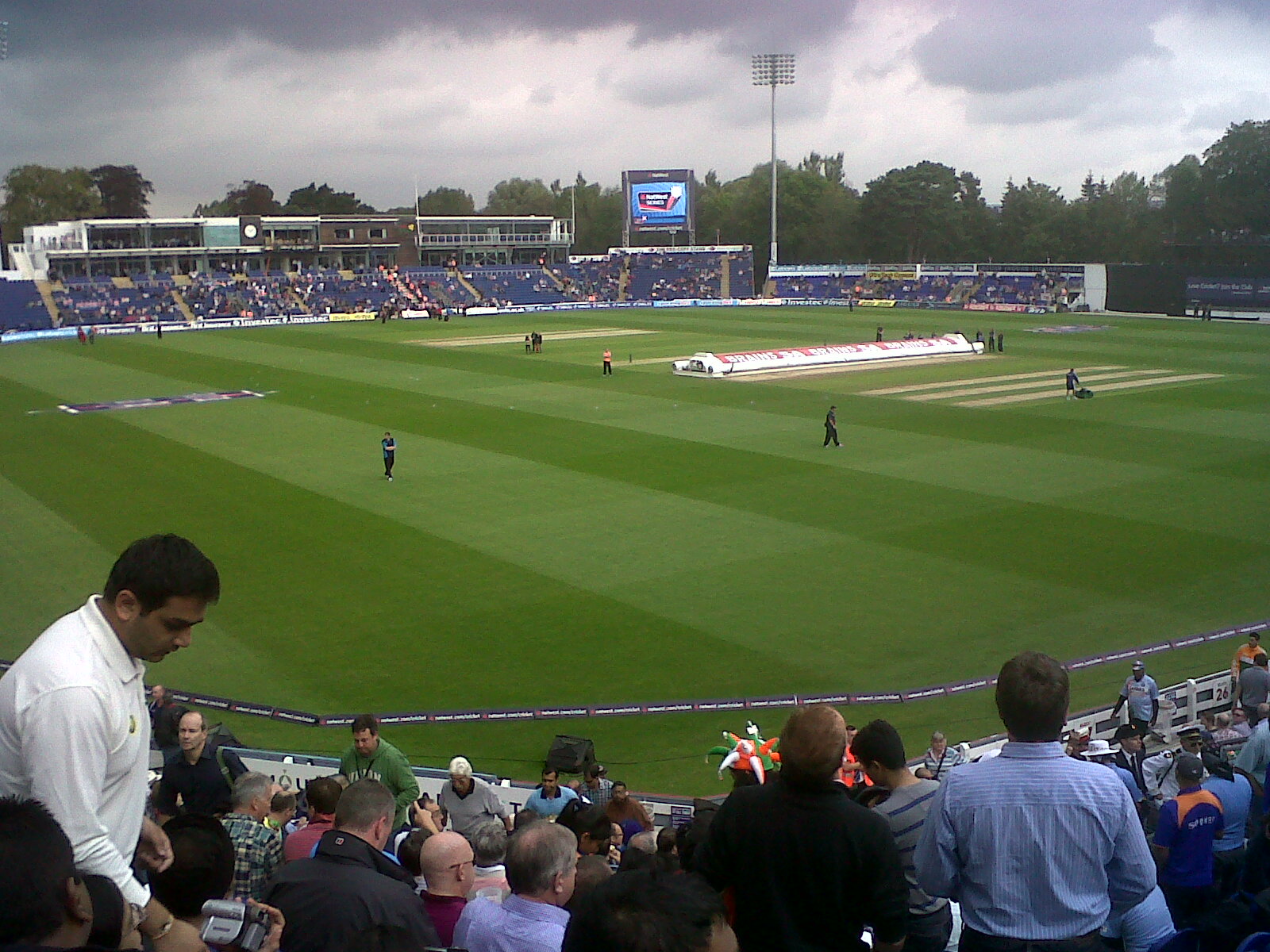
Fortunately, although it came down in stair-rods for a while, the rain didn’t last long so play actually got under way about 2.40 and the authorities decided that the game would remain 50 overs a side (with a late finish).
England won the toss and decided to field. Openers Parthiv Patel and Ajinkya Rahane got the Indian innings off to a good start with a partnership of 52 runs, then Rahane was removed by Jade Dernbach when the batsman, after scoring just 26 runs off 47 deliveries, was caught by Steven Finn at third man, right down in front of us. In the 16th over, Patel also fell, for 9 runs off 39 deliveries, when he was caught by Tim Bresnan at mid-on off the bowling of spinner Graeme Swann. Rahul Dravid (playing his last ODI) and Virat Kohli then played a wonderful partnership which was not broken until the last delivery of the 42nd over. England finally managed to grab the wicket of Dravid who left the field to a standing ovation after scoring 69 runs. The Dravid/ Kohli partnership had brought 170 runs; by the time Dravid’s wicket fell, India were on 227-3. Meanwhile, Kholi had managed to score his sixth one-day hundred but he was out for 107 in the 44th over when he was given out hit-wicket while trying to play a delivery by Swann; his back foot had apparently slipped and struck the stumps, dislodging a bail. Unlucky.
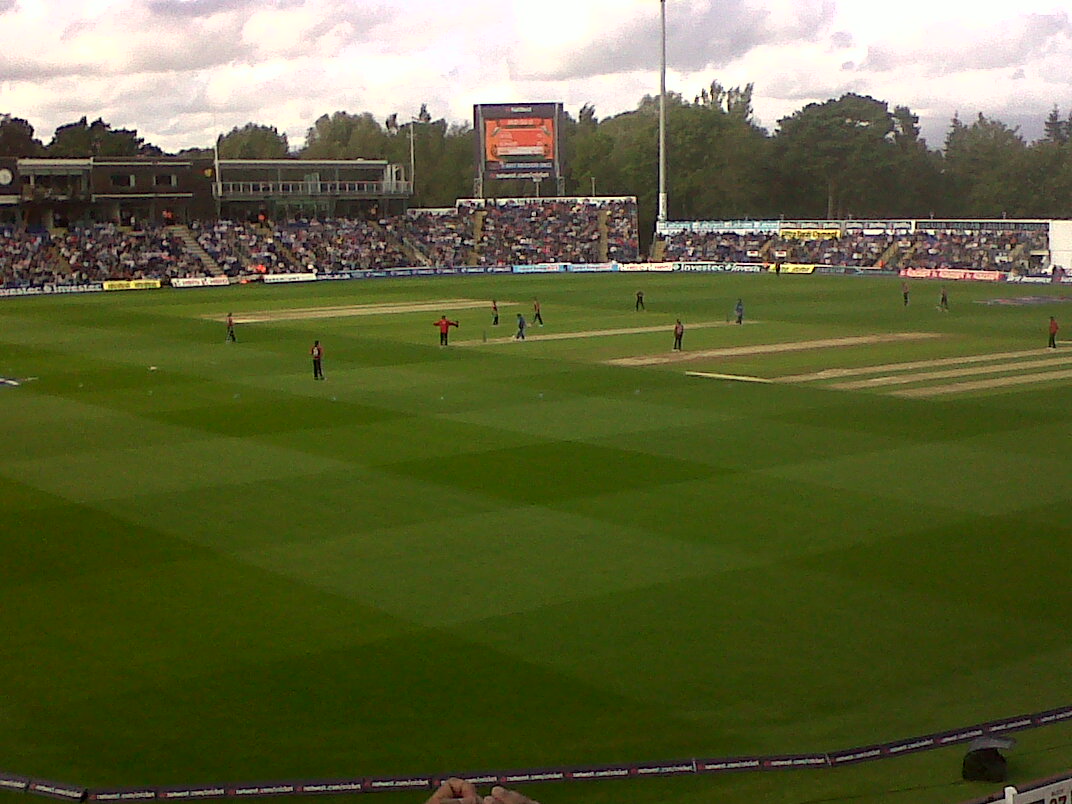
The Indian skipper Mahendra Singh Dhoni then smashed 50 runs off 26 deliveries to help his side post a score of 304-6, leaving England a daunting target of 305 runs to win. India certainly batted well, but were helped a bit by poor bowling by some of the England players. Indeed the only bowler I thought was really impressive was Finn, who was consistetly over 90 mph in his opening spell and was clearly troubling the Indian batsmen. Jade Dernbach, by contrast, committed the unpardonable sin of bowling wides in the last over. Incidentally, I managed to catch the umpire signalling an England wide, but I can’t remember who was bowling at the time:
Just after they players went off for a (shortened) interval, the rain came back again and this time it was decided that there wouldn’t be time for another full 50 overs. The Duckworth–Lewis (D/L) method was wheeled out, with the initial outcome that England would have to score 270 to win off 40 overs. That seemed very tough – the ten overs lost only reducing England’s target by 35. Another rain delay then revised the target further to 241 runs from 34 overs, a very stiff challenge indeed.
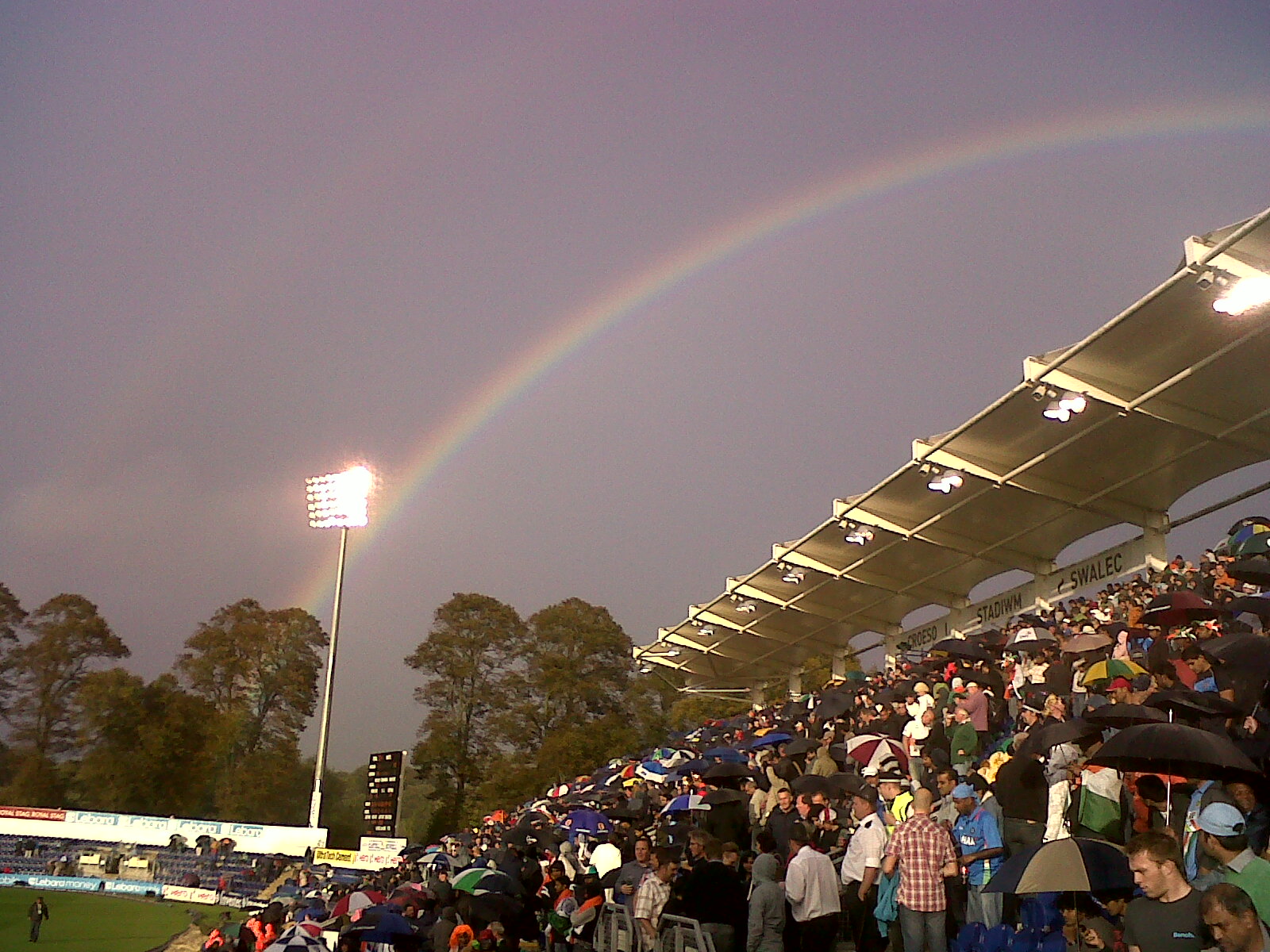
The many Indian supporters in the ground were buoyed by their team’s strong batting performance and seemed confidedent of a first victory against England this tour. I thought India would win at this point too, as a matter of fact. Anyway, the rain finally cleared and as the sun came out a rather nice rainbow appeared over Sophia Gardens as the floodlights were switched on for the “night” part of this “day-night” game.
England came out to bat and, rightly, sought to take the attack to India right from the ouset. Openers Alastair Cook and Craig Kieswetter scored quickly against some frankly rather poor Indian bowling.
England suffered their first loss in the fifth over with the score on 27 when Kieswetter was given leg-before wicket off the bowling of Vinay Kumar. Cook was then joined by Jonathan Trott, often a rather slow scorer, but both batsmen scored quite freely building a partnership of 79 runs until Cook was dismissed in the 18th, bowled by Kohli. The England total was 106 at this point, with three wickets down but plenty of batting still to comeyet only 16 overs to score the remaining 135 needed to win.
Ian Bell departed after scoring 26 runs and then Trott fell to a catch, off an uncharacteristically poor shot, for 63 runs off 60 deliveries. With four wickets now down, India (and their fans) must have been feeling pretty confident that they could stop England’s run chase. The result was firmly in the balance.
Cue the 21-year-old debutant Jonathan Bairstow who looked a little nervous for his first two or three deliveries, but then proceeded to smash the Indian bowling all round the park (and out of it). I think at least two of his big straight hits may well have landed in the River Taff after clearing the stands at the Riverside end quite comfortably. The flurry of boundaries boosted England’s scoring rate so quickly that in no time the target started to look not just possible but comfortable. In the end Bairstow remained unbeaten on 41 runs while his partner Ravi Bopara was not out 37 as England won by 6 wickets with more than an over to spare.
It was an impressive performance by the England batsman and a crushing disappointment for India, who now return home without winning a single match in England this season.
Despite the showery weather it was a thoroughly enjoyable occasion. The ground was packed, the sizeable Indian contingent contributed a lot to the atmosphere, and the usual groups of daft blokes in bizarre fancy dress also added a measure of eccentricity to the event. It did look at one point that there might be an ugly scene between two groups of fans in our stand, but thankfully it didn’t turn out to be very serious. We don’t want any of that sort of thing at cricket matches, thank you very much.
So that’s that. A fine end to the summer of international cricket, though perhaps not for the Indian players and supporters….
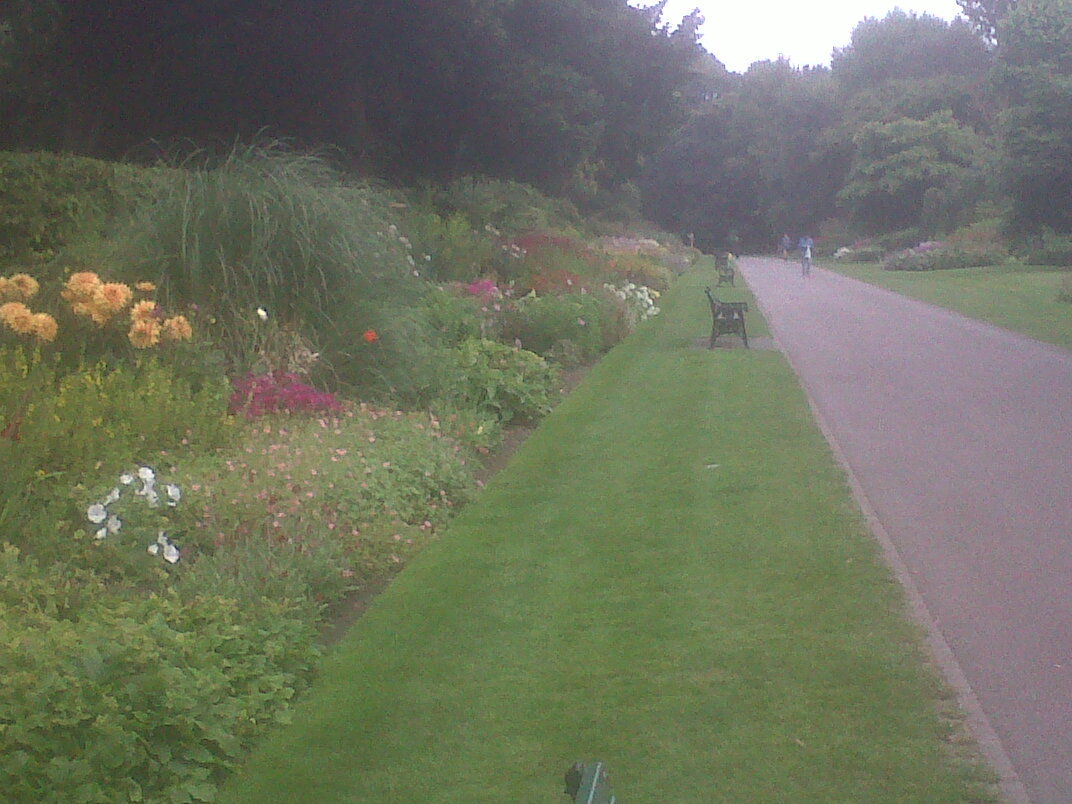
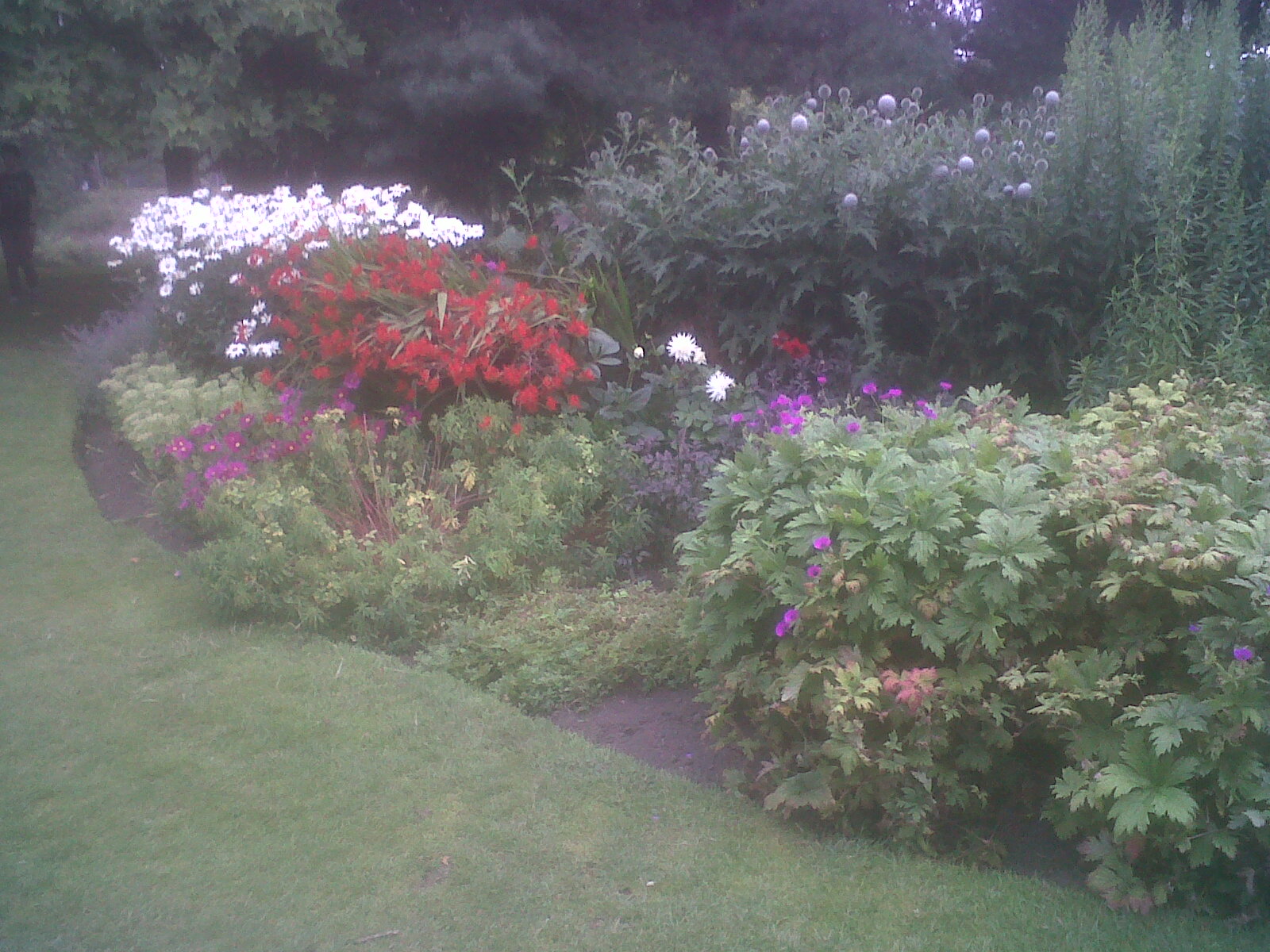
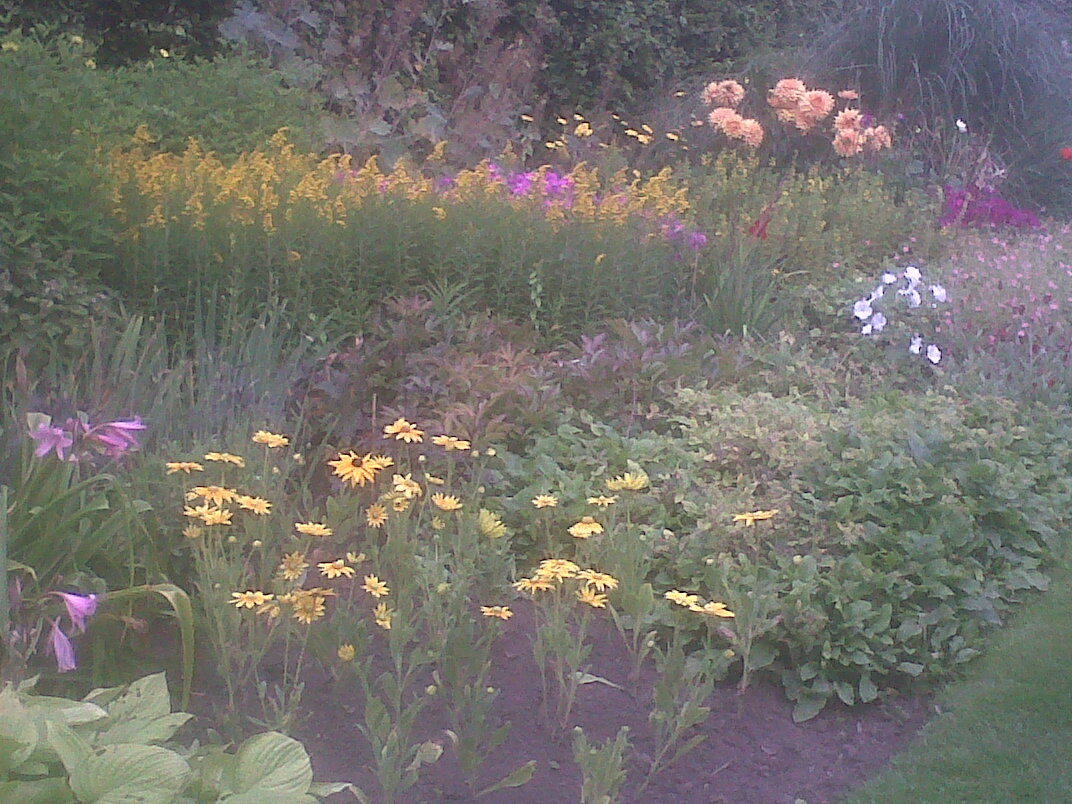
Follow @telescoperI know my posts about Bute Park tend to be very critical of its “restoration” (i.e. commercial redevelopment) by Cardiff City Council, especially the ridiculous construction project that is doing untold damage opposite the cricket ground. However, I thought I’d balance that with a bit of credit where credit is due. The floral beds in the Park are looking really beautiful, as you can see from these snaps I took on the way home last night. See how many plants you can identify!
The problem is that you’re increasingly likely to come across this sort of thing these days too, as the Council seems to want to encourage private motor vehicles to drive around the footpaths and park on the grass. This was taken just down the footpath, to the south of the flower beds shown in the previous picture.
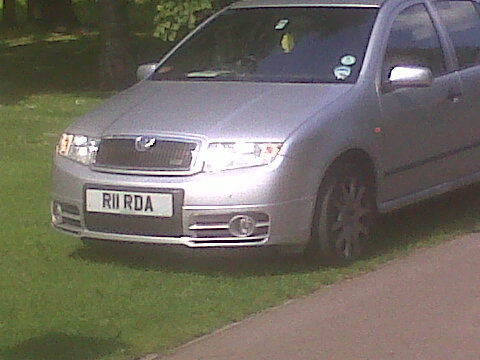
If you recognize the numberplate please tell the owner he’s a twat, from me. If I had my way there’d be a complete ban on cars and lorries in the park.
Another thing you might be interested to learn concerns the little refreshment kiosk just north of the flower beds:
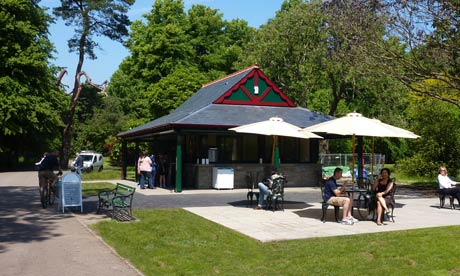
This little Wendy House was built to replace a Victorian summer house as part of the Council’s “restoration” project. Actually, it’s not a restoration, just a new cafe, next to a paved seating area that doesn’t look anything like the original, doesn’t add anything to the aesthetic of the park, and eats even further into the contiually dwindling green space. What I’d most like to know, however, is how this little building managed to cost the Council £165,778.20. That’s more than the cost of an average home in Cardiff….
…dare I suggest that somebody has been lining their pockets at the expense of the local Council Tax payers?
Follow @telescoperIt’s been a while since I’ve blogged about local affairs, but the emergence of three items of news in the past few days has given me an opportunity to remedy that.
First, and hot off the press this morning, is the news that Cardiff University has at last decided who its next Vice-Chancellor will be after the incumbent, David Grant, retires next year. The lucky winner is Professor Colin Riordan, who is currently Vice-Chancellor of the University of Essex (which apparently exists). His background is in the humanities, and his speciality post-war German literature. Since his previous institution doesn’t have a Physics Department, we’re probably safe for a few years until he finds out Cardiff has one and decides to close it.
Anyway, Professor Riordan became a Vice Chancellor for the first time at the age of 48, which is the same age I am now. Maybe I should be climbing aboard the gravy train? I hear there’s a vacancy as Vice Chancellor at the University of Essex. I would apply, but I fear I have all the wrong vices…
That brings me to yesterday’s news that Cardiff University, along with all the proper most other universities in Wales, is to charge annual tuition fees of, you guessed it, £9K. This is despite recent reports that the Higher Education Funding Council for Wales (HEFCW) was set to refuse permission to set such high fees. I always thought it was inevitable that Welsh universities would want to charge as much as possible to bring funding levels closer to those in England, but it remains to be seen what effect the new regime will have on student recruitment. The £9K level is substantially higher than the Welsh Assembly Government’s initial estimate of £7K so it also remains to be seen what the implications are for the WAG budget. We live in interesting times…
However, not wishing to end on a down note, I’ll finish by passing on a bit of up-beat news. Apparently – according to the esteemed National Geographic Magazine – Cardiff is one of the top ten places in the world to visit in 2011, coming in at Number 6 in this rigorously compiled and totally objective league table. I’m usually a bit skeptical about such things, but who could possibly disagree with the ranking?
1. Muskoka Orange County, Ontario, Canada
2. Patagonia, Argentina
3. San Juan Islands, Washington
4. Minneapolis, Minnesota
5. Glacier Bay National Park, Alaska
6. Cardiff, Wales
7. Stockholm Archipelago Sweden
8. Azores, Portugal
9. Roatan, Honduras
10. Istria, Croatia
Hang on a minute. Minneapolis? At Number 4?
Follow @telescoperIt was tipping down with rain this morning so I wrote off the prospect of there being any result in the First Test between England and Sri Lanka at Cardiff which I’ve blogged about once already. However, the weather steadily improved and play eventually got started at about 3pm. England, resuming on 491 for 5, batted on for a couple of overs to allow Ian Bell to get his century then – perhaps surprisingly – declared on 496-5, with a lead of 96 on the first innings. An unusually adventurous decision by Strauss to declare so early, in fact. Nevertheless, a draw looked a virtual certainty to me (and most sports writers) so I wasn’t paying much attention to the cricket at first, deciding instead to get on with some other stuff at home.
When I checked the score around 4 o’clock I discovered Sri Lanka had lost a couple of early wickets and had gone in for tea at 33-2. It being free to get in for the last session and the weather now being very sunny, I finally decided to go and watch the final stages. A draw still seemed the likeliest outcome – Sri Lanka only had to bat out time for 35 overs or so. However, we don’t get much Test cricket in Cardiff and the last match here had an exciting finish, so I walked to the ground just after tea. There couldn’t have been more than a few hundred spectators in the ground, but what we saw turned out to be a demonstration of what Test cricket is all about.
I had hardly got to my seat when Tremlett produced a beauty that found the edge of M. Jayawardene’s bat and was caught at slip. Sri Lanka 33-3. A few minutes later Samaraweera played an inexplicable slash at spinner Graham Swann and dragged the ball onto his stumps; 36-4. Swann then disposed of Sangakkara and Maharoof, and Tremlett took the wicket of P. Jayawardene, all with the score on 43. Sri Lanka’s batting, so solid in the first innings was now in pieces on the floor. In came Herath with the air of a man wishing to commit suicide. Eventually he succeeded, playing an agricultural swipe at a delivery from Swann; he missed and the ball hit him on the back leg, plumb in front of the wicket. At 52-8 Sri Lanka looked doomed. Perera decided to take the attack to England. He played some good shots, as well as some lucky ones, and was fortunate to be dropped when two fielders ran into each other. Nevertheless, he and Mendis steadied the Sri Lankan ship for a while. I on the other hand was literally shaking with excitement and anticipation, hoping that I was about to witness a spectacular finale.
The score quickly moved onto 82 and it looked like Sri Lanka might at least have a chance of making England bat again. Then Broad replaced Tremlett, Perera tried to flick him away and Ian Bell took a superb reaction catch at short leg. 82-9. Last man Lakmal departed without troubling the scorers just three balls later, caught at 3rd slip by Alastair Cook. England had won by an innings and 14 runs. Amazing.
It had all been so exciting I hadn’t even had time to think about going for a beer. I think I’ll have one while I watch the highlights on TV.
There really is nothing like Test cricket, you know…
Thanks to MaryCav for this ironic take on the ongoing destruction of Britain’s green spaces, including Bute Park. It was made by Friends of the Earth.


 In the Dark