Archive for Celtic languages

Proto, by Laura Spinney

Posted in History, Irish Language with tags , , , , , , , , on September 24, 2025 by telescoper

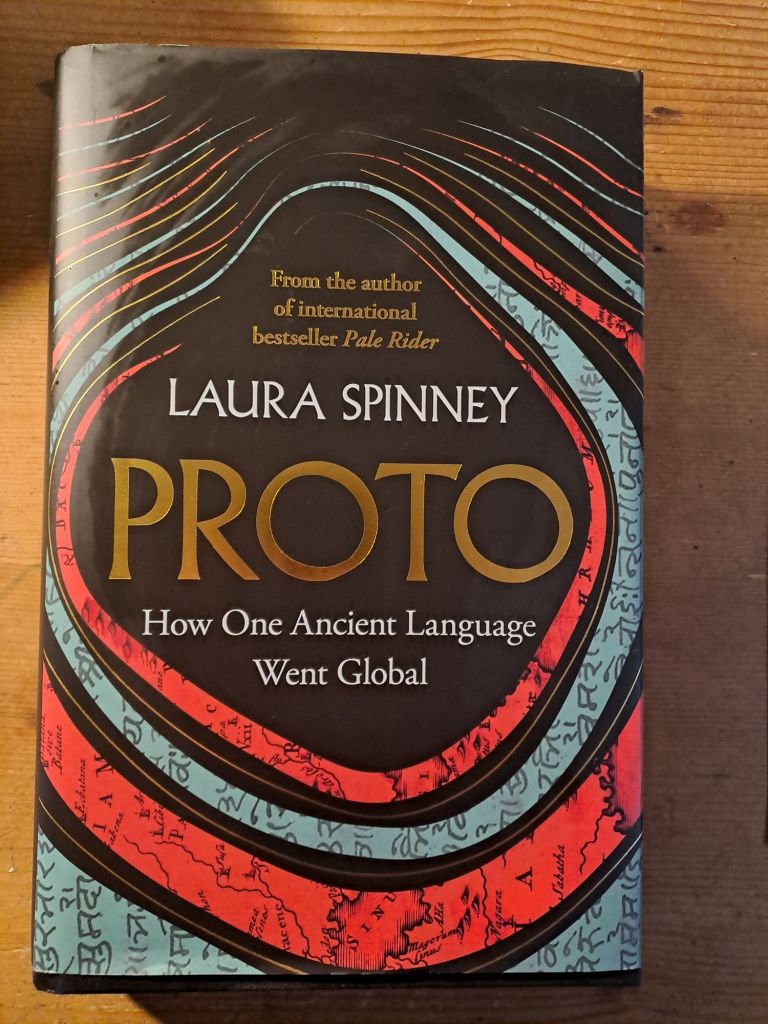
I interrupted the sequence of novels I’ve been reading recently to absorb a non-fiction book, Proto by Laura Spinney (left). I find linguistics a fascinating subject and when I saw a review of this recently and couldn’t resist. I’m glad I bought it because it’s absolutely fascinating. It is the story – or at least a very plausible account of the story of the lost ancestor of the Indo-European languages, the methods that have been used to reconstruct “Proto”, and why it was the spark that generated so many other languages across Europe, Eurasia and India.

The topic is very complex and I won’t attempt to describe it all in depth here; each chapter could be a book in itself because each family of languages within the Indo-European group – including lost ones such as Tocharian – has its own fascinating story. There are chapters focussing on the origins of language itself, the possibilities surround Proto (a language that was never written and probably exists in many dialects), Anatolian, Tocharian, Celtic, Germanic and Italic, the Indo-Iranian group (based on Sanskrit), Baltic and Slavic, and Albanian, Armenian and Greek. The last of these is fascinating because it used a method of writing borrowed from a  non-Indo-European source that became the origin of the European alphabet.

The story of which all these are subplots begins around the Black Sea shortly after end of the last Ice Age. In this area there lived mesolithic hunter-gatherers who had survived the ice who interacted with farmers moving up from the direction of modern day Syria. Their languages would have merged in some way to allow them to describe things that their neighbours had that they didn’t. Hunter-gatherers would not have words for, e.g., ploughing or barley while farmers would have fewer words for spears and other hunting equipment. Into this mix, the argument goes, came a third group, a fully nomadic culture called the Yamnaya people. These people and their successors subsequently underwent vast migrations from the steppes across the continent and were responsible for spreading the Proto-Indo-European languages. That’s a hypothesis, not a proven fact, but it is plausible and has a reasonable amount of evidence in its favour.

Recent progress in this field has been driven not only by linguists but also by archaeologists and geneticists, with each aspect of this triangulation vital. It was reading about archaeology in this book that prompted me to write a post about the Nebra Sky Disc. There are some fascinating snippets from palaeogenetics, too. Full DNA sequences are now known for about 10,000 individuals who lived in prehistoric times.

One extraordinary find involves two burials of individuals who both lived about 5,000 years ago. Their DNA profiles match so well that they were probably second cousins or first cousins once removed. The thing is that one of them was buried in the Don Valley, north-east of Rostov in modern-day Russian, while the other was found 3,000 km away in the Altai mountains. Assuming they were both buried where they died, the implications for the distance over which people could move in a lifetime are remarkable.

Another fascinating genetic snippet applies to Irish, a Celtic language. The Celtic languages derive from a proto-Celtic source that probably arose about 1000 BC. Around 2450 BC one of the cultures preceding the Celts arrived in Britain and Ireland, now called the Bell Beaker People because of their taste in pottery. The genetic record shows that the DNA of the Beaker folk replaced about 90% of the previous local gene pool, and all of the Y chromosomes; for some reason men of the earlier culture stopped fathering children. A similar change happened in Ireland, about 200 years later.One possible inference is that there was a violent conquest involving the erasure of the male population, but we don’t know for sure that it was sudden and catastrophic.

Whatever language the Beaker people brought with them was not Celtic (though it may have been Indo-European). The fascinating conundrum is that when Celtic languages arrived in Ireland whoever brought them left not a trace in the genetic record. This is unlike any of the similar changes in language use throughout European pre-history. Either the population responsible has not been identified or the language was spread through communication (e.g. for trade) rather than settlement. Irish may be a Celtic language, but there is little evidence of significant numbers of Celts settling here and bringing it with them.

Some time ago I wrote a post about the Celtic languages, which you might want to look at if you’re interested in this topic. A lot of that post I now realize to be very simplistic, but to add one other snippet I should mention that the name of Turkish football team Galatasaray translates to “Palace of the Celts” after the Celtic-speaking people who settled in Anatolia; these were the Galatians to whom Paul addressed his Epistle.

I thoroughly recommend this fascinating book. It made me want to find out more about so many things. It also gacve me additional motivation to pursue an idea I had a while ago to do a Masters in Linguistics wehn I retire from physics…
Language on Dry Land

Posted in Football, Irish Language with tags , , , , , , , , , on July 13, 2024 by telescoper

Since I’ve got my own computer again now I thought I’d celebrate by doing one of those rambling, inconsequential posts I haven’t had time to do recently.

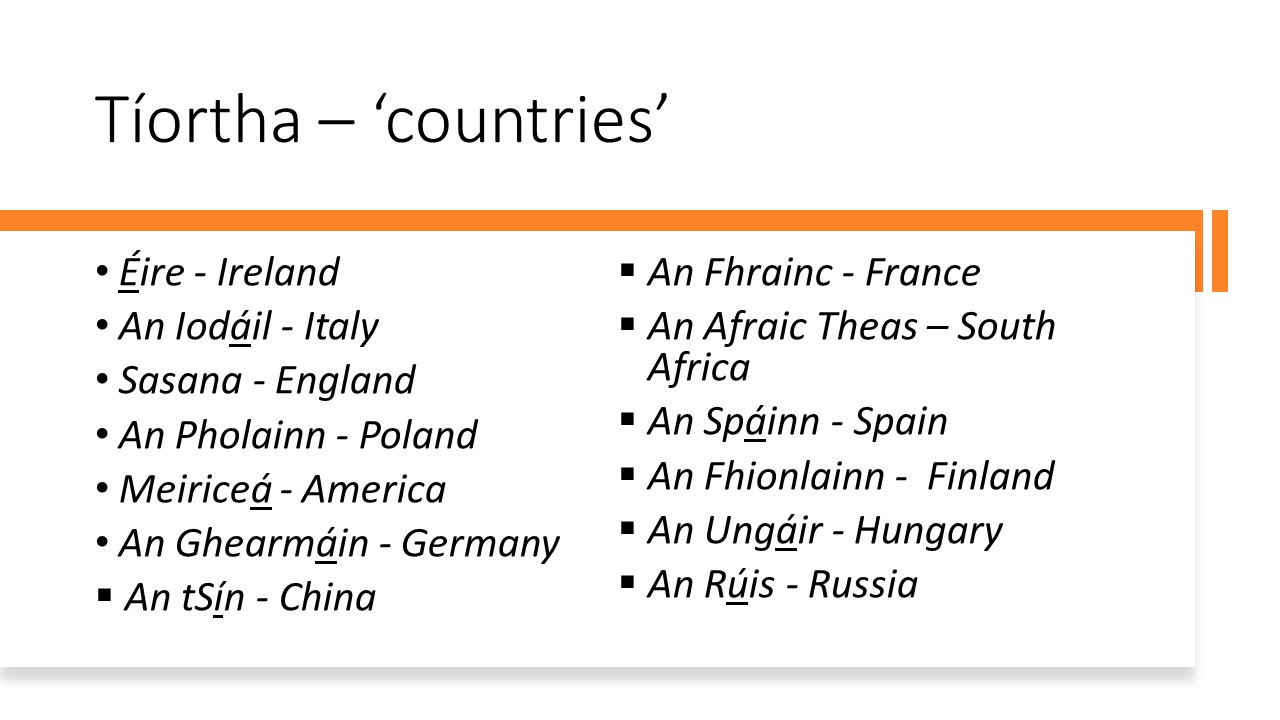
Last week, in the run up to the European Championship semi-final between England and The Netherlands, I for some reason decided to look up what “The Netherlands” is in the Irish language. I did know this once, as it came up when I was trying to learn Irish a few years ago but I had forgotten. I remembered “England”, which is Sasana (cf. Saxon). Anyway, the answer is An Ísiltír. I’ll return to that in a moment.

Here are some other names:

Anyway, a couple of things may be interest. One is that you can see that most country names in Irish are introduced by An. This is the definite article in Irish; there is no indefinite article. This contrasts with English in which only a few names start with the definite article, “The Netherlands” being one. The exceptions in Irish include England (Sasana) and Scotland (Albain). Wales is An Bhreatain Bheag (literally “Little Britain”). Of relevance to the final of the European Championship, Spain is An Spáinn.

I should also mention that some nouns suffer an initial consonant mutation (in the form of lenition, i.e. softening) after the direct article. In modern Irish this is denoted by an h next to the initial consonant, hence Fhrainc, for example; the Irish word for “French” is Fraincis.

The second interesting thing pertains to An Ísiltír itself. The second part of this, tír, means “country” or “nation” – see the plural in the heading above – and the first, Ísil, means “low”. An Ísiltír is therefore literally “The Low Country”. I shared this fascinating insight on social media and found in the replies a mention that the Welsh name for The Netherlands is Yr Iseldiroedda meaning literally “The Low Lands”. The first part of this is clearly similar to the Irish, but the second is the plural of a different word meaning ground or earth or an area of land. There is a word tir in Welsh that means ground or earth or an area of land but it does not mean country or nation like the very similar Irish word; the word for that is gwlad. In Irish the word for land or ground or earth (or turf) is talamh.

Welsh and Irish belong to distinct branches of the Celtic group of languages, the first wave of Indo-European languages to sweep across Europe. I blogged about this here.  Celtic languages therefore share roots with many other Indo-European languages and very basic words in many branches of the tree often bear some similarity in form, if slight but significant differences in meaning. It seems that tír/tir illustrates this rather well. These two words also have a very similar form to the French terre which is derived from the Latin terra. And so I disappeared down an etymological rabbit hole and found that all these words are probably derived from a Proto-Indo-European word meaning “dry”, presumably through reference to “that which is dry” as opposed to the wet bits (although neither Ireland nor Wales is famous for being particular dry).

And to bring this little excursion back full circle, the Irish word tirim means “dry”…

Tywysog and Taoiseach

Posted in History, Irish Language with tags , , , , on September 12, 2022 by telescoper

When I heard that King Charles III has conferred the title “Prince of Wales, Tywysog Cymru”, on his eldest son and heir William, I was intrigued by the appearance of the Welsh word Tywysog because of its similarity to the Irish word Taioseach. There aren’t that many words that sound so similar in Welsh and Irish because the two language groups to which they belong diverged in the distant past. Their similarity suggests to me a common etymology that pre-dates the development of the two distinct branches of the Celtic languages that we now refer to as Goidelic and Brythonic. There isn’t any literature to go on, as ancient Celtic languages were primarily oral, but the theory is that both words are derived from a Proto-Celtic form towissākos.

The Goidelic group comprises Irish, Manx and Scottish Gaelic; and the Brythonic group comprises Welsh, Cornish and Breton. These are sometimes referred to as q-Celtic and p-Celtic, respectively, although not everyone agrees that is a useful categorization. It stems from the fact that the “q” in Indo-European languages morphed into a “p” in the Brythonic languages. The number five in Irish is a cúig which has a q sound (though there is no letter q in the Irish alphabet); five in Welsh is pump. Contrast with the number two: a dó in Irish and dau in Welsh.

Incidentally, Scottish Gaelic is not the language spoken by the Picts, the Celtic people who lived in Scotland at the time of the Romans, which is lost. Scottish Gaelic is actually descended from Middle Irish due to migration and trading contacts. The Ulster dialect of Irish is in turn much influenced by reverse migration from Scotland. Languages do not evolve in isolation or in any simple linear trajectory.

Contrary to popular belief, Breton is not a Continental Celtic language but was taken to Brittany by a mass migration of people, which peaked in the 6th Century AD, from South-West Britain, fleeing the Anglo-Saxons. The Saxons won a great victory in battle at Dyrham (near Bath) in 577 after which they advanced through Somerset and Devon, splitting the Celts of Cornwall and Wales and leading to the formation of two distinct Brythonic language groups, Welsh and Cornish. Breton is much closer to Cornish than it is to Welsh.

The Continental Celtic languages are all extinct, except for fascinating remnants that linger here and there in local dialect words in French and Spanish.

Anyway, both modern words tywysog and taioseach originally meant “leader”. In Scots Gaelic, tòiseach was the name given to a clan chief; the Irish taioseach had a similar usage. The capitalized form “Taioseach” has only been used for the Head of the Irish Government since 1937 when the name was introduced in the Constitution. It was remarked at the time that An Taoiseach – the equivalent of Prime Minister – has the same literal meaning as “Il Duce” or “Die Führer“…

The last native Welsh Tywysog was Owain Glyndŵr after whose demise in c1415 the title was appropriated by the English monarchy no doubt as part of its rigorous suppression of Welsh identity. The term doesn’t actually mean “Prince” and the “Prince of Wales” is certainly not a leader. If anything the word should be applied to the First Minister of Wales, an office currently held by Mark Drakeford.

P.S. The presence of the “e” in taioseach indicates that the “s” is pronounced like “sh” (as in “Seán”) so the word should not be pronounced “tea sock”…


Celtic Europe

Posted in History, Irish Language with tags , , , , on February 6, 2021 by telescoper

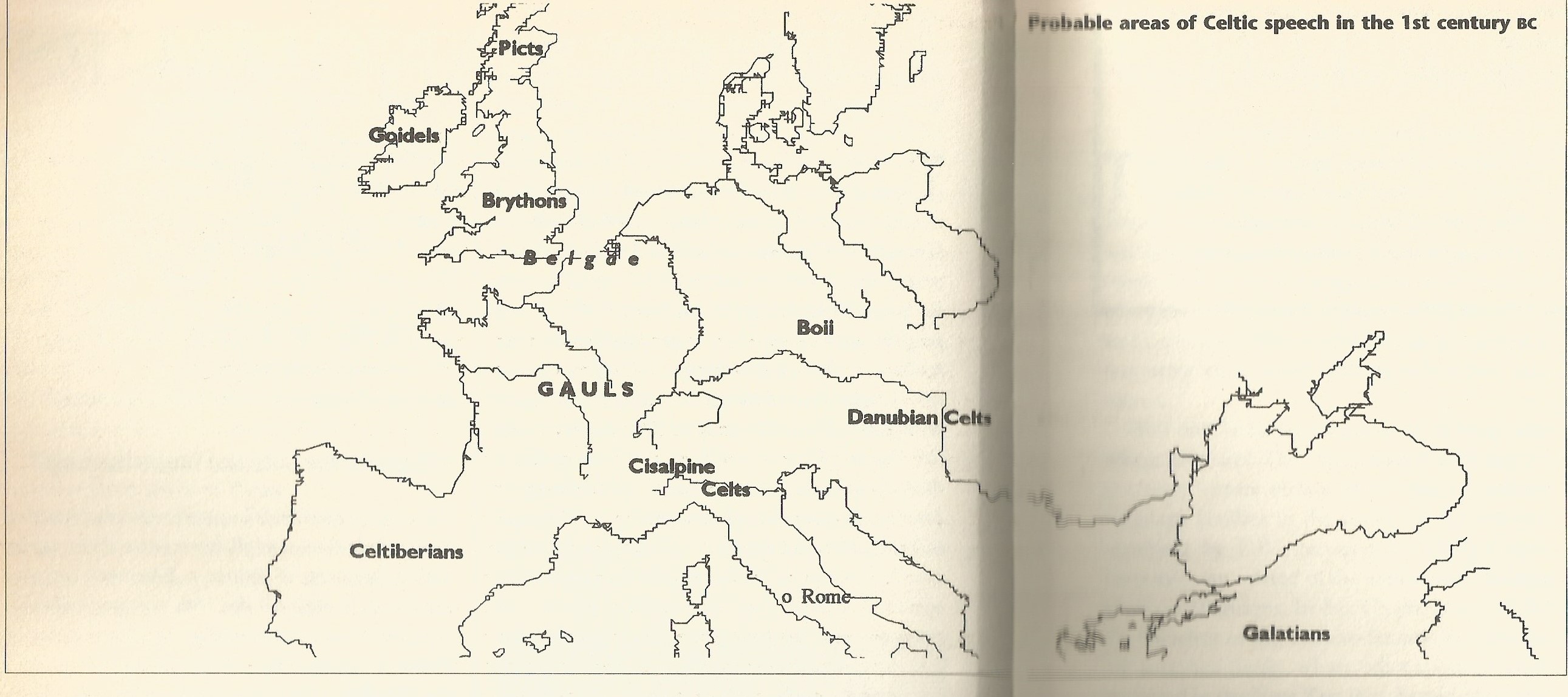
The Extent of Celtic Europe, from “Dictionary of Languages” by Andrew Dalby

Following on from Thursday’s post I thought I’d show the above map that shows the spread of Celtic languages in Europe. I’m sorry that the picture isn’t great but I scanned the map from a big hardback book and the map spreads across the fold as you can see.

The Celtic languages at the time depicted in the map (1st Century BC) were all oral languages, but when the Roman Empire spread across Europe about two thousand years ago it came into contact with the major dialects. Evidence for these can be found in place names, from Mediolanum (modern-day Milan, originally in cisalpine Gaul) to Singidunum (the Roman name for modern-day Belgrade) and Laccobriga (Lagos in Southern Portugal).

Belgium gets its name from the Belgae, regarded by Julius Caesar as the bravest and most fearsome of the tribes of Gaul. There are also words recorded in early inscriptions and in reconstructions based on later texts from which it is possible to glean clues about these languages. The picture that emerges is of a network of dialects spoken by Celtic peoples that inhabited a swathe of Continental Europe from the Iberian peninsula in the West to Galatia in the East, much of the Danube valley, and from Cisalpine Gaul (now part of Italy) in the South to modern-day Germany in the North.

Galatia (in classical Asia Minor) merits a special mention. St Paul’s Letter to the Galatians was addressed to the young Christian churches in this Celtic-speaking enclave which was then a distant province of the Roman Empire.

Linguists refer to the language that was spoken in Ireland at this time as Goidelic and it sits apart from the others because Ireland was never part of the Roman Empire. Brythonic is the name given to the dialects spoken in Britain. Continental Celtic is the name given to the dialects stretching all the way from Spain to Galatia of which the largest group was Gaulish. The language of the Scottish highlands Pictish may have been a separate subdivision but I don’t think anybody really knows because the language is extinct.

None of these groups was homogeneous. The Celts lived in relatively small communities and there were many regional variations even within each major group. Irish has four main dialects, roughly aligned with the four provinces. In Description of Ireland (1577), Richard Stanyhurst wrote:

As the whole realme of Ireland is sundred into foure principal parts so eche parcell differeth very much in the Irish tongue, euery country hauing his dialect or peculiar manner in speaking the language.

Our Irish teacher speaks the Irish of Connacht in which some pronunciations are very different from Leinster, which is the province I live in. As an absolute beginner this is the least of my worries at the moment.

The Goidelic group comprises Irish, Manx and Scottish Gaelic; and the Brythonic group that comprises Welsh, Cornish and Breton. These are sometimes referred to as q-Celtic and p-Celtic, respectively, although not everyone agrees that is a useful categorization. It stems from the fact that the “q” in Indo-European languages morphed into a “p” in the Brythonic languages. The number five in Irish is a cúig which has a q sound (though there is no letter q in the Irish alphabet); five in Welsh is pump. Contrast with the number two: a dó in Irish and dau in Welsh.

Incidentally, Scottish Gaelic is not the language spoken by the Celtic people who lived in Scotland at the time of the Romans, the Picts, which is lost. Scottish Gaelic is actually descended from Middle Irish due to migration and trading contacts. The Ulster dialect of Irish is in turn much influenced by reverse migration from Scotland. Languages do not evolve in isolation or in any simple linear trajectory.

Contrary to popular myth, Breton is not a Continental Celtic language but was taken to Brittany by a mass migration of people, which peaked in the 6th Century AD, from South-West Britain, fleeing the Anglo-Saxons. The Saxons won a great victory in battle at Dyrham (near Bath) in 577 after which they advanced through Somerset and Devon, splitting the Celts of Cornwall and Wales and leading to the formation of two distinct Brythonic language groups, Welsh and Cornish. Breton is much closer to Cornish than Welsh.

The Continental Celtic languages are all extinct, except for fascinating remnants that linger here and there in local dialect words in French and Spanish.

Language Lessons

Posted in History, Irish Language, Maynooth with tags , , , , , , , , , , on February 4, 2021 by telescoper

Thursday is Computational Physics Day this term so this morning I delivered the first Panopto lecture of that module and in the afternoon we had our first laboratory session. The students are all at home of course so we had to run the lab with them using their own laptops rather than the dedicated Linux cluster we have in the Department and interacting via Microsoft Teams.  The first lab is very introductory so it was really just me presenting and them following on their machines without too much interaction. The ability to share a screen is actually very useful though and I imagine using it quite a lot to share Spyder. It went fairly well, I think, with all the students getting started out on the business of learning Python.

In between lecturing the morning and running the laboratory session this afternoon I had the chance to study another kind of language. Soon after I first arrived in Maynooth I got an email from Maynooth University about Irish language classes. Feeling a bit ashamed about not having learned Welsh in all my time in Cardiff, I thought I’d sign up for the Beginners class and fill in a Doodle Poll to help the organizers schedule it. Unfortunately, when the result was announced  it was at a time that I couldn’t make owing to teaching, so I couldn’t do it. That  happened a couple of times, in fact. This year however I’ve managed to register at a time I can make, though obviously the sessions are online.

I’m not sure how wise it is for me to try learning a new language during a term as busy as this, but I have to say I enjoyed the first session enormously. It was all very introductory, but I’ve learnt a few things about pronunciation – unsurprisingly the Irish word for pronunciation fuaimniú is unsurprisingly quite difficult to pronounce – and the difference between slender and broad vowels. I also learnt that to construct a verbal noun, instead of putting -ing on the end as you would in English, in Irish you use the word ag in front of the verb.

That’s not to say I had no problems. I’m still not sure I can say  Dia duit (hello) properly. The second “d” is hardly pronounced. 

Irish isn’t much like Welsh, which I failed to learn previously.  Although Irish and Welsh are both Celtic languages they are from two distinct groups: the Goidelic group that comprises Irish, Manx and Scottish Gaelic; and the Brythonic group that comprises Welsh, Cornish and Breton. These are sometimes referred to as q-Celtic and p-Celtic, respectively, although not everyone agrees that is a useful categorization. Incidentally, Scottish Gaelic is not the language spoken by the Celtic people who lived in Scotland at the time of the Romans, the Picts, which is lost. Scottish Gaelic is actually descended from Middle Irish. Also incidentally, Breton was taken to Brittany by a mass migration of people from South-West Britain fleeing the Anglo-Saxons which peaked somewhere around 500 AD. I guess that was the first Brexodus.

Welsh and Irish don’t sound at all similar to me, which is not surprising really. It is thought that the Brythonic languages evolved from a language  brought to Britain by people from somewhere in Gaul (probably Northern France), whereas the people whose language led to the Goidelic tongues were probably from somewhere in the Iberia (modern-day Spain or Portugal). The modern versions of Irish and Welsh do contain words borrowed from Latin, French and English so there are similarities there too.

Only a diacritic mark appears in Irish, the síneadh fada (`long accent’), sometimes called the fada for short, which looks the same as the acute accent in, e.g., French. There’s actually one in síneadh if you look hard enough. It just means the vowel is pronounced long (i.e. the first syllable of síneadh is pronounced SHEEN). The word sean (meaning old) is pronounced like “shan” whereas Seán the name is pronounced “Shawn”.

One does find quite a few texts (especially online) where the fada is carelessly omitted, but it really is quite important. For example Cáca is the Irish word for `cake’, while the unaccented Caca means `excrement’…

I took the above text in Irish and English from the front cover of an old examination paper. You can see the accents as well as another feature of Irish which is slightly similar to Welsh, the mysterious lower-case h in front of Éireann. This is a consequence of an initial mutation, in which the initial character of word changes in various situations according to syntax or morphology (i.e. following certain words changing the case of a noun or following certain sounds). This specific case is an an example of h-prothesis (of an initial vowel).

In Welsh, mutations involve the substitution of one character for another. For example, `Wales’ is Cymru but if you cross the border into Wales you may see a sign saying Croeso i Gymru, the `C’ having mutated. The Irish language is a bit friendlier to the learner than Welsh, however, as the mutated character (h in the example above) is inserted in front of the unmutated character. Seeing both the mutated and unmutated character helps a person with limited vocabulary (such as myself) figure out what’s going on.

Mutations of consonants also occur in Irish. These can involve lenition (literally `weakening’, also known as aspiration) or eclipsis (nasalisation). In the case of eclipsis the unmutated consonant is preceded by another denoting the actual sound, e.g. b becomes m in terms of pronunciation, but what is written is mb. On the other hand, lenition is denoted by an following the unmutated consonant. In older forms of Irish the overdot (ponc séimhithe) -another diacritic – was used to denote lenition.

Anyway, I’ve seen Dia duit written Dia dhuit which might explain why the d sounds so weak. We live and learn. If I keep at it long enough I might eventually be able to understand the TG4 commentary on the hurling..

The Irish Accent

Posted in History, Maynooth with tags , , , , , , , , on December 11, 2018 by telescoper

It’s been a very busy day, as Tuesdays tend to be this term, so I thought I’d wind down with a little blog post.

Some time ago I got an email from Maynooth University about Irish language classes. Still feeling a bit ashamed about not having learned Welsh in all my time in Cardiff, I thought I’d sign up for the Beginners class and fill in a Doodle Poll to help the organizers schedule it. Unfortunately, when the result was announced it was at a time that I couldn’t make owing to teaching, so sadly I’m not learning Irish properly yet.

I have picked up a few things about the language, however, which it might be worth passing on here. Although Irish and Welsh are both Celtic languages they are from two distinct groups: the Goidelic group that comprises Irish, Manx and Scottish Gaelic; and the Brythonic group that comprises Welsh, Cornish and Breton. These are sometimes referred to as q-Celtic and p-Celtic, respectively, although not everyone agrees that is a useful categorization. Incidentally, Scottish Gaelic is not the language spoken by the Celtic people who lived in Scotland at the time of the Romans, the Picts, which is lost. Scottish Gaelic is actually descended from Middle Irish. Also incidentally, Breton was taken to Brittany by a mass migration of people from South-West Britain which peaked somewhere around 500 AD. I guess that was the first Brexodus.

Welsh and Irish don’t sound at all similar to me, which is not surprising really. It is thought that the Brythonic languages evolved from a language  brought to Britain by people from somewhere in Gaul (probably Northern France), whereas the people whose language led to the Goidelic tongues were probably from somewhere in the Iberia (modern-day Spain or Portugal). There are nevertheless some similarities. For example, `Merry Christmas’ is Nadolig Llawen in Welsh and Nollaig Shona in Irish..

Anyway, back to the topic of this post, there is only one accent in Irish (in the sense of a diacritic mark), which is the síneadh fada (`long accent’), sometimes called the fada for short, which looks the same as the acute accent in, e.g., French. There’s actually one in síneadh if you look hard enough. It just means the vowel is pronounced long (i.e. the first syllable of síneadh is pronounced SHEEN).

One does find quite a few texts (especially online) where the fada is carelessly omitted, but it really is quite important. For example Cáca is the Irish word for `cake’, while the unaccented Caca means `excrement’…

I took the above text in Irish and English from the front cover of an old examination paper. You can see the accents as well as another feature of Irish which is slightly similar to Welsh, the mysterious lower-case h in front of Éireann. This is a consequence of an initial mutation, in which the initial character of word changes in various situations according to syntax or morphology (i.e. following certain words changing the case of a noun or following certain sounds). This specific case is an an example of h-prothesis (of an initial vowel).

In Welsh, mutations involve the substitution of one character for another. For example, `Wales’ is Cymru but if you cross the border into Wales you may see a sign saying Croeso i Gymru, the `C’ having mutated. The Irish language is a bit friendlier to the learner than Welsh, however, as the mutated character (h in the example above) is inserted in front of the unmutated character. Seeing both the mutated and unmutated character helps a person with limited vocabulary (such as myself) figure out what’s going on.

Mutations of consonants also occur in Irish. These can involve lenition (literally `weakening’, also known as aspiration) or eclipsis (nasalisation). In the case of eclipsis the unmutated consonant is preceded by another denoting the actual sound, e.g. b becomes m in terms of pronunciation, but what is written is mb. On the other hand, lenition is denoted by an following the unmutated consonant.

In older forms of Irish the overdot (ponc séimhithe) -another diacritic – was used to denote lenition. Had this practice continued into the modern era there would be two Irish accents, but nowadays there is only one.