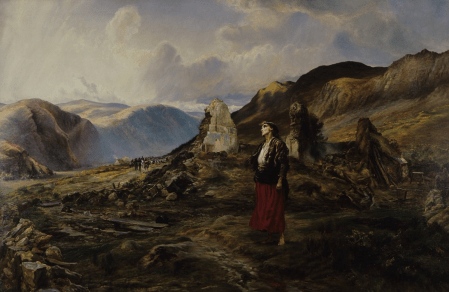
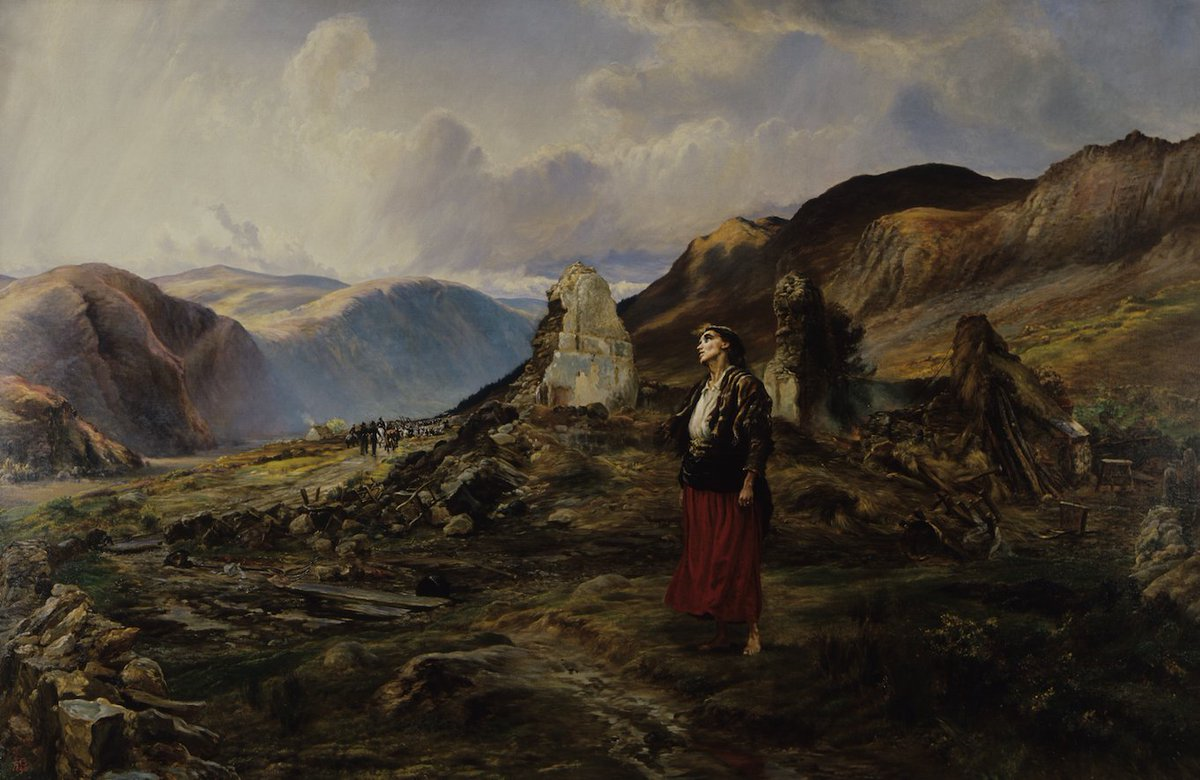
I was listening to an interesting radio programme the other day about artistic depictions of Ireland and Irish history. One of the paintings discussed was a work called Evicted which was painted in 1890 by Elizabeth Thompson (Lady Butler). I haven’t seen the actual painting – the original (oil on canvas) is apparently somewhere in University College Dublin – but i found the discussion intriguing and decided to see if I could find a representation on the internet. Here it is in reasonably high resolution.
I’m not a proper art critic or anything, but I found this a remarkably powerful work of art made all the more interesting when I read a little bit about the artists. Elizabeth Thompson married Lieutenant General Sir William Butler after which she became Lady Butler. She made her name as an artist painting heroic depictions of British soldiers in, for example, the Crimean War. When her husband retired from military service the couple moved to Ireland, and at the time this painting was made they were living in Wicklow where one of their neighbours was none other than Charles Stewart Parnell. The late 19th Century was the time of the Land War, a period of intense social unrest in rural Ireland caused by the exploitative practices of landlords and the unfair treatment of tenants. Parnell was a vigorous campaigner for land reform and the Butlers became staunch supporters of the cause.
One day Elizabeth witnessed the eviction of a Irishwoman from her cottage in the Wicklow mountains and was so moved by it that she made this wonderful painting. When it was exhibited in London it was met with disapproval for being “too political”. The British establishment of the time did not appreciate anything too critical of the Empire.
In the painting itself there are some striking touches. The eviction party, its job done, can be seen to the left disappearing back down the valley. By all accounts the people who did this sort of thing were sadistic brutes who very much enjoyed their work. Tenants were not only evicted, but their homes and possessions completely destroyed in order to prevent them returning. The standing figure of the woman seems to form a group with the pieces of her cottage that are still standing, her own devastation mirroring that of her home. A few glowing embers can be seen among the wreckage.
But it’s the depiction of the woman herself which in my opinion gives the painting most of its power. You might have expected her to be shown in obvious distress, hunched, perhaps crying or wringing her hands. Instead she is standing up with her hands by her sides, looking up at the sky. Is she praying? Resigned to her fate? Or perhaps just traumatized? The painting seems to ask the viewer: how would you react if this happened to you?

 In the Dark