Archive for Cosmic Microwave Background

Published BICEP2 paper admits “Unquantifiable Uncertainty”..

Posted in Bad Statistics, The Universe and Stuff with tags , , , , , , on June 20, 2014 by telescoper

Just a quick post to pass on the news that the BICEP2 results that excited so much press coverage earlier this year have now been published in Physical Review Letters. A free PDF version of the piece can be found here.  The published version incorporates a couple of important caveats that have arisen since the original release of the results prior to peer review. In particular, in the abstract (discussing models of the dust foreground emission:

However, these models are not sufficiently constrained by external public data to exclude the possibility of dust emission bright enough to explain the entire excess signal. Cross correlating BICEP2 against 100 GHz maps from the BICEP1 experiment, the excess signal is confirmed with 3σ significance and its spectral index is found to be consistent with that of the CMB, disfavoring dust at 1.7 σ.

Since the primary question-mark over the original result was whether the signal was due to dust or CMB, this corresponds to an admission that the detection is really at very low significance. I’ll set aside my objection to the frequentist language used in this statement!

There is an interesting comment in the footnotes too:

In the preprint version of this paper an additional DDM2 model was included based on information taken from Planck conference talks. We noted the large uncertainties on this and the other dust models presented. In the Planck dust polarization paper [96] which has since appeared the maps have been masked to include only regions “where the systematic uncertainties are small, and where the dust signal dominates total emission.” This mask excludes our field. We have concluded the information used for the DDM2 model has unquantifiable uncertainty. We look forward to performing a cross-correlation analysis against the Planck 353 GHz polarized maps in a future publication.

The emphasis is mine. The phrase made me think of this:

hazards

The paper concludes:

More data are clearly required to resolve the situation. We note that cross-correlation of our maps with the Planck 353 GHz maps will be more powerful than use of those maps alone in our field. Additional data are also expected from many other experiments, including Keck Array observations at 100 GHz in the 2014 season.

In other words, what I’ve been saying from the outset.


Has BICEP2 bitten the dust?

Posted in The Universe and Stuff with tags , , , , , , , , , , on June 5, 2014 by telescoper

Time for yet another update on twists and turns of the ongoing saga of  BICEP2 and in particular the growing suspicion that the measurements could be accounted for by Galactic dust rather than primordial gravitational waves; see various posts on this blog.

First there is a Nature News and Views article by Paul Steinhardt with the title Big Bang blunder bursts the multiverse bubble. As the title suggests, this piece is pretty scathing about the whole affair, for two main reasons. The first is to do with the manner of the release of the result via a press conference before the results had been subjected to peer review. Steinhardt argues that future announcements of “discoveries” in this area

should be made after submission to journals and vetting by expert referees. If there must be a press conference, hopefully the scientific community and the media will demand that it is accompanied by a complete set of documents, including details of the systematic analysis and sufficient data to enable objective verification.

I also have reservations about the way the communication of this result was handled but I wouldn’t go as far as Steinhardt did. I think it’s quite clear that the BICEP2 team have detected something and that they published their findings in good faith. The fact that the media pushed the result as being a definitive detection of primordial gravitational waves wasn’t entirely their fault; most of the hype was probably down to other cosmologists (especially theorists) who got a bit over-excited.

It is true that if it turns out that the BICEP2 signal is due to dust rather than primordial gravitational waves then the cosmology community will have a certain amount of egg on its face. On the other hand, this is actually what happens in science all the time. If we scientists want the general public to understand better how science actually works we should not pretend that it is about absolute certainties but that it is a process, and because it is a process operated by human beings it is sometimes rather messy. The lesson to be learned is not about hiding the mess from the public but about communicating the uncertainties more accurately and more honestly.

Steinhardt’s other main point is one with which I disagree very strongly. Here is the core of his argument about inflation:

The common view is that it is a highly predictive theory. If that was the case and the detection of gravitational waves was the ‘smoking gun’ proof of inflation, one would think that non-detection means that the theory fails. Such is the nature of normal science. Yet some proponents of inflation who celebrated the BICEP2 announcement already insist that the theory is equally valid whether or not gravitational waves are detected. How is this possible?

The answer given by proponents is alarming: the inflationary paradigm is so flexible that it is immune to experimental and observational tests.

This is extremely disingenuous. There’s a real difference between a theory that is “immune to experimental and observational tests” and one which is just very difficult to test in that way. For a start, the failure of a given experiment to detect gravitational waves  does not prove that gravitational waves don’t exist at some level; a more sensitive experiment might be needed. More generally, the inflationary paradigm is not completely specified as a theory; it is a complex entity which contains a number of free parameters that can be adjusted in the light of empirical data. The same is also true, for example, of the standard model of particle physics. The presence of these adjustable degrees of freedom makes it much harder to test the hypothesis than would be the case if there were no such wiggle room. Normal science often proceeds via the progressive tightening of the theoretical slack until there is no more room for manoeuvre. This process can take some time.

Inflation will probably be very difficult to test, but then there’s no reason why we should expect a definitive theoretical understanding of the very early Universe to come easily to us. Indeed, there is almost certainly a limit to the extent that we can understand the Universe with “normal science” but I don’t think we’ve reached it yet. We need to be more patient. So what if we can’t test inflation with our current technology? That doesn’t mean that the idea is unscientific. It just means that the Universe is playing hard to get.

Steinhardt continues with an argument about the multiverse. He states that inflation

almost inevitably leads to a multiverse with an infinite number of bubbles, in which the cosmic and physical properties vary from bubble to bubble. The part of the multiverse that we observe corresponds to a piece of just one such bubble. Scanning over all possible bubbles in the multi­verse, every­thing that can physically happen does happen an infinite number of times. No experiment can rule out a theory that allows for all possible outcomes. Hence, the paradigm of inflation is unfalsifiable.

This may seem confusing given the hundreds of theoretical papers on the predictions of this or that inflationary model. What these papers typically fail to acknowledge is that they ignore the multiverse and that, even with this unjustified choice, there exists a spectrum of other models which produce all manner of diverse cosmological outcomes. Taking this into account, it is clear that the inflationary paradigm is fundamentally untestable, and hence scientifically meaningless.

I don’t accept the argument that “inflation almost inevitably leads to a multiverse” but even if you do the rest of the argument is false. Infinitely many outcomes may be possible, but are they equally probable? There is a well-defined Bayesian framework within which one could answer this question, with sufficient understanding of the underlying physics. I don’t think we know how to do this yet but that doesn’t mean that it can’t be done in principle.

For similar discussion of this issue see Ted Bunn’s Blog.

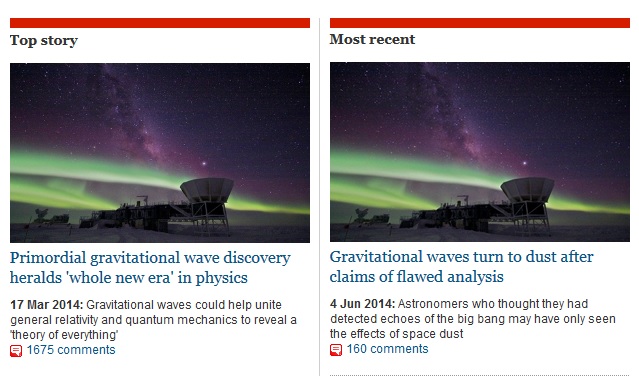
Steinhardt’s diatribe was accompanied  yesterday by a sceptical news piece in the Grauniad entitled Gravitational waves turn to dust after claims of flawed analysis. This piece is basically a rehash of the argument that the BICEP2 results may be accounted for by dust rather than primordial gravitational waves, which definitely a possibility, and that the BICEP2 analysis involved a fairly dubious analysis of the foregrounds. In my opinion it’s an unnecessarily aggressive piece, but mentioning it here gives me the excuse to post the following screen grab from the science section of today’s Guardian website:

BICEP_thenandnow

Aficionados of Private Eye will probably think of the Just Fancy That section!

Where do I stand? I can hear you all asking that question so I’ll make it clear that my view hasn’t really changed at all since March. I wouldn’t offer any more than even money on a bet that BICEP2 has detected primordial gravitational waves at all and I’d offer good odds that, if the detection does stand, the value of the tensor-to-scalar ratio is significantly lower than the value of 0.2 claimed by BICEP2.  In other words, I don’t know. Sometimes that’s the only really accurate statement a scientist can make.

BICEP2: The Dust Thickens…

Posted in The Universe and Stuff with tags , , , , , , on May 29, 2014 by telescoper

Off to a day-long staff training event today so just time to post a quick update on the BICEP2 saga (see various posts on this blog). There’s a new paper on the arXiv today by Flauger, Hill and Spergel. The first part of its rather lengthy abstract reads:

BICEP2 has reported the detection of a degree-scale B-mode polarization pattern in the Cosmic Microwave Background (CMB) and has interpreted the measurement as evidence for primordial gravitational waves. Motivated by the profound importance of the discovery of gravitational waves from the early Universe, we examine to what extent a combination of Galactic foregrounds and lensed E-modes could be responsible for the signal. We reanalyze the BICEP2 results and show that the 100×150 GHz and 150×150 GHz data are consistent with a cosmology with r=0.2 and negligible foregrounds, but also with a cosmology with r=0 and a significant dust polarization signal. We give independent estimates of the dust polarization signal in the BICEP2 region using four different approaches. While these approaches are consistent with each other, the expected amplitude of the dust polarization power spectrum remains uncertain by about a factor of three. The lower end of the prediction leaves room for a primordial contribution, but at the higher end the dust in combination with the standard CMB lensing signal could account for the BICEP2 observations, without requiring the existence of primordial gravitational waves. By measuring the cross-correlations between the pre-Planck templates used in the BICEP2 analysis and between different versions of a data-based template, we emphasize that cross-correlations between models are very sensitive to noise in the polarization angles and that measured cross-correlations are likely underestimates of the contribution of foregrounds to the map. These results suggest that BICEP1 and BICEP2 data alone cannot distinguish between foregrounds and a primordial gravitational wave signal, and that future Keck Array observations at 100 GHz and Planck observations at higher frequencies will be crucial to determine whether the signal is of primordial origin. (abridged)

The foreground analysis done in this paper seems to me to be much more convincing that that presented in the original BICEP2 paper and it confirms that the data as presented can not discriminate between B-modes arising from a polarized foreground component and from the presence of primordial gravitational waves. As I’ve said before (several times now), the press hype surrounding this discovery was a bit premature and we have to wait for observations at other frequencies before a clearer picture emerges through the dust.

UPDATE: A new Nature News and Views Article contains a strong statement by David Spergel to the effect that BICEP2 provides no evidence either for or against the existence of primordial gravitational waves.

Sakharov Oscillations in Cosmology

Posted in The Universe and Stuff with tags , , , , on May 21, 2014 by telescoper

No time for much of a post today, but I couldn’t resist commenting on something I picked up from Twitter just now. Today is the 93rd anniversary of the birth of the nuclear physicist and dissident Andrei Dmitrievich Sakharov who died in 1989. Sakharov is probably more famous for his political campaigning and the award of the Nobel Peace Prize in 1975 than for his work in physics, but I couldn’t resist mentioning a classic paper by him which was first published in Russian in 1965.

Here is the abstract:

Sakharov

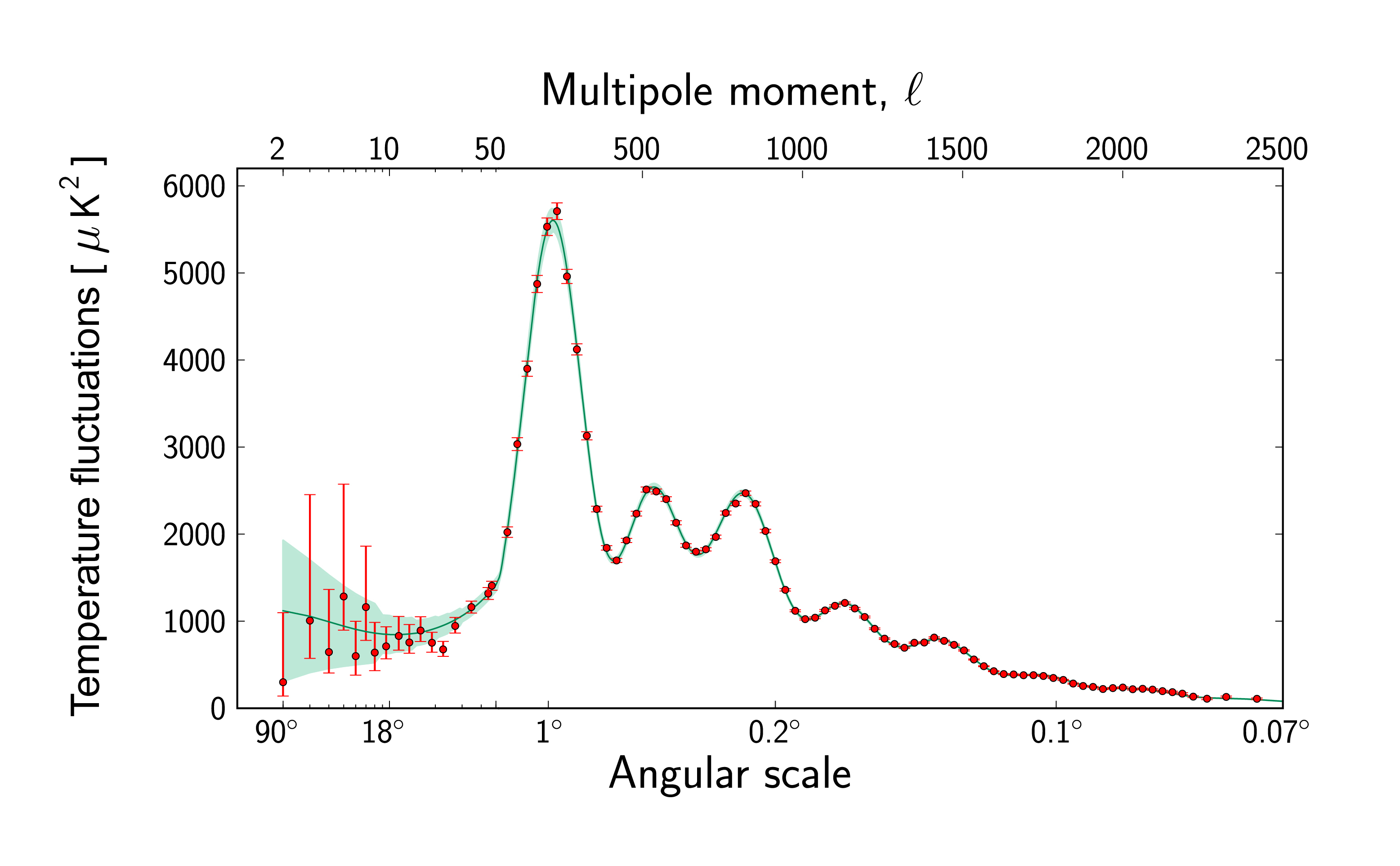
The importance of this remarkable paper for modern cosmology can’t be overstated, although many modern cosmologists have either forgotten it or were never aware of it in the first place. The details are a bit out of date, but the idea that density perturbations that grew by a process of gravitational instability to form galaxies and the large-scale structure of the Universe has survived almost fifty years, and plays a central role in the standard cosmological model. Moreover, the Sakharov Oscillations predicted in this paper manifest themselves in the temperature fluctuations of the cosmic microwave background as measured by, e.g., the Planck experiment:

Planck_power_spectrum_orig

The wiggles in the power spectrum plotted above appear because these fluctuations, generated in the modern theory during an episode of cosmic inflation, are set up in phase and thus reach the epoch of scattering at different phases of their oscillation and hence with different amplitudes. The detailed behaviour of the spectrum displayed above tells us a huge amount about the composition and evolution of the Universe.

When Francesco Lucchin and I were writing the first edition of our cosmology textbook (second edition here) we were careful to acknowledge Sakharov’s role in the development of cosmological theory, which wasn’t generally reflected in texts written outside Russia. I particularly recall the late Leonid Grischuk banging on about Sakharov’s work at many conferences in order to ensure he got proper credit and some books, e.g. Zel’dovich and Novikov’s two-volume Relativistic Astrophysics, do acknowledge him correctly. Somehow, however, the CMB wiggles never acquired the name of Sakharov; the peaks in the spectrum are often still called Doppler Peaks or Acoustic Peaks, when surely they should be Sakharov Peaks. It’s probably too late to change the nomenclature now, but there you go.

Anyway, I’ve now realized that I was working on the First Edition of Coles & Lucchin in 1994 which is now twenty years ago so before I get too depressed about the passage of time I’ll stop writing and get on with something else!

Anyway, I’ve now realized that

That BICEP Rumour…

Posted in The Universe and Stuff with tags , , , on May 14, 2014 by telescoper

So there’s been another twist in the story of BICEP2 and whether or not it has actually detected primordial gravitational waves.

This time it is a blog post on a site called Résonaances by Adam Falkowski who alleges that the BICEP2 team has made a pretty astounding error in their analysis of the data. This suggestion has been picked up by a couple of fairly influential science news sites (here and here). The BICEP2 team deny having made any such error and are quoted in the news stories defending their results in robust terms.

Before I continue let me make it clear that I stand by the scepticism I have expressed on this blog about this result (which, in fact, is shared by many of my colleagues in the cosmology fraternity1). The problem is that the measurement is made at a single frequency (150 GHz) and it is by no means clear on that basis whether it has the black-body spectrum that would characterize it as being associated with the cosmic microwave background rather than some sort of foreground emission. At 150 GHz the major worry is that polarized emission from galactic dust might contribute significantly to the signal, and might even swamp any primordial contribution.

Anyway, the blog post states that:

To estimate polarized emission from the galactic dust, BICEP digitized an unpublished 353 GHz map shown by the Planck collaboration at a conference.  However, it seems they misinterpreted the Planck results: that map shows the polarization fraction for all foregrounds, not for the galactic dust only (see the “not CIB subtracted” caveat in the slide). Once you correct for that and rescale the Planck results appropriately, some experts claim that the polarized galactic dust emission can account for most of the BICEP signal.

Here’s the map concerned as it appeared in the conference talk as presented on the blog post:

culprit

The point about this is that dust emission increases with frequency, so that at 353 GHz it would be expected to dominate the primordial cosmic microwave component. However, if one can measure the polarized component of this emission at high frequency (where it is larger and consequently easier to measure) then one could try to estimate the polarized contribution at the lower frequency measured at 150 GHz by BICEP2 by assuming it has a similar polarized fraction. This is actually just about the only way to estimate the foreground contribution.

Unfortunately in this map there is an additional unpolarized foreground arising from the Cosmic Infrared Background (CIB) which comprised integration dust emission from extragalactic sources. Including this component makes the polarized fraction look lower than it would if it were separated out and only the more highly polarized Galactic contribution considered. In other words including the CIB leads to an underestimate of the polarized fraction and consequently an underestimate of the foreground contamination at 150 GHz.

So now there are three issues:

  1. Did BICEP2 actually use this digitized image to estimate the polarized foreground for their experiment?
  2. Did they make the error of which they have been accused?
  3. Does this invalidate the BICEP2 announcement?

The answer to (1) is that I don’t know for sure but it’s certainly possible that they did. It sounds a pretty ropey approach, but the Planck data are not publicly available so they had to improvise. Even if (1) is the case, I am not at all sure that (2) is true. They may have, but in their responses to the suggestion they have denied it. It seems such a silly error that I’d be surprised, but that doesn’t in itself make it untrue.

However, even if (1) and (2) are the case that doesn’t mean that (3) is true, i.e. it does not imply that the entire analysis presented by BICEP2 is wrong. They have several different estimates of the foreground contribution using other methods so the entire result clearly does not stand or fall on the basis of the use of this particular map in a particular way.

I repeat what I’ve said before in response to the BICEP2 analysis, namely that the discussion of foregrounds in their paper is disappointing. I’d also say that I think the foreground emission at these frequencies is so complicated that none of the simple approaches that were available to the BICEP2 team are reliable enough to be convincing. My opinion on the analysis hasn’t therefore changed at all as a result of this rumour. I think BICEP2 has definitely detected something at 150 GHz but we simply have no firm evidence at the moment that it is primordial. That will change shortly, with the possibility of other experiments (specifically Planck, but also possibly SPTPol) supplying the missing evidence.

I’m not particularly keen on the rumour-mongering that has gone on, but then I’m not very keen either on the way the BICEP2 result has been presented in some quarters as being beyond reasonable doubt when it clearly doesn’t have that status. Yet.

Rational scepticism is a very good thing. It’s one of the things that makes science what it is. But it all too easily turns into mudslinging.

Note: 1 I use the word “fraternity” in the sense given in the Chambers Dictionary as “any set of people with something in common” rather than as “an all-male N American college association”. Cosmology is neither “all-male” nor exclusively American and I did not mean to imply either by my use of English.


Galactic Loops as Sources of Polarized Emission

Posted in The Universe and Stuff with tags , , , , , on April 8, 2014 by telescoper

Since I seem to have established myself as an arch-sceptic concerning the cosmological interpretation of the the BICEP2 measurement of the polarization of the cosmic microwave background (CMB), I couldn’t resist posting a link to an interesting paper by Liu et al. that has just appeared on the arXiv.

The abstract is:

We investigate possible imprints of galactic foreground structures such as the `radio loops’ in the derived maps of the cosmic microwave background. Surprisingly there is evidence for these not only at radio frequencies through their synchrotron radiation, but also at microwave frequencies where emission by dust dominates. This suggests the mechanism is magnetic dipole radiation from dust grains enriched by metallic iron, or ferrimagnetic molecules. This new foreground we have identified is present at high galactic latitudes, and potentially dominates over the expected B-mode polarisation signal due to primordial gravitational waves from inflation.

The authors argue that foreground emission from our own Galaxy has not been fully subtracted from maps of the cosmic microwave background. This emission could result in significant contamination of the CMB polarization if it is associated with dust grains aligned with the Galaxy’s magnetic field.

I’m grateful to one of the authors of the paper, Philip Mertsch, for sending me this map of the Galactic Loops with the BICEP2 region superimposed on it, demonstrating that there is potential for a contribution…

bicep2_loops


This paper is likely to provoke quite a discussion, so I thought I’d suggest one possible way of testing it, namely by updating the analysis presented by myself and Patrick Dineen in 2003 with new data. Here’s the abstract of our old paper:

We present a diagnostic test of possible Galactic contamination of cosmic microwave background sky maps designed to provide an independent check on the methods used to compile these maps. The method involves a non-parametric measurement of cross-correlation between the Faraday rotation measure (RM) of extragalactic sources and the measured microwave signal at the same angular position. We argue that statistical properties of the observed distribution of rotation measures are consistent with a Galactic origin, an argument reinforced by a direct measurement of cross-correlation between dust, free-free and synchrotron foreground maps and RM values with the strongest correlation being for dust and free-free. We do not find any statistically compelling evidence for correlations between the RM values and the COBE DMR maps at any frequency, so there is no evidence of residual contamination in these CMB maps. On the other hand, there is a statistically significant correlation of RM with the preliminary WMAP individual frequency maps which remains significant in the Tegmark et al. Wiener-filtered map but not in the Internal Linear Combination map produced by the WMAP team.

The idea is that cross-correlating the CMB pattern with Faraday rotation measures should provide an independent diagnostic of the effect of magnetic fields. Our analysis was based on old CMB data, so there’s an interesting project to be done updating it with, e.g., Planck CMB data and a larger set of rotation measures. See the comment below for a reference to more recent work along these lines, but still not including Planck.

Anyway, this all goes to show that there’s one question you can always ask about an astrophysics result: have you considered the possible role of magnetic fields?

Clover: What Might Have Been

Posted in Science Politics, The Universe and Stuff with tags , , , on March 23, 2014 by telescoper

Quite a few people have been asking me whether the UK’s cancelled B-mode experiment, Clover, could have detected what BICEP2 may  have found; I’m still not convinced, by the way. It therefore seemed apt to do a quick post in order to direct you to relevant sources of information. If you’re interested in Clover’s capabilities you can find a nice summary on the ArXiv here. The abstract reads:

We describe the objectives, design and predicted performance of Clover, which is a ground-based experiment to measure the faint “B-mode” polarisation pattern in the cosmic microwave background (CMB). To achieve this goal, clover will make polarimetric observations of approximately 1000 deg^2 of the sky in spectral bands centred on 97, 150 and 225 GHz. The observations will be made with a two-mirror compact range antenna fed by profiled corrugated horns. The telescope beam sizes for each band are 7.5, 5.5 and 5.5 arcmin, respectively. The polarisation of the sky will be measured with a rotating half-wave plate and stationary analyser, which will be an orthomode transducer. The sky coverage combined with the angular resolution will allow us to measure the angular power spectra between 20 < l < 1000. Each frequency band will employ 192 single polarisation, photon noise limited TES bolometers cooled to 100 mK. The background-limited sensitivity of these detector arrays will allow us to constrain the tensor-to-scalar ratio to 0.026 at 3sigma, assuming any polarised foreground signals can be subtracted with minimal degradation to the 150 GHz sensitivity. Systematic errors will be mitigated by modulating the polarisation of the sky signals with the rotating half-wave plate, fast azimuth scans and periodic telescope rotations about its boresight. The three spectral bands will be divided into two separate but nearly identical instruments – one for 97 GHz and another for 150 and 225 GHz. The two instruments will be sited on identical three-axis mounts in the Atacama Desert in Chile near Pampa la Bola. Observations are expected to begin in late 2009.

The following points, gleaned from a very quick skimming of the above paper, are worth noting (but please note the important corrections and clarifications in the comments below from the first author of the above paper and also bear in mind that the Clover numbers are estimated rather than based on actual measurements):

  1. The sky coverage of Clover would have been 1000 square degrees, compared with 380 square degrees of BICEP2
  2. Clover measurements would have been made at three frequencies, 97 GHz, 150 GHz and 225 GHz. This would have enabled the possibility of foreground contamination to be rejected with much greater confidence than in BICEP2 (which only operates at 150 GHz)
  3. The sensitivity of Clover at 150 GHz (the frequency at which BICEP2 operates) would have been about 1.4 times better than BICEP2
  4. Had it gone ahead, Clover would have started taking data at around the same time as BICEP2 (perhaps even a bit earlier).
  5. Clover was originally intended to be positioned at the South Pole, where observing conditions are better than in Chile and where BICEP2 is placed, but this was in the middle of STFC’s financial crisis and running costs would have been much higher than the alternative location in Chile. This might have had a negative impact on its sensitivity.

Here’s a plot from the above paper showing a the anticipated measurement if the tensor scalar ratio had been 0.1; BICEP2 detection (if real) corresponds to a signal twice this amplitude:

Clover_sensitivity

In other words, we don’t know whether Clover would have hit its target sensitivity and there are many other imponderables, but  it’s a very great shame it never got the chance to try…

BICEP2: Is the Signal Cosmological?

Posted in The Universe and Stuff with tags , , , , , on March 19, 2014 by telescoper

I have a short gap in my schedule today so I thought I would use it to post a short note about the BICEP2 results announced to great excitement on Monday.

There has been a great deal of coverage in the popular media about a “Spectacular Cosmic Discovery” and this is mirrored by excitement at a more technical level about the theoretical implications of the BICEP2 results. Having taken a bit of time out last night to go through the discovery paper, I think I should say that I think all this excitement is very premature. In that respect I agree with the result of my straw poll.

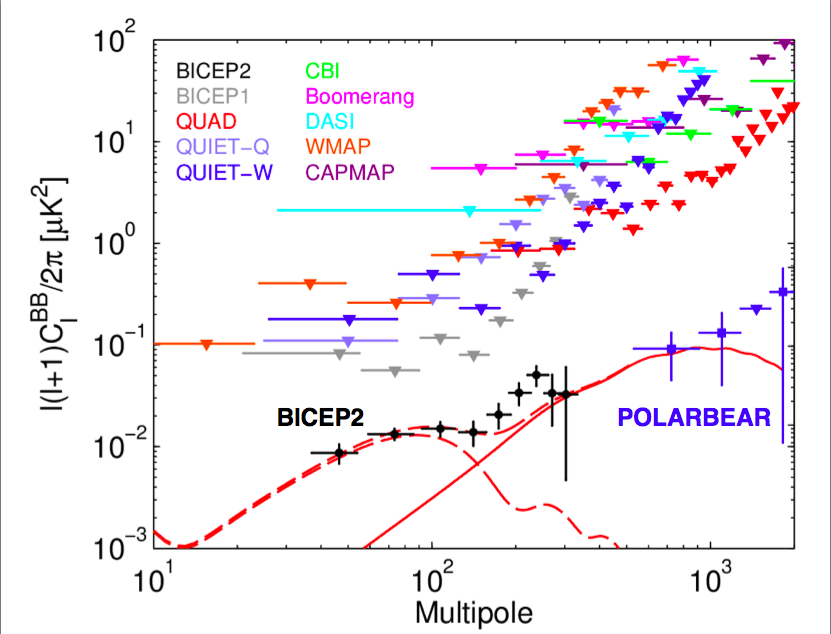
First of all let me make it clear that the BICEP2 experiment is absolutely superb. It was designed and built by top-class scientists and has clearly functioned brilliantly to improve its sensitivity so much that it has gone so far ahead of so many rivals:
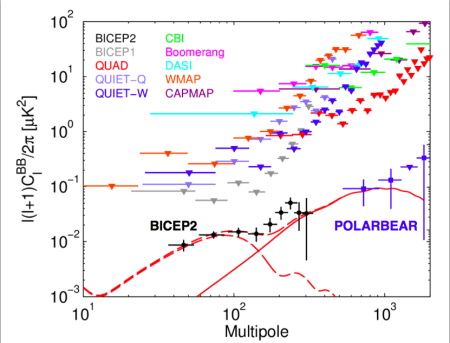
Polarization detections

Notice that the only other detection of the elusive B-mode signal is by POLARBEAR, but that is actually accounted for by gravitational lensing effects rather than being evidence of a primordial gravitational wave contribution.

The B-mode signal is so weak that it is to mind absolutely amazing that an experiment can get anywhere near measuring it. There’s no denying the fact that BICEP2 team have done heroic work.

But – and it’s a big “but” – we have to ask the question “How confident can we be that the signal detected by BICEP2 is, in fact, the imprint of primordial gravitational waves on the cosmic microwave background that cosmologists were hoping for?”

The answer to this question will depend on the individual, but I would say that to convince me the absolute minimum would be a detection of the signal in more than one frequency band. A primordial signal should not vary as a function of frequency, whereas foreground emission (likely to be from dust) would be frequency dependent.

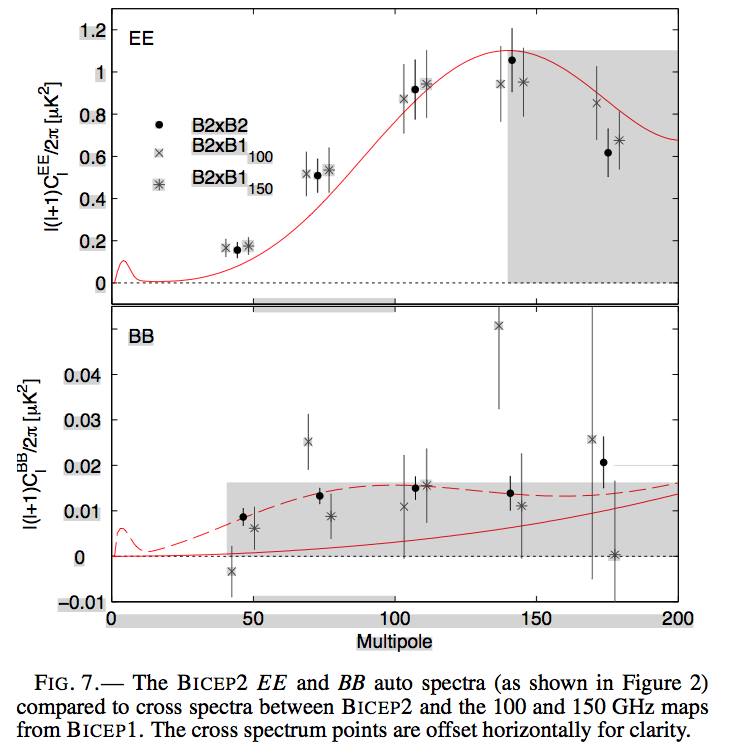
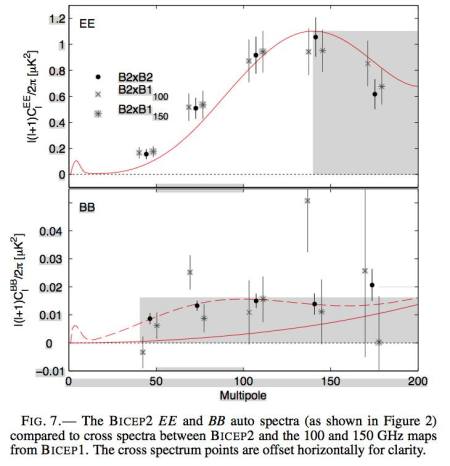
Now BICEP2 only operates at one frequency, 150GHz, so the experiment on its own can’t satisfy this criterion but it could through cross-correlation with the original BICEP1 instrument which worked at 100 GHz and 150 GHz. In the discovery paper we find the

Additionally, cross-correlating BICEP2 against 100GHz maps from the BICEP1 experiment, the excess signal is confirmed with 3sigma significance and its spectral index is found to be consistent with that of the CMB.

Here is the relevant plot, Figure 7 from the paper,
Xcor_BICEP

Well, the correct though the statement in the paper might be,  it is clear from this (rather ratty) cross-correlation that there is actually no firm detection of the B-modes at all at 100GHz. In other words, the 100 GHz BICEP1 data may be consistent with BICEP2 but they are also consistent with zero. (NOTE ADDED: I am ready to rescind this statement when I see a full analysis of these cross-correlations; at face value the scatter looks strange and certainly consistent with a null detection). In any case a positive cross-correlation does not exclude the possibility that the signal in common across the two channels is dust. If we only have a detection at one frequency we have no compelling evidence at all that the signal is cosmological.

When asked on Tuesday about this by Physics World I stated that I wasn’t convinced:

It seems to me though that there’s a significant possibility of some of the polarization signal in E and B [modes] not being cosmological. This is a very interesting result, but I’d prefer to reserve judgement until it is confirmed by other experiments. If it is genuine, then the spectrum is a bit strange and may indicate something added to the normal inflationary recipe.

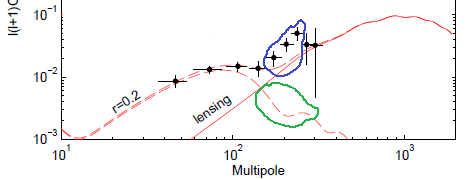
My scepticism was then derived primarily from the distribution of the points around l=200 in the first figure: they look too high compared to the expected gravitational lensing contribution (which seems to have been pinned down by the POLARBEAR measurements to the right of the plot):
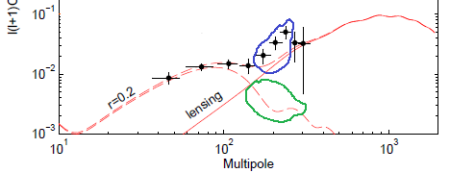
My concern: the three data points circles in blue are all higher than they should be, by about 0.01, which is the same height as the points to their left.  But the prediction of gravitational waves from inflation, circles in green, is that there should be very little contribution here --- which is why these points should lie closer to the solid red "lensing" prediction.  So the model of lensing for the right-hand part of the data + gravitational waves from inflation for the left-hand part of the data does not seem to be a very convincing fit.

I’ve taken this plot from the post I reblogged yesterday. The errors in the measurements ringed in blue are probably correlated so the fact that all three lie well above the red curve may not be as significant as it first seems, but note that the vertical scale is logarithmic. If some sort of systematic error has indeed bumped these points up then the amount of power involved could easily account for all the signal in the points to the left; the fit to the primordial B-mode (red dashed) part of the curve could then be fortuitous.

One possible systematic, apart from foreground contamination by dust, is leakage between E and B modes in the spherical harmonic decomposition. This arises because the spherical harmonic modes are only orthogonal over a complete sphere; BICEP2 does not map the whole sky, so the modes get mixed and separating them becomes extremely messy. Since the E-mode signal is so much larger, the worry is that some of it might leak into the B-mode.

UPDATE: 20/3/2014

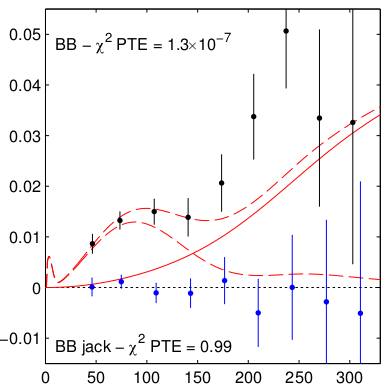
I noticed a post on the BICEP2 Facebook Page from Hans Kristian Eriksen pointing another oddity:
PTE

The above plot is one of many showing jackknife estimates relating to various aspects of the polarization signal. What is strange is that all the blue dots lie so close to zero. Statistically speaking this is extremely unlikely and it may suggest that the noise levels have been over-estimated underestimated; roughly one in three data points should be further away than one sigma from zero if sigma is estimated correctly.

Taking all this together I have to say that I stick to the point of view I took when I first saw the results. They are very  interesting, but it is far too earlier to even claim that they are cosmological, let alone to start talking about providing evidence for or against particular models of the early Universe. No doubt I’ll be criticized for trying to put a wet blanket over the whole affair, but this is a measurement of such potential importance that I think we have to set the bar very high indeed when it comes to evidence. If I were running a book on this, I would put it at no better than even money that this is a cosmological signal.

Of course the rush to embrace these results as “definitive proof” of something is a product of human nature and the general level of excitement this amazing experiment has generated. That’s entirely understandable and basically a very good thing. It reminds those of us working in cosmology how lucky we are that we work in a field in which such momentous discoveries do actually happen. This is no doubt why so many budding scientists are drawn into cosmology in the first place. Let’s not forget, however, that there is a thing called the scientific method and often after years of hard work there remain more questions than answers. For the time being, that’s where we are with gravitational waves.

BICEP2DAY

Posted in Astrohype, The Universe and Stuff with tags , , , , on March 17, 2014 by telescoper

Well, it’s official that this afternoon’s announcement of a “major discovery” is going to be from the BICEP team, and it specifically concerns the BICEP2 CMB telescope experiment. I’ve just got back to Sussex (after a weekend in Cardiff) and will be following the events in among other things I have to do before going off to give a lecture at 5pm GMT.

The schedule of events is as follows: there will be a special webcast presenting the first results from the BICEP2 CMB telescope. The webcast will begin with a presentation for scientists 10:45-11:30 EDT, followed by a news conference 12:00-1:00 EDT.

You can join the webcast from the link at http://www.cfa.harvard.edu/news/news_conferences.html

Papers and data products will be available at 10:45 EDT from http://bicepkeck.org/

EDT is four hours behind Greenwich Mean Time so the webcast will begin at 14:45 GMT, i.e. in about half an hour.

In the mean time, for those of you wondering what these BICEPS are all about, here is a useful graphic in which a Harvard astrophysicist demonstrates the possibilities:

biceps

LIVE BLOG:

14:36 The press conference server has gone down. There’s no truth in the rumour that ex-members of the Clover collaboration have sabotaged it.

14:42 There’s a grave danger that this press conference will run into tea time.

14:45 The BICEP2 papers are now live at http://bicepkeck.org/

14:48 Straight to the headline: R=0.2 (+0.07, -0.05) with R=0 rejected at about 7 sigma, if you like things stated in such terms…

14:53 Here’s the crucial graph. Results a bit higher than the expected  signal at l in range 200-300?

Bi7-IpDCEAA7frU

15:06 The news avalanche has started, e.g. here at the BBC, but there is some concern about the shape of the spectrum.

15:10 I’m not getting anything from the press conference, so may have missed important details. It seems to me though that there’s a significant possibility of some of the polarization signal in E and B not being cosmological. This is a very interesting result, but I’d prefer to reserve judgement until it is confirmed by other experiments.

15:35 Despite the press hype there’s still some scepticism among cosmologists arising from the strange-looking shape of the spectrum. I’m not convinced myself. Anyway, I have to sign off now in order to prepare a lecture..

16:20 Back-of-the-envelope time: if the result is correct then the inflationary energy scale is about 2×10¹⁶ GeV. That’s just two orders of magnitude below the Planck scale…

18:19 Returned from my 5pm Theoretical Physics lecture. Couldn’t resist spending 30 minutes talking about BICEP2, though I did tell them it’s not in the examination.

18:25 Main points of controversy:

  1. there seems to be evidence of leakage of temperature into polarization (lines in Fig. 5);
  2. there’s an excess in the B-B spectrum at l~250 shown above;
  3. there’s an excess at low l in the E-E spectrum
  4. there’s a deficit at low l in the cross-correlation with Keck

There may be a connection between 1. and 2.-4. If 2.-4 are real then they may be evidence of something interesting that requires more than a straightforward modification of inflation (such as might include just a running of the spectral index).

18:35 Other controversy: why has this result been announced before the paper has been published or even peer-reviewed?

Some B-Mode Background

Posted in Astrohype, Science Politics, The Universe and Stuff with tags , , , , , , , , , , , on March 15, 2014 by telescoper

Well, in case you hadn’t noticed, the cosmology rumour mill has gone into overdrive this weekend primarily concerning the possibility that an experiment known as BICEP (an acronym formed from Background Imaging of Cosmic Extragalactic Polarization). These rumours have been circulating since it was announced last week that the Harvard-Smithsonian Center for Astrophysics (CfA) will host a press conference  on Monday, March 17th, to announce “a major discovery”. The grapevine is full of possibilities, but it seems fairly clear that the “major discovery” is related to one of the most exciting challenges facing the current generation of cosmologists, namely to locate in the pattern of fluctuations in the cosmic microwave background evidence for the primordial gravitational waves predicted by models of the Universe that involve inflation.

Anyway, I thought I’d add a bit of background on here to help those interested make sense of whatever is announced on Monday evening.

Looking only at the temperature variation across the sky, it is not possible to distinguish between tensor  (gravitational wave) and scalar (density wave) contributions  (both of which are predicted to be excited during the inflationary epoch).  However, scattering of photons off electrons is expected to leave the radiation slightly polarized (at the level of a few percent). This gives us additional information in the form of the  polarization angle at each point on the sky and this extra clue should, in principle, enable us to disentangle the tensor and scalar components.

The polarization signal can be decomposed into two basic types depending on whether the pattern has  odd or even parity, as shown in the nice diagram (from a paper by James Bartlett)

The top row shows the E-mode (which look the same when reflected in a mirror and can be produced by either scalar or tensor modes) and the bottom shows the B-mode (which have a definite handedness that changes when mirror-reflected and which can’t be generated by scalar modes because they can’t have odd parity).

The B-mode is therefore (at least in principle)  a clean diagnostic of the presence of gravitational waves in the early Universe. Unfortunately, however, the B-mode is predicted to be very small, about 100 times smaller than the E-mode, and foreground contamination is likely to be a very serious issue for any experiment trying to detect it. To be convinced that what is being measured is cosmological rather than some sort of contaminant one would have to see the signal repeated across a range of different wavelengths.

Moreover, primordial gravitational waves are not the only way that a cosmological B-mode signal could be generated. Less than a year ago, a paper appeared on the arXiv by Hanson et al. from SPTpol, an experiment which aims to measure the polarization of the cosmic microwave background using the South Pole Telescope. The principal result of this paper was to demonstrate a convincing detection of the so-called “B-mode” of polarization from gravitational lensing of the microwave background photons as they pass through the gravitational field generated by the matter distributed through the Universe. Gravitational lensing can produce the same kind of shearing effect that gravitational waves generate, so it’s important to separate this “line-of-sight” effect from truly primordial signals.

So we wait with bated breath to see exactly what is announced on Monday. In particular, it will be extremely interesting to see whether the new results from BICEP are consistent with the recently published conclusions from Planck. Although Planck has not yet released the analysis of its own polarization data, analysis of the temperature fluctuations yields a (somewhat model-dependent) conclusion that the ratio of tensor to scalar contributions to the CMB pattern is no more than about 11 per cent, usually phrased in the terms, i.e. R<0.11. A quick (and possibly inaccurate) back-of-the-envelope calculation using the published expected sensitivity of BICEP suggests that if they have made a detection it might be above that limit. That would be really interesting because it might indicate that something is going on which is not consistent with the standard framework. The limits on R arising from temperature studies alone assume that both scalar and tensor perturbations are generated by a relatively simple inflationary model belonging to a class in which there is a direct relationship between the relative amplitudes of the two modes (and the shape of the perturbation spectrum). So far everything we have learned from CMB analysis is broadly consistent with this simplifying assumption being correct. Are we about to see evidence that the early Universe was more complex than we thought? We'll just have to wait and see…

Incidentally, once upon a time there was a British experiment called Clover (involving the Universities of  Cardiff, Oxford, Cambridge and Manchester) which was designed to detect the primordial B-mode signal from its vantage point in Chile. I won’t describe it in more detail here, for reasons which will become obvious.

The chance to get involved in a high-profile cosmological experiment was one of the reasons I moved to Cardiff in 2007, and I was looking forward to seeing the data arriving for analysis. Although I’m primarily a theorist, I have some experience in advanced statistical methods that might have been useful in analysing the output.  Unfortunately, however, none of that actually happened. Because of its budget crisis, and despite the fact that it had spent a large amount (£4.5M) on it already,  STFC decided to withdraw the funding needed to complete it (£2.5M)  and cancelled the Clover experiment. Had it gone ahead it would probably have had two years’ data in the bag by now.

It wasn’t clear that Clover would have won the race to detect the B-mode cosmological polarization, but it’s a real shame it was withdrawn as a non-starter. C’est la vie.