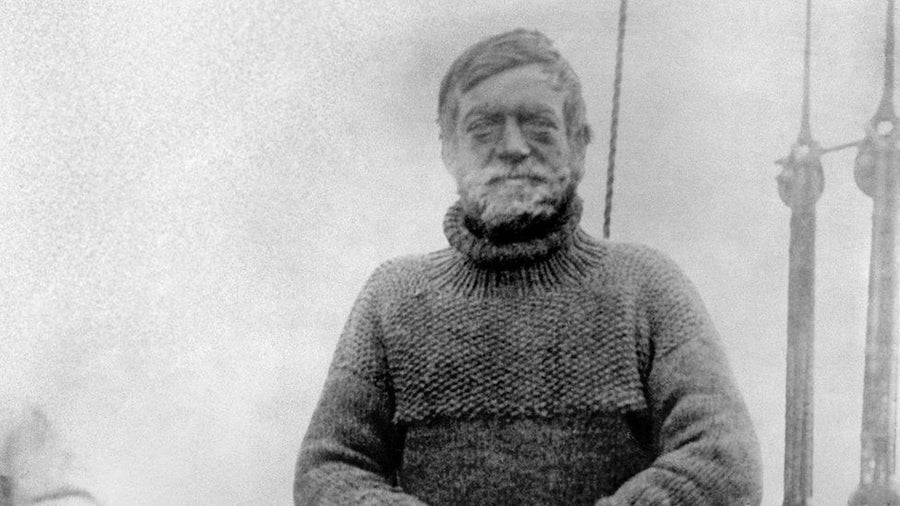
I notice this morning a short item about a museum in Athy about explorer Ernest Shackleton, who was born in Kilkea which is near Athy. There was a museum there before, but it has been much expanded and renovated. I must make an expedition there one day to see it, as Athy is in County Kildare only about 60km to the south of Maynooth.
Seeing this article reminded me that some months ago I watched a documentary series called Shackleton: Death or Glory. It’s not a new series, but I hadn’t seen it before, and found it gripping and inspiring. You can see the entire series (3 episodes) on Youtube here. The idea was to reproduce the situation that Shackleton and his crew faced in 1916 when they had to abandon their expedition to cross Antarctica when their ship, Endurance, was trapped in the ice. The courage and leadership he showed in saving all their lives is awe-inspiring.
To cut a long and amazing story short, in 1914 Shackleton led an expedition to cross Antarctica on foot for the first time. But disaster struck before even reaching the continent. His ship Endurance was trapped in sea ice and he and his 27 men were marooned. Realising that the ship would be crushed, he ordered the crew to take everything they could, including the (three) lifeboats. They made a camp on the ice and stayed there several months, but it was clear they could not remain there indefinitely, so they set off with their provisions in the lifeboats towards Elephant Island, a perilous journey of almost 300 km, through freezing water thick with blocks of ice.
Elephant Island was safer that the ice shelf from which they had escaped but it was nowhere near any trade route so chance of being rescued by a passing ship was zero. The outlook was grim. A slow death from starvation and exposure seemed inevitable.
Shackleton could see only one (remote) possibility of rescue, which was to take one of the boats and try to find help. That meant travelling across the open sea to South Georgia, a journey of some 1500 km. Not just any sea, mind you: the notoriously stormy and treacherous South Atlantice. It was a very tall order but in his diary he calmy recorded his thought process, which was basically that if they all stayed put they would certainly die and if the rescue party perished those left behind would be no worse off. He had to take the chance.
Shackelton picked five men and set off in one of the lifeboats – a 22ft wooden vessel – across the merciless ocean, in an apparently desperate attempt to reach the only possible help at the Stromness Whaling station in South Georgia. The rest of the crew – 22 men – were left on Elephant Island.
Almost unbelievably, Shackleton and his five men survived 16 days at sea and made the crossing. But his gruelling mission didn’t end there, because they arrived on the wrong side of the island of South Georgia. The boat and two of the crew were in poor shape by then so they could not continue by sea. Shackleton, taking two men with him, had to traverse about 40km of an unchartered mountain range, without any mountaineering equipment in order to reach the safety of Stromness. Shackleton successfully raised the alarm, but the story was still far from over. The first thing Shackleton had to do was collect the two men he had left on the other side of South Georgia. All six were safe.
Now he had to think about the other 22 still at Elephant Island. In search of more appropriate ships, Shackleton went first to the Falkland Islands and then to Chile. Several rescue attempts failed, because of the pack ice and, once because of a fire onboard. Eventually he persuaded the Chilean Navy to lend him a steam tug, the Yelcho, which made it to Elephant Island. The men there were in poor shape, hungry and demoralised, almost but they were all alive. Against all the odds, Shackleton, saved every single one of his men from what must have seemed like certain death.
Aside from his physical courage and endurance, two characteristics exemplify the quality of Ernest Shackleton’s leadership: one is that he would never ask any of his men to do anything he wouldn’t do himself, and the other is that he put the wellbeing of his men at the centre of all his decisions. Can you say those things about your “Leader”?
These days we hear a lot of talk, in various contexts, about leadership but most of the people who claim to show leadership don’t know the meaning of the word. Next time you hear some useless twit claiming to be a leader, think about Ernest Shackleton and judge them by his standards.

 In the Dark