I couldn’t resist a short post to mark the success of England’s cricketers down under in successfully retaining The Ashes. After getting themselves comprehensively thrashed in the Third Test of the Ashes series in Perth, to tie the level the series 1-1 (with one match drawn), the pressure was on when the Fourth Test started on Boxing Day in Melbourne. However, it all seemed to get to the Australians more than the English: Australia were dismissed for a paltry 98 after being put into bat by England captain Andrew Strauss who won the toss. England finished the day on 157 without loss, with defeat for Australia already probable at stumps on the opening day. England batted all the second day and a bit of the third, amassing 513 all out, and then had Australia 169 for 6 at the end of Day Three. Although the last few Australian batsmen showed a bit of spirit on Day Four, they were eventually all out for 258, leaving England the victors by an innings and 157 runs, their second innings victory of the series.
Now they are 2-1 up in the series with one Test to play (at Sydney), which means they can’t lose the series and therefore keep the Ashes, which they won in England last year (2009). I hope England keep their focus and go on to win at Sydney too. I’d like to see them win the series outright. Incidentally, if I’ve done my sums right, Australia have now won 123 Ashes tests since the first in 1882, to England’s 99, so if England can win in Sydney it will be their 100th.
My Australian friends and colleagues will be wincing at this outcome, but although England have proved worthy winners this time I’m sure Australia will be back to winning ways before too long. As an English cricket fan, I’ve endured enough disappointments to make this victory especially sweet. I dare say when the Australians do reclaim the Ashes at some point in the future their supporters will feel the same. As it is in life, so it is in cricket – the good times make the bad times worth enduring.
I thought I’d mark this very special occasion with a poem called Brahma by Andrew Lang. It’s a clever parody of a poem by Ralph Waldo Emerson, and the reference to Hinduism seems to fit with the theme of a cyclic universe of sporting success and failure.
If the wild bowler thinks he bowls,
Or if the batsman thinks he’s bowled,
They know not, poor misguided souls,
They too shall perish unconsoled.
I am the batsman and the bat,
I am the bowler and the ball,
The umpire, the pavilion cat,
The roller, pitch, and stumps, and all.
At the end of day two of the Second Ashes Test between England and Australia, England were 317 for 2 in response to Australia’s 245 all out. Cook is 136 not out and Petersen 85 not out. Going well for England down under in the heat of Adelaide, I’d say. Australian captain Ricky Ponting seems to be hoping for help from above..
..although, given that this is in Australia, surely his hands are actually pointing downwards?
Just a quick post to commemorate the record-breaking First Test of the Ashes series between England and Australia in Brisbane that finished yesterday. It was notable for a number of reasons, including Australian bowler Peter Siddle’s hat-trick in England’s first innings, and some fine batting by Mike Hussey and Brad Haddin in Australia’s first innings, but chiefly for an extraordinary fightback by England’s batsmen in their 2nd innings which took them to an amazing 517 for 1 declared from a situation in which they might well have folded. Well played Messrs Strauss, Cook and Trott for all getting centuries and saving the game.
The way the press have been going on about the result you’d think England had won, but it was only a draw. There’s a long way to go – another four Tests to be precise – before the fate of the Ashes is decided. Still, England have already done better than they did last time they played an Ashes series in Australia. They lost that one 5-0!
I thought I’d post this little poem by Simon Rae to mark the occasion. There wasn’t that much evidence of high-quality spin bowling in the First Test, but A Red Ball Spins is more about the fact that although it might be winter here and the domestic season long over, somewhere in the world there’s always cricket, lovely cricket…
A red ball spins, a swallow’s flight, That every generation follows From rituals first performed in meadows To epic Tests in packed arenas.
Shadows signal the close of play Then slip through turnstiles into light: Another match, another day. Around the world the red balls spins.
The summer draws ever nearer to its close and autumn beckons.
The latest marker of the turning season to rush past was the last match of cricket’s County Championship, which ended yesterday. It was a disappointing finale for my local team, Glamorgan, who had a chance of winning promotion to Division 1 having spent most of the season in second place in Division 2. However, after a feeble first innings batting performance against Derbyshire – and a lot of rain here in Cardiff – they could only draw their final game. Meanwhile, third-placed Worcestershire responded to a generous declaration by first-placed Sussex by scoring 306-6 in only 55 overs to win with time to spare. Thus, Sussex and Worcestershire (who got relegated last year) get promoted back to Division 1, while Kent and Essex (who were promoted last year) get relegated. Better luck next year for Glamorgan. Nottinghamshire, by the way, won the Championship.
In the end it was quite an exciting final day of the county season but since it’s now all over until next spring it seems appropriate to mark the end of the County Championship with one of the classic cricket poems, Close of Play, by Thomas Moult.
How shall we live, now that the summer’s ended,
And bat and ball (too soon!) are put aside,
And all our cricket deeds and dreams have blended —
The hit for six, the champion bowled for none,
The match we planned to win and never won? …
Only in Green-winged memory they abide.
How shall we live, who love our loveliest game
With such bright ardour that when stumps are drawn
We talk into the twilight, always the same
Old talk with laughter round off each tale —
Laughter of friends across a pint of ale
In the blue shade of the pavilion.
For the last time a batsman is out, the day
Like the drained glass and the dear sundown field
is empty; what instead of Summer’s play
Can occupy these darkling months ere spring
Hails willows once again the crowned king?
How shall we live so life may not be chilled?
Well, what’s a crimson hearth for, and the lamp
Of winter nights, and these plump yellow books
That cherish Wisden’s soul and bear his stamp —
And bat and ball (too soon!) are put aside,
Time’s ever changing, unalterable score-board,
Thick-clustered with a thousand names adored:
Half the game’s magic in their very looks!
And when we’ve learnt those almanacs by heart,
And shared with Nyren … Cardus ….the distant thrill
That cannot fade since they have had their part,
We’ll trudge wet streets through fog and mire
And praise our heroes by the club-room fire:
O do not doubt the game will hold us still!
Just a quick post to share a picture taken at last night’s Twenty20 International in Cardiff between England and Pakistan. We had the entire spectrum of Welsh weather to contend with, but the worst of yesterday’s rain was over well before the match started and the SWALEC stadium, just ten minutes’ walk from my house, was a fine sight under a variety of peculiar cloud formations and the floodlights, as you can tell from the picture I took on my phone.
Pakistan won the toss and batted first, but didn’t make a very good fist of it and were bowled out for a mere 89 from their 20 overs. England had a little wobble during the run chase but in the end won comfortably by 6 wickets.
Unfortunately, the crowd numbered only a few thousand so the atmosphere was a bit flat and Pakistan’s poor showing with the bat made it all a bit of anti-climax, but it was still a good way to precede a nice curry. I’ve heard various theories as to why the attendance was so poor, but I think it’s pretty obvious: at £45 for a game whose format ensures it can last no longer than about three hours, tickets for this match were just too expensive. I think the authorities should think again about their pricing strategy.
I don’t know why, but last week was my most popular week ever, at least in terms of blog hits! I was going to follow up with a foray into the role of spin in quantum mechanics, but decided instead to settle for a less ambitious project for this evening.
Yesterday I walked past the cricket ground at the SWALEC Stadium in Sophia Gardens, Cardiff, during the Twenty20 international between England and Pakistan. There is another match of this type tomorrow night which I’ll actually be going to, as long as it’s not rained off, but I have too many things to do to go to both games. Anyway, England’s excellent off-spinner Graham Swann was bowling when I watched through a gap in the stands at the river end of the stadium. He seemed to be getting an impressive amount of turn, and I got wondering about how fast a bowler like “Swannee” actual spins the ball.
For those of you not so familiar with cricket here’s a clip of another prodigious spinner of the ball, Australia’s legend of legspin Shane Warne:
For beginners, the game of cricket is a bit similar to baseball (insofar as it’s a game involving a bat and a ball), but the “strike zone” in cricket is a physical object ( a “wicket” made of wooden stumps with bails balanced on the top) unlike the baseball equivalent, which exists only in the mind of the umpire. The batsman must prevent the ball hitting the wicket and also try to score runs if he can. In contrast to baseball, however, he doesn’t have to score; he can elect to play a purely defensive shot or even not play any short at all if he judges the ball is going to miss, which is what happened to the hapless batsman in the clip.
You will see that Warne imparts considerable spin on the ball, which has the effect of making it change direction when it bounces. The fact that the ball hits the playing surface before the batsman has a chance to play it introduces extra variables that you don’t see in baseball, such as the state of the pitch (which generally deteriorates over the five days of a Test match, especially in the “rough” where bowlers have been running in). A spin bowler who causes the ball to deviate from right to left is called a legspin bowler, while one who makes it turn the other way is an offspin bowler. An orthodox legspinner generates most of the spin from a flick of the wrist while an offspinner mainly lets his fingers do the torquing.
Another difference that’s worth mentioning with respect to baseball is that the ball is bowled, i.e. the bowler’s arm is not supposed to bend during the delivery (although apparently that doesn’t apply if he’s from Sri Lanka). However, the bowler is allowed to take a run up, which will be quite short for a spin bowler, but long like a javelin thrower if it’s a fast bowler. Fast bowlers – who can bowl up to 95 mph (150 km/h) – don’t spin the ball to any degree but have other tricks up their sleeve I haven’t got time to go into here. A typical spin bowler delivers the ball at speeds ranging from 45 mph to 60 mph (70 km/hour to 100 km/hour).
The physical properties of a cricket ball are specified in the Laws of Cricket. It must be between 22.4 and 22.9 cm in circumference, i.e. 3.57 to 3.64 cm in radius and must weigh between 155.9g and 163g. It’s round, made of cork, and surrounded by a leather case with a stitched seam.
So now, after all that, I can give a back-of-the-envelope answer to the question I was wondering about on the way home. Looking at the video clip my initial impression was that the ball is deflected by an angle as large as a radian, but in fact the foreshortening effect of the camera is quite deceptive. In fact the ball deviates by less than a metre between pitching and hitting the stumps. There is a gap of about 1 metre between the popping crease (where the batsman stands) and the stumps – it looks much less from the camera angle shown – and the ball probably pitches at least 2 metres in front of the crease. I would guess therefore that it actually deflects by an angle less than twenty degrees or so.
What happens physically is that some of the rotational kinetic energy of the ball is converted into translational kinetic energy associated with a component of the velocity at right angles to the original direction of travel. In order for the deflection to be so large, the available rotational kinetic energy must be non-negligible compared to the original kinetic energy of the ball. Suppose the mass of the ball is , the translational kinetic energy is where is the speed of the ball. If the angular velocity of rotation is then the rotational kinetic energy , where is the moment of inertia of the ball.
Approximating the ball as a uniform sphere of mass and radius , the moment of inertia is . Putting , cancelling on both sides and ignoring the factor of – because I’m lazy – we see that the rotational and translational kinetic energies are comparable if
or , which makes sense because is just the speed of a point on the equator of the ball owing to the ball’s rotational motion. This equation therefore says that the speed of sideways motion of a point on the ball’s surface must be roughly comparable to speed of the ball’s forward motion. Taking km/h gives m/s and m gives radians per second, which is about 100 revolutions per second. This would cause a huge deviation (about 45 degrees), but the real effect is rather smaller as I discussed above (see comments below). If the deflection is actually around 15 degrees then the rotation speed needed would be around 30 rev/s.
This estimate is obviously very rough because it ignores the direction of spin and the efficiency with the ball grips on the pitch – friction is obviously involved in the change of direction – but it gives a reasonable ballpark (or at least cricketground) estimate.
Of course if the bowler does the same thing every time it’s relatively easy for the batsman to allow for the spin. The best bowlers therefore vary the amount and angle of spin they impart on each ball. Most, in fact, have at least two qualitatively different types of ball but they disguise the differences in the act of delivery. Offspinners typically have an “arm ball” which doesn’t really spin but holds its line without appearing to be any different to their spinning delivery. Legspinners usually have a variety of alternative balls, including a topspinner and/or a flipper and/or a googly. The latter is a ball that comes out of the back of the hand and actually spins the opposite way to a legspinner while being produced with apparently the same action. It’s very hard to bowl a googly accurately, but it’s a deadly thing when done right.
Another thing also worth mentioning is that the rotation of the cricket ball also causes a deviation of its flightpath through the air, by virtue of the Magnus effect. This causes the ball to curve in the air in the opposite direction to which it is going to deviate on bouncing, i.e. it would drift into a right-handed batsman before breaking away from him off the pitch. You can see a considerable amount of such movement in the video clip, away from the left-hander in the air and then back into him off the pitch. Nature clearly likes to make things tough for batsmen!
With a number of secret weapons in his armoury the spin bowler can be a formidable opponent, a fact that has apparently been known to poets, philosophers and astronomers for the best part of a thousand years:
The Ball no Question makes of Ayes and Noes,
But Right or Left, as strikes the Player goes;
And he that toss’d Thee down into the Field,
He knows about it all — He knows — HE knows!
Strange day. After a few days dominated by departmental duties I actually started to get down to doing some research, or at least trying to remember where I was with half-a-dozen projects I haven’t looked at for a while. Hopefully I’ll get some of them finished in the next few weeks now that the students have gone for the summer, but inevitably my concentration’s disrupted a bit by the World Cup. It’s so tempting just to have a quick peek at the scores…
It was the turn of the department’s contingent of Italians to slope off to watch their World Cup match this afternoon. Strangely, though, they didn’t come back afterwards. Perhaps it was something to do with their team – the current holders of the World Cup – losing 3-2 to Slovakia and now being out of the competition.
After a somewhat disappointing start, the tournament is producing some smashing games – although perhaps not if you’re Italian! Tonight I watched a splendid performance from Japan, who beat Denmark 3-1 in great style. Many of my most recent research collaborations have involved scientists from Denmark, Italy and Japan. I know which group will be happier tonight!
More importantly, after an initial dearth it’s good to see a recent increase in the number of clichés being deployed by the comentators, especially in the final third and at the end of the day, defending deep and holding a high line. Tonight’s match even produced a mention of the Last Chance Saloon, which is one I haven’t heard for a while.
Coming home around 7pm I walked in the bright evening sunshine past the cricket ground at Sophia Gardens which is where England were playing Australia in a 50-over one-day international. In fact when I walked to work this morning, spectators were already arriving. That surprised me because the game didn’t start until 2.30pm. Quite a few Australians among them too.
I had toyed with the idea of going myself but never got round to buying a ticket. I’m not as keen on one-day cricket compared to Test matches so decided to give it a miss. As I meandered home through Bute Park, I did stop to watch a bit of the England innings from the Taff embankment from which I saw Monty hold off the Australians for a hard-earned draw at the end of last summer’s test match. The curious thing was that although the sun was shining, all the floodlights were on. I suppose that’s to get the players used to the lights in good time before they’re actually needed.
The other noticeable sign of a big cricket match was an extraordinary blend of food smells wafting up from the assorted purveyors of greasy comestibles surrounding the stadium. I can’t say the smell was particularly enticing, although it didn’t put me off my dinner.
I’ve waited to post this until the match finished, which it has now done. I could hear the roar from my garden as England won by four wickets with 5 overs to spare. No doubt the England supporters will be heading for the local pubs for a few drinks before closing time. Come to think of it….
I was walking home a couple of weeks ago and noticed that there were several cricket matches going on in the Park, just over the road from my house in Cardiff. I stopped to watch a few overs, taking one or two experimental pictures with my phone, and was quite impressed at the standard of play. Two distinctly lively quick bowlers were causing the batsmen quite a few problems, though they were not just blocking but also taking every available opportunity to score. It was attritional, but absorbing stuff.
The use of these fields for cricket was interrupted in 2008 when the National Eisteddfod was held here in Cardiff, on this very spot. It tipped down with rain for the entire week and the fields turned to mud. It has taken the best part of two years for Cardiff City Council to repair the damage and get everything back to working order so that the many local clubs that use the fields here could resume their sporting activities. Of course they had nowhere to play for all that time, thanks to the fools at the Council who totally underestimated the time it would take, not to mention the amount it would cost. You can see in the foreground that some of the grass is still in need of attention.
Just a few hundred yards to the South (right in the picture) lies Sophia Gardens, and the SWALEC stadium home to Glamorgan Cricket Club, currently at the top of the Second Division of the County Championship. I hope the good weather stays with us long enough that I can actually get to see a decent amount of cricket once term finally finishes.
Incidentally, the view is roughly eastwards. The River Taff flows from left to right, concealed by the trees which are part of the landscaping performed by Capability Brown. They don’t show up too well in the photo, but they were clearly carefully chosen to provide a variety of colour and texture, especially in the changing light of the spring sunshine. Also hidden is a weir (Blackweir), where the Dock Feeder Canal is taken off the river to supply water to the docks at Cardiff Bay, and a small bridge. On the far side of the river is Bute Park and, further South, Cardiff Castle.
I may not have a very big garden, but it’s lovely having this beautiful park just a short walk from the house. I hope the Council learn their lesson and stop buggering about with it.
Apologies for my posts being a bit thin lately. It turned out to be quite a strange week, as I’ll explain in due course, but I thought I’d take the opportunity now to catch up a little bit. I apologize in advance for the rambling nature of this contribution, but if you read this blog regularly you’ll be used to that.
We’re all now back at work after the Christmas break, but this was always going to be an unusual week because it’s the last one before the mid-year examinations start. During this time there are revision lectures, but the timetable isn’t as full as in term-time proper, so it’s more like a half-way house than a genuine return to full-time work. Although I’m always glad not to be thrown into full-time teaching or examination marking straight away after the break, I always find this hiatus slightly disorienting.
This year things are even stranger than usual because, after largely escaping the bad weather that has affected the rest of the country since before Christmas, snow and ice finally arrived with a vengeance in Cardiff on Tuesday night. It wasn’t too bad where I live, quite near the city centre, but a lot of snow fell up in rural areas, especially up in the valleys, with the result that quite a few members of staff couldn’t make it into work.
Talking of the weather gives me the excuse to include this absolutely beautiful picture of snow-bound Britain taken by NASA’s Earth Observatory satellite:
The problem wasn’t so much the snow itself, but the fact that the temperature dropped steeply soon after it fell leaving roads and pavements coated with sheets of ice. My regular refuse collection, scheduled for Wednesday, didn’t happen because the trucks couldn’t make it through the treacherous conditions, and buses and trains were severely disrupted. I think there’s been a similar picture across most of the United Kingdom.
Incidentally, the well-known Christmas carol from which I took the title of this post began life as a poem by Christina Rossetti, the first verse of which goes
In the bleak mid-winter
Frosty wind made moan,
Earth stood hard as iron,
Water like a stone;
Snow had fallen, snow on snow,
Snow on snow,
In the bleak mid-winter
Long ago.
I don’t know why but, as the snow was falling heavily in the early hours of Wednesday morning, I woke up with terrible stomach pains, so bad that they kept me awake all night. I assume that this was some sort of belated reaction to yuletide over- indulgence rather than anything more serious because the discomfort eventually died away and I was left with mere exhaustion after losing a whole night’s sleep. Rather than risk walking in through the snow, I retreated to bed and slept most of Wednesday although I didn’t eat or drink anything the whole day.
Columbo kept me good company during this unpleasant episode. Usually if we’re in the house at the same time he sometimes stays by my side, but he’s at other times quite happy to potter around, or sleep on his own in a place of his choosing. I think he knew something wasn’t right, because he never left me alone all day which is quite unusual. Alternatively, he may just have found it warmer being next to me than elsewhere. Who knows?
My guts apparently having recovered, I went into the department on Thursday for a busy day of project interviews. These are held half-way through the third year in order to assess the students progress on their projects. In between the interviews I was trying to keep up with progress on the last day of the test match between South Africa and England taking place in Cape Town, where the weather was somewhat different to Cardiff. The match had been coming to the boil, eventually ending in a draw as England’s last pair once again staved off what looked likely to be a defeat. Shades of Monty last summer! Although it was clearly a gripping finale, I’m glad in a way that I didn’t get to follow it more closely. I always get an uneasy churning feeling in my stomach during tense passages of play, and after what had happened the day before I think that was best avoided.
Yesterday (Friday) was the date of the January meeting of the Royal Astronomical Society in London, and I decided to show my faith in the public transport system by making the round trip to London. No-one can accuse me of having lost my spirit of adventure! Some trains had been cancelled, but those still running seemed to be on time and I thought the odds weren’t too bad.
The specialist Discussion Meeting featured a programme dedicated to the legacy of XMM, a highly successful X-ray satellite that has just had its funding axed by STFC. Later on, during the Ordinary Meeting there was an interesting talk by Alan Fitzsimmons about the impact of a small asteroid with the Earth that took place in October 2008, and Matt Griffin presented some of the stunning new results from Herschel. RAS Discussion meetings are always held on the 2nd Friday of the month. Astronomical historian Alan Chapman reminded the Society that the corresponding meeting 80 years ago, on 10th January 1930, was an important event in the development of the theory of the expanding universe.
Fully recovered from my tummy problems, I rounded the week off with a trip to the RAS Club for a nice dinner at the Athenaeum. Turnout was a bit lower than usual, presumably because of the inclement weather. This was the so-called Parish Meeting, at which various items of Club business are carried out, including the election of new members and Club officers. Professor Donald Lynden-Bell recently announced his retirement from the position of President and this was his last occasion in the Chair; the resulting Presidential Election was a close-run affair won by Professor Dame Carole Jordan. The election of new members is an archaic and slightly dotty process which always leaves me wondering how I managed to get elected myself. At one point during these proceedings the Club finds itself to be “without Officers”, whereupon the most junior member (by length of membership rather than age) suddenly becomes important. On this occasion, this turned out to be me but since I didn’t know what I was supposed to do, I fluffed it. If I’d known I might have seized the opportunity to stage a coup d’etat. Other than this, it seemed to go off without any major hitches and eventually we dispersed into the freezing night to make our ways home.
As usual on Club nights I took the 10.45pm train from Paddington to Cardiff. In the prevailing meteorological circumstances I was a bit nervous about getting home, but my fears were groundless. The train was warm and, with Ipod, Guardian and Private Eye crosswords, and the last 100 pages of a novel to occupy me, the journey was remarkably pleasant. We got to Cardiff 4 minutes ahead of schedule.
Following on from my previous posts (here and here) about the First Ashes Test in Cardiff, I can’t help adding a quick post about my visit to Lord’s yesterday (Saturday) to see the third day’s play at the Second Ashes Test.
The circumstances of the day’s play were a bit different to those at Cardiff, to say the least. On the first day England had batted first, starting in great style but then surrending some silly wickets. At the end of day 1 England were 364-6 with Strauss unbeaten on 161, the total score not being dissimilar to that on the first day at Cardiff. On day 2 Strauss was out almost immediately and it looked like it was going to be a disappointing day for England. But the last pair added 47 runs and England got to 425 all out. When the Austalians batted, however, England took control of the game, reducing them to 156-8 by the end of Day 2. I don’t know what got into the Ozzies on Friday but most of them lost their wickets to daft shots rather than good bowling. Perhaps it was nerves.
I arrived at Lord’s on Saturday morning, about 9.15. I have been to Lord’s a few times before but not recently and never as the guest of a member of the MCC (Anton). I joined the lengthy queue for member’s guests but made it into the ground in good time to find seats in the Warner Stand (next to the Pavilion) and then have a look around the cricket museum (where the Ashes themselves are on display).
It was a considerably posher occasion than Cardiff, with MCC ties, blazers and other paraphernalia on display. Picnic hampers were in evidence around the enclosure and champagne corks popped at regularly intervals. I contented myself, however, with lager and a bacon butty from the bar behind the stand.
Before the start of play the talk around the crowd was all about knocking over the last two Australian batsmen quickly and then enforcing the follow on. (If the team batting second doesn’t get within 200 runs of the team batting first then they can be required to bat again by the captain of the other team, which is called “following on”.) As it happened the tailenders clung on doggedly and it looked for a while they would close in on the 225 runs needed to avoid the follow-on. However, the last two wickets did eventually fall for a total of 215, leaving a deficit of 210 runs. England could have asked Australia to bat again but, to the consternation of most of the crowd, the England captain Andrew Strauss declined to enforce the follow-on.
There are pros and cons making a team follow on. One of the pros is that it maintains the momentum of the bowling performance. One of the cons is that the bowlers have already bowled an entire innings and have to do the same again almost immediately. They might be a bit tired, which could hand the advantage to the batting side if they can avoid losing early wickets. If the Australian batsmen had scored well after following on then England might also have needed to bat last on a pitch that may have started to break up. Batting last in a Test match is usually quite difficult.
I think Strauss is quite a cautious man and I think he decided that Australia’s strong batting display at Cardiff was enough evidence of ability for him not to want to risk them posting a huge second-innings score. England’s brittle second-innings batting performance at Cardiff provided further reason for not wanting to get into a run chase.
Strauss obviously wants to win the game but he also won’t want to lose it from this position. Test cricket isn’t just win-or-lose: there is also a third possibility, a draw (like at Cardiff). Often the biggest chance of winning a game is to give the side batting last a target that they might try to chase in risky fashion and get bowled out. However, if the batting side are good they might actually get the runs. Too big a target and they won’t be tempted to go for it, too small and they might well reach it. Maximizing the probability of winning does not miminize the probability of losing in this situation. If England simply didn’t want to lose they would bat out time, accumulate a huge total and give Australia insufficient time to make the runs. England might still win in such a strategy but a draw becomes much more probable.
It was clearly Strauss’ judgement was that England needed more runs but he wanted to get them quickly enough to declare and try to force a result in the two remaining days. The England batsmen came out just before lunch to try to push on to a huge lead. They started very brightly but unfortunately both openers Strauss and Cook were out shortly after lunch. There then followed a very turgid couple of hours when Pietersen and Bopara struggled to score runs. Pietersen, usually a prolific hitter, apeared to be struggling with his Achilles injury while Bopara is clearly out of touch at this level. Both batsmen scratched around unconvincingly for most of the session and then got themselves out.
At 174-4 it was looking like another collapse might be on the cards and the Australians might have to chase a total under about 400, which appeared to me to be eminently achievable with two full days play available after Saturday. However, Collingwood and (especially) Prior batted superbly well together taking the score to 260-5 and then Flintoff and Collingwood carried it onto 311 before Collingwood was out.
Many members of the crowd were screaming for a declaration now, but the weather intervened. It had been getting very dark for some time and finally started raining about 6.30. The umpires called off play for the day with England at 311-6, a lead of 521 with two days left to play, a good position to be in by any standards.
Unless the weather turns very bad over the next two days then it seems to me a draw is a very unlikely possibility now. If England declare overnight and Australia can bat for two days they will score enough runs to win the game, but in doing so they will have to surpass by some margin the highest ever total reached in the last innings to win a Test match. Frankly, if they can do that they deserve to win! On the other hand, England have plenty of time to bowl them out even if a bit is lost to the weather. I actually think Strauss’ decision to bat again was probably a good one and I think he should carry on batting tomorrow to get another 100 runs or so. There will still be time to bowl out the Ozzies, but the chance of them scoring enough to win the game is smaller.
I left the ground and walked to Paddington to get the train back to Cardiff and was home by 10pm. A very satisfactory day.
Postscript. I just looked at the scorecard of today’s play (Sunday) before posting this. England declared their innings closed on 311-6 and Australia went into bat this morning. At lunch they were 76-2. The odds are in favour of England winning, but Ponting is still in. It’s nicely poised.
The views presented here are personal and not necessarily those of my employer (or anyone else for that matter).
Feel free to comment on any of the posts on this blog but comments may be moderated; anonymous comments and any considered by me to be vexatious and/or abusive and/or defamatory will not be accepted. I do not necessarily endorse, support, sanction, encourage, verify or agree with the opinions or statements of any information or other content in the comments on this site and do not in any way guarantee their accuracy or reliability.


 , the translational kinetic energy is
  where
where  is the speed of the ball. If the
  then the rotational kinetic energy
  , where
  is the
  , the moment of inertia is
  . Putting
  , cancelling
  – because I’m lazy – we see that the rotational and translational kinetic energies are comparable if
 , which makes sense because
  is just the speed of a point on the equator of the ball owing to the ball’s rotational motion. This equation therefore says that the speed of sideways motion of a point on the ball’s surface must be roughly comparable to speed of the ball’s forward motion. Taking
  km/h gives
  m/s and
  m gives
  radians per second, which is about 100 revolutions per second. This would cause a huge deviation (about 45 degrees), but the real effect is rather smaller as I discussed above (see comments below). If the deflection is actually around 15 degrees then the rotation speed needed would be around 30 rev/s.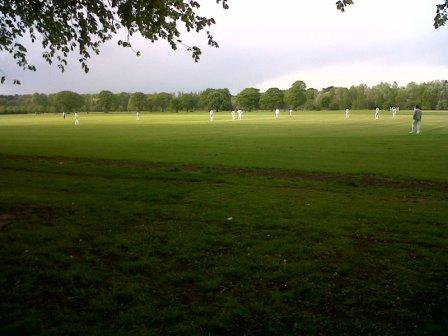


 In the Dark