The news on the radio this morning featured a story about the Prime Minister wanting the UK to “get behind” hydraulic fracturing (or “fracking” as it is known for short) , a means of liberating shale gas that offers the prospect of boosting the UK’s energy supply.
There’s not much sign any “getting behind” happening up the road from here in Balcombe, where a sizable anti-fracking protest has been going on for some time. There’s actually no fracking going on in Balcombe at the moment; the company involved, Cuadrilla Resources, is doing exploratory drilling to look for oil but may apply for a licence to pursue hydraulic fracturing if that is unsuccessful.
There’s a simple graphic on the BBC website that illustrates how fracking works:
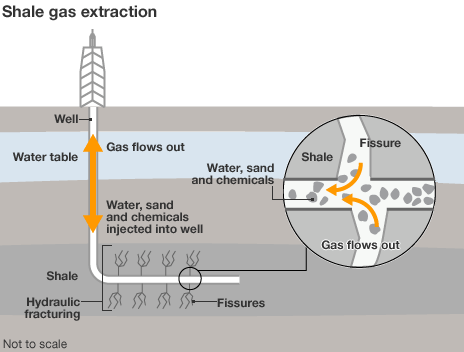
In simple terms it involves pumping a mixture of water, sand and chemicals into a deposit of shale ato fracture the solid material contained therein and thus liberate the gas. Environmentalists argue that this technique might cause earth tremors and/or contamination of the water supply; advocates of fracking dispute these claims. I’m not sufficiently expert to be able to comment usefully on the arguments about the possible environmental dangers associated with it, so I’d be glad to receive comments via the box below.
One thing I will comment on, though, is the very poor quality of the media reporting on this issue. I’ve yet to see any meaningful attempt to comment on the science involved when surely that’s the key to whether we should “get behind” fracking or not? It struck me that quite a few readers might also be interested but ill-informed about this issue to, so for them I’d recommend reading the Beddington Report, the key findings of which were:
- The health, safety and environmental risks can be managed effectively in the UK. Operational best practices must be implemented and enforced through strong regulation. Fracture propagation is an unlikely cause of contamination.
- The risk of fractures propagating to reach overlying aquifers is very low provided that shale gas extraction takes place at depths of many hundreds of metres or several kilometres. Even if fractures reached overlying aquifers, the necessary pressure conditions for contaminants to flow are very unlikely to be met given the UK’s shale gas hydrogeological environments.
- Well integrity is the highest priority. More likely causes of possible contamination include faulty wells. The UK’s unique well examination scheme was set up so that independent, specialist experts could review the design of every offshore well. This scheme must be made fit for purpose for onshore activities.
- Robust monitoring is vital. Monitoring should be carried out before, during and after shale gas operations to detect methane and other contaminants in groundwater and potential leakages of methane and other gases into the atmosphere.
- An Environmental Risk Assessment (ERA) should be mandatory. Every shale gas operation should assess risks across the entire lifecycle of operations, from water use through to the disposal of wastes and the abandonment of wells.
- Seismic risks are low. Seismicity should be included in the ERA.Seismicity induced by hydraulic fracturing is likely to be of smaller magnitude than the UK’s largest natural seismic events and those induced by coal mining.
- Water requirements can be managed sustainably. Water use is already regulated by the Environment Agency. Integrated operational practices, such as recycling and reusing wastewaters where possible, would help to minimise water requirements further. Options for disposing of wastes should be planned from the outset. Should any onshore disposal wells be necessary in the UK, their construction, regulation and siting would need further consideration.
- Regulation must be fit for purpose. Attention must be paid to the way in which risks scale up should a future shale gas industry develop nationwide. Regulatory co-ordination and capacity must be maintained.
- Policymaking would benefit from further research. The carbon footprint of shale gas extraction needs further research. Further benefit would also be derived from research into the public acceptability of shale gas extraction and use in the context of the UK’s energy, climate and economic policies.
I’m not sure how many anti-fracking activists, or others involved in the Balcombe protest, have read this report.
Anyway, in an attempt to gauge the mood of my totally unrepresentative readership, I thought I’d try a little poll:
And if you have strong opinions, please feel free to use the comments box.
Follow @telescoper
 In the Dark