Archive for Daylight Saving Time

It’s That Time Again

Posted in Biographical, Maynooth with tags , , , , on October 26, 2025 by telescoper
Photo by Ola Dapo on Pexels.com

It’s Sunday 26th October 2025 and in the early hours of this morning the clocks went back, bidding goodbye to Summer Time. You can tell I’m an oldie because I have quite a lot of time-keeping devices around the house that need to be set by hand. My computer updates itself, of course, but I’m not sure if WordPress does. I’ll find out when I publish this post!

I’ve written before about the silly business of moving the clocks backwards and forwards (e.g. here) so I won’t repeat it all again. I will mention, however, that some time ago, before the Covid-19 Pandemic, the European Parliament approved a directive that would abolish `Daylight Saving Time’.  Unfortunately that plan was ‘paused’ although Spain is apparently going to try to get it going again.  I’ve long felt that the annual ritual of putting the clocks forward in the Spring and back again in the Autumn was a waste of time effort, so I’ll be glad if and when this silly practice is terminated. It would be far better in my view to stick with a single Mean Time throughout the year. I’m disappointed that this hasn’t already happened.

Anyway, talking of time, we have now completed five weeks of teaching in Semester 1 at Maynooth University. Tomorrow (Monday 27th October) is the October Bank Holiday and next week is Study Week so there are no lectures or tutorials. We do, however, have conferring (graduation) ceremonies including one that involves my recently-completed PhD student. Looking at my diary I notice also that I also have an appointment for my flu jab and Covid-19 booster, another sign that I’m an old codger.

Normally Study Break comes halfway through the 12-week teaching term but this year it splits 5-7. It did so last year too, actually. I am not unhappy to have an earlier break as I’m very tired, but I am conscious that this is going to make for a longer run-in to the Christmas holiday. We are supposed to teach up until Friday 19th December, but I don’t have any lectures on that day.

I’m not sure how much studying the students do during Study Week, but it’s not a holiday for academic staff even though there is no undergraduate teaching. Among other things we have examinations to write for the January examination period, which must be checked and printed well in advance. The deadline for these is November 3rd, so I have all week but I am planning to spend next weekend elsewhere so I need to get them done beforehand.
Saving Time Again

Posted in Biographical, Maynooth with tags , , , on October 27, 2024 by telescoper

It’s Sunday 27th October 2024 and in the early hours of this morning the clocks went back, bidding goodbye to Summer Time. You can tell I’m an oldie because I have quite a lot of time-keeping devices around the house that need to be set by hand. My computer updates itself, of course, but I’m not sure if WordPress does. I’ll find out when I publish this post!

I’ve written before about the silly business of moving the clocks backwards and forwards (e.g. here) so I won’t repeat it all again. I will mention, however, that some time ago, before the Covid-19 Pandemic, the European Parliament approved a directive that would abolish `Daylight Saving Time’.  Unfortunately that plan has been ‘paused’ and there’s no sign of it happening for the foreseeable future.  I’ve long felt that the annual ritual of putting the clocks forward in the Spring and back again in the Autumn was a waste of time effort, so I’ll be glad when this silly practice is terminated. It would be far better in my view to stick with a single Mean Time throughout the year. I’m disappointed that this hasn’t already happened.

Anyway, talking of time, we have now completed five weeks of teaching in Semester 1 at Maynooth University. Tomorrow (Monday 28th October) is the October Bank Holiday and next week is Study Week so there are no lectures or tutorials. When I took the train into Dublin on Friday evening I noticed it was much less busy than during term-time. I think most students had already left for the week.

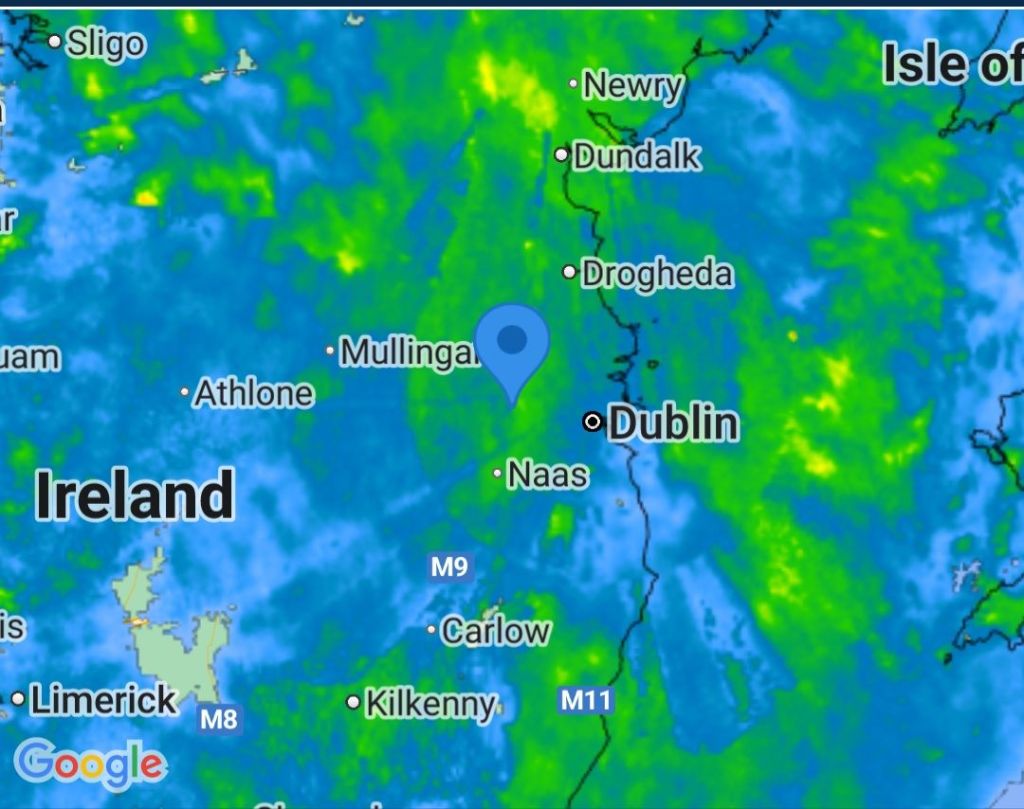
Bank Holiday Weekend Weather..

Normally Study Break comes halfway through the 12-week teaching term but this year it splits 5-7. Since I’m teaching two new modules this term I am not unhappy to have an earlier break to allow me a bit more time for preparation and to catch up on some correcting, but I am conscious that this is going to make for a longer run-in to the Christmas holiday. We are supposed to teach up until Friday 20th December, on which day I do have a lecture scheduled, though I suspect attendance will be low!

I’m not sure how much studying the students do during Study Week, but it’s not a holiday for academic staff even though there is no undergraduate teaching. Among other things we have examinations to write for the January examination period, which must be checked and printed well in advance. The break from teaching will also allow me a bit of time to work on my retirement plans and figure out how much Time I can afford buy with my Savings…

It’s That Time Again…

Posted in Barcelona, History with tags , , on October 29, 2023 by telescoper

It’s 29th October 2023, which marks the end of “Summer Time” in Europe. Accordingly, the temperature in Barcelona has plummetted to 22°C. I have to make a flying visit to the UK next week and I suspect that I’m in for a bit of a shock, having adjusted to these balmy climes.  I have numerous telecons next week too and, since  some parts of the world will be still on Daylight Saving Time (or whatever) there’s potential for confusion in the timing.

Some time ago, before the Covid-19 Pandemic, the European Parliament approved a directive that would abolish `Daylight Saving Time’.  Unfortunately that plan has been ‘paused’ and there’s no sign of it happening for the foreseeable future.  I’ve long felt that the annual ritual of putting the clocks forward in the Spring and back again in the Autumn was a waste of time effort, so I’ll be glad when this silly practice is terminated. It would be far better in my view to stick with a single Mean Time throughout the year. I’m only disappointed that this hasn’t happened already.

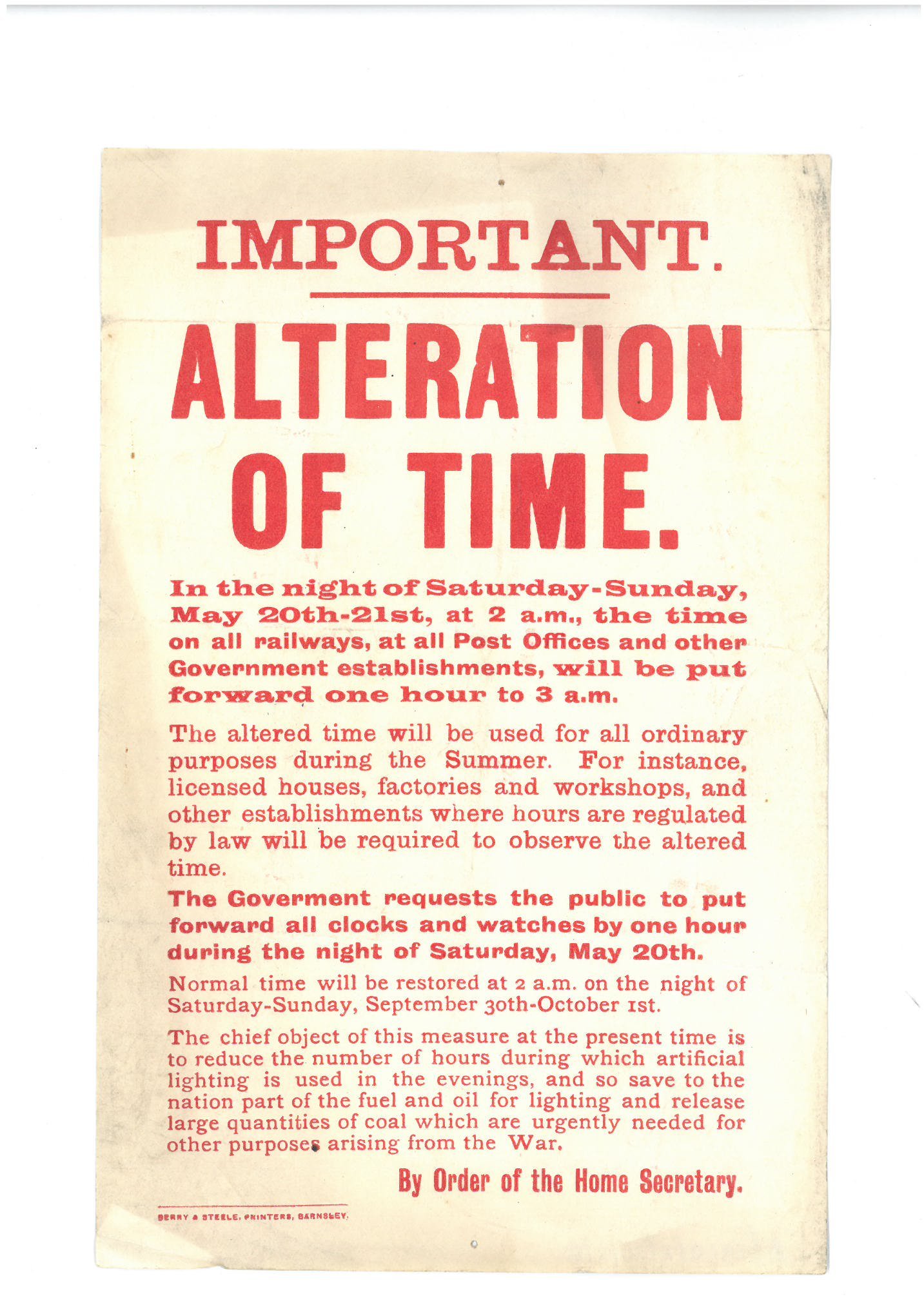
The marvellous poster above is from 1916, when British Summer Time was introduced. I was surprised to learn recently that the practice of changing clocks backwards and forwards in the UK is only about a hundred years old and was introduced as an emergency measure in wartime. To be honest I’m also surprised that the practice persists to this day, as I can’t see any real advantage in it. Any institution or organisation that really wants to change its working hours in summer can easily do so, but the world of work is far more flexible nowadays than it was a hundred years ago and I think very few would feel the need.

Anyway, while I am on about Mean Time, here is a another poster from 1916.

Until October 1916, clocks in Ireland were set to Dublin Mean Time, as defined at Dunsink Observatory, rather than at Greenwich. The adoption of GMT in Ireland was driven largely by the fact that the British authorities found that the time difference between Dublin and London had confused telegraphic communications during the Easter Rising earlier in 1916. Its imposition was therefore, at least in part, intended to bring Ireland under closer control. This did not go down well with Irish nationalists.

Ireland had not moved to Summer Time with Britain in May 1916 because of the Easter Rising. Dublin Mean Time was 25 minutes 21 seconds behind GMT but the change to GMT was introduced in Ireland at the same time as BST ended in the UK, hence the alteration by one hour minus 25 minutes 21 seconds, i.e. 34 minutes and 39 seconds as in the poster.

Britain will probably never scrap British Summer Time on the grounds that whatever the EU does must necessarily be bad. What will happen to Northern Ireland when Ireland scraps Daylight Saving Time is yet to be seen.

Changing Time Again

Posted in History with tags , , on October 30, 2022 by telescoper

Some time ago, before the Covid-19 Pandemic, the European Parliament approved a directive that would abolish `Daylight Saving Time’. Unfortunately that plan has been ‘paused’ and this year we had to go through the usual rigmarole of putting the clocks back. Fortunately most devices do this automatically, though I have never figured out how to change the time on the clock on my cooker which means that we’re now in the 5 months of the year during which it shows the correct time.

I’ve long felt that the annual ritual of putting the clocks forward in the Spring and back again in the Autumn was a waste of time effort, so I’ll be glad when this silly practice is terminated. It would be far better in my view to stick with a single Mean Time throughout the year. I’m only disappointed that this hasn’t happened already.

The marvellous poster above is from 1916, when British Summer Time was introduced. I was surprised to learn recently that the practice of changing clocks backwards and forwards in the UK is only about a hundred years old and was introduced as an emergency measure in wartime. To be honest I’m also surprised that the practice persists to this day, as I can’t see any real advantage in it. Any institution or organisation that really wants to change its working hours in summer can easily do so, but the world of work is far more flexible nowadays than it was a hundred years ago and I think very few would feel the need.

Anyway, while I am on about Mean Time, here is a another poster from 1916.

Until October 1916, clocks in Ireland were set to Dublin Mean Time, as defined at Dunsink Observatory, rather than at Greenwich. The adoption of GMT in Ireland was driven largely by the fact that the British authorities found that the time difference between Dublin and London had confused telegraphic communications during the Easter Rising earlier in 1916. Its imposition was therefore, at least in part, intended to bring Ireland under closer control. This did not go down well with Irish nationalists.

Ireland had not moved to Summer Time with Britain in May 1916 because of the Easter Rising. Dublin Mean Time was 25 minutes 21 seconds behind GMT but the change to GMT was introduced in Ireland at the same time as BST ended in the UK, hence the alteration by one hour minus 25 minutes 21 seconds, i.e. 34 minutes and 39 seconds as in the poster.

Britain will probably never scrap British Summer Time on the grounds that whatever the EU does must be bad. What will happen to Northern Ireland when Ireland scraps Daylight Saving Time is yet to be seen…

Changing Time

Posted in History, Politics with tags , , , , , , , , , on March 27, 2019 by telescoper

Among the many sensible decisions made yesterday by the European Parliament was to approve a directive that will abolish `Daylight Saving Time’. I’ve long felt that the annual ritual of putting the clocks forward in the Spring and back again in the Autumn was a waste of time effort, so I’ll be glad when this silly practice is terminated.
It would be better in my view to stick with a single Mean Time throughout the year. I’m only disappointed that this won’t happen until 2021 as EU countries have to enact the necessary legislation according to their constitutional processes.

The marvellous poster above is from 1916, when British Summer Time was introduced. I was surprised to learn recently that the practice of changing clocks backwards and forwards is only about a hundred years old. in the United Kingdom. To be honest I’m also surprised that the practice persists to this day, as I can’t see any real advantage in it. Any institution or organisation that really wants to change its working hours in summer can easily do so, but the world of work is far more flexible nowadays than it was a hundred years ago and I think few would feel the need.

Anyway, while I am on about Mean Time, here is a another poster from 1916.

Until October 1916, clocks in Ireland were set to Dublin Mean Time, as defined at Dunsink Observatory rather than at Greenwich. The adoption of GMT in Ireland was driven largely by the fact that the British authorities found that the time difference between Dublin and London had confused telegraphic communications during the Easter Rising earlier in 1916. Its imposition was therefore, at least in part, intended to bring Ireland under closer control and this did not go down well with Irish nationalists.

Ireland had not moved to Summer Time with Britain in May 1916 because of the Easter Rising. Dublin Mean Time was 25 minutes 21 seconds behind GMT but the change was introduced at the same time as BST ended in the UK, hence the alteration by one hour minus 25 minutes 21 seconds, ie 34 minutes and 39 seconds as in the poster.

Britain will probably not scrap British Summer Time immediately as it will be out of the European Union by then. British xenophobia will resist this change on the grounds that anything to do with the EU must be bad. What happens to Northern Ireland when Ireland scraps Daylight Saving Time is yet to be seen.

Moreover the desire expressed by more than one Brexiter to return to the 18th Century may be behind the postponement of the Brexit deadline from 29th March to 12th April may be the result of an attempt to repeal the new-fangled Gregorian calendar (introduced in continental Europe in 1582 but not adopted by Britain until 1750). It’s not quite right though: 29th March in the Gregorian calendar would be 11th April in the Gregorian calendar…