One of the bonuses on offer during the BBC Proms season on Radio 3 is the opportunity to listen to the fascinating discussions recorded over the road from the Albert Hall at Imperial College and broadcast during the intervals under the title of Proms Extra. Last week (at Prom Number 4) there was a discussion with the title Deep Time, taking its theme from the UK premier of a fascinating composition of the same name by Sir Harrison Birtwistle.
The Proms Extra programme focussed on `Deep Time’ in the sense in which it is used in geological, i.e. time as inferred from rock strata and the fossil record. In the course of the discussion mention was made of Doggerland which is not, as you might imagine, a theme park devoted to outdoor sexual activities, but an area now submerged beneath the North Sea that connected Great Britain to continental Europe during and after the last glacial period. About 12,000 years ago at the start of the Holocene Era, it is thought that the area now covered by the North Sea looked something like this:

(Picture credit: this website). Obviously the cities marked on the map where not there at the time! Britain was connected to mainland at this time, although much of the land mass was under glaciers at the time. At the end of the last ice age the glaciers retreated, sea levels rose and the area once covered by Doggerland was submerged. It is thought that this happened around 8500 years ago. Great Britain has been separated from the continent by less than 10,000 years.
Doggerland gets its name from the Dogger Bank, a huge sandbank off the North-Eastern coast of England which is thought to be a glacial moraine left behind by the retreating ice sheet. The Dogger bank lies about 60 miles from the coast, and is about 60 miles wide by 100 miles long. The water is quite shallow – typically 20 metres deep and is a well-known fishing area. Its name derives from old Dutch fishing vessels called doggers who specialised in catching cod. Here’s a map (from here) showing the Dogger Bank:
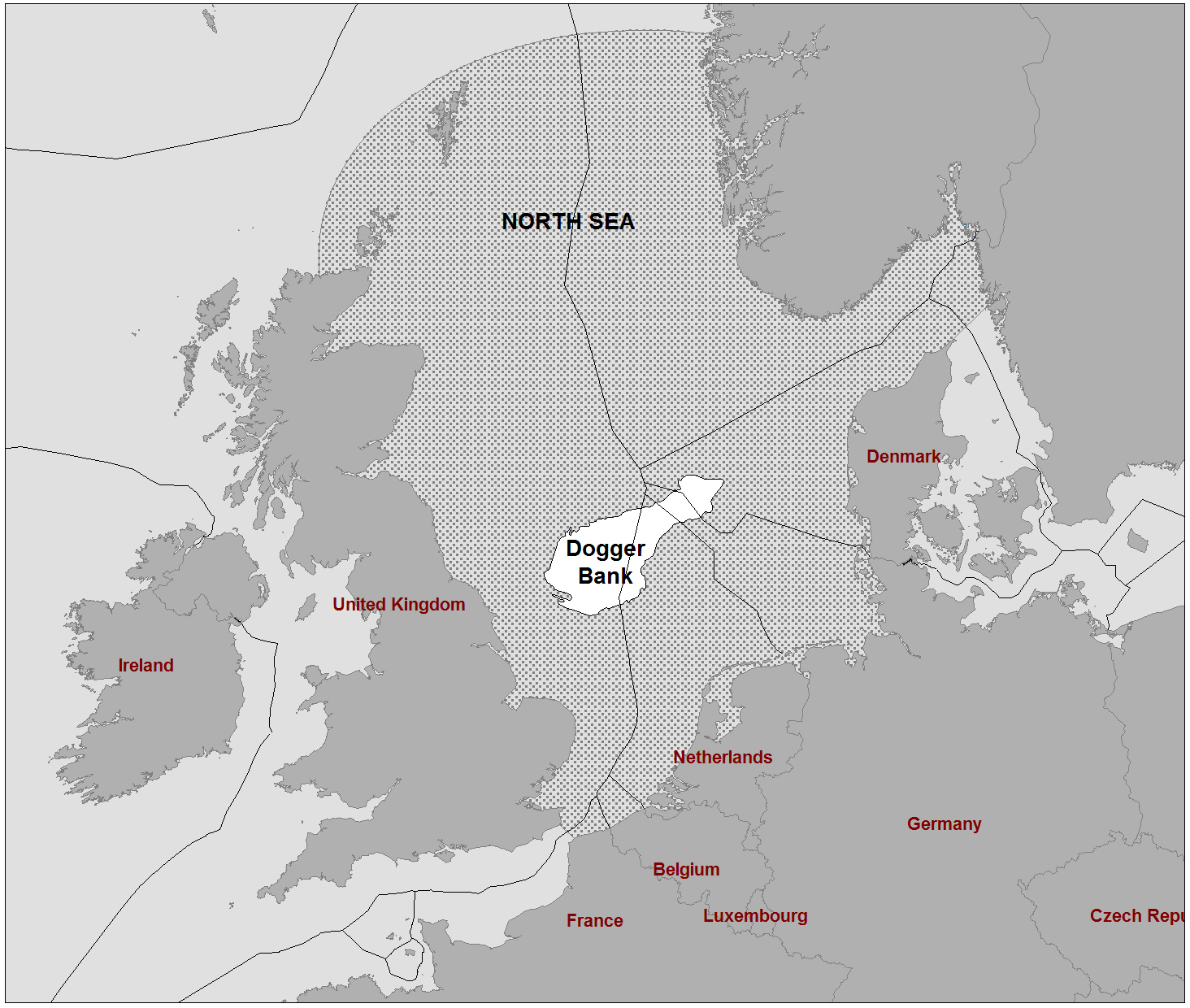
When I was a teenager I had the opportunity, with a few friends from school, to go out from Newcastle in a trawler to the Dogger Bank. The skipper insisted that the Dogger Bank was, in places, so shallow that you could paddle around on it with your trousers rolled up. We all believed him, but he was clearly having us on!
The other thing I remember about that trip in a trawler – apart from the all-pervasive smell of fish – was that a bit of storm brewed up on the way home. All my school friends got sea-sick, but I didn’t. That was the first time I realised that I don’t suffer from seasickness. I can enjoy travelling on ships and boats without having to worry about it.
Dogger is of course also the name of one of the sea areas used in the Shipping Forecast: it is East of the coastal area Tyne, South of Forties, North of Humber and West of German Bight. Whenever I hear the shipping forecast on the radio, I always feel a bit of nostalgia when I hear the names of these areas read out.
Anyway, trawlers operating at the Dogger Bank frequently bring up bits of ancient animals (including mammoth and rhinoceros) as well as prehistoric human artefacts, showing that the area was at one time inhabited. I don’t think anybody knows exactly how long it took Doggerland to become submerged, but it may well have involved one or more catastrophic flooding events. If there were people living on Doggerland then, they obviously had to migrate one way or the other..
Follow @telescoper

 In the Dark