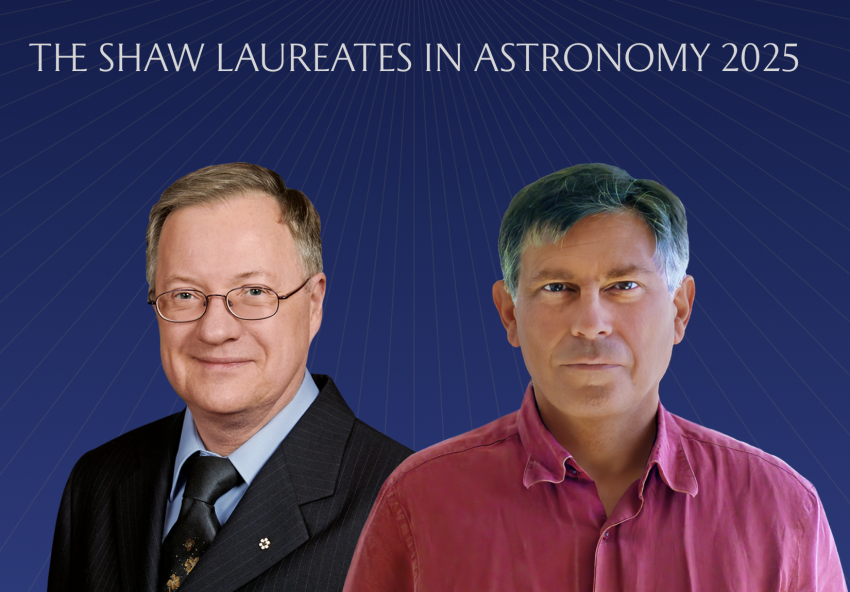
I’m a few days late on this, as the announcement on 27th May came at a very busy time, but it’s a pleasure to pass on the news that the 2025 Shaw Prize for Astronomy has been awarded to Dick Bond and George Efstathiou. Congratulations to both on a very well deserved award!
The full citation can be found here, but the first paragraph reads:
The Shaw Prize in Astronomy 2025 is awarded in equal shares to John Richard Bond, Professor of the Canadian Institute for Theoretical Astrophysics and University Professor at the University of Toronto, Canada and George Efstathiou, Professor of Astrophysics at the University of Cambridge, UK for their pioneering research in cosmology, in particular for their studies of fluctuations in the cosmic microwave background. Their predictions have been verified by an armada of ground-, balloon- and space-based instruments, leading to precise determinations of the age, geometry, and mass-energy content of the universe.
One of the first papers I was given to read when I started my postgraduate studies in 1985 was the pioneering Bond & Efstathiou (1984) “Cosmic background radiation anisotropies in universes dominated by nonbaryonic dark matter”. Here is the abstract:
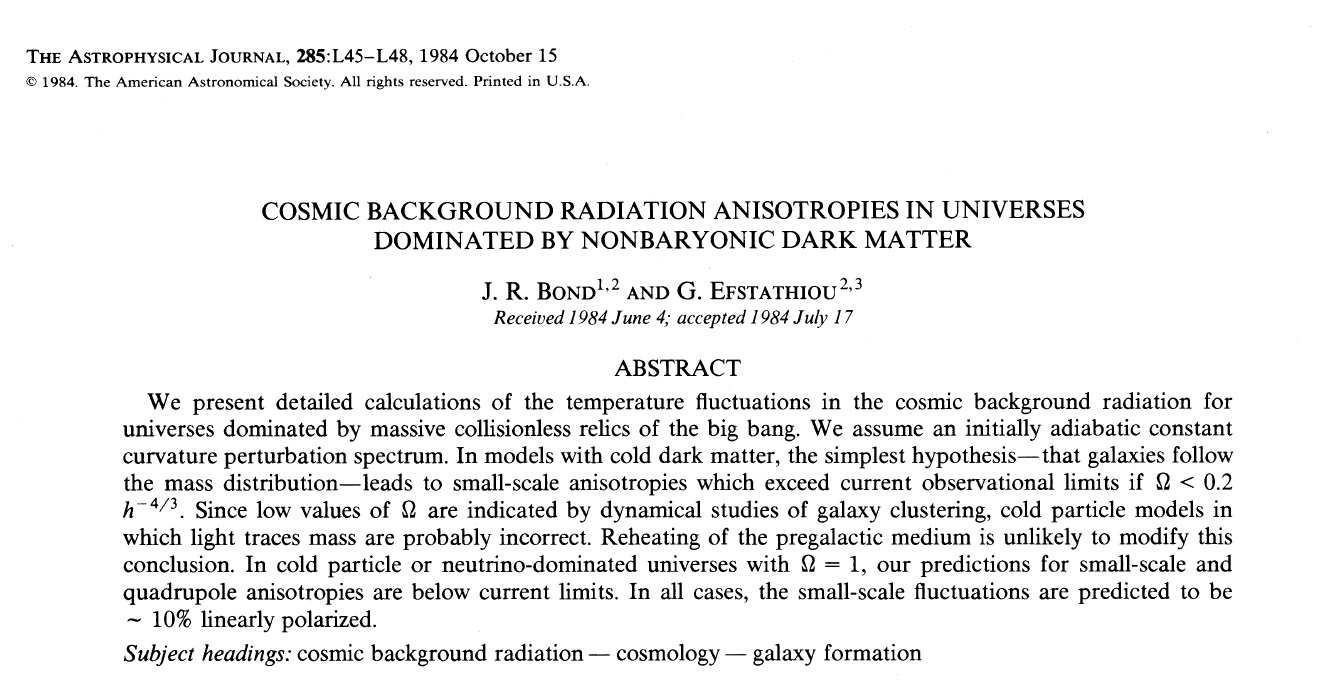
This work was hugely influential and prescient in many ways. It does remind me, though, that in the 1980s, before the detection of large-scale anisotropies by the Cosmic Background Explorer (COBE) announced in 1992, the prevailing mentality was to find models in which the predicted cosmic microwave background anistropies were as small as possible. The COBE fluctuations turned out to be rather larger than those predicted in the model discussed in the paper, which was one reason why the standard cosmological model now has a lower density of dark matter than then.
On a more technical level, the paper also reminds us that it was to be a while until the angular power spectrum, as opposed to the correlation function, became the standard tool it is now for quantifying the statistical properties of these temperature fluctuations.
The Shaw Prize wasn’t awarded for just this paper, of course, but I think it’s emblematic of the sustained importance and influence of the work of the Laureates over many years.

 In the Dark