The Winter Solstice in the Northern hemisphere happens later today, Wednesday 21st December, at 21:48 Irish Time.
People often think that the Winter Solstice is defined to be the “shortest day” or the “longest night” of the year. The Solstice does indeed happen on the shortest day, but it is defined in astronomical terms much more precisely than that. It happens when the axial tilt of the Earth away from the Sun is greatest, so that the Sun appears in the sky with its lowest maximum elevation. The timing of this event can be calculated with great precision.
Anyway, today is the shortest day of the year in the Northern hemisphere. Days will get steadily longer from then until the Summer Solstice next June. The shortest day – defined by the interval between sunrise and sunset – is today, although not by much. Today in Dublin is shorter than yesterday by about six seconds, but tomorrow will be longer than today by less than a second.
This does not, however, mean that sunrise will happen earlier tomorrow than it did this morning. Actually, sunrise will carry on getting later until the new year, the length of the day nevertheless increasing because sunset occurs even later. Sunrise yesterday morning (20th December) was at 08.42 Dublin Time while today it was 08.43; the latest sunrise will be on 30th December (09.05). Sunset last night was at 16.49 and tonight it will be at 16.50. The earliest sunset this year was actually on 13th December (16:48).
These complications arise because there is a difference between mean solar time (measured by clocks) and apparent solar time (defined by the position of the Sun in the sky, i.e. what you would measure on a sundial), so that a solar day does not always last exactly 24 hours as measured by a clock. A description of apparent and mean time was given by Nevil Maskelyne in the Nautical Almanac for 1767:
Apparent Time is that deduced immediately from the Sun, whether from the Observation of his passing the Meridian, or from his observed Rising or Setting. This Time is different from that shewn by Clocks and Watches well regulated at Land, which is called equated or mean Time.
The discrepancy between mean time and apparent time arises because of the Earth’s axial tilt and the fact that it travels around the Sun in an elliptical orbit in which its orbital speed varies with time of year (being faster at perihelion than at aphelion). The upshot of this is that solar noon – when the Sun is at its highest point in the sky on a given day – is not always at 12 noon local mean time. Solar noon today in Ireland is actually at 12.30 Irish time. Around the time of the Winter Solstice, solar noon is getting later in the day and this will continue to happen until well into the New Year; solar noon on New Year’s Eve is at 12.34. While the interval between sunrise and sunset shrinks towards the solstice, the mid-point of this interval is drifting later in the day, making both sunrise and sunset occur later despite the gap between the two getting smaller.
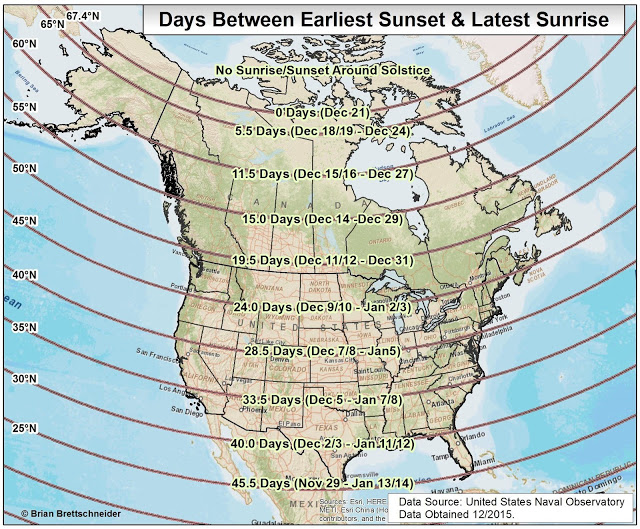
The discrepancy between latest sunrise (or earliest) and the solstice varies with latitude, although if you go far enough North into the Arctic Circle, there is neither sunrise or sunset around the Winter Solstice, and if you go far enough South to the Equator the length of the day does not vary at all with time of year. The behaviour is illustrated for North America in this graphic produced by the United States Naval Observatory
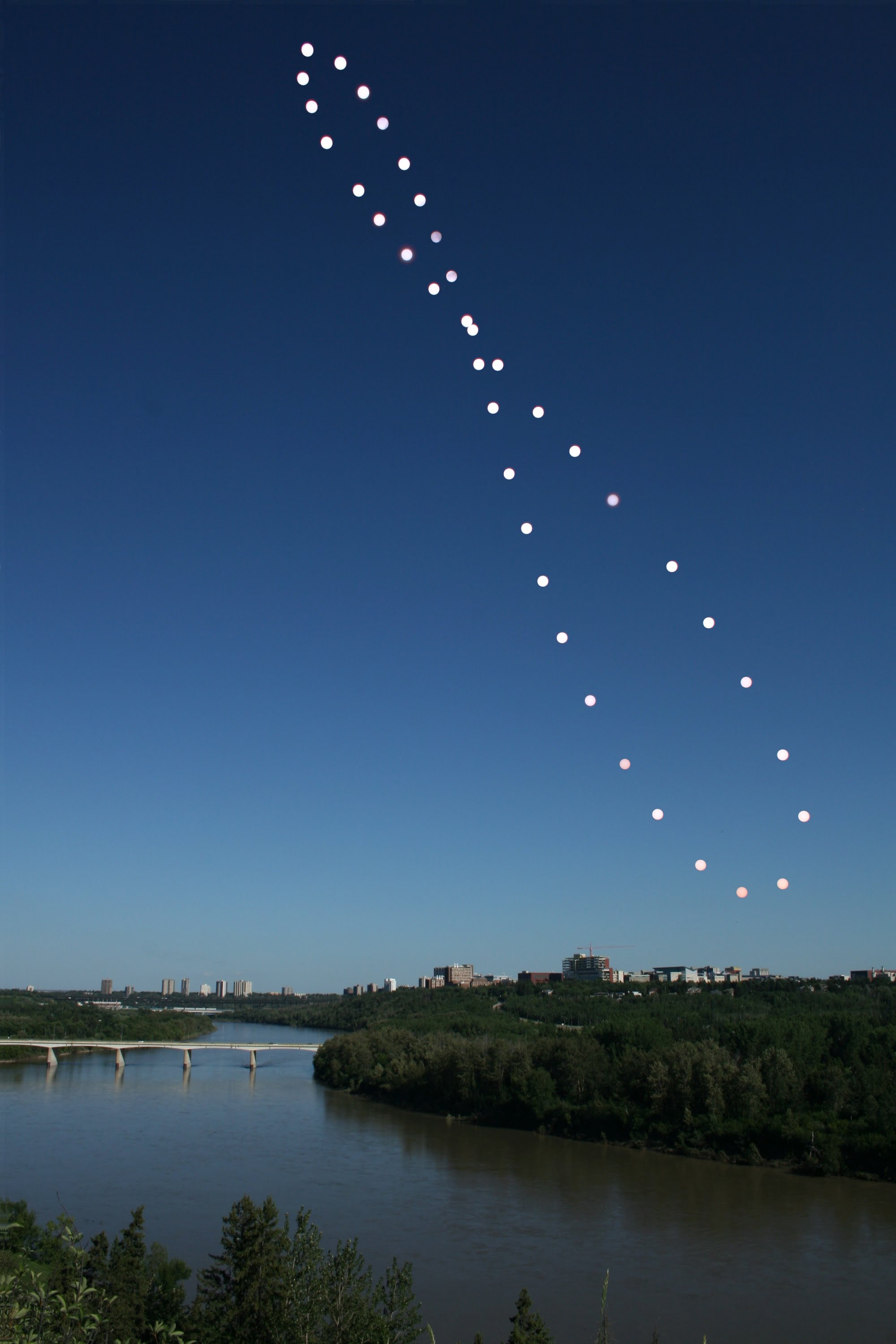
If you plot the position of the Sun in the sky at a fixed time each day from a fixed location on the Earth you get a thing called an analemma, which is a sort of figure-of-eight shape whose shape depends on the observer’s latitude. Here’s a photographic version taken in Edmonton, with photographs of the Sun’s position taken from the same position at the same time on different days over the course of a year:
The winter solstice is at the lowermost point on this curve and the summer solstice is at the top. These two turning points define the time of the solstices much more precisely than the “shortest day” or “longest night”. The Winter Solstice is takes place at a very specific time, when the angle of tilt of the Earth’s axis relative to the Sun is maximum.
Anyway, the north–south component of the analemma is the Sun’s declination, and the east–west component arises from the equation of time which quantifies the difference between mean solar time and apparent solar time. This curve is used to calculate the earliest and/or latest sunrise and/or sunset. Looking at a table of the local mean times of sunrise and sunset for Dublin around the 2022 winter solstice shows that today is indeed the shortest day (with a time between sunrise and sunset of 7 hours 33 minutes and 49 seconds).
P.S. As usual, crowds gathered today at the spectacular neolithic monument at Newgrange in County Meath to observe the sunrise at the Solstice.


 In the Dark