A very busy day today so I thought I’d wind down by giving you a chance to test your brains with some order-of-magnitude physics problems. I like using these in classes because they get people thinking about the physics behind problems without getting too bogged down in or turned off by complicated mathematics. I’ve also kept some of these in archaic units just to annoy people who can only do things in the SI system. I think it’s good to practice swapping between systems, especially for us astro-types who use all kinds of bizarre units, so if you don’t know the units, look them up! And if there’s any information missing that you need to solve the problem, make an order-of-magnitude estimate!
Give order of magnitude answers to the following questions:
What is the mass of a body whose weight is equivalent to the total force exerted by a 40 mph gale on the side of a house 40 ft long and 20 ft high? Express your answer in tons.
What is the power required to keep in the air a helicopter of mass 500 kg whose blades are 3m long? Express your answer in kilowatts.
The base of the Great Pyramid is 750 ft square and its height is 500ft. How much work was done building it? Express your answer in Joules.
How high would the jet of a fountain reach if it were aimed vertically up and supplied by a water main in which the pressure is 3 atmospheres? Express your answer in feet.
There’s no prize involved, but feel free to post answers through the comments box. It would be helpful if you explained a bit about how you arrived at your answer!
I’m back home now after a trip to and from the fine city of Edinburgh which, in case you weren’t aware, is known to the locals as Auld Reekie. I wonder if there’s a local internet guide called Reekipedia?
The excuse for this trip was an invitation to take part in an exercise called a Teaching Programme Review in the School of Physics & Astronomy at the University of Edinburgh. The TPR is an exercise that looks at the courses on offer in the department, how they are taught, as well as the technical and administrative arrangements to back it all up. The Panel involved people from other departments inside the University and a couple of external advisers (both physicists), of which I was one. The Panel will be writing a detailed report on our findings which I hope will turn out to be useful, but it definitely wouldn’t be appropriate to comment on the details here.
What I will say here is that, although it was a very intense and busy few days, including face-to-face meetings with all kinds of academic and support staff, as well as current students, it was extremely interesting. As well as hopefully providing some input and suggestions to the TPR, it was also a chance for me to see the inner workings of another department and pick up a few ideas for the way we teach Physics courses in Cardiff.
One of the striking things about this visit was how similar are many of the problems facing Edinburgh to those we encounter in Cardiff. Another is how easy it is to recognize kindred spirits. It may not always be obvious to the students, but physicists are passionate about their subject, not only in terms of their research but also in terms of nurturing the talents of the students in their care. In the Brave New World of Higher Education we’re all supposed to see universities as businesses, competing ruthlessly in an unforgiving marketplace. In fact, most of us at the real business end of the university system (i.e. teaching and research as opposed to PR and marketing) see our competitors more as colleagues than as rivals. Long may that continue, in my opinion.
During the visit I was taken on a tour of the excellent facilities available at Edinburgh, including some really snazzy and impressive “teaching studios” the like of which I’d never seen before. I’d really love to have a go at teaching in one of those some day, as they offer a different style of education which I’m sure complements the more traditional lecture format. The students seem to like them a lot, which is the most important thing.
However, I have to say that the thing that I was most jealous about was the fact that most of their teaching rooms still have blackboards. Ours have all been replaced with horrible whiteboards that require expensive markers and are far less visible to a big audience. “Chalk and talk” is a tried and tested method and when it’s done well I still think it’s a very effective one. I’m all for innovation in teaching, but some traditional methods are actually pretty good!
Anyway, I’d like to thank everyone from Auld Reekie University for hosting this visit. It was hard work, but thoroughly enjoyable. If anyone from Edinburgh reads this I hope they will pass on my thanks to all the staff and students there for making it such a rewarding occasion! I’m just sorry I didn’t have the chance to see a bit more of the city, but the schedule was just too hectic.
What I did enjoy was staying in a nice hotel for 3 days that offered a truly splendid cooked breakfast in the mornings. I hadn’t started the day with kippers for a very long time! Might need to go on a diet for a few days though….
I’ve just taken a short break from reading grant applications and filling in forms to read through the stack of teaching questionnaires that arrived yesterday, along with a complicated statistical analysis which I won’t even try to explain – because I don’t understand it.
These questionnaires are handed out during a lecture, filled in by the students (anonymously), and then sent off to be analysed by a team of elves. Doing this during a lecture ensures a reasonable rate of return; in my case about 2/3 of the students returned completed questionnaires. The results are condensed into a “Figure of Merit” (FOM) using a mystic formula of some sort. If my FOM turned out badly I would probably try to work out what it means, but since it’s quite good I’ll just assume the algorithm is excellent.
Questions on the questionnaire are divided into questions about the module (we don’t have courses, we have modules), e.g. is it easy, hard, interesting etc, and questions about the lecturer(s), e.g. was he/she audible, legible. Generally speaking, students seemed to enjoy this particular first-year module, Astrophysical Concepts, but also thought it was difficult. In fact it’s a generic outcome of this sort of analysis that modules that are considered to be easy don’t get the best student feedback – they don’t seem to mind so much if the material is difficult, as long as it is interesting. I think that’s where astrophysics is a lot easier to score well than, say, solid state physics.
The only thing I was disappointed with was the score for the responses to the prompt “The lecturer wrote helpful comments on the marked homework“. In fact, I didn’t write anything at all on the marked homework because I didn’t mark it – that’s usually done by PhD students, according to a mark scheme I provide. Nevertheless, I do post full worked solutions (on a system called Learning Central) along with the mark scheme after the scripts have been returned to students so they can easily find out where they went wrong and how they lost marks. I though that, supplemented by the comments written by the markers on the scripts, would be sufficient feedback. Obviously not. Heigh-ho.
More interesting than the statistical analysis (to me) are the individual comments written on the reverse of the questionnaire. Most don’t write anything at all here, but there’s an opportunity to massage one’s ego by reading things like “Best lecturer this term by a long, long way”. Actually, come to think of it, that was the only one that said that.
Occasionally, however, one comes across a disgruntled response. An example was
I think the homeworks should be on Blackboard. They never are. If you misplace a homework you can never get another!
Sigh. Actually, all the homeworks were put on Blackboard (the older name for Learning Central) at the same time that I handed them out. As a matter of fact, they’re all still there…along with the solutions in a folder marked Assignments.
Anyway, Astrophysical Concepts was fun to teach and popular with the students, so obviously it had to go. It’s now been discontinued and replaced in the first year by a module about Planets. But I think some of it will make a return in a new problem-solving class for 2nd year students…
PS. In case you’re not up with the jargon, “reflective practice” is “the capacity to reflect on action so as to engage in a process of continuous learning” and is “one of the defining characteristics of professional practice” that involves “paying critical attention to the practical values and theories which inform everyday actions, by examining practice reflectively and reflexively. This leads to developmental insight.”
In other words, thinking about the stuff you do in order to do it better.
I thought I’d reblog this because it pertains to my earlier post from today…
I’ve had a healthy number of responses to my question from the previous post. In case you are reading this post without having read the previous one, I shall continue after the fold, because if you read on it will render you ineligible to participate in the little experiment I am conducting. Every year in Britain, at round about this time of the year, we have the same debate. The GCSE and A-level results come out (these are taken at the ages of 1 … Read More
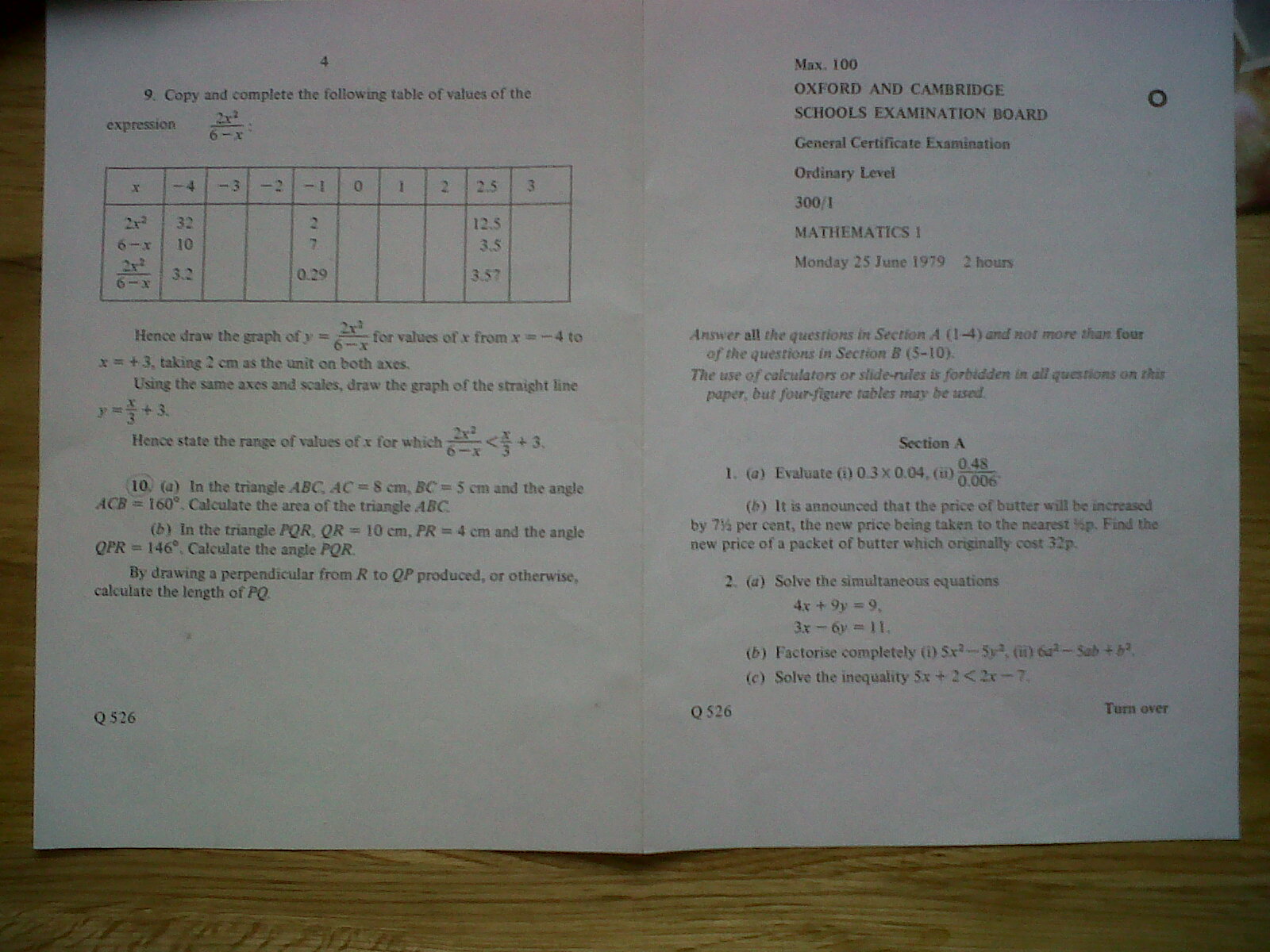
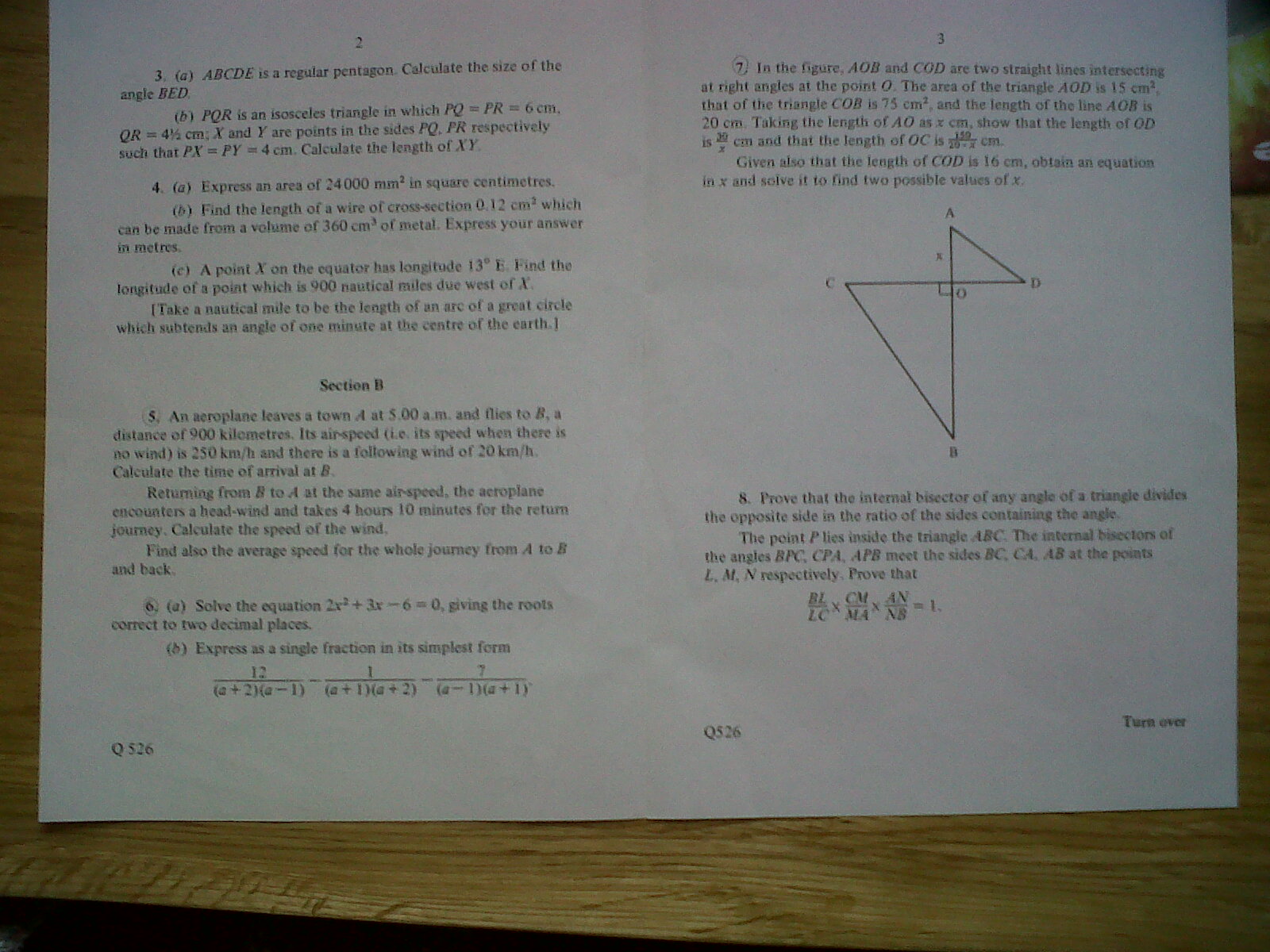
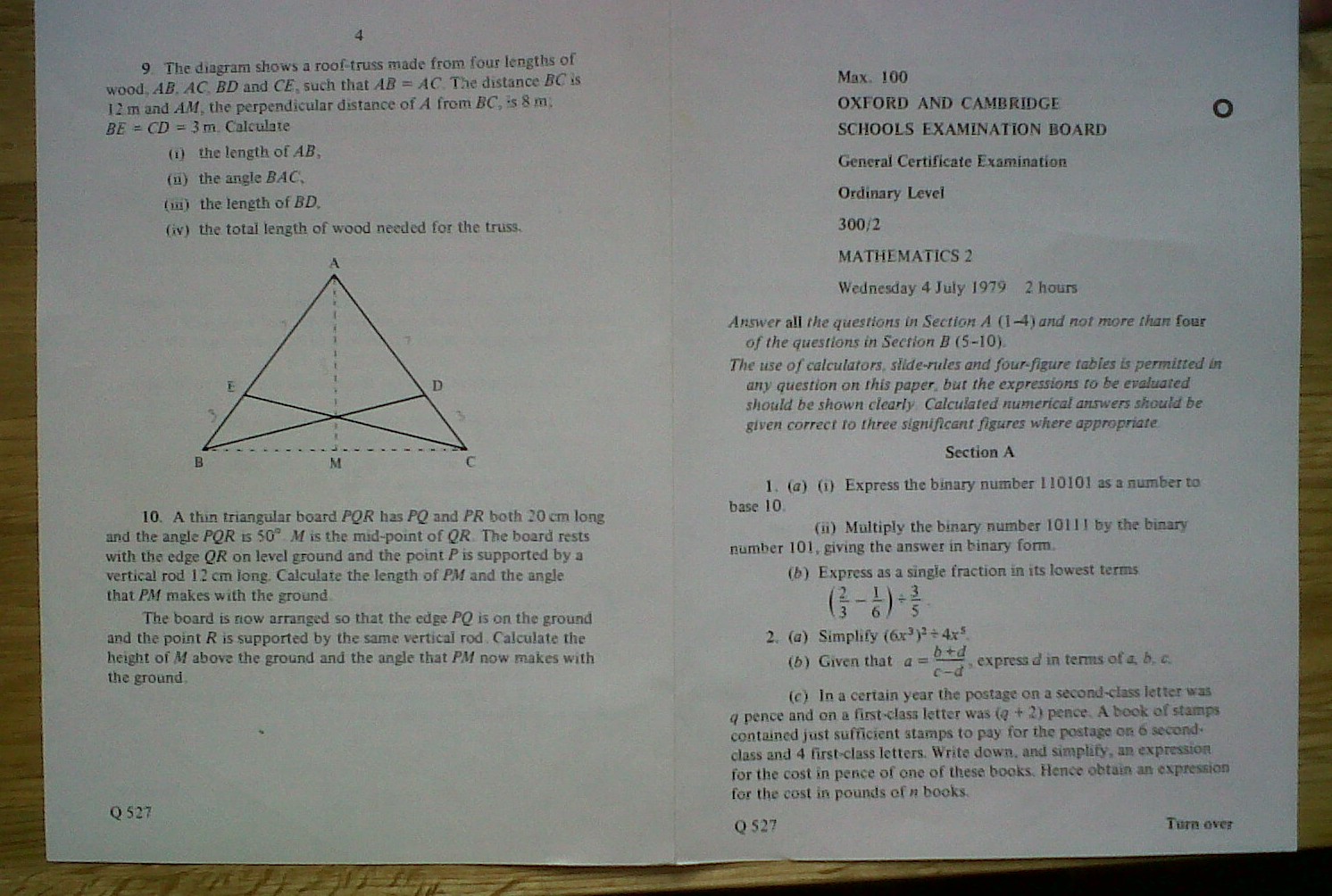
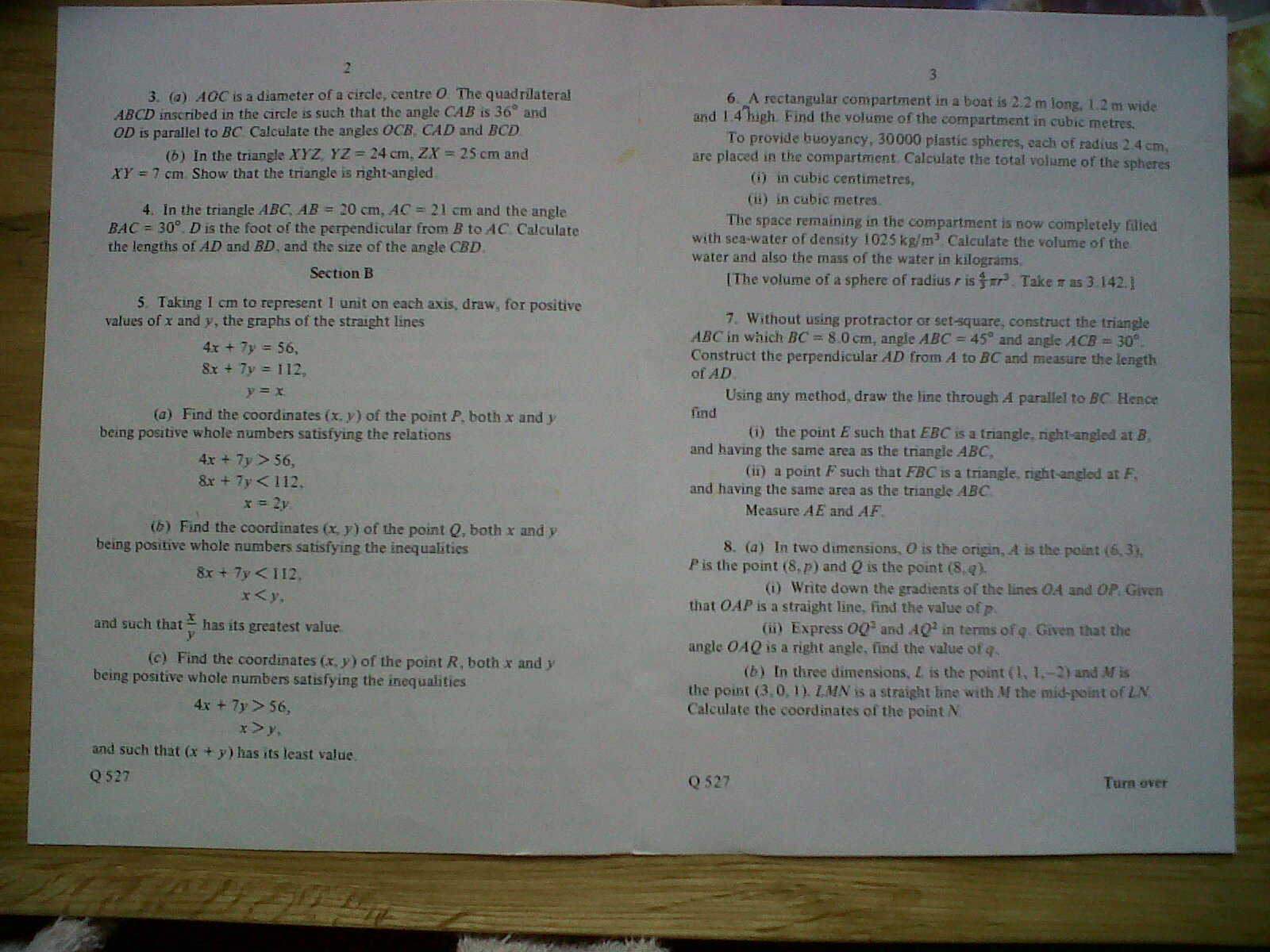
With the publication of this year’s GCSE results there’s been the usual clamour about “dumbing down” of educational standards. So are these examinations getting easier or not? I can’t answer that question because I’m far too old to have done GCSEs. The examinations I took at the equivalent stage of my school career were O-levels. But, being an inveterate hoarder of useless articles, I kept the exam papers that I took, so what I can do is put up and example the O-level papers I took (in 1979) and let you decide. I thought the Mathematics one might be of interest, so here it is or rather here they are, because there were two 2-hour written papers; there was no coursework component, so these counted 100% of the final grade.
If you’ve done GCSE mathematics recently, have a look and see what you think!
(You can click on the images to make them bigger if they’re difficult to read…)
I’d be interested in any comments you might have, especially if you’ve actually done GCSE Mathematics (recently or a long time ago). I suspect the most obvious difference is that in my day we did much more geometry…
I might put up the Physics papers if there’s enough interest!
I thought I’d reblog this post in order to send some traffic in its direction. The piece is asking for input concerning the science curriculum for Years 7 to 11. We didn’t have Years like this when I was at School, so I’ll translate this as meaning the age group 11 to 16, i.e. secondary school.
I’m going to have a think before I post a comment on the site, but I will do eventually, and I hope many of you will consider doing likewise.
You’ll have already gathered that I’m a school science adviser with the Hampshire Science Team. We support all schools in Hampshire in trying to develop exciting and inspiring science, as well as helping children make the best possible progress. Schools often feel under pressure to ‘teach to the test’ in order to achieve good examination results and this pressure can actually impede the development of good scientific thinking. Yesterday we began … Read More
In the course of linking my previous post to Richard Feynman’s wikipedia page, I happened upon an interesting fact:
Feynman (in common with the famous physicists Edward Teller and Albert Einstein) was a late talker; by his third birthday he had yet to utter a single word.
I therefore have something in common with these famous physicists. I didn’t learn to speak until I was well past my third birthday, as my mum never tires of reminding me. In fact, as I have blogged about before, I was a very slow developer in other ways and when I started school was immediately earmarked as an educational basket case.
Which is obviously where the similarity between me and these chaps ends, as I certainly don’t have “exceptional and innate analytical prowess”. I am however intrigued by the fact that I at least shared their failure to develop language abilities on the same timescale as “normal” infants. I don’t know very much at all about this field, even to the extent of not knowing at what age most children learn to talk…
So here’s a couple of questions for my readers out there in blogoland. Were any of you late talkers? And how unusual is it for a child not to speak until they’re three years old?
It’s that time of year again. The annual meeting of the Board of Examiners of the School of Physics & Astronomy at Cardiff University met this afternoon to consider the marks for students due to graduate this year and to draw up recommendations for the final degree classifications.
This year’s meeting was actually quite interesting and, at just over two hours, somewhat shorter than some we’ve had in previous years. A group of students has already gathered in the foyer waiting for the dreaded list to be posted, and many will no doubt be celebrating or drowning their sorrows in local hostelries shortly after their fate is revealed.
Cardiff is a little old-fashioned in the way the final examiners’ meetings are conducted. For a start we still have a system of viva voce examinations for borderline candidates; they happened yesterday, in fact. Many universities have dispensed with this aspect of the process, but I still think they’re worthwhile. The Board of Examiners, including the two External Examiners, also still has some discretion in how it arrives at the degree boundaries (which are nominally at 70% for a first, 60% for a 2.1, 50% for a 2.2, and 40% for a 3rd).
The tide is turning against this very traditional approach, however, and there are moves here to dispense with the viva examinations and with academic discretion. I’m not sure when this will happen, but it’s likely to be sooner rather than later. I think the main reason for this is to make the system more automatic so there’s less chance of legal challenge. In any case there doesn’t seem to me that there can be any educational reason for it.
The one thing that strikes me about the system we have is that it’s the whole business of classifying degrees into broad categories which is where the problem lies. It was suggested some time ago that we should dispense with, e.g., the “Desmond” (2.2) and the “Thora Hird” (3rd) and instead simply give each student a transcript containing details of the entire spectrum of their academic performance. It’s been suggested again just recently too. That would seem to me to make much more sense than the current system of classifying degrees which involves (a) trying to condense a huge amout of information – examination marks, coursework, project assignments and the like – into a single number and then (b) drawing boundaries based on this number precisely where the distribution is most densely peaked. However, years have passed and nothing concrete has happened. The academic world is good at inertia.
Anyway, this isn’t the time or the place for a lengthy diatribe about the ins-and-outs of degree classifications. I’ve got to go back to marking my 1st year examination papers shortly in fact; these are considered by a separate meeting of the Board of Examiners.
It is time, however, for me to congratulate all our graduating students on their success. It’s the first group of Cardiff MPhys students that I’ve seen all the way through from entry to graduation. I’ll be sad to see them go, but wish them all the best as they venture forth into the real world. At least I hope to see them back next month for graduation. Until then, however, all I’ll say is
We’ve now reached the half-way point of the Spring Semester, which means that my teaching load has just doubled; I do the “Particle” bit of a third-year module on “Nuclear and Particle Physics”, which means I have 11 lectures from now until the end of the Semester to tell the students everything I know about particle physics. More than enough time.
Anyway, the first lecture today, as it was last year, was all about Natural Units. I always find it fun doing this, partly because the students stare at me as if I’ve taken leave of my senses. Come to think of it, they do that anyway.
The other night I was having a drink with some colleagues after work. Various topics came up, but we spent a bit of time talking about teaching. It appears that I’m in a small minority of my physics colleagues in that I actually like teaching. In fact, the older I’ve got the more I enjoy it. There’s always a limit, of course, and I wouldn’t like to do so much teaching that I couldn’t do other things, especially research, but I wouldn’t like to be in a job that didn’t involve teaching at all. I think most of my colleagues would jump at the chance to abandon teaching altogether. I can’t understand that attitude, mainly because I find it so rewarding myself, but I’m in a minority of one about so many things nowadays that I’ve ceased worrying about it.
I do sometimes wonder why I find teaching so rewarding. Perhaps it’s because I’m already middle-aged and don’t have any kids of my own. Teaching at least gives me a chance to play some sort of a role in someone else’s development as a person. I can’t guarantee that it’s necessarily a positive role, but there you are. Another thing is that sometimes when I travel about at conferences and whatnot I get to meet people I taught years ago. It means a lot when they say they remember the lectures, especially if they’ve now embarked on scientific careers of their own.
One of the problems of the government’s push for greater concentration of research funds and the simultaneous slashing of teaching budgets is that the quality of University teaching is bound to suffer. If research funding is allocated only to self-styled research “superstars” then Universities will obviously spare them from other duties. Teaching loads for ordinary foot soldiers will increase, with obvious consequences in decreasing enthusiasm among lecturing staff.
It’s already the case that teaching is grossly undervalued, and it’s probably worse in physics departments than anywhere else because, without research funding, most would simply go bust. Teaching funding is nowhere near sufficient to cover the real cost of a physics degree and in any case we can’t deliver advanced physics training without access to the research labs.
On top of this there’s the way teaching is entirely disregarded in promotion cases. On paper, promotion to Professor requires demonstrated commitment to teaching. In reality, all that committees care about is how much research income the candidate brings in. Excellence in teaching counts very little, if anything at all, in the assessment of a promotion case. I think this situation must change, especially with tuition fees set to rise to unprecedented levels, but all the forces currently at play are acting in precisely the wrong direction.
If we concentrate physics research funding any further then we’ll have a small number of rich institutions stuffed full of research professors whom the undergraduates never see. The less successful academics in these departments will be put on teaching-only contracts, not because they like teaching but because their alternative is Her Majesty’s Dole. Meanwhile, less favoured research labs – i.e. those who don’t get lucky in the REF – won’t be able to sustain world-class research or teaching activities and will be forced to shut up shop. Further research concentration is bad news all round for the higher education system.
But I digress.
One of the other things we talked about in the pub was the National Lottery. As regular readers of this blog might know, I put the princely sum of £1 on the lottery every Saturday. Some think this is strange, but I see it partly as one of those little rituals we all invent for ourselves and partly as a small price to pay for a little frisson of excitement when the numbers are drawn.
But I do sometimes wonder what on Earth I would do if I won a multi-million pound jackpot prize. Would I quit my job? Would I quit teaching? Actually, I’m not sure I would do either of those. If I could ditch the admin stuff, I would of course do so. I don’t have a car and have no interest in getting one, especially a fancy one. I don’t need a bigger house, or a yacht. In fact, frankly, there’s nothing that I would really want to buy that I couldn’t buy already. It’s not that I have a huge salary, just that I’m not exactly very materialistic.
So even if I were rich I’d probably carry on doing pretty much what I do now. And that thought brings home just how lucky we are, those of us working in academia. For all the frustrations, the fact remains that we are fortunate to be getting paid for things that we enjoy doing.
I’ve felt a mini-rant brewing for a few days now, as I’ve been reading through some of the interim reports my project students have written. I usually quite enjoy reading these, in fact. They’re not too long and I’m usually pretty impressed with how the students have set about the sometimes tricky things I’ve asked them to do. One pair, for example, is reanalysing the measurements made at the 1919 Eclipse expedition that I blogged about here, which is not only interesting from a historical point of view but which also poses an interesting challenge for budding data analysts.
So it’s not the fact that I have to read these things that annoys me, but the strange way students write them, i.e. almost entirely in the passive voice, e.g. “The experiment was calibrated using a phlogiston normalisation widget…”.
I accept that people disagree about whether the passive voice is good style or not. Some journals actively encourage the passive voice while others go the opposite way entirely . I’m not completely opposed to it, in fact, but I think it’s only useful either when the recipient of the action described in the sentence is more important than the agent, or when the agent is unknown or irrelevant. There’s nothing wrong with “My car has been stolen” (passive voice) since you would not be expected to know who stole it. On the other hand “My Hamster has been eaten by Freddy Starr” would not make a very good headline.
The point is that the construction of a statement in the passive voice in English is essentially periphrastic in that it almost inevitably involves some form of circumlocution – either using more words than necessary to express the meaning or being deliberately evasive by introducing ambiguity. Both of these failings should be avoided in scientific writing.
Apparently our laboratory instructors tell students to write their reports in the passive voice as a matter of course. I think this is just wrong. In a laboratory report the student should describe what he or she did. Saying what “was done” often leaves the statement open to the interpretation that somebody else did it. The whole point of a laboratory report is surely for the students to describe their own actions. “We calibrated the experiment..” is definitely to be preferred to the form I gave above.
Sometimes it is appropriate to use the passive voice because it is the correct grammatical construction in the circumstances. Sometimes also the text just seems to work better that way too. But having to read an entire document written in the passive voice drives me to distraction. It’s clumsy and dull.
In scientific papers, things are a little bit different but I still think using the active voice makes them easier to read and less likely to be ambiguous. In the introduction to a journal paper it’s quite acceptable to discuss the background to your work in the passive voice, e.g. “it is now generally accepted that…” but when describing what you and your co-authors have done it’s much better to use the active voice. “We observed ABC1234 using the Unfeasibly Large Telescope..” is, to my mind, much better than “Observations of ABC1234 were made using..”.
Reading back over this post I notice that I have jumped fairly freely between active and passive voice, thus demonstrating that I don’t have a dogmatic objection to its use. What I’m arguing is that it shouldn’t be the default, that’s all.
My guess is that a majority of experimental scientists won’t agree with this opinion, but a majority of astronomers and theoreticians will.
The views presented here are personal and not necessarily those of my employer (or anyone else for that matter).
Feel free to comment on any of the posts on this blog but comments may be moderated; anonymous comments and any considered by me to be vexatious and/or abusive and/or defamatory will not be accepted. I do not necessarily endorse, support, sanction, encourage, verify or agree with the opinions or statements of any information or other content in the comments on this site and do not in any way guarantee their accuracy or reliability.


 In the Dark