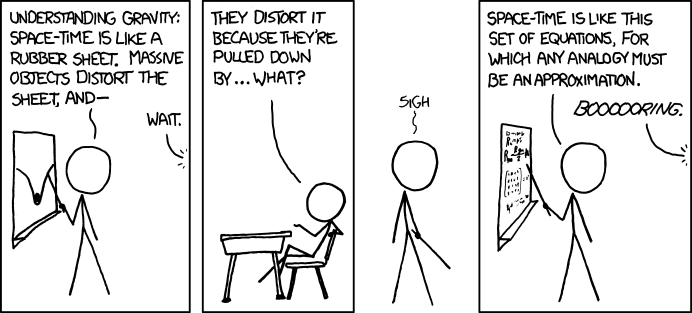
More on this weeks’ theme, from the inestimable xkcd…
I thought I’d do a quick post before I go out to pass on a story from the latest Times Higher. The news won’t come as a shock to anyone who actually works in a University, but it appears that the number of “managers” working in Higher Education is growing rapidly:
Data released by the Higher Education Statistics Agency reveal there were 15,795 managers in higher education in December 2010 – up by almost 40 per cent on the 11,305 employed in the 2003-04 academic year.
That was compared to the 19.2 per cent increase in academics since 2003-04. It means there is now a manager for every 9.2 academics compared with a ratio of one to 10.8 seven years earlier.
It’s tempting to take the usual easy shot at “managers”, but I’m not going to do that, at least not immediately, because I’m not at all sure precisely how they define a “manager” in the context of this survey. In my School we have a School Manager, who looks after budgets and runs the School Office which carries out a large number of complex administrative tasks related to research grants, undergraduate and postgraduate admissions, student records, and so on. People like this are indispensible because if we didn’t have them these tasks would have to be done by academics, which would be a distraction from their proper business of teaching and research, and which they would almost certainly do extremely badly. Managers who work alongside academic staff and understand the realities of University life are therefore a good thing to have. They actually help.
The problem I have is that, as it seems to me, much of the growth in numbers of “managers” does not involve people in this sort of job at all. The greater part of the increase is in centralised administrative divisions or, as they’re called in Cardiff, “Directorates”. In fact Cardiff is nowhere near as bad in this respect as some other universities I’ve either worked in or heard about from colleagues, but it is an issue even here.
The problem we find with such folk is that they are so remote that they seem to have no idea what people working in academic Schools and Departments actually do. For one thing they seem to think we just loaf around all day waiting for the chance to fill in some new forms or attend a some allegedly vitally important meeting at short notice (usually in teaching term, and usually mid-morning when lectures are in progress). In fact, there isn’t a day of the week when I don’t have teaching of some sort going on in teaching term. That’s not unusual for an academic in my Schoo, so it’s extremely difficult to attend such events at the drop of a hat without jeopardising teaching. The frequent requests to do so mean that I’d be surprised, in fact, if most of these managers actually knew when teaching term was. Meetings scheduled outside term of course eat into research time, but given that managers think “doing research” means “having a holiday”, you might be surprised we don’t have more meetings during the student vacations. Of course the real reason for this is that they don’t want us to attend (see below).
Another result of the increase in administrative staff is a plethora of badly thought out “initiatives”, similar initiatives even arising from several directorates simulaneously as managers compete with each other to weigh down academics with forms to fill in. The worst of these involve idiotic schemes in which Schools have to prepare lengthy documents to bid for minuscule amount of money from the central University coffers, the cost in staff time of administering such procedures far exceeding the financial or other benefits they can possibly deliver.
Worse, these central units are sometimes so badly run that they mess up the basic administrative tasks that they should be carrying out. Schools are thus forced to duplicate the work that should be done by someone else to make sure that it’s done properly. The idea that centralised administration leads to greater efficiency rarely works in practice. In contrast to the staff in individual Schools, most of whom actually care deeply about what they do because they work directly with the people involved, to the administrators are sometimes – not always, by any means, but definitely sometimes – too remote to care.
So in the end I am going to take a cheap shot at creeping managerialism, but only insofar as it relates to the invasion of universities by people who have no understanding of the core activities of a higher education institution, but who think they have the right to dictate to people who do. Instead of meaningful cooperation with academics, we have phoney “consultations”: meetings usually scheduled in such a way that academics can’t attend (see above) or documents requiring a response with absurdly short deadlines. This kind of management does not lead to a more “professional” institution, it just leads to alienation. In short, these people don’t help at all, they’re a positive hindrance.
Over the last decade, the burden of red tape has steadily increased for all kinds of institutions, but only the NHS vies with Universities in taking the fetish of managerialism to absurd levels. Academics will soon have to take courses in management-speak before they can be employed at a University as the influx of business types continues to accelerate.
The greatest irony of all this is that in the UK universities (with some notable exceptions) are generally regarded by the wider world as examples of international excellence, whereas British businesses (again with some notable exceptions) are seen by those abroad to epitomize incompetence and failure….
Follow @telescoperI’ve been annoyed ever since I woke up this morning because there was an item on the 7am news that irked me. A person called Claire Tomalin was quoted as saying, among other things, that
Children are not being educated to have prolonged attention spans and you have to be prepared to read steadily for a Dickens novel and I think that’s a pity.
She goes on to lay most of the blame for this shortcoming on television, as such people tend to do.
It’s a facile argument. For one thing most of Dickens’ novels were originally published in short installments, so reading them that way seems quite a sensible approach to me, and one that should probably be encouraged not criticized. There’s no getting away either from the fact that some of Dickens’ output is very heavy going indeed. Dare I say that not all Dickens is particularly good? Not liking Dickens is a matter of taste, not a mental defect caused by watching Big Brother.
And another thing: what fraction of children in Dickens’ time could read at all? Much lower than today, I suspect.
Claire Tomalin’s comment is not just a lazy generalization, it’s also yet another easy shot at the younger generations who have to put up with this sort of gibe from middle-aged grouches over and over again.
Examination results usually provoke similar outbursts, related to “dumbing down”. I actually do think that, at least in some subjects, examinations are much easier than they were “in my day”, but I don’t think that’s a reason to criticize the examinees. It’s more a fault with the examiners, who have decided that the young can’t cope with difficult challenges. That’s an insult in its own right. I maintain my view that education, especially higher education, is not about making things easy. It’s about showing students that they can do things that are hard. Most importantly, though, dumbing down examinations is not the same as dumbing down people.
It’s not just young schoolkids that attract such ill-informed invective. I come across it quite regularly with respect to the (alleged) lack of skills possessed by the young adults (usually 18-22) we teach as undergraduates, some of it even from colleagues.
I was thinking the other day what a boon it is for a middle-aged fogey – and obvious potential grouch – like myself to have the pleasure of actually talking to so many younger people at work, and listening to what they have to say. That way I’ve come to my own conclusions about what they’re really like. You know, like you do with people. Most folk of my age don’t have jobs that bring them into contact with younger folk, so they have to rely on articles in the Daily Telegraph to tell them what to think. That, sadly, even goes for those lecturers who have fixed ideas about the inferiority of “students nowadays”.
I think I’ve been very lucky, especially over the last few years, to have had the opportunity to work with a wide range of students as, e.g., project supervisor or tutor. Interactions like this provide a constant reminder not to generalize about the generations. There is of course a range of ability and commitment, but there was in my day too. The majority still work hard, learn quickly, and are friendly and courteous. There’s also no doubt in my mind that the best students nowadays are as good as they have ever been, if not better.
It’s the oldies who are the problem.
Follow @telescoperI came across the phrase Impostor Syndrome the other day. As a phrase it was quite new to me, but the state of mind it describes is far from unfamiliar. Digging around to find out a bit more I chanced upon an article written by renowned MIT astrophysicist Ed Bertschinger who explains it thus:
Impostor Syndrome is the feeling of not deserving to be in the position you are, and of being afraid that advisors, instructors, or peers will come to realize that you are not as capable as you may seem. The effect can be harmful when it selectively reinforces negative messages and causes people to try less hard because they are convinced they are incompetent when they are not.
That someone as intelligent and capable as Ed Bertschinger could confess to having such feelings will surely help others counter the negative effects these self-doubts might have on their careers. In the piece he reveals figures that show that Impostor Syndrome is pretty commonplace in academia, though more prevalent among females than males. Sarah Kendrew has blogged about this from the perspective of a younger researcher.
Impostor Syndrome has certainly accompanied me all the way through my academic career. It started as early as the 11+ examination to get into the Royal Grammar School. I was quite a backward child when I was very young – I didn’t learn to speak until I was three – and assumed that taking the examination would be a waste of time and I would go to the local comprehensive along the rest of the kids. In fact, I passed, and got a scholarship without which I couldn’t have gone, but was convinced that I only got in because of some form of adminstrative error. During my first term at RGS I was overwhelmed by feelings of inferiority and struggled at almost every subject. I kept at it though and surprised both myself and my teachers by doing rather well in the examinations.
It was all very similar when I went to Cambridge. Nobody from my family had ever gone to university before, never mind Cambridge, and I assumed I’d fluked the entrance examination there as well. I took it for granted that everyone else was cleverer and better prepared than me, but I gradually realised that wasn’t true. Some were, of course, but I found that if I worked hard I could do OK. I admit I was a bit erratic as student, but I always thought it was better to be good at some things than average at everything. In parenthesis I’d say that I think the Cambridge style of examinations was kinder to people like me than the way things are done in most places now, in that it didn’t involve a straight average over papers.
The same pattern emerged when I began graduate studies at Sussex. I felt woefully unprepared to work in cosmology, especially since many of my supervisor’s other DPhil students had completed the fiendish Part III Maths at Cambridge before starting their postgraduate degree. I was fortunate in being given a problem that suited me – and I should say received excellent guidance and advice from my supervisor, John Barrow. Despite going through some frustrating periods when I thought I wasn’t going to get anywhere with my research, I completed in less than three years.
Thereafter I got postdoc position, an SERC Advanced Fellowship, a permanent position at Queen Mary, and then a Chair (at Nottingham) by the time I was 35. Looking back on all these successes the only thing I can attribute them to is outrageously good fortune. There are many cleverer people with far stronger technical skills than me who either took much longer to get a permanent job or who haven’t yet managed to do so. At times I marvel at my own good luck, at others I feel guilty about others who are clearly better than me but haven’t been so fortunate. I guess they probably resent people like me, but it’s best not to think of that.
If you compare yourself with others,
you may become vain or bitter,
for always there will be greater and lesser persons than yourself.
The bad thing about having feeling that you’re an impostor all the time is the constant fear that you’ll be found out and be subjected to all sorts of humiliation and, worse, that you’ll find someone relies on you for something that you’re unable to deliver. The latter is especially stress-inducing if you work a lot in collaborations.
However, there is a good side too. I think a bit of self-doubt actually makes one a better person, in that knowing your own weaknesses helps appreciate better the qualities that others possess and instils a desire to help nurture the talents of people around you, especially the younger ones.
When students ask me for advice about scientific careers I usually say the usual things: work hard, choose your problems wisely, make connections, believe in yourself. If I were being completely honest, however, I’d say that I really believe that the most important thing is to be lucky.
Ps. The wikipedia page on Impostor Syndrome also includes a reference to its converse, Dunning-Kruger Effect in which “incompetent people find it impossible to believe in their own incompetence”. I wonder if this might be even more prevalent in academia?
Follow @telescoperOne of the biggest news stories this week derived from an investigation by the Daily Telegraph into the behaviour of officials connected with the Welsh examination board WJEC who, it appears, have been passing on tips about the content of their examination papers to teachers who have paid to attend their seminars. Of course this reflects very badly on Wales – especially coming so soon after the University of Wales scandals – but it is symptomatic of a much wider malaise; this episode undermines not just the examination process but the entire education system in the United Kingdom. The sad thing is that that there’s not really anything new in this story. It’s been obvious for some time that the whole framework has become corrupted by the profit motive. There have been previous warnings about how the examination boards compete for customers (and cash) by dumbing down examination papers, but nothing seems to have been done.
The problem is particularly acute for A-level examinations, which universities use to select applicants for admission onto courses. In my own subject, Physics, the A-level course being taught in schools are clearly not fit for this purpose – the syllabuses have been filleted of any challenging material and there’s no correlation that I can discern between high grades at A-level and good performance at undergraduate level. In fact,some of our very best students at Cardiff – who are as good as any I’ve come across anywhere – came in with very modest A-level grades but have performed brilliantly on the course. Relying only on A-levels might have led to us closing the door on these folks. Actually, I don’t know why we bother making offers based on A-level results at all!
Anyway, it’s clearly time to sort out the examinations system properly. The Exam Boards won’t fix the problem themselves because they are doing very nicely out of the status quo, so what should be done?
I like the suggestion is that the Examination Boards should be scrapped and the business of setting examinations should be carried out by one organization: no competition means no temptation to cheat. I’d also add that, at least for A-levels, the people who set and mark the examinations should be based in universities. I’d envisage a series of national subject panels with representatives from a number of institutions. A single Exam Board with members based in the university sector would also help simplify the process of university admissions, perhaps even streamlining it enough to allow for post-examination applications without having to have earlier examinations. Above all it would ensure that A-level courses are relevant to university entrance requirements, which they are not at the moment.
Another possibility – which also like but which is probably politically a non-starter – is to scrap our tarnished A-levels altogether and adopt the International Baccalaureate as the UK’s educational gold-standard. The reason this wouldn’t be acceptable to our Lords and Masters in Whitehall is that it would immediately dispel the comforting myth that standards in British schools are rising; I’d bet my bottom dollar that, relative to the rest of the world, they are not and adopting the IB would demonstrate that as it would allow comparisons to be made which can’t be made with A-levels.
Follow @telescoperA very busy day today so I thought I’d wind down by giving you a chance to test your brains with some order-of-magnitude physics problems. I like using these in classes because they get people thinking about the physics behind problems without getting too bogged down in or turned off by complicated mathematics. I’ve also kept some of these in archaic units just to annoy people who can only do things in the SI system. I think it’s good to practice swapping between systems, especially for us astro-types who use all kinds of bizarre units, so if you don’t know the units, look them up! And if there’s any information missing that you need to solve the problem, make an order-of-magnitude estimate!
Give order of magnitude answers to the following questions:
There’s no prize involved, but feel free to post answers through the comments box. It would be helpful if you explained a bit about how you arrived at your answer!
Follow @telescoper
I’m back home now after a trip to and from the fine city of Edinburgh which, in case you weren’t aware, is known to the locals as Auld Reekie. I wonder if there’s a local internet guide called Reekipedia?
The excuse for this trip was an invitation to take part in an exercise called a Teaching Programme Review in the School of Physics & Astronomy at the University of Edinburgh. The TPR is an exercise that looks at the courses on offer in the department, how they are taught, as well as the technical and administrative arrangements to back it all up. The Panel involved people from other departments inside the University and a couple of external advisers (both physicists), of which I was one. The Panel will be writing a detailed report on our findings which I hope will turn out to be useful, but it definitely wouldn’t be appropriate to comment on the details here.
What I will say here is that, although it was a very intense and busy few days, including face-to-face meetings with all kinds of academic and support staff, as well as current students, it was extremely interesting. As well as hopefully providing some input and suggestions to the TPR, it was also a chance for me to see the inner workings of another department and pick up a few ideas for the way we teach Physics courses in Cardiff.
One of the striking things about this visit was how similar are many of the problems facing Edinburgh to those we encounter in Cardiff. Another is how easy it is to recognize kindred spirits. It may not always be obvious to the students, but physicists are passionate about their subject, not only in terms of their research but also in terms of nurturing the talents of the students in their care. In the Brave New World of Higher Education we’re all supposed to see universities as businesses, competing ruthlessly in an unforgiving marketplace. In fact, most of us at the real business end of the university system (i.e. teaching and research as opposed to PR and marketing) see our competitors more as colleagues than as rivals. Long may that continue, in my opinion.
During the visit I was taken on a tour of the excellent facilities available at Edinburgh, including some really snazzy and impressive “teaching studios” the like of which I’d never seen before. I’d really love to have a go at teaching in one of those some day, as they offer a different style of education which I’m sure complements the more traditional lecture format. The students seem to like them a lot, which is the most important thing.
However, I have to say that the thing that I was most jealous about was the fact that most of their teaching rooms still have blackboards. Ours have all been replaced with horrible whiteboards that require expensive markers and are far less visible to a big audience. “Chalk and talk” is a tried and tested method and when it’s done well I still think it’s a very effective one. I’m all for innovation in teaching, but some traditional methods are actually pretty good!
Anyway, I’d like to thank everyone from Auld Reekie University for hosting this visit. It was hard work, but thoroughly enjoyable. If anyone from Edinburgh reads this I hope they will pass on my thanks to all the staff and students there for making it such a rewarding occasion! I’m just sorry I didn’t have the chance to see a bit more of the city, but the schedule was just too hectic.
What I did enjoy was staying in a nice hotel for 3 days that offered a truly splendid cooked breakfast in the mornings. I hadn’t started the day with kippers for a very long time! Might need to go on a diet for a few days though….
Follow @telescoperI’ve just taken a short break from reading grant applications and filling in forms to read through the stack of teaching questionnaires that arrived yesterday, along with a complicated statistical analysis which I won’t even try to explain – because I don’t understand it.
These questionnaires are handed out during a lecture, filled in by the students (anonymously), and then sent off to be analysed by a team of elves. Doing this during a lecture ensures a reasonable rate of return; in my case about 2/3 of the students returned completed questionnaires. The results are condensed into a “Figure of Merit” (FOM) using a mystic formula of some sort. If my FOM turned out badly I would probably try to work out what it means, but since it’s quite good I’ll just assume the algorithm is excellent.
Questions on the questionnaire are divided into questions about the module (we don’t have courses, we have modules), e.g. is it easy, hard, interesting etc, and questions about the lecturer(s), e.g. was he/she audible, legible. Generally speaking, students seemed to enjoy this particular first-year module, Astrophysical Concepts, but also thought it was difficult. In fact it’s a generic outcome of this sort of analysis that modules that are considered to be easy don’t get the best student feedback – they don’t seem to mind so much if the material is difficult, as long as it is interesting. I think that’s where astrophysics is a lot easier to score well than, say, solid state physics.
The only thing I was disappointed with was the score for the responses to the prompt “The lecturer wrote helpful comments on the marked homework“. In fact, I didn’t write anything at all on the marked homework because I didn’t mark it – that’s usually done by PhD students, according to a mark scheme I provide. Nevertheless, I do post full worked solutions (on a system called Learning Central) along with the mark scheme after the scripts have been returned to students so they can easily find out where they went wrong and how they lost marks. I though that, supplemented by the comments written by the markers on the scripts, would be sufficient feedback. Obviously not. Heigh-ho.
More interesting than the statistical analysis (to me) are the individual comments written on the reverse of the questionnaire. Most don’t write anything at all here, but there’s an opportunity to massage one’s ego by reading things like “Best lecturer this term by a long, long way”. Actually, come to think of it, that was the only one that said that.
Occasionally, however, one comes across a disgruntled response. An example was
I think the homeworks should be on Blackboard. They never are. If you misplace a homework you can never get another!
Sigh. Actually, all the homeworks were put on Blackboard (the older name for Learning Central) at the same time that I handed them out. As a matter of fact, they’re all still there…along with the solutions in a folder marked Assignments.
Anyway, Astrophysical Concepts was fun to teach and popular with the students, so obviously it had to go. It’s now been discontinued and replaced in the first year by a module about Planets. But I think some of it will make a return in a new problem-solving class for 2nd year students…
PS. In case you’re not up with the jargon, “reflective practice” is “the capacity to reflect on action so as to engage in a process of continuous learning” and is “one of the defining characteristics of professional practice” that involves “paying critical attention to the practical values and theories which inform everyday actions, by examining practice reflectively and reflexively. This leads to developmental insight.”
In other words, thinking about the stuff you do in order to do it better.
Follow @telescoperI thought I’d reblog this because it pertains to my earlier post from today…
via Gowers’s Weblog
With the publication of this year’s GCSE results there’s been the usual clamour about “dumbing down” of educational standards. So are these examinations getting easier or not? I can’t answer that question because I’m far too old to have done GCSEs. The examinations I took at the equivalent stage of my school career were O-levels. But, being an inveterate hoarder of useless articles, I kept the exam papers that I took, so what I can do is put up and example the O-level papers I took (in 1979) and let you decide. I thought the Mathematics one might be of interest, so here it is or rather here they are, because there were two 2-hour written papers; there was no coursework component, so these counted 100% of the final grade.
If you’ve done GCSE mathematics recently, have a look and see what you think!
(You can click on the images to make them bigger if they’re difficult to read…)
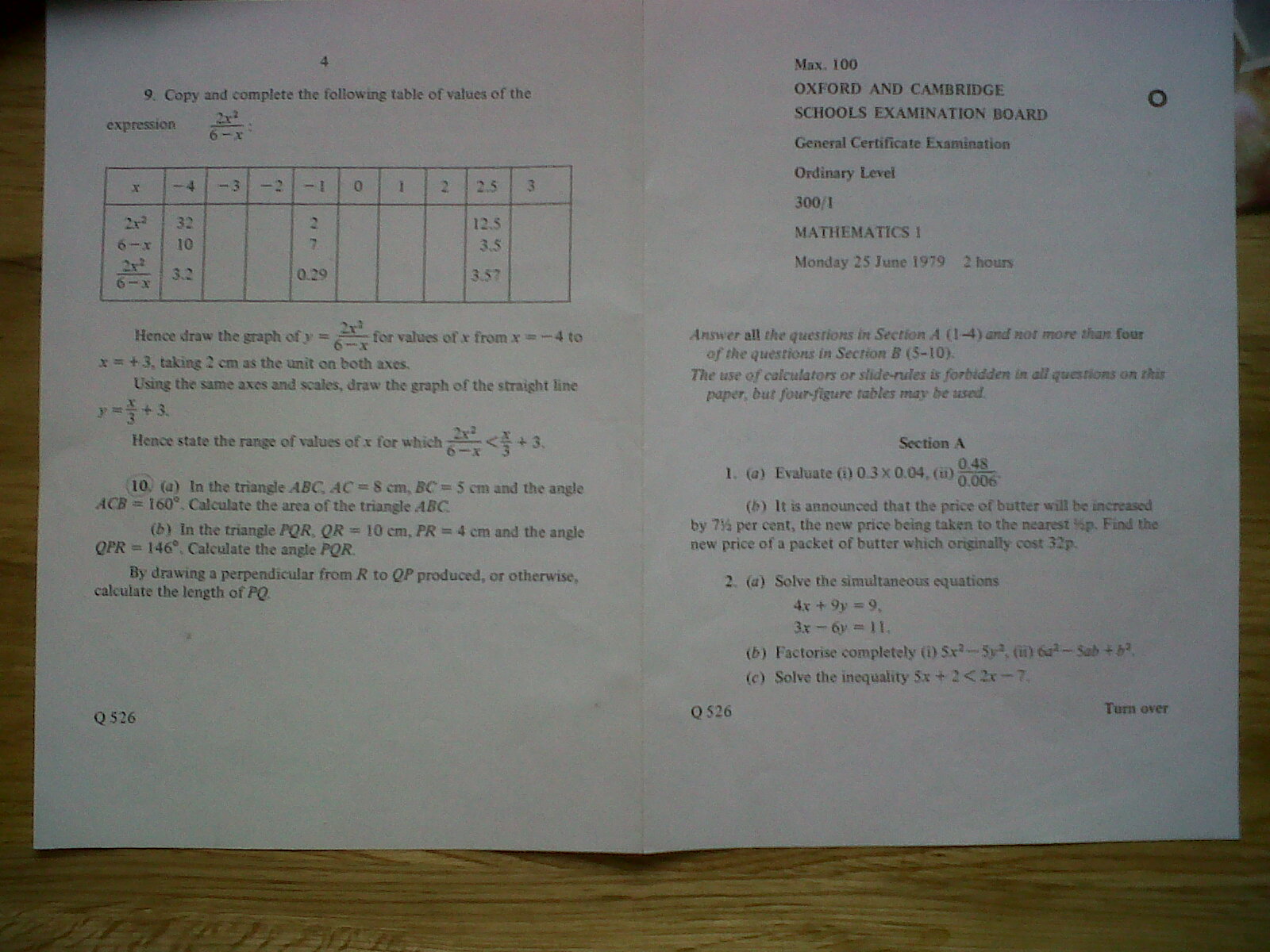
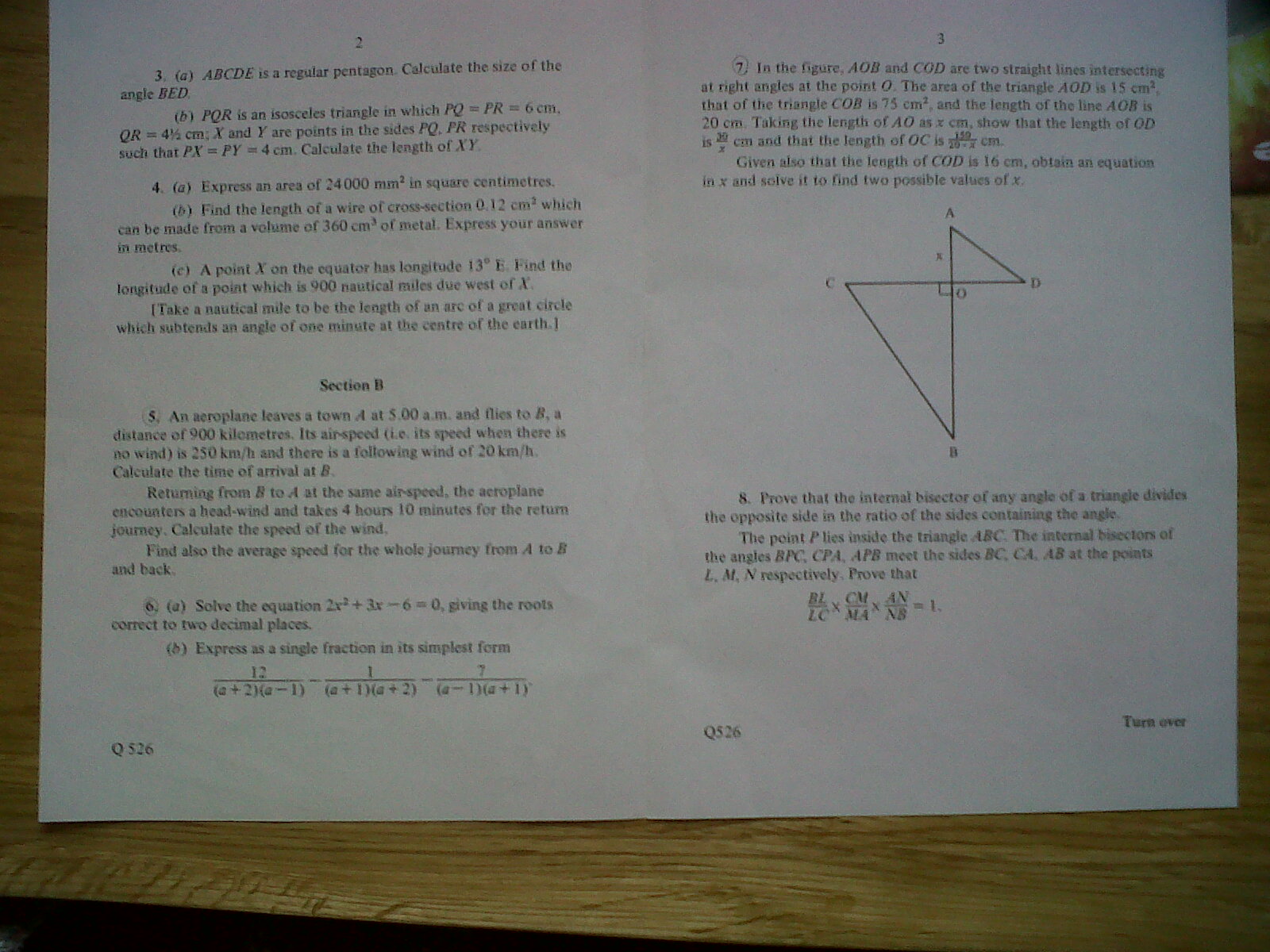
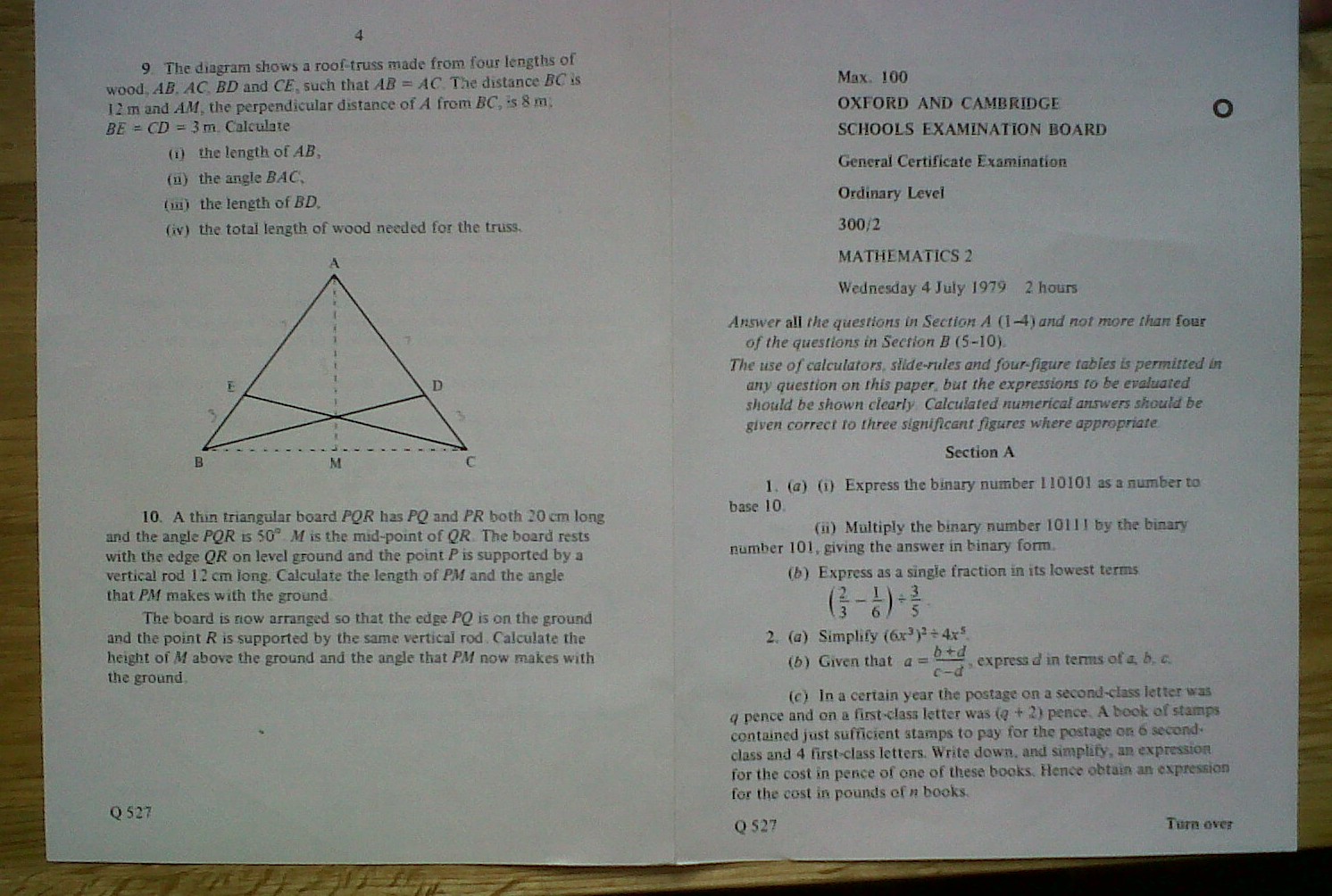
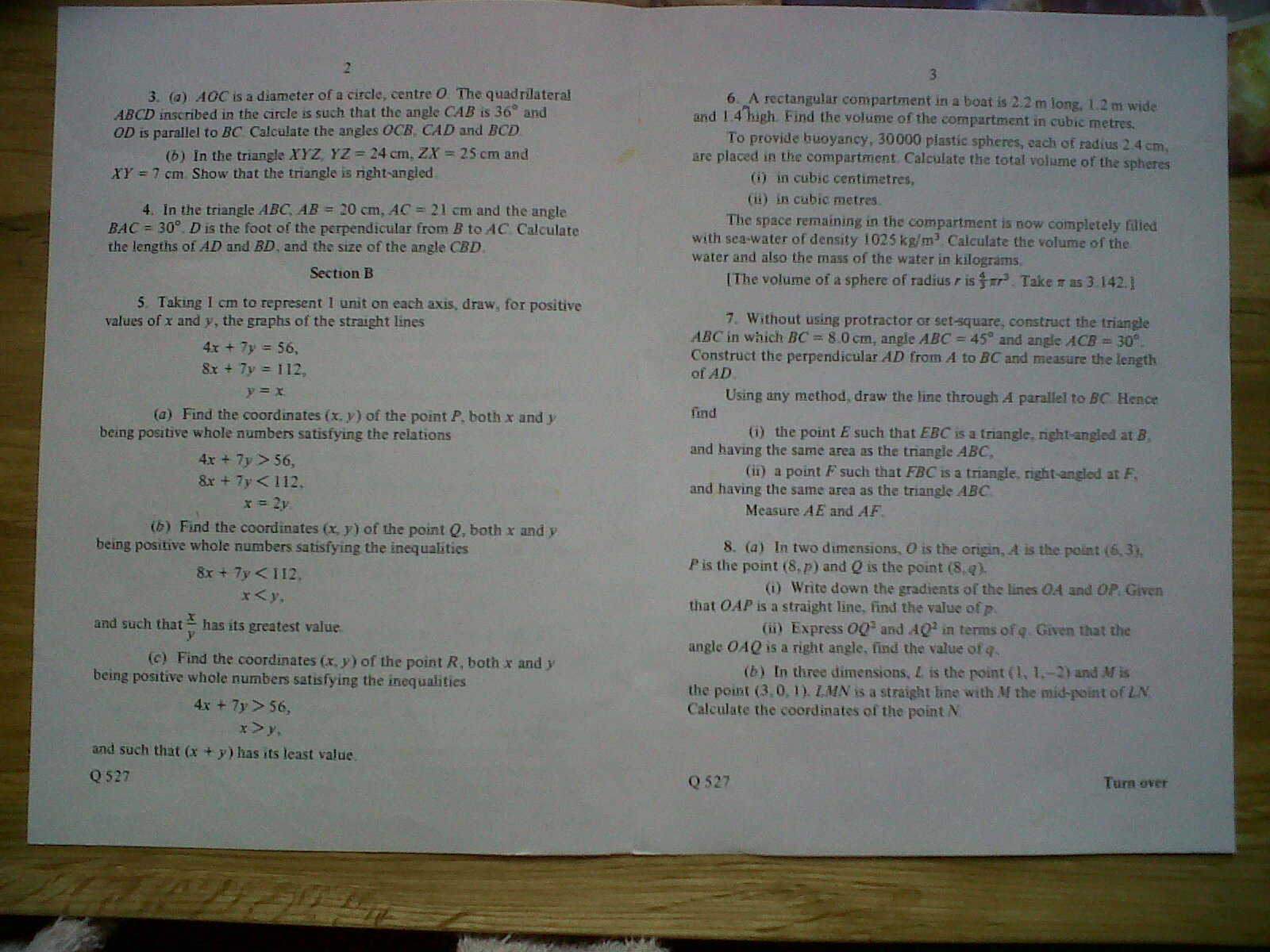
I’d be interested in any comments you might have, especially if you’ve actually done GCSE Mathematics (recently or a long time ago). I suspect the most obvious difference is that in my day we did much more geometry…
I might put up the Physics papers if there’s enough interest!
Follow @telescoper

