Archive for English

Language on Dry Land

Posted in Football, Irish Language with tags , , , , , , , , , on July 13, 2024 by telescoper

Since I’ve got my own computer again now I thought I’d celebrate by doing one of those rambling, inconsequential posts I haven’t had time to do recently.

Last week, in the run up to the European Championship semi-final between England and The Netherlands, I for some reason decided to look up what “The Netherlands” is in the Irish language. I did know this once, as it came up when I was trying to learn Irish a few years ago but I had forgotten. I remembered “England”, which is Sasana (cf. Saxon). Anyway, the answer is An Ísiltír. I’ll return to that in a moment.

Here are some other names:
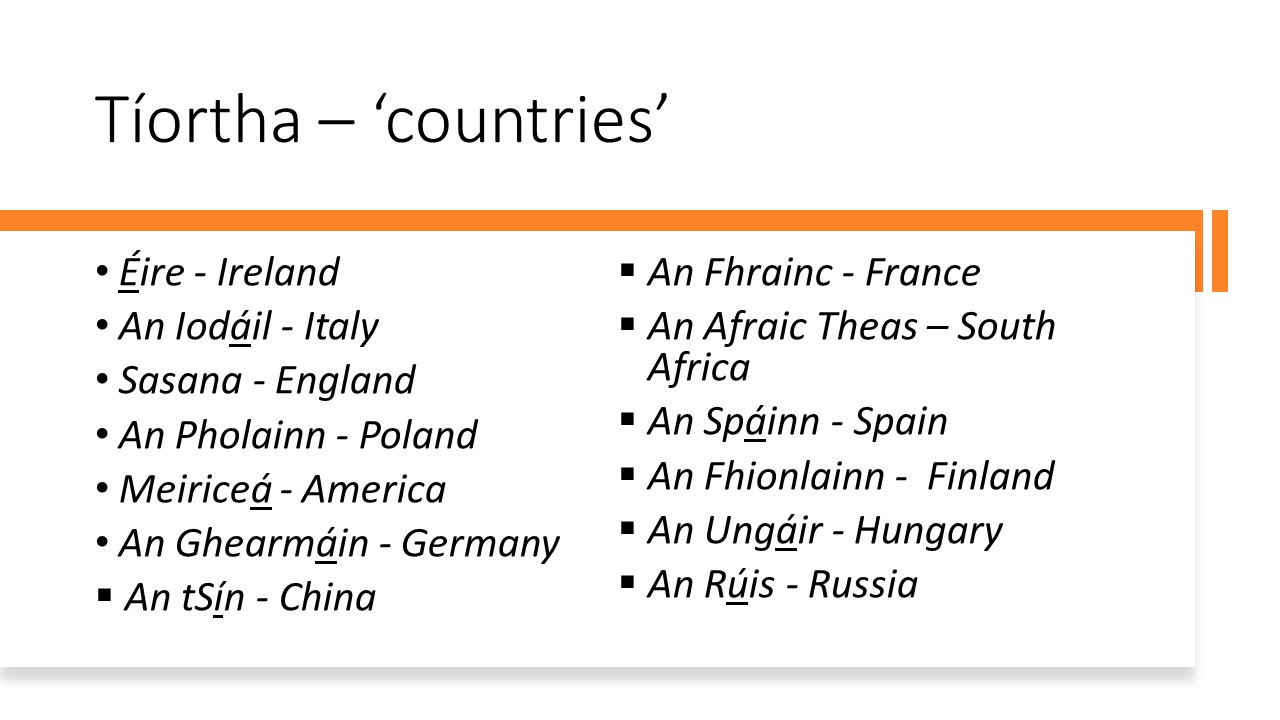
Anyway, a couple of things may be interest. One is that you can see that most country names in Irish are introduced by An. This is the definite article in Irish; there is no indefinite article. This contrasts with English in which only a few names start with the definite article, “The Netherlands” being one. The exceptions in Irish include England (Sasana) and Scotland (Albain). Wales is An Bhreatain Bheag (literally “Little Britain”). Of relevance to the final of the European Championship, Spain is An Spáinn.

I should also mention that some nouns suffer an initial consonant mutation (in the form of lenition, i.e. softening) after the direct article. In modern Irish this is denoted by an h next to the initial consonant, hence Fhrainc, for example; the Irish word for “French” is Fraincis.

The second interesting thing pertains to An Ísiltír itself. The second part of this, tír, means “country” or “nation” – see the plural in the heading above – and the first, Ísil, means “low”. An Ísiltír is therefore literally “The Low Country”. I shared this fascinating insight on social media and found in the replies a mention that the Welsh name for The Netherlands is Yr Iseldiroedda meaning literally “The Low Lands”. The first part of this is clearly similar to the Irish, but the second is the plural of a different word meaning ground or earth or an area of land. There is a word tir in Welsh that means ground or earth or an area of land but it does not mean country or nation like the very similar Irish word; the word for that is gwlad. In Irish the word for land or ground or earth (or turf) is talamh.

Welsh and Irish belong to distinct branches of the Celtic group of languages, the first wave of Indo-European languages to sweep across Europe. I blogged about this here.  Celtic languages therefore share roots with many other Indo-European languages and very basic words in many branches of the tree often bear some similarity in form, if slight but significant differences in meaning. It seems that tír/tir illustrates this rather well. These two words also have a very similar form to the French terre which is derived from the Latin terra. And so I disappeared down an etymological rabbit hole and found that all these words are probably derived from a Proto-Indo-European word meaning “dry”, presumably through reference to “that which is dry” as opposed to the wet bits (although neither Ireland nor Wales is famous for being particular dry).

And to bring this little excursion back full circle, the Irish word tirim means “dry”…
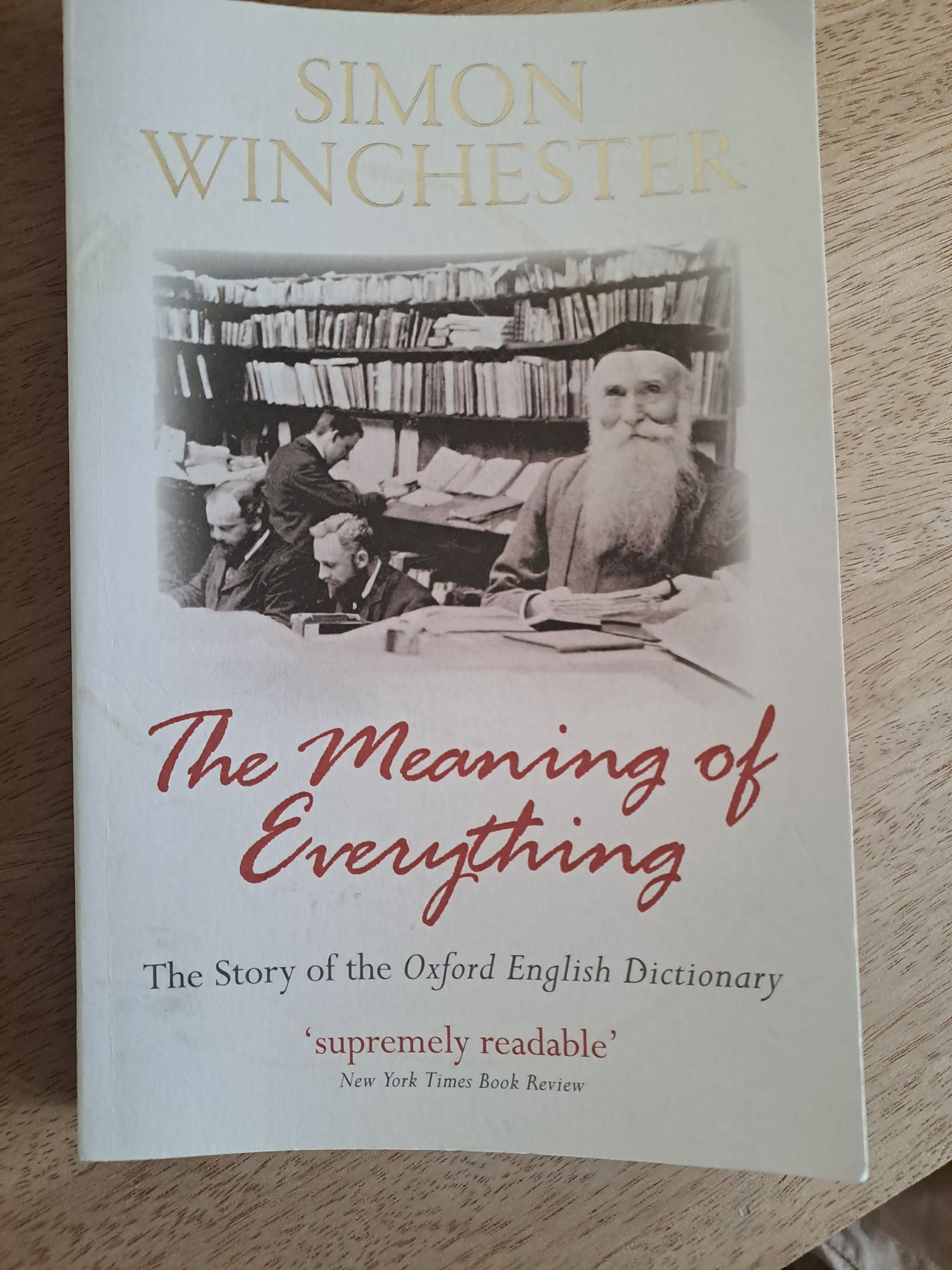
The Meaning of Everything by Simon Winchester

Posted in Biographical, History, Literature with tags , , , , , , , , , , on May 12, 2024 by telescoper

The most recent item on my (non-research-related) sabbatical reading list to be completed is The Meaning of Everything by Simon Winchester, subtitled “The Story of the Oxford English Dictionary”. I didn’t actually buy this book, but won it in a crossword competition back in February 2019. It didn’t arrive in Ireland until the end of May 2019, so it has taken me a bit less than 5 years to read it. I wish I’d read it earlier as it is fascinating and very well-written.

There’s quite a lot of information about the Oxford English Dictionary on the wikipedia page so I will keep it brief here. In short, the idea of a definitive dictionary of the English language emanated from the Philological Society and dates back to 1857, but real work didn’t start on it until a decade later. The whole project was many times on the brink of cancellation because the task of compiling the dictionary turned out to be much greater than was imagined at the outset. It was thought that the dictionary would be finished in a few years, but the First Edition was not completed until 1928. I think most people imagine that the OED has been around much longer than that!

Almost immediately work began on a supplement to include words that had entered usage during the decades needed to compile the original. A complete Second Edition was published in 1989.

The OED was actually first published in fascicles, softbound publications of about 300 pages that could be later sewn into a hard binding. These were quite expensive – 12/6 each. The first, A-Ant, was published in 1884. A complete list of these can be found here.

One might imagine that the laborious nature of the work involved in compiling a dictionary of this sort would make the story rather dull but it’s actually fascinating, both to see how the task was approached and to learn about some of the characters involved. As well as the Editors – who were paid a salary – the work relied heavily on hundreds of volunteer readers who would scour the literature looking for useful quotations that revealed the meaning of a word. By “the literature” I mean anything written – novels, non-fiction, newspapers, magazines, technical papers, anything. These volunteers would send in apposite quotations from which the compilers would construct definitions of the words. Some “headwords” have many meanings – set is an extreme example, with over 430 senses – and others – such as back – appear in a large number of compound words, all of which it had been decided needed to be illustrated with a quotation. The First Edition contained over 400,000 words and nearly two million quotations, all written and indexed laboriously by hand.

Among the volunteer readers were some extraordinary characters. One such was William Chester Minor, an American former surgeon who worked tirelessly for the Dictionary, sending his contributions in the post from an address in Crowthorne, Berkshire, which happened to be Broadmoor Psychiatric Hospital. The Chief Editor of the OED, James Murray, apparently assumed that W.C. Minor worked at Broadmoor but in fact he had been committed there in 1878 because, overcome by some form of psychosis, he had murdered a stranger and deemed insane. Minor carried on his work – using the prison guards as assistants – until he became seriously ill in 1902 after another psychotic episode during which he cut off his own penis.

The real star of the show however is English itself and this book offers some fascinating insights into the origin and evolution of the language. Almost nothing of the Celtic languages spoken throughout England before the Roman conquest survives into Old English (which used to be called Anglo-Saxon). This had a lexicon of around 50,000 words but only a few thousand of these survived in any form into Middle English and Modern English. Many common words in Old English were replaced and the language otherwise altered dramatically due to an influx of words, first from Scandinavia, via the Vikings, then from Norman French, and later on from diverse languages around the world. English has steadily absorbed and incorporated words from other languages for centuries, and is still doing so, though these words sometimes have a meaning in English that differs from their original.

In the light of this dramatic evolution in the language the Oxford English Dictionary was never intended to legislate on usage, but to register it; this is why its lexicographers relied so much on quotations in forming their definitions. This is also why the OED will never really be finished. The task of updating it nowadays is, on the one hand, made easier by the availability of computers and searchable databases but, on the other, made more difficult by the sheer amount of literature being produced.

I’ll send with one of the (apparently inadvertent) funny bits in the OED, from the second definition of the rarely used noun abbreviator:

An officer of the court of Rome, appointed… to draw up the Pope’s briefs…

I say it is inadvertent because the OED gives the earliest usage of the word briefs meaning underwear as 1930, after the publication of the First Edition (in which this appears).

From Labour to Labor

Posted in Crosswords, History, Politics with tags , , , , , , , , on May 22, 2022 by telescoper

I don’t know very much about Australian politics but I was delighted yesterday to hear news of Rupert Murdoch’s defeat in the Federal elections. The losing leader of the illiberal party, and previous PM, Scott Morrison, has now resigned. I’ve got nothing against Mr Morrison’s family, but I’m glad he’s going to be spending more time with them.

One thing that confused me is that the victorious Australian Labor Party is the spelling of the word “Labor”. I think Australians use the English spelling “labour” for the noun or verb so why the political party uses a different spelling for the political party is unclear to me. It is however just a name, and we all know that a rose by any other name would smell as sweet.

Some people refer to “labor” as the American spelling but it’s not as simple as that. The English word “labour” is derived from the 3rd declension Latin noun labor/laboris from which in turn is derived the verb laborare. The same sort of Latin origin is the case for many other familiar words: honor, color, valor, humor, vapor, rigor, and so on. All these were original Latin nouns that came into English via Norman French in the course of which they acquired the “u”.

The person responsible for the spelling of these words in American English (ie “labor” etc) was Noah Webster who thought English spelling was unnecessarily complicated and reverted to the Latin in these cases. It was also he who turned “centre” into “center”, for example. This spelling was introduced in his famous dictionary, first published in 1828, and subsequently acquired by the G&C Merriam Co and still in circulation nowadays after many revisions as the Merriam-Webster Dictionary.

Anyway, my point is that the English often look down on such spellings as “labour” and “colour” as vulgar Americanism but these are the “original” (unfrenchified) spellings.

It’s interesting that Norman French words sometimes displaced Old English words entirely but sometimes the Old English form survives as synonym. For example, the Old English word for “colour” is “hew” which survives as the English “hue”. The Old English word for “labour” is “swink” which has completely disappeared from common usage (though it is listed in the One True Chambers Dictionary with the description archaic).

All of which nonsense gives me an excuse to mention that I managed to get an HC (“Highly Commended”) for my clue in Azed Competition No. 2603 which I thought was a very tough puzzle to complete, which is no doubt why there were only 117 entries!

Pronouns for Yous

Posted in Biographical, GAA, Television with tags , , , , , on August 21, 2021 by telescoper

Last night I was watching a very interesting television programme on the Irish language channel TG4. It was about the origins and history of ice hockey, which began as ice hurling as a sport played by Irish immigrants in Canada. The word “puck” comes from the Irish word poc which means to stroke or hit; in hurling the “puck out” is a free hit from the goal area by the goalkeeper much like a goal kick in soccer. The programme was called Poc na nGael, which roughly translates as “The Puck of the Irish”. I think it was repeated last night because this Sunday sees the biggest event of the year in the hurling calendar: the Final of the All-Ireland Senior Hurling Championship at Croke Park, which this year is between Limerick and Cork.

While watching that programme I got thinking about Irish language lessons and whether I will have time to continue them next academic year and then onto wider issues about differences between Irish and English. One thing that struck me was the second person pronoun, so I thought I’d do the following rambling post about it.

In English the personal pronouns I (first person) and he/she (third person) are unusual in that they change depending on their grammatical role. This isn’t unusual in other languages especially Latin where it is the rule rather than the exception. In English we use “I” in the nominative case (“I hit the dog”) but “me” in the accusative case (“the dog bit me”) or when following a preposition (“the dog gave the stick to me”). The same goes with he/him and she/her.

In the example “the dog gave the stick to me”, “me” is really in the dative case but there is no distinct word for that in English; we can only really distinguish between the nominative (subject) and “other” (non-subject) cases. The words “my”, “our”, etc are often called pronouns but they are really of adjectival form, e.g. “this is my cat” and are more correctly called determiners. There are possessive pronouns (“mine”, “ours”, etc) which are in some sense genitive cases of the personal pronouns (meaning “of me”, “of us”, etc) but I digress.

Notice also that the first person and third person plural also have distinct plural forms (we/us and they/them).

The funny one is the second person “you”, which has neither an accusative nor prepositional form nor a distinct plural: “You hit the dog”, “the dog bit you” and “the dog gave the stick to you” all employ the same word although each is in a different grammatical case.

This is by no means the only oddity in modern English, and I have no idea why it developed. In older forms of English there were distinct forms: “thou/thee” in the singular and “ye/you” in the plural. These forms persist in dialects such as Yorkshire.

For some reason, though, as English evolved these four distinct forms merged into one, i.e. “you”. One can usually tell from the context whether “you” is singular or plural or can emphasize it by adding extra words (e.g. in the American “y’all” which is a contraction of “you all”) but there is no single word in standard English that expresses the difference between singular and plural or between subject and non-subject.

Incidentally, in Irish the second person singular is in the nominative case and thú in the non-nominative cases; the second person plural is sibh which is like “ye” in that it has no distinct non-nominative form.

I was brought up on Tyneside and it is a feature of the Geordie dialect that people use the word “yous” to denote the second person plural. It’s definitely a working-class slang, and was very much frowned upon at school, but it was very commonplace when and where I was grew up. I thought it was only in Newcastle that people used this form but when I worked at Sussex a while ago my boss, originally from Glasgow, also on occasion used “yous”. When I asked here about it she explained that it was common usage in Glasgow but didn’t think it was widespread in other parts of Scotland. Geordie and Glaswegian are thus two regional dialects I know that use this form but there may be others. I’d be interested to know so please feel free to comment via the box below!

Anyway the reason for going off on this tangent was that I’d already noticed that a few Irish people use “ye” in Hiberno-English for the second person plural, it was only yesterday that I noticed some using “yous”. I wonder how widespread that is in Ireland and is it regional or more of a class divide?

Would any of yous like to comment?

It’s raining…

Posted in Biographical, Maynooth, Poetry with tags , , , , , , on January 19, 2021 by telescoper

Taking a short break from examination marking I had a look outside. I’m not sorry to be cooped up indoors given that it’s pouring with rain. In fact it rained all night and morning and is set to continue in the same vein until tomorrow.

While I was waiting for my coffee to brew I was thinking about some idiomatic expressions for heavy rain. The most familiar one in English is Raining Cats and Dogs which, it appears, originated in a poem by Jonathan Swift that ends with the lines:

Drowned puppies, stinking sprats, all drenched in mud,
Dead cats and turnip tops come tumbling down the flood.

My French teacher at school taught me the memorable if slightly indelicate Il pleut comme vache qui pisse, although there are other French expressions involving, among other things nails, frogs and halberds.

One of my favourites is the Welsh Mae hi’n bwrw hen wragedd a ffyn which means, bizarrely, “It’s raining old ladies and sticks”. There is also Mae hi’n bwrw cyllyll a ffyrc – “It’s raining knives and forks”.

Related idiomatic expressions in Irish are constructed differently. There isn’t a transitive verb meaning “to rain” so there is no grammatical way to say “it rains something”. The way around this is to use a different verb to represent, e.g., throwing. For example Tá sé ag caitheamh sceana gréasaí which means “It’s throwing cobblers’ knives”.

Talking (of) cobblers, I note that in Danish there is Det regner skomagerdrenge – “It’s raining shoemakers’ apprentices” and in Germany Es regnet Schusterjungs – “It’s raining cobblers’ boys”.

Among the other strange expressions in other languages are Está chovendo a barba de sapo (Portuguese for “It’s raining toads’ beards”), Пада киша уби миша (Serbian for “It’s raining and killing mice”),  Det regner trollkjerringer (Norwegian for “It’s raining female trolls”) and Estan lloviendo hasta maridos (Spanish for “It is even raining husbands”).

No sign of any husbands outside right now so I’ll get back to correcting exams.

Remarks on Regrading

Posted in Education, Politics with tags , , , , , , on September 24, 2012 by telescoper

I haven’t had time thus far to comment on the ongoing row about GCSE examinations, but was inspired to do a quick lunchtime postette when I read some of Chief Stooge Deputy Prime Minister Nick Clegg’s comments over the weekend.

It seems Mr Clegg objects to Welsh Education Minister Leighton Andrews’ decision to order the examination board WJEC to regrade GCSEs in English, as a response to a report from regulatory officials arguing that the grading process had been unfair and that it had disadvantaged students. As a result of Leighton Andrews’ intervention, over two thousand Welsh students of English have received higher grades than initially awarded.  In England, on the other hand, the regulator Ofqual decided not to regrade examinations, but to offer students the chance to resit.

Here is a statement from a spokesperson for the Welsh Government explaining the different approaches in England and Wales:

Unlike in England where responsibility for qualifications is devolved through legislation to Ofqual, in Wales the Welsh Ministers have regulatory responsibility for the qualifications taken by learners.

In requiring the regrading to take place, the Minister was fulfilling properly these regulatory responsibilities. The decision to carry out the re-grade in Wales led to the swift resolution of an injustice served to well over 2,000 Welsh candidates.

The decision to direct the WJEC to carry out this work was about fairness and ensuring that Welsh students got the grades they deserved for the work they put into their examination. The result of the re-grade was the only acceptable outcome for learners affected by a questionable grading methodology.

Candidates can now rest assured that the process used to determine their final grades was fair and just.

Nick Clegg accuses the Welsh government of “moving the goalposts” – Westminster politicians can always be relied upon to produce  a tired cliché at the drop of a hat – and accused Mr Andrews of political interference.

I think what I’m going to say may prove quite controversial with readers of this blog, but I think Leighton Andrews did the right thing. He has responsibility for regulating the examination system in Wales, and his officials told him the grades were likely to be wrong. He therefore stepped in and ordered the examinations to be  regraded. What’s the problem?

Minister for Education Michael Gove has already admitted that the grading of GCSE examinations this year was indeed unfair, but he decided not to intervene and left it up to Ofqual to decide what to do. I don’t think this because he was worried about political interference in the examination system, as he’s been all over the exam system like a rash in recent months. He decided not to intervene because he wants to kill CGSEs, and the problems this year have probably done just that.

Presumably Nick Clegg’s response to the grading errors would just have involved saying “sorry”….

But whatever the rights and wrongs of Michael Gove and Leighton Andrews, I think this episode just demonstrates what a complete mess the examination system really is.  If anyone previously thought they knew what a grade C in English was supposed to mean then the behaviour of the exam boards this year will have convinced them otherwise. Students and parents must surely now regard the whole process as arbitrary and meaningless.

It’s also a shame that we now seem to think that education is entirely about examinations and qualifications, as if tinkering with the grades that come out of one end of the process somehow means that the students have learned more.  If  more people grasped the fact that there’s much more to education than bits of paper or rankings in league tables then the power of those in authority to depress and demoralize students and teachers would be immediately diminished.

That wouldn’t solve all the problems in our education system, but it would be a start.