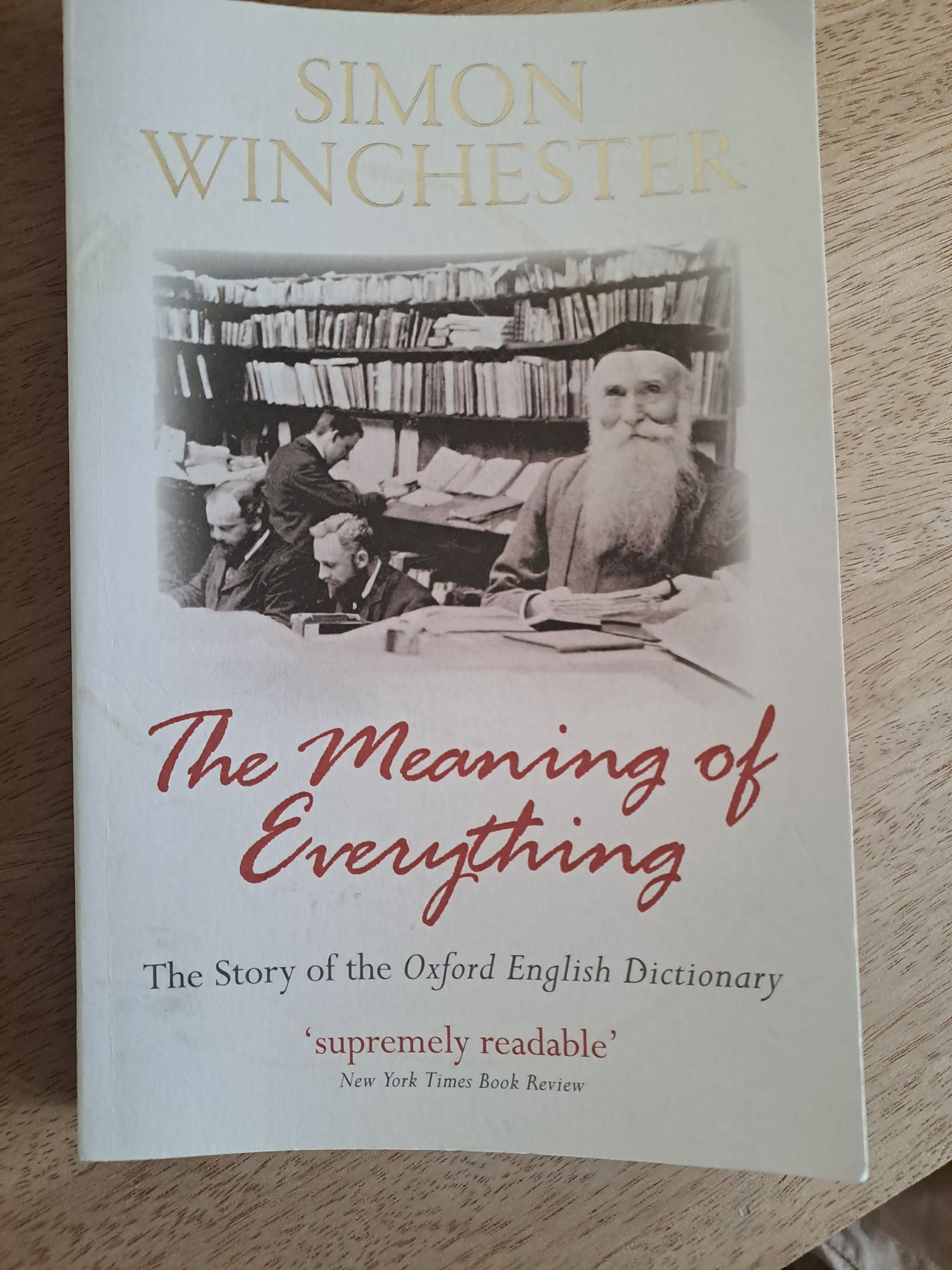
The most recent item on my (non-research-related) sabbatical reading list to be completed is The Meaning of Everything by Simon Winchester, subtitled “The Story of the Oxford English Dictionary”. I didn’t actually buy this book, but won it in a crossword competition back in February 2019. It didn’t arrive in Ireland until the end of May 2019, so it has taken me a bit less than 5 years to read it. I wish I’d read it earlier as it is fascinating and very well-written.
There’s quite a lot of information about the Oxford English Dictionary on the wikipedia page so I will keep it brief here. In short, the idea of a definitive dictionary of the English language emanated from the Philological Society and dates back to 1857, but real work didn’t start on it until a decade later. The whole project was many times on the brink of cancellation because the task of compiling the dictionary turned out to be much greater than was imagined at the outset. It was thought that the dictionary would be finished in a few years, but the First Edition was not completed until 1928. I think most people imagine that the OED has been around much longer than that!
Almost immediately work began on a supplement to include words that had entered usage during the decades needed to compile the original. A complete Second Edition was published in 1989.
The OED was actually first published in fascicles, softbound publications of about 300 pages that could be later sewn into a hard binding. These were quite expensive – 12/6 each. The first, A-Ant, was published in 1884. A complete list of these can be found here.
One might imagine that the laborious nature of the work involved in compiling a dictionary of this sort would make the story rather dull but it’s actually fascinating, both to see how the task was approached and to learn about some of the characters involved. As well as the Editors – who were paid a salary – the work relied heavily on hundreds of volunteer readers who would scour the literature looking for useful quotations that revealed the meaning of a word. By “the literature” I mean anything written – novels, non-fiction, newspapers, magazines, technical papers, anything. These volunteers would send in apposite quotations from which the compilers would construct definitions of the words. Some “headwords” have many meanings – set is an extreme example, with over 430 senses – and others – such as back – appear in a large number of compound words, all of which it had been decided needed to be illustrated with a quotation. The First Edition contained over 400,000 words and nearly two million quotations, all written and indexed laboriously by hand.
Among the volunteer readers were some extraordinary characters. One such was William Chester Minor, an American former surgeon who worked tirelessly for the Dictionary, sending his contributions in the post from an address in Crowthorne, Berkshire, which happened to be Broadmoor Psychiatric Hospital. The Chief Editor of the OED, James Murray, apparently assumed that W.C. Minor worked at Broadmoor but in fact he had been committed there in 1878 because, overcome by some form of psychosis, he had murdered a stranger and deemed insane. Minor carried on his work – using the prison guards as assistants – until he became seriously ill in 1902 after another psychotic episode during which he cut off his own penis.
The real star of the show however is English itself and this book offers some fascinating insights into the origin and evolution of the language. Almost nothing of the Celtic languages spoken throughout England before the Roman conquest survives into Old English (which used to be called Anglo-Saxon). This had a lexicon of around 50,000 words but only a few thousand of these survived in any form into Middle English and Modern English. Many common words in Old English were replaced and the language otherwise altered dramatically due to an influx of words, first from Scandinavia, via the Vikings, then from Norman French, and later on from diverse languages around the world. English has steadily absorbed and incorporated words from other languages for centuries, and is still doing so, though these words sometimes have a meaning in English that differs from their original.
In the light of this dramatic evolution in the language the Oxford English Dictionary was never intended to legislate on usage, but to register it; this is why its lexicographers relied so much on quotations in forming their definitions. This is also why the OED will never really be finished. The task of updating it nowadays is, on the one hand, made easier by the availability of computers and searchable databases but, on the other, made more difficult by the sheer amount of literature being produced.
I’ll send with one of the (apparently inadvertent) funny bits in the OED, from the second definition of the rarely used noun abbreviator:
An officer of the court of Rome, appointed… to draw up the Pope’s briefs…
I say it is inadvertent because the OED gives the earliest usage of the word briefs meaning underwear as 1930, after the publication of the First Edition (in which this appears).

 In the Dark