Archive for ESA Euclid

Euclid and the Dark Cloud

Posted in Art, Euclid, The Universe and Stuff with tags , , , , on November 6, 2025 by telescoper

I haven’t posted anything recently about the European Space Agency’s Euclid mission, but I can remedy that by passing on a new image with text from the accompanying press release. This is actually just one of a batch of new science results emerging from the first `Quick Release’ (Q1) data; I blogged about the first set of Q1 results here.

Incidentally, I find the picture is very reminiscent of a famous painting by James McNeill Whistler.

Image description: The focus of the image is a portion of LDN 1641, an interstellar nebula in the constellation of Orion. In this view, a deep-black background is sprinkled with a multitude of dots (stars) of different sizes and shades of bright white. Across the sea of stars, a web of fuzzy tendrils and ribbons in varying shades of orange and brown rises from the bottom of the image towards the top-right like thin coils of smoke.

Technical details: The colour image was created from NISP observations in the Y-, J- and H-bands, rendered blue, green and red, respectively.  The size of the image is 11 232 x 12 576 pixels. The jagged boundary is due to the gaps in the array of NISP’s sixteen detectors, and the way the observations were taken with small spatial offsets and rotations to create the whole image. This is a common effect in astronomical wide-field images.

Accompanying Press Release

The above view of interstellar gas and dust was captured by the European Space Agency’s Euclid space telescope. The nebula is part of a so-called dark cloud, named LDN 1641. It sits at about 1300 light-years from Earth, within a sprawling complex of dusty gas clouds where stars are being formed, in the constellation of Orion.  

This is because dust grains block visible light from stars behind them very efficiently but are much less effective at dimming near-infrared light.  

The nebula is teeming with very young stars. Some of the objects embedded in the dusty surroundings spew out material – a sign of stars being formed. The outflows appear as magenta-coloured spots and coils when zooming into the image.  

In the upper left, obstruction by dust diminishes and the view opens toward the more distant Universe with many galaxies lurking beyond the stars of our own galaxy. 

Euclid observed this region of the sky in September 2023 to fine-tune its pointing ability. For the guiding tests, the operations team required a field of view where only a few stars would be detectable in visible light; this portion of LDN 1641 proved to be the most suitable area of the sky accessible to Euclid at the time. 

The tests were successful and helped ensure that Euclid could point reliably and very precisely in the desired direction. This ability is key to delivering extremely sharp astronomical images of large patches of sky, at a fast pace. The data for this image, which is about 0.64 square degrees in size – or more than three times the area of the full Moon on the sky – were collected in just under five hours of observations. 

Euclid is surveying the sky to create the most extensive 3D map of the extragalactic Universe ever made. Its main objective is to enable scientists to pin down the mysterious nature of dark matter and dark energy. 

Yet the mission will also deliver a trove of observations of interesting regions in our galaxy, like this one, as well as countless detailed images of other galaxies, offering new avenues of investigation in many different fields of astronomy

In visible light this region of the sky appears mostly dark, with few stars dotting what seems to be a primarily empty background. But, by imaging the cloud with the infrared eyes of its NISP instrument, Euclid reveals a multitude of stars shining through a tapestry of dust and gas. 
“First Light” Images from Euclid

Posted in Euclid, The Universe and Stuff with tags , , , , , on July 31, 2023 by telescoper

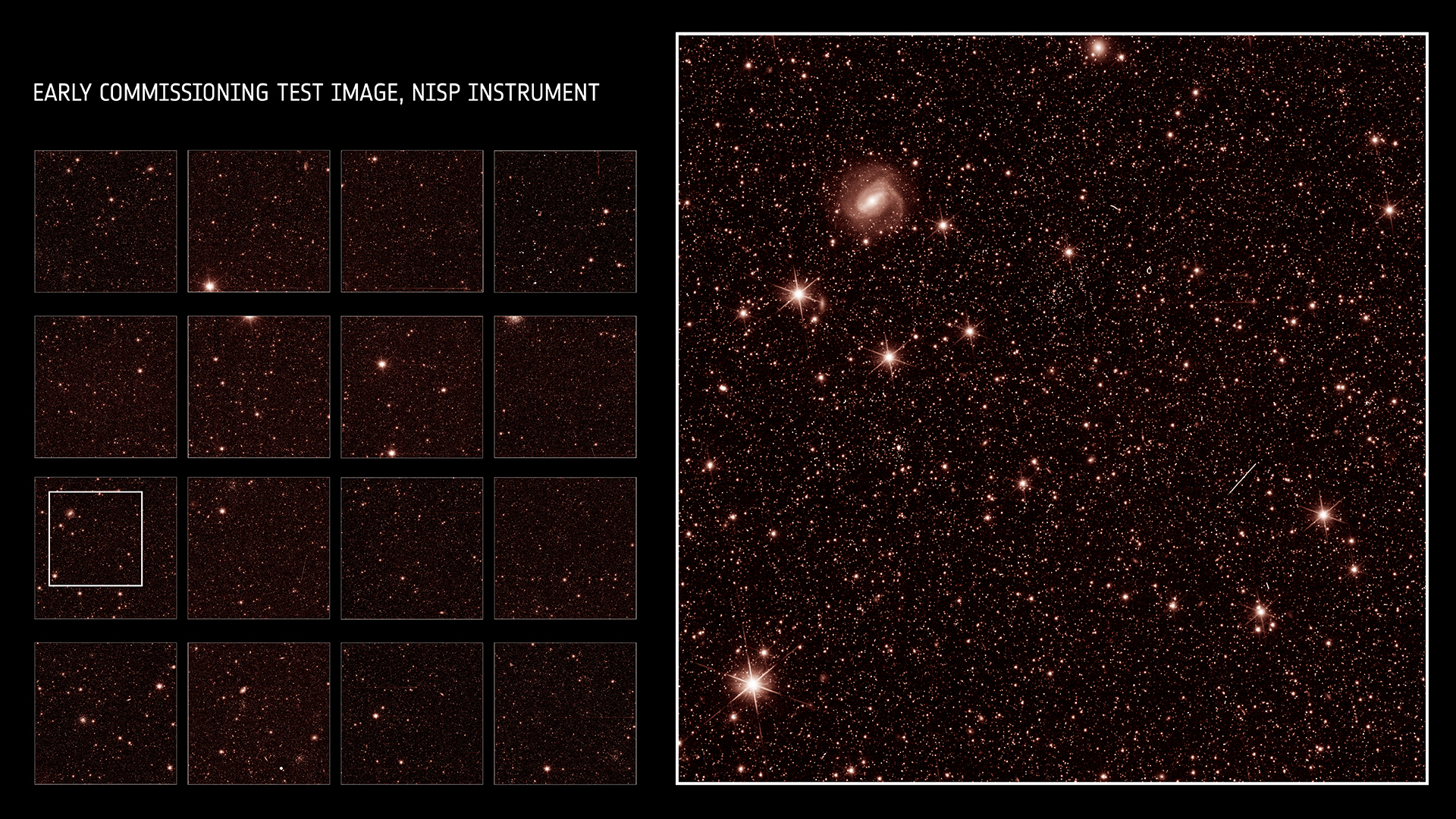
As I promised a couple of days ago, the “first light” images from the European Space Agency’s Euclid mission have now been released. You can find all the details here, but a summary is that these are “engineering” images, rather than part of the full survey to be undertaken by Euclid, and the commissioning of the instruments is not quite finished, but the telescope is now in focus and both instruments (the visual instrument, VIS, and the Near-Infrared Spectrometer & Photometer, NISP) are working well enough to show some preliminary results.

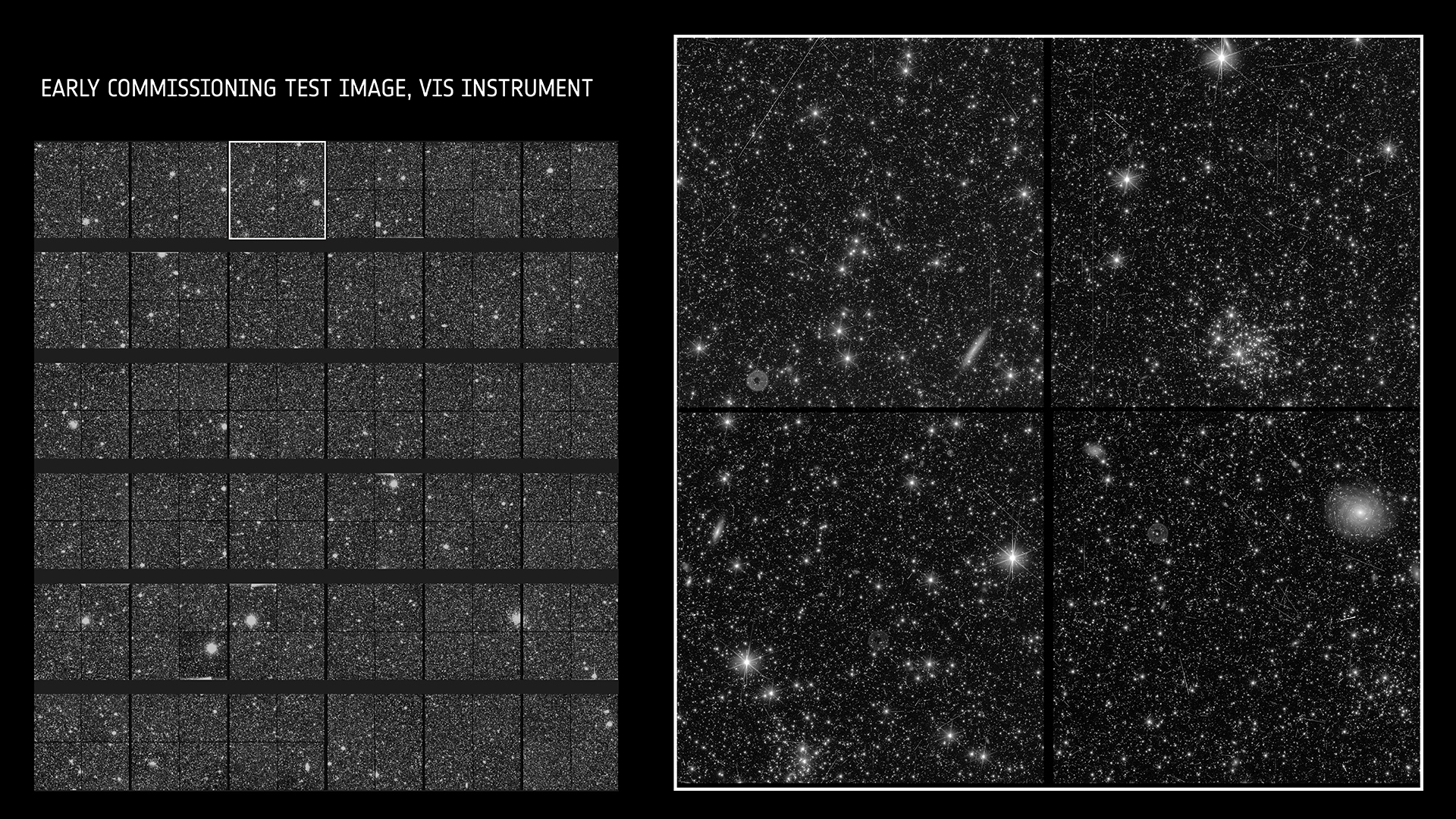
Anyway, here are the pictures released today, first from VIS:

Euclid early commissioning test images, showing an image by the VIS instrument (visible light). The full focal plane of VIS consisting of 36 detectors is shown on the left, and one detector in higher resolution on the right. Credits: © ESA/Euclid/Euclid Consortium/NASA, CC BY-SA 3.0 IGO

The next one is from NISP:

Euclid early commissioning test images, showing an image by the NISP instrument (near-infrared light). The full focal plane of NISP consisting of 16 detectors is shown on the left, and part of one detector in higher resolution on the right. Credits: © ESA/Euclid/Euclid Consortium/NASA, CC BY-SA 3.0 IGO

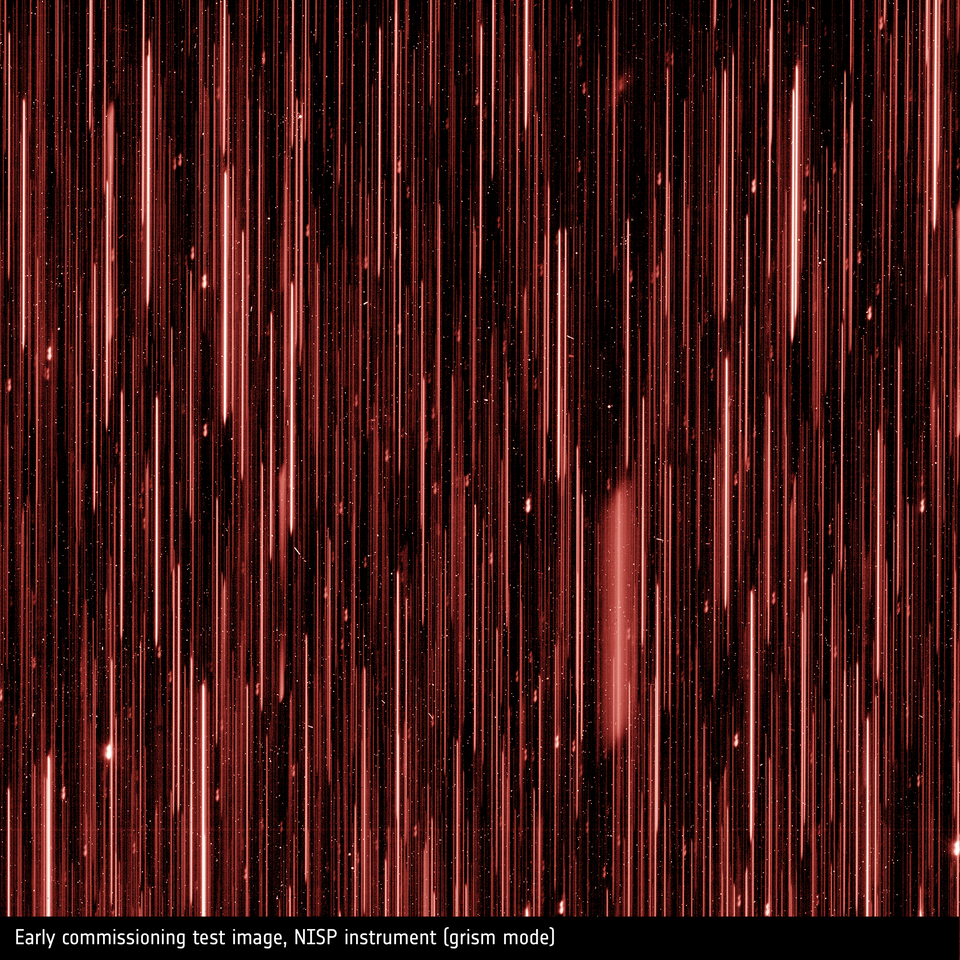
This final one, also from NISP, shows it working in grism mode, which allows the light from sources to be dispersed into a spectrum, enabling us to get much more information about the sources galaxies than a straightforward image would. The resulting images look a bit strange to the untrained eye – as the light from a point is spread out into a streak – but the result is wonderfully rich in information:

Euclid early commissioning test images, showing an image by the NISP instrument (near-infrared light), in its grism slitless spectroscopy mode. The full focal plane of NISP consists of 16 detectors, here a part of one detector is shown in full resolution. Credits: © ESA/Euclid/Euclid Consortium/NASA, CC BY-SA 3.0 IGO

For more information – and some higher-resolution images – see the official Euclid press release here.

For myself, I’d just say these images are absolutely amazing given that they were taken during the commissioning phase and the instruments aren’t fully tweaked yet. Over the next few weeks, there will be a performance verification phase which will tell us how good Euclid will be at meeting its science goals. But so far it’s all looking very good indeed. I’ve only ever seen simulations of what would come out and it’s very exciting to see what the real thing looks like!

Hats off to the brilliant instrumentation experts who not only designed and built the kit but who have been working so hard on the commissioning. They’ve done so much in the month that has passed since the launch!

P.S. You can find here a nice explainer of some of the instrumental artefacts you might have spotted in the images above.

Euclid Update

Posted in Euclid, The Universe and Stuff with tags , , on July 10, 2023 by telescoper

The Euclid spacecraft launched over a week ago so so here’s a short video explaining its trajectory and what it will do over the next weeks and months.

Countdown to the Euclid Launch

Posted in Euclid, The Universe and Stuff with tags , , , on July 1, 2023 by telescoper

Today’s the day! Weather permitting, of course, all eyes will be on Cape Canaveral for the launch of the Euclid satellite later this afternoon (as reckoned in Ireland). You can watch the launch on YouTube via the following stream (but it won’t start until 15.30 Irish Time; 16.30 CEST):

The Key Events to look for in local time are:

16:12 Euclid launch on SpaceX Falcon 9
16:53 Separation of Euclid from Falcon 9
16:57 Earliest expected time to establish communication with Euclid

After that, the mission is handed over to the ESA Space Operations Centre in Darmstadt, Germany as it sets out for the Sun-Earth Lagrange point L2. Approximately four weeks after launch, Euclid will enter in orbit around this point, which is located at 1.5 million km from Earth, in the opposite direction from the Sun. Once in orbit, mission operators will start verifying all the functions of the telescope. During this, residual water is outgassed, after which Euclid’s instruments will be turned on. Between one and three months after launch, Euclid will go through several calibrations and scientific performance tests and get ready for science. The telescope begins its early phase of the survey of the Universe three months after launch. There will be a preliminary release of a small amount of data in December 2024, but the first full data release – DR1 – will take about two years.

UPDATE: All critical stages of the launch passed satisfactorily, and contact has been established with the ground control. Euclid is now on its way to L2. Bon Voyage, Euclid!