Archive for European Union

Farewell to Brexit Britain

Posted in Biographical, Politics with tags , , on July 23, 2018 by telescoper

I popped into the office at Cardiff University today to finish off one piece of outstanding business I didn’t have time to complete on Friday and to collect the last of my possessions – including a number of bottles of wine! – before flying to Ireland tomorrow morning.

I couldn’t resist doing a quick post about the chaotic state of UK politics towards Brexit. For all the turmoil of the past two weeks, In a sense nothing has changed since I wrote about this almost exactly a year ago. The so-called `Chequers Plan’ was greeted with predictable disdain by the EU negotiators who must be exasperated that Theresa May seems not to have understood anything that’s said about the European Single Market for the last two years, as well as signalling that she wanted to renege on agreements already reached in December. And then we had the new Brexit Secretary, Dominic Raab, announcing that he intended that the UK would not pay its outstanding bills if a Trade Deal were not agreed, despite the UK having agreed to this months ago too.

All this is consistent with what I have always felt would be this government’s approach to the Brexit negotiations, which is not to negotiate at all. Their plan, as it has always been, is just to go through the motions until they able to find some pretext to storm out, blaming the EU for trying to bully them. The staged walkout will probably happen in October, after a summer media offensive against the EU supported by propaganda pieces in the Daily Express, Mail and Telegraph. That is, I believe, the Government’s plan. The new Foreign Secretary more or less said so today. It is why Theresa May called a snap election, hoping to build up a larger majority and a full parliamentary term to withstand the inevitable backlash. That gamble backfired, but the Conservatives are still in power and the plan remains in place.

This strategy might just allow the Tories to cling onto power while the economy suffers as we crash out of the EU in the most disorderly fashion possible. This will not only cause chaos for trade and commerce but will also be awful for for EU residents in the UK and UK residents in the EU. Above all, it will show that the UK government has not been acting in good faith at all throughout the process, and will ensure for generations to come that the United Government is entirely untrustworthy. And that’s before you even consider the fact that the 2016 referendum has now been demonstrated beyond all reasonable doubt to have been crooked, due to unlawfully excessive spending by both Leave campaigns, and other dirty tricks such as illegal use of personal data.

So why has the Government decided to adopt this position? Simple. It does not have the wherewithal even to formulate a negotiating position, let alone deliver a successful outcome., because no possible end result can deliver the economic and political benefits of remaining in the European Union. If we’re going to make people suffer, the reasoning goes, we might as well find a scapegoat to deflect criticism away from our poor choices.

And what about the EU position? Well, they hold all the cards so they won’t be worried. Their priority will be to take over all the business opportunities that we have decided we no longer want. Whatever happens with the negotiations, the UK leaves the EU in March 2019. That’s plenty of time for EU companies to relocate their operations to mainland Europe, to write British producers out of their supply chains, and to expand its portfolio of trade agreements to the further disadvantage of the UK economy, like it has recently done with Japan.

The UK government views my new home, Ireland, as the Achilles Heel of the European Union. Things could get very tough in the Republic when the UK crashes out of the EU, no doubt to the delight of the Tory party’s henchmen in the DUP. But even if that is the case I’d much rather be living in Ireland than in Brexit Britain. Just as a xenophobic backward-looking insular and authoritarian agenda grips the UK, Ireland is moving in the opposite direction, towards a modern outward-looking progressive liberal democracy.

Oh, and if you’re an academic who is as fed up with the UK as I am, take a look at Science Foundation Ireland’s Future Research Leaders scheme. Maynooth University is particularly keen to welcome applicants to the Scheme!

The Brexit Non-negotiations

Posted in Politics with tags , , , on July 17, 2017 by telescoper

daviddavis

The above picture was taken in Brussels this morning, it shows British government minister David Davis MP (right, centre of three) and the chief negotiator for the European Union, Michel Barnier (left, centre of three).

Notice that the EU negotiating team has come prepared with stacks of paperwork (probably including the detailed briefing papers that have been published by the European Union). By contrast, the British team have brought no papers at all.

It turns out that David Davis spent just an hour or so in Brussels before returning to London. With the clock ticking on the UK’s departure from the EU you would think that the Minister would want to make full use of the negotiations to secure a good outcome for this country, but by all accounts his team have yet to produce any position papers at all, unless you count the calculatedly mean-spirited `offer’ to EU citizens resident in the UK, which falls well short of what the EU had already tabled some months ago.

So what’s going on?

All this is consistent with what I have always felt would be this government’s approach to the Brexit negotiations, which is not to negotiate at all. Their plan, as it has always been, is just to go through the motions until they able to find some pretext to storm out, blaming the EU for trying to bully them. The most likely time for the staged walkout is in the autumn, probably after the German federal elections.

This gambit will no doubt be supported by propaganda pieces in the Daily Express, Mail and Telegraph and it might just allow the Tories to cling onto power while the economy suffers as we crash out of the EU in the most disorderly fashion possible. Not to mention the chaos it will cause for EU residents in the UK and UK residents in the EU.

That is, I believe, the Government’s plan. It is why Theresa May called a snap election, hoping to build up a larger majority and a full parliamentary term to withstand the inevitable backlash. That gamble backfired, but the Conservatives are still in power and the plan remains in place.

So why has the Government decided to adopt this position? Simple. It does not have the wherewithal even to formulate a negotiating position, let alone deliver a successful outcome. No possible end result can deliver the economic and political benefits of remaining in the European Union. If we’re going to make people suffer, the reasoning goes, we might as well find a scapegoat to deflect criticism away from our poor choices.

And what about the EU position? Well, they hold all the cards so they won’t be worried. Their priority will be to take over all the business opportunities that we have decided we no longer want. Whatever happens with the negotiations, the UK leaves the EU in March 2019. That’s plenty of time for EU companies to relocate their operations to mainland Europe, to write British producers out of their supply chains, and to expand its portfolio of trade agreements to the further disadvantage of the UK economy.

I may of course be completely wrong about this view of how Brexit will pan out, but so far nobody has been able to convince me that I am. You could try, if you like, through the comments box,.


We’ll Be Together Again

Posted in Jazz, Politics with tags , , , , , on March 29, 2017 by telescoper

So, we’ve come to it at last.

At 12.30 BST the Prime Minister’s letter invoking Article 50 of the Lisbon Treaty will be delivered to the President of the European Council, Donald Tusk. This will begin the process by which the United Kingdom leaves the European Union. It also begins the process of dismantling the United Kingdom itself. Scottish independence is now an inevitability as is, probably on a slightly longer timescale, the reunification of Ireland.

I am sad beyond words that this country has taken this path to self-destruction, but can only hope that we eventually see sense and change or mind at some point in the next two years, or return to the fold at some later stage.

No artist was better at conveying a sense of tragedy and loss through their music than Billie Holiday, and here’s a track by her that perfectly expresses my feelings at this bleak time:

No tears, no fears
Remember there’s always tomorrow
So what if we have to part
We’ll be together again


Ten Years of the European Research Council

Posted in Politics, Science Politics with tags , , , , on February 9, 2017 by telescoper

This little video reminded me that we’re coming up to the tenth anniversary of the founding of the European Research Council (ERC).


In my opinion the ERC has been an outstanding success that has revitalized science across the continent and here in the United Kingdom. Sadly the UK government has decided that the United Kingdom will play no further part in ERC-funded schemes or any other programme funded by the EU.  The participation of UK scientists has already started to diminish and when it dries up completely there will be a significant loss of research income, especially for fundamental science. I’m grateful to Paul Crowther for pointing out that over the past decade there have been no fewer than 176 ERC awards to UK physics departments, meaning over  1/3 of a billion Euros in research funding.

I estimate that most physics & astronomy departments in the UK will lose 20-30% of their research income as a result of leaving the EU. Most also have a similar fraction of staff who are EU nationals, many of whom will leave because of the UK government’s shocking refusal to guarantee their right to remain. I find it sad beyond words that we as a nation are not only about to throw away our leading role in so many excellent research projects but also destroy our own credibility as a civilized nation by the mean-spirited way we are behaving.

But the ERC will at least offer British scientists two ways to continue their involvement with EU programmes. The first is that existing grants are portable, so principal investigators who decided to relocate to an EU country can take their funding with them. The second is that future ERC grants are open to applicants from any country in the world who wish to carry out their research within the EU.

As Niels Bohr famously remarked “prediction is very difficult, especially about the future”. I don’t know whether there will be a significant brain drain to the EU from the UK as a result of BrExit, but I do know many colleagues are talking about it right now. As for myself, if someone were to offer me a job in Europe I’d definitely take it.

(My CV is available on request).


Freedom of Movement isn’t the problem – The problem is in the way the UK fails use the available controls

Posted in Politics with tags , , on January 23, 2017 by telescoper

Here’s an important corrective to some of the misinformation about “Freedom of Movement” within the EU. A summary is that controls are available, but the UK government has never implemented them.

I maintain that freedom of movement is one of the benefits of EU membership, not one of the costs. Why are we throwing away so much to deal with a non-existent problem?

This also explains why the David Cameron’s bluster didn’t persuade anyone in the EU to jump through hoops on his behalf. We could have reduced migration ourselves within existing regulations, but decided not to, no doubt because of the positive economic benefits.

RemaininEU's avatarbrexit853

Myth Buster – Debunking the horror stories surrounding the EU Freedom of Movement directive. 

 Currently Theresa May has made stopping FoM a red-line issue even at the expense of the UK’s membership of the Single Market.

Introduction

 One of the four freedoms enjoyed by EU citizens is the free movement of workers. This includes the rights of movement and residence for workers, the rights of entry and residence for family members, and the right to work in another Member State and be treated on an equal footing with nationals of that Member State. Restrictions apply in some countries for citizens of Member States that have recently acceded to the EU.

There appears to be 4 major arguments in favour of stopping EU migrants exercising this freedom to come and work in the UK. It is my intention to debunk each of these arguments as plainly false.

Claim 1 – “Inability…

View original post 1,485 more words

The EU Referendum – “Dishonesty on an Industrial Scale”

Posted in Politics with tags , , , on June 22, 2016 by telescoper

This short talk, by Professor Michael Dougan of the University of Liverpool Law School, has been widely circulated but I thought I’d nevertheless share it here as it explodes many of the untruths circulating about the European Union. There’s far more useful information in this than anything produced in the official campaigns on either side, so whether you’ve made your mind up already or not, please have a look..

Open Science in the European Union

Posted in Open Access, Science Politics with tags , on May 29, 2016 by telescoper

A few days ago I noticed a remarkable announcement about a meeting of European Ministers in Brussels relating to Open Access Publishing.This has subsequently been picked up by the Grauniad and has been creating quite a stir.

To summarise the report coming out of the meeting, here is a quotation from the draft communique, which states that they

…welcome open access to scientific publications as the option by default for publishing the results of publicly-funded research..

They also plan to

To remove financial and legal barriers, and to take the necessary steps for successful implementation in all scientific domains.

In a nutshell, the proposal is a move to abandon the traditional journal subscription model and embrace freely-available scientific research by 2020.

This is definitely a very good move. My only worry is that those involved seem not to have been able to make a decision on whether to go for the Green or Gold Open Access Model. The latter route has, in my opinion, been grossly abused by profiteering academic publishers who charge eye-watering “processing fees” for open access. I hope this initiative by the EU is not hijacked by vested interests as was the case with the UK’s Finch Report.

There’s clearly a lot more to be done before this proposal can be implemented, but it’s a very positive development the EU which will benefit science, both in the UK and across the continent, hugely. The European Union’s enthusiastic embrace of the principles of open access to scientific research is just one more to add to the list of reasons to remain.


The UK Financial Contribution to the EU

Posted in Finance, Politics with tags , , on April 22, 2016 by telescoper

There’s so much misunderstanding and distortion flying around about the United Kingdom’s contribution to the European Budget and what it might be spent on if we left the EU that I just thought I would post this for information. It shows official figures from HMRC for 2014. Similar pie charts are available for other years, but often they include the EU contribution under “other” which is why I’ve chosen this particular one. Also, I’m very lazy and it came up first on Google…

fat cut

Although it’s a lot of money in cash terms, it’s very small compared to current expenditure on, e.g. Health, Education and Welfare and even compared to the interest payments on our national debt. Saving this contribution would not make sufficient financial resources  available to make a significant difference to these other big ticket  items. Note also that if the UK loses its current credit rating, the expense of servicing our debt will increase by an amount that could easily on its own wipe out the saving on our EU subscription.

And of course what we get for that relatively small contribution is access to beneficial trade agreements, inward investment from EU companies and other sources, and access to the science programmes. You may disagree, of course, but I think it’s money very well spent.


Why EU funding is so important for UK science

Posted in Politics, Science Politics, Uncategorized with tags , , , , , , , on April 12, 2016 by telescoper

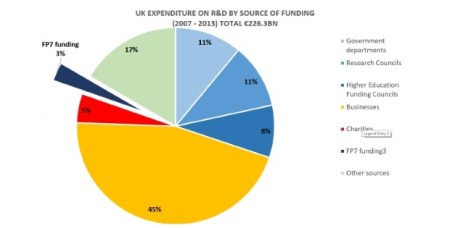
One of the figures bandied about by the Leave campaign and in particular by the strangely litigious group  that calls itself “Scientists for Britain” (which has only six members that I know of, not all of them scientists) is that the EU is not important for British science because it only funded 3% of UK R&D between 2007 and 2013). They’ve even supplied a helpful graphic:

UK_RD_2007-2013

The figures are taken from a Royal Society report and are, as far as I’m aware, accurate. It’s worth noting however that the level of funding  under the FP7 “Framework Programme” which funds research is much smaller than the current Horizon2020 programme.

However, as Stephen Curry has pointed out in a typically balanced and reasonable blog post, the impact of a BrExit on UK science is much more complex than this picture would suggest. I want to add just a few  points from my specific perspective as a university-based researcher.

First, the 3% figure is arrived at by a tried-and-tested technique of finding the smallest possible numerator and dividing it by the lowest possible denominator. A fairer comparison, in my view, would just look at research funded by the taxpayer (either directly from the UK or via the EU). For one thing we don’t know how much of the research funded by businesses in the UK is funded by businesses which are only here in the UK because we’re part of the European Union. For another these figures are taken over the whole R&D effort and they hide huge differences from discipline to discipline.

From my perspective as an astrophysicist – and this is true of many researchers in “blue skies” areas – most of the pie chart is simply not relevant. The main sources of funding that we can attempt to tap are the UK Research Councils (chiefly STFC and EPSRC) and EU programmes; we also get a small amount of research income from charities, chiefly the Leverhulme Trust. The situation is different in other fields: medical research, for example, has much greater access to charitable funding.

As it happens I’ve just received the monthly research report of the School of Mathematical and Physics Sciences at the University of Sussex (of which I am currently Head) and I can tell you the EU counts not for 3% of our  income but 21% (which is in line with the proportions) above; most of that comes from the European Research Council. The possibility of losing access to EU funding  alarms me greatly as it would mean the loss of about one-fifth of our research base. I know that figure is much higher in some other institutions and departments.

But it’s not just the money that’s important, it’s also the kind of programmes that the EU funds. These are often to do with mobility of researchers, especially those early in their careers (including PhD students), grants that allow us to exploit facilities that we would otherwise not be able to access, and those that sustain large collaborations. It’s not just the level of cash that matters but the fact that what it funds is nicely complementary to the UK’s own programmes. The combination of UK and EU actually provides a much better form of “dual funding” than the UK can achieve on its own.

Some say that BrExit would not change our access to EU funding, but I maintain there’s a huge risk that this will be the case. The loss of the UK’s input into the overall EU budget will almost certainly lead to a revision of the ability of non-member states to access these programmes. The best that even BrExit campaigners argue for is that access to EU funding will not change. There is therefore, from a science perspective, there is no chance of a gain and a large risk of a loss. For me, that kind of a decision is a no-brainer. I’m not the only one who thinks that either: 150 Fellows of the Royal Society agree with me, as do the vast majority of scientists surveyed in a poll conducted by Nature magazine.

Of course there will be some who will argue that this “blue skies” academic research in universities isn’t important and we should be spending more money on stuff that leads to wealth creation. I can think of many arguments against that, but for the purposes of this post I’ll just remind you that 45% of UK research is done in industry and commercial businesses of various kinds. Where do you think the supply of science graduates come from, what kind of research draws students into science courses in the first place, and where do the teachers come from that educate the next generations?

As a scientist who cares passionately about the sustainability of Britain’s research base, I think we should definitely remain in the European Union.

Fear, Risk, Uncertainty and the European Union

Posted in Politics, Science Politics, The Universe and Stuff with tags , , , , , , , , , on April 11, 2016 by telescoper

I’ve been far too busy with work and other things to contribute as much as I’d like to the ongoing debate about the forthcoming referendum on Britain’s membership of the European Union. Hopefully I’ll get time for a few posts before June 23rd, which is when the United Kingdom goes to the polls.

For the time being, however, I’ll just make a quick comment about one phrase that is being bandied about in this context, namely Project Fear.As far as I am aware this expression first came up in the context of last year’s referendum on Scottish independence, but it’s now being used by the “leave” campaign to describe some of the arguments used by the “remain” campaign. I’ve met this phrase myself rather often on social media such as Twitter, usually in use by a BrExit campaigner accusing me of scaremongering because I think there’s a significant probability that leaving the EU will cause the UK serious economic problems.

Can I prove that this is the case? No, of course not. Nobody will know unless and until we try leaving the EU. But my point is that there’s definitely a risk. It seems to me grossly irresponsible to argue – as some clearly are doing – that there is no risk at all.

This is all very interesting for those of us who work in university science departments because “Risk Assessments” are one of the things we teach our students to do as a matter of routine, especially in advance of experimental projects. In case you weren’t aware, a risk assessment is

…. a systematic examination of a task, job or process that you carry out at work for the purpose of; Identifying the significant hazards that are present (a hazard is something that has the potential to cause someone harm or ill health).

Perhaps we should change the name of our “Project Risk Assessments” to “Project Fear”?

I think this all demonstrates how very bad most people are at thinking rationally about uncertainty, to such an extent that even thinking about potential hazards is verboten. I’ve actually written a book about uncertainty in the physical sciences , partly in an attempt to counter the myth that science deals with absolute certainties. And if physics doesn’t, economics definitely can’t.

In this context it is perhaps worth mentioning the  definitions of “uncertainty” and “risk” suggested by Frank Hyneman Knight in a book on economics called Risk, Uncertainty and Profit which seem to be in standard use in the social sciences.  The distinction made there is that “risk” is “randomness” with “knowable probabilities”, whereas “uncertainty” involves “randomness” with “unknowable probabilities”.

I don’t like these definitions at all. For one thing they both involve a reference to “randomness”, a word which I don’t know how to define anyway; I’d be much happier to use “unpredictability”.In the context of BrExit there is unpredictability because we don’t have any hard information on which to base a prediction. Even more importantly, perhaps, I find the distinction between “knowable” and “unknowable” probabilities very problematic. One always knows something about a probability distribution, even if that something means that the distribution has to be very broad. And in any case these definitions imply that the probabilities concerned are “out there”, rather being statements about a state of knowledge (or lack thereof). Sometimes we know what we know and sometimes we don’t, but there are more than two possibilities. As the great American philosopher and social scientist Donald Rumsfeld (Shurely Shome Mishtake? Ed) put it:

“…as we know, there are known knowns; there are things we know we know. We also know there are known unknowns; that is to say we know there are some things we do not know. But there are also unknown unknowns – the ones we don’t know we don’t know.”

There may be a proper Bayesian formulation of the distinction between “risk” and “uncertainty” that involves a transition between prior-dominated (uncertain) and posterior-dominated (risky), but basically I don’t see any qualititative difference between the two from such a perspective.

When it comes to the EU referendum is that probabilities of different outcomes are difficult to calculate because of the complexity of economics generally and the dynamics of trade within and beyond the European Union in particular. Moreover, probabilities need to be updated using quantitative evidence and we don’t actually have any of that. But it seems absurd to try to argue that there is neither any risk nor any uncertainty. Frankly, anyone who argues this is just being irrational.

Whether a risk is worth taking depends on the likely profit. Nobody has convinced me that the country as a whole will gain anything concrete if we leave the European Union, so the risk seems pointless. Cui Bono? I think you’ll find the answer to that among the hedge fund managers who are bankrolling the BrExit campaign…