Archive for Examinations

Better learning means less assessment and more feedback

Posted in Education with tags , , on September 28, 2013 by telescoper

Yesterday I took part in a meeting that discussed, among other things, how to improve the feedback on student assessments in order to help them learn better. It was an interesting meeting, involving academics, administrative staff and a representative of the Students Union, that generated quite a few ideas which I hope will be implemented pretty soon.

Positive though the discussion was, it didn’t do anything to dissuade me from a long-held view that the entire education system holds back the students’ ability to learn by assessing them far too much. The combination of the introduction of modular programmes and the increase of continuously assessed coursework has led to a cycle of partial digestion and regurgitation that involves little in the way of real learning.

I’m not going to argue for turning the clock back entirely, but for the record my undergraduate degree involved no continuous assessment at all (apart from a theory project I opted for in my final year. Having my entire degree result based on the results of six three-hour unseen examinations in the space of three days is not an arrangement I can defend, but note that despite the lack of continuous assessment I still spent less time in the examination hall than present-day students.

That’s not to say I didn’t have coursework. I did, but it was formative rather than summative; in other words it was for the student to learn about the subject, rather for the staff to learn about the student. I handed in my stuff every week, it was marked and annotated by a supervisor, then returned and discussed at a supervision.

People often tell me that if a piece of coursework “doesn’t count” then the students won’t do it. There is an element of truth in that, of course. But I had it drummed into me that the only way really to learn my subject (Physics) was by doing it. I did all the coursework I was given because I wanted to learn and I knew that was the only way to do it.

The very fact that coursework didn’t count for assessment made the feedback written on it all the more useful when it came back because if I’d done badly I could learn from my mistakes without losing marks. This also encouraged me to experiment a little, such as using a method different from that suggested in the question. That’s a dangerous strategy nowadays, but surely we should be encouraging students to exercise their creativity rather than simply follow the instructions? The other side of this is that more challenging assignments can be set, without worrying about what the average mark will be or what specific learning outcome they address.

I suppose what I’m saying is that the idea of Learning for Learning’s Sake, which is what in my view defines what a university should strive for, is getting lost in a wilderness of modules, metrics, percentages and degree classifications. We’re focussing too much on those few aspects of the educational experience that can be measured, ignoring the immeasurable benefit (and pleasure) that exists for all humans in exploring new ways to think about the world around us.

Examination Period

Posted in Biographical, Education with tags , , on January 14, 2013 by telescoper

Up early this morning as I have to chair my final meeting of the Board of Studies in the School of Physics and Astronomy at Cardiff University before heading off to the Sussex-by-the-Sea for a three days of lectureship interviews and related matters. I’ll therefore probably only have time for brief posts over the next week or so.

Today is also the start of our mid-year examination period which goes on for a fortnight at Cardiff University. It’s therefore a good opportunity to send a hearty “good luck” message to all students about to take examinations, whether in Cardiff or elsewhere, especially those who are further on in their courses and for whom these papers have greater importance.

I’m a bit too busy for anything new so I thought I’d just post a rehash of a rehash of an excerpt from something I posted a while ago on the subject of examinations.

My feelings about examinations agree pretty much with William Wordsworth, who studied at the same University as me, as expressed in this quotation from The Prelude:

Of College labours, of the Lecturer’s room
All studded round, as thick as chairs could stand,
With loyal students, faithful to their books,
Half-and-half idlers, hardy recusants,
And honest dunces–of important days,
Examinations, when the man was weighed
As in a balance! of excessive hopes,
Tremblings withal and commendable fears,
Small jealousies, and triumphs good or bad–
Let others that know more speak as they know.
Such glory was but little sought by me,
And little won.

It seems to me a great a pity that our system of education – both at School and University – places such a great emphasis on examination and assessment to the detriment of real learning. The biggest bane of physics education is the way modular degrees have been implemented in this respect…

Don’t get me wrong. I’m not opposed to modularisation in principle. I just think the way we teach modules in British universities fails to develop any understanding of the interconnection between different aspects of the subject. That’s an educational disaster because what is most exciting and compelling about physics is its essential unity. Splitting it into little boxes, taught on their own with no relationship to the other boxes, provides us with no scope to nurture the kind of lateral thinking that is key to the way physicists attempt to solve problems. The small size of each module makes the syllabus very “bitty” and fragmented. No sooner have you started to explore something at a proper level than the module is over. More advanced modules, following perhaps the following year, have to recap a large fraction of the earlier modules so there isn’t time to go as deep as one would like even over the whole curriculum.

Our students take 120 “credits” in a year, split into two semesters. These are usually split into 10-credit modules with an examination at the end of each semester. Laboratories, projects, and other continuously-assessed work do not involve a written examination, but the system means that a typical  student will have 5 written examination papers in January and another 5 in May. Each paper is usually of two hours’ duration.

This means that the ratio of assessment to education has risen sharply over the last decades with the undeniable result that academic standards have fallen in physics. The system encourages students to think of modules as little bit-sized bits of education to be consumed and then forgotten. Instead of learning to rely on their brains to solve problems, students tend to approach learning by memorising chunks of their notes and regurgitating them in the exam. I find it very sad when students ask me what derivations they should memorize to prepare for examinations. A brain is so much more than a memory device. What we should be doing is giving students the confidence to think for themselves and use their intellect to its full potential rather than encouraging rote learning.

You can contrast this diet of examinations with the regime when I was an undergraduate. My entire degree result was based on six three-hour written examinations taken at the end of my final year, rather than something like 30 examinations taken over 3 years. Moreover, my finals were all in a three-day period. Morning and afternoon exams for three consecutive days is an ordeal I wouldn’t wish on anyone so I’m not saying the old days were better, but I do think we’ve gone far too far to the opposite extreme. The one good thing about the system I went through was that there was no possibility of passing examinations on memory alone. Since they were so close together there was no way of mugging up anything in between them. I only got through  by figuring things out in the exam room.

I don’t want to denigrate the achievements of students who are successful under the current system.  What I’m saying is that I don’t think the education we provide does justice to their talents. That’s our fault, not theirs…

Examination Period

Posted in Biographical, Education with tags , , on January 16, 2012 by telescoper

Today is the start of our mid-year examination period which goes on for a fortnight at Cardiff University.It’s therefore a good opportunity to send a hearty “good luck” message to all students about to take examinations, especially those who are further on in their courses for whom these papers have greater importance.

I’m a bit too busy for anything particularly profound today, so I thought I’d just rehash an excerpt from something I posted a while ago on the subject of examinations.

My feelings about examinations agree pretty much with William Wordsworth, who studied at the same University as me, as expressed in this quotation from The Prelude:

Of College labours, of the Lecturer’s room
All studded round, as thick as chairs could stand,
With loyal students, faithful to their books,
Half-and-half idlers, hardy recusants,
And honest dunces–of important days,
Examinations, when the man was weighed
As in a balance! of excessive hopes,
Tremblings withal and commendable fears,
Small jealousies, and triumphs good or bad–
Let others that know more speak as they know.
Such glory was but little sought by me,
And little won.

It seems to me a great a pity that our system of education – both at School and University – places such a great emphasis on examination and assessment to the detriment of real learning. The biggest bane of physics education is the way modular degrees have been implemented.

Don’t get me wrong. I’m not opposed to modularisation in principle. I just think the way we teach modules in British universities fails to develop any understanding of the interconnection between different aspects of the subject. That’s an educational disaster because what is most exciting and compelling about physics is its essential unity. Splitting it into little boxes, taught on their own with no relationship to the other boxes, provides us with no scope to nurture the kind of lateral thinking that is key to the way physicists attempt to solve problems. The small size of each module makes the syllabus very “bitty” and fragmented. No sooner have you started to explore something at a proper level than the module is over. More advanced modules, following perhaps the following year, have to recap a large fraction of the earlier modules so there isn’t time to go as deep as one would like even over the whole curriculum.

Our students take 120 “credits” in a year, split into two semesters. These are usually split into 10-credit modules with an examination at the end of each semester. Laboratories, projects, and other continuously-assessed work do not involve a written examination, but the system means that a typical  student will have 5 written examination papers in January and another 5 in May. Each paper is usually of two hours’ duration.

This means that the ratio of assessment to education has risen sharply over the last decades with the undeniable result that academic standards have fallen in physics. The system encourages students to think of modules as little bit-sized bits of education to be consumed and then forgotten. Instead of learning to rely on their brains to solve problems, students tend to approach learning by memorising chunks of their notes and regurgitating them in the exam. I find it very sad when students ask me what derivations they should memorize to prepare for examinations. A brain is so much more than a memory device. What we should be doing is giving students the confidence to think for themselves and use their intellect to its full potential rather than encouraging rote learning.

You can contrast this diet of examinations with the regime when I was an undergraduate. My entire degree result was based on six three-hour written examinations taken at the end of my final year, rather than something like 30 examinations taken over 3 years. Moreover, my finals were all in a three-day period. Morning and afternoon exams for three consecutive days is an ordeal I wouldn’t wish on anyone so I’m not saying the old days were better, but I do think we’ve gone far too far to the opposite extreme. The one good thing about the system I went through was that there was no possibility of passing examinations on memory alone. Since they were so close together there was no way of mugging up anything in between them. I only got through  by figuring things out in the exam room.

I don’t want to denigrate the achievements of students who are successful under the current system.  What I’m saying is that I don’t think the education we provide does justice to their talents. That’s our fault, not theirs…

School for Scandal

Posted in Education with tags , , , , on December 10, 2011 by telescoper

One of the biggest news stories this week derived from an investigation by the Daily Telegraph into the behaviour of officials connected with the Welsh examination board WJEC who, it appears, have been passing on tips about the content of their examination papers to teachers who have paid to attend their seminars. Of course this reflects very badly on Wales – especially coming so soon after the University of Wales scandals – but it is symptomatic of a much wider malaise;  this  episode  undermines not just the examination process  but  the entire education system in the United Kingdom. The sad thing is that that there’s not really anything new in this story.  It’s been obvious for some time that the whole framework  has become corrupted by the profit motive. There have been previous warnings about how the examination boards compete for customers (and cash) by dumbing down examination papers, but nothing seems to have been done.

The problem is particularly acute for A-level examinations, which universities use to select applicants for admission onto courses. In my own subject, Physics, the A-level course being taught in schools are clearly not fit for this purpose – the syllabuses have been filleted of any challenging material and there’s no correlation that I can discern between high grades at A-level and good performance at undergraduate level. In fact,some of our very best students at Cardiff – who are as good as any I’ve come across anywhere –  came in with very modest A-level grades but have performed brilliantly on the course. Relying only on A-levels might have led to us closing the door on these folks. Actually, I don’t know why we bother making offers based on A-level results at all!

Anyway, it’s clearly time to sort out the examinations system properly. The Exam Boards won’t fix the problem themselves because they are doing very nicely out of the status quo, so what should be done?

I like the suggestion is that the Examination Boards should be scrapped and the business of setting examinations should be carried out by one organization: no competition means no temptation to cheat. I’d also add that, at least for A-levels, the people who set and mark the examinations should be based in universities. I’d envisage a series of national subject panels with representatives from a number of institutions. A single Exam Board with members based in the university sector would also help simplify the process of university admissions, perhaps even streamlining it enough to allow  for post-examination applications without having to have earlier examinations. Above all it would ensure that A-level courses are relevant to university entrance requirements, which they are not at the moment.

Another possibility – which also like but which is probably politically a non-starter – is to scrap our tarnished A-levels altogether and adopt the International Baccalaureate as the UK’s educational gold-standard. The reason this wouldn’t be acceptable to our Lords and Masters in Whitehall is that it would immediately dispel the comforting myth that  standards in British schools are  rising;  I’d bet my bottom dollar that, relative to the rest of the world, they are not and adopting the IB would demonstrate that as it would allow comparisons to be made which can’t be made with A-levels.

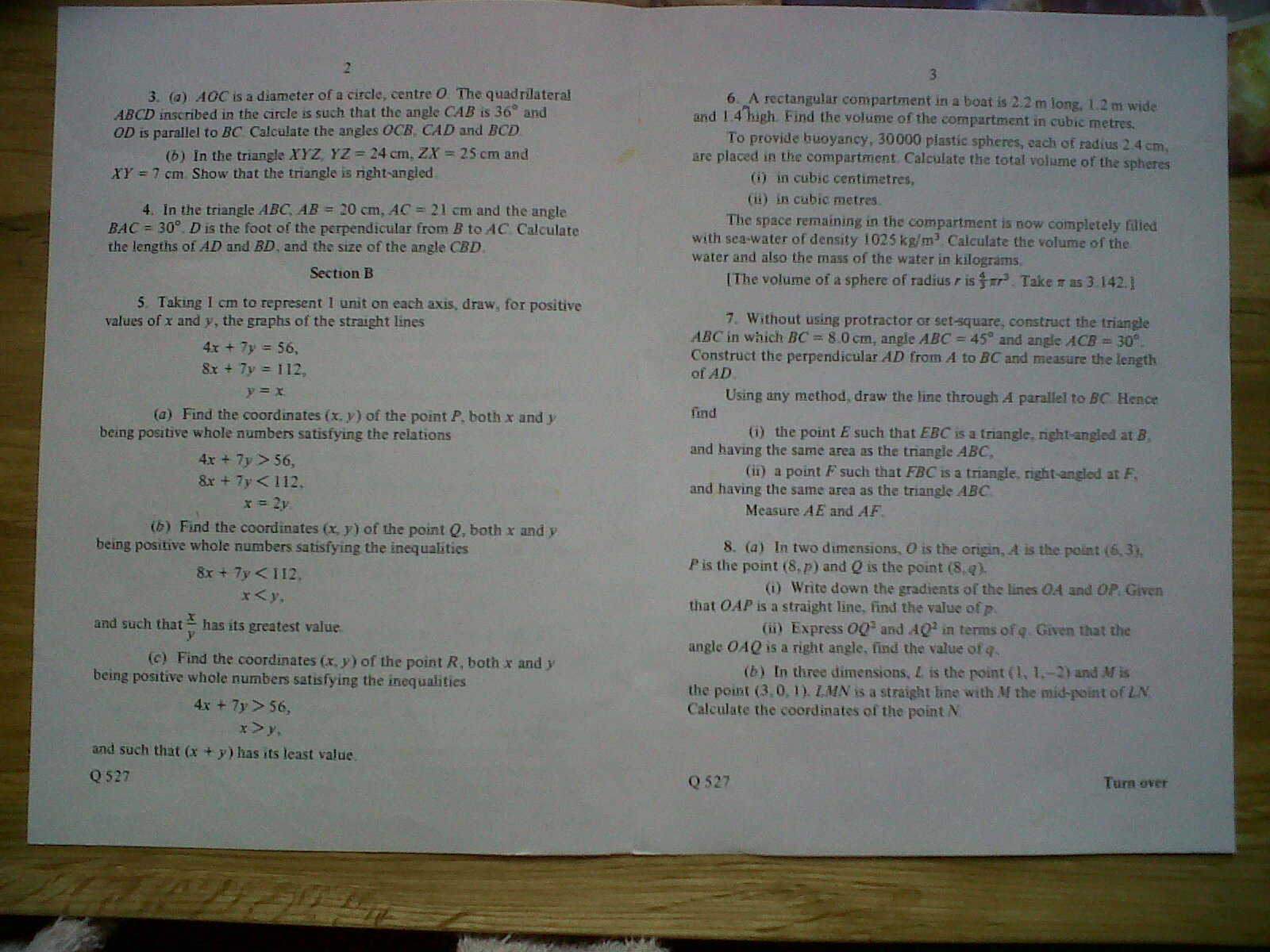
Advanced Level Mathematics Examination, Vintage 1981

Posted in Education with tags , , , , , , on September 26, 2011 by telescoper

It’s been a while since I posted any of my old examination papers, but I wanted to put this one up before term starts in earnest. In the following you can find both papers (Paper I and Paper 2) of the Advanced Level Mathematics Examination that I sat in 1981.

Each paper is divided into two Sections: A covers pure mathematics while B encompasses applied mathematics (i.e. mechanics) and statistics. Students were generally taught only one of the two parts of Section B and in my case it was the mechanics bit that I answered in the examination. Paper I contains slightly shorter questions than Paper 2 and more of them..

Note that slide rules were allowed, but calculators had crept in by then. In fact I used my wonderful HP32-E, complete with Reverse Polish Notation. I loved it, not least because nobody ever asked to borrow it as they didn’t understand how it worked…

I also did Further Mathematics, and will post those papers in due course, but in the meantime I stress that this is just plain Mathematics.

If it looks a bit small you can use the viewer to zoom in.

I’ll be interested in comments from anyone who sat A-Level Mathematics more recently than 1981. Do you think these papers are harder than the ones you took? Is the subject matter significantly different?

University Physics Examinations, Vintage 1892

Posted in Education, History with tags , , on September 7, 2011 by telescoper

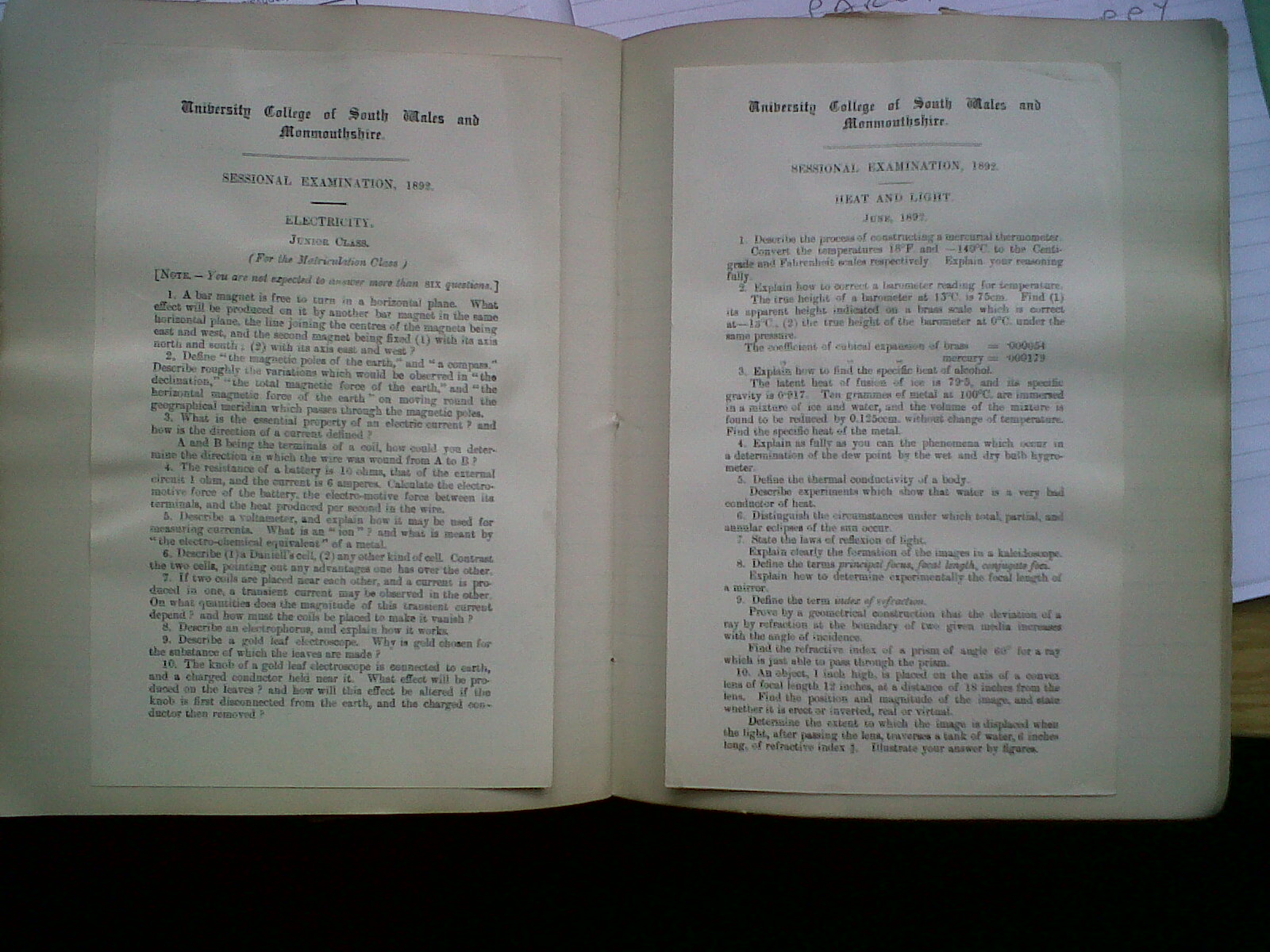
There recently came into my possession a book of very old school and university physics examinations, which are of interest because I’ve been posting slightly less ancient examples in recent weeks. These examinations were set by the University College of South Wales and Monmouthshire, which was founded in 1883,  an institution which eventually became Cardiff University. I find them absolutely fascinating.

The papers are rather fragile, as is the book containing them, so I daren’t risk trying to scan them systematically in case flattening them out causes damage. Here instead are a few random examples that I photographed on my desk, in the manner of an old-fashioned secret agent. Sorry they’re not all that clear, but you can see them blown up if you click on them.

The collection is fairly complete, covering most of classical physics, at all examination levels from university entry to final honours. For some reason, however, the papers on relativity and quantum physics appear to be missing….

Results and explanation (via Gowers’s Weblog)

Posted in Education with tags , , on August 26, 2011 by telescoper

I thought I’d reblog this because it pertains to my earlier post from today…

I’ve had a healthy number of responses to my question from the previous post. In case you are reading this post without having read the previous one, I shall continue after the fold, because if you read on it will render you ineligible to participate in the little experiment I am conducting. Every year in Britain, at round about this time of the year, we have the same debate. The GCSE and A-level results come out (these are taken at the ages of 1 … Read More

via Gowers’s Weblog

Are exams getting easier?

Posted in Education with tags , , , on August 26, 2011 by telescoper

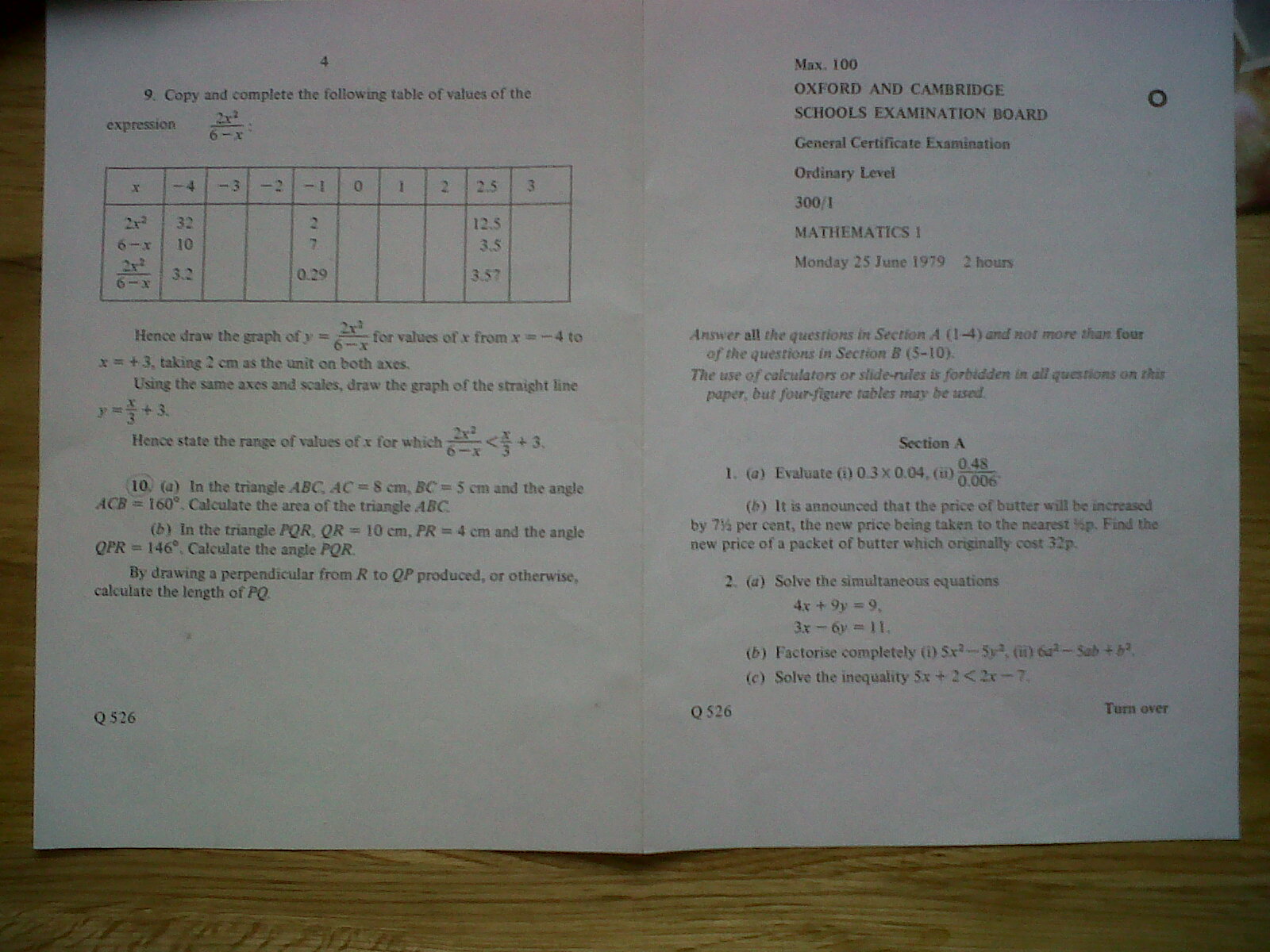
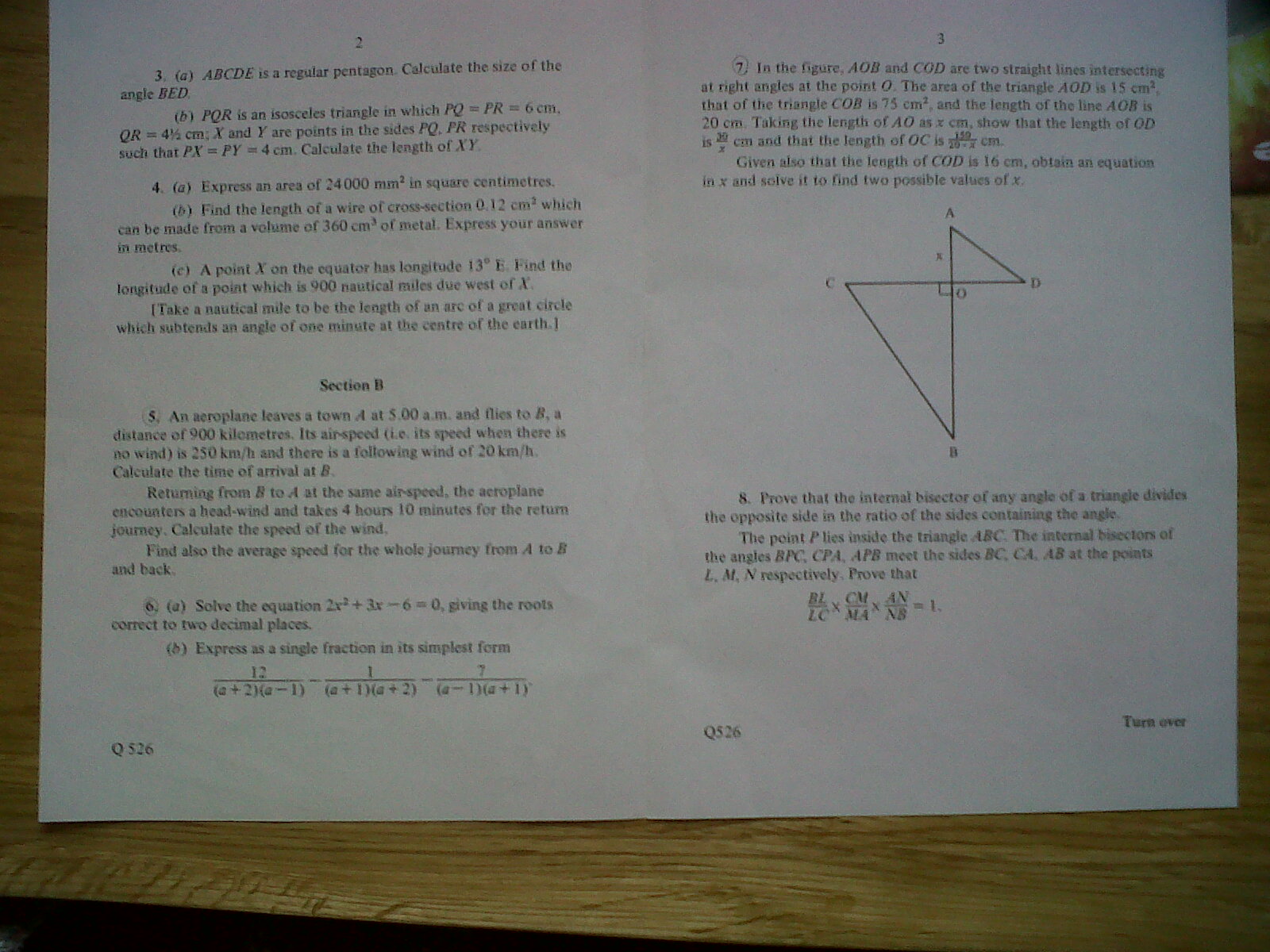
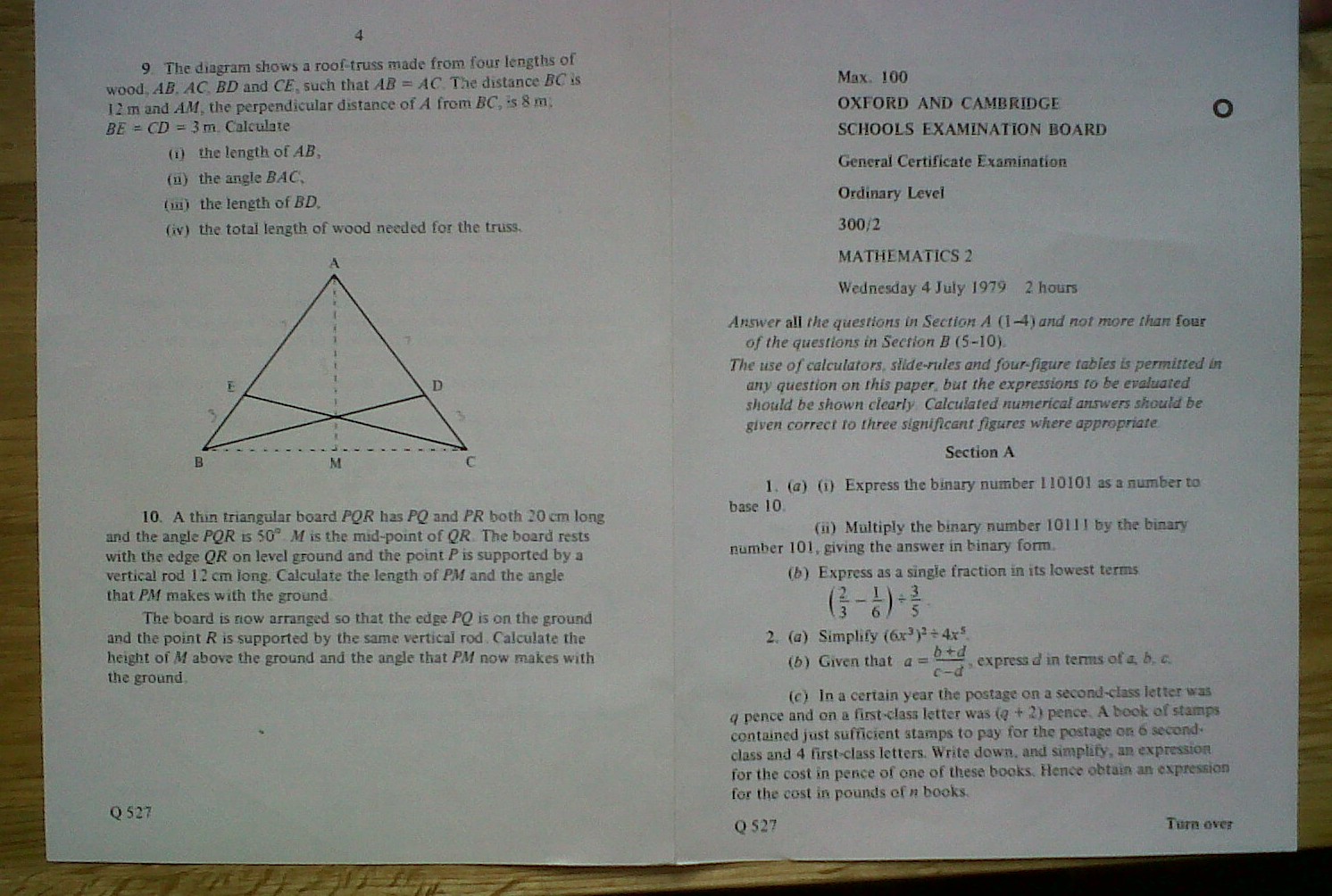
With the publication of this year’s GCSE results there’s been the usual clamour about “dumbing down” of educational standards. So are these examinations getting easier or not? I can’t answer that question because I’m far too old to have done GCSEs. The examinations I took at the equivalent stage of my school career were O-levels. But, being an inveterate hoarder of useless articles, I kept the exam papers that I took, so what I can do is put up and example the O-level papers I took (in 1979) and let you decide. I thought the Mathematics one might be of interest, so here it is or rather here they are, because there were two 2-hour written papers; there was no coursework component, so these counted 100% of the final grade.

If you’ve done GCSE mathematics recently, have a look and see what you think!

(You can click on the images to make them bigger if they’re difficult to read…)

I’d be interested in any comments you might have, especially if you’ve actually done GCSE Mathematics (recently or a long time ago). I suspect the most obvious difference is that in my day we did much more geometry…

I might put up the Physics papers if there’s enough interest!

The Final Analysis

Posted in Education with tags , , , , on June 14, 2011 by telescoper

It’s that time of year again. The annual meeting of the Board of Examiners of the School of Physics & Astronomy at Cardiff University met this afternoon to consider the marks for students due to graduate this year and to draw up recommendations for the final degree classifications.

This year’s meeting was actually quite interesting and, at just over two hours, somewhat shorter than some we’ve had in previous years.  A group of students has already gathered in the foyer waiting for the dreaded list to be posted, and many will no doubt be celebrating or drowning their sorrows in local hostelries shortly after their fate is revealed.

Cardiff is a little old-fashioned in the way the final examiners’ meetings are conducted. For a start we still have a system of viva voce examinations for borderline candidates; they happened yesterday, in fact. Many universities have dispensed with this aspect of the process, but I still think they’re worthwhile. The Board of Examiners, including the two External Examiners,  also still has some discretion in how it arrives at the degree boundaries (which are nominally at 70% for a first, 60% for a 2.1, 50% for a 2.2, and 40% for a 3rd).

The tide is turning against this very traditional approach, however, and there are moves here to dispense with the viva examinations and with academic discretion. I’m not sure when this will happen, but it’s likely to be sooner rather than later. I think the main reason for this is to make the system more automatic so there’s less chance of legal challenge. In any case there doesn’t seem to me that there can be any educational reason for it.

The one thing that strikes me about the system we have is that it’s the whole business of classifying degrees into broad categories which is where the problem lies.  It was suggested some time ago that we should dispense with, e.g., the “Desmond” (2.2) and the “Thora Hird” (3rd) and instead simply give each student a transcript containing details of the entire spectrum of their academic performance. It’s been suggested again just recently too. That would seem to me to make much more sense than the current system of classifying degrees which involves (a) trying to condense a huge amout of information – examination marks, coursework, project assignments and the like – into a single number and then (b) drawing boundaries based on this number precisely where the distribution is most densely peaked. However, years have passed and nothing concrete has happened. The academic world is good at inertia.

Anyway, this isn’t the time or the place for a lengthy diatribe about the ins-and-outs of degree classifications. I’ve got to go back to marking my 1st year examination papers shortly in fact; these are considered by a separate meeting of the Board of Examiners.

It is time, however, for me to congratulate all our graduating students on their success. It’s the first group of Cardiff MPhys students that I’ve seen all the way through from entry  to graduation. I’ll be sad to see them go, but wish them all the best as they venture forth into the real world. At least I hope to see them back next month for graduation.  Until then, however, all I’ll  say is

Congratulations!

Examination Matters

Posted in Biographical, Education with tags , , on June 10, 2009 by telescoper

I made it safely back to Blighty last night and have spent the day catching up on a few things. I wasn’t really planning to post anything today, but after looking through the comments on my previous item I thought it was probably a good idea to move on!

My trip to Copenhagen was carefully timed to miss the mammoth examiners’ meeting that took place yesterday in the Cardiff School of Physics & Astronomy, at which decisions were made about the degree classes of the graduating students. Final results have to be confirmed by the University but, following a longstanding tradition, provisional pass lists went up on the boards immediately after the meeting.

When I came in this morning I was delighted to hear that the meeting went off fairly smoothly and also delighted to see the pass lists had very good news for many of the students I know quite well personally. Particular congratulations to all the students who got First Class Honours, some of whom will be taking another step on the academic treadmill and going on to do PhDs here and there. I’m not really sorry I missed the examiners’ meeting, but I am sorry I wasn’t here to congratulate the soon-to-be-graduates in person.

I remember that when I finished my degree and got the result I didn’t actually feel much euphoria, only exhaustion. When I was younger, exams were always times of enormous stress for me. I guess that’s because, when I first went to School, I was very far behind everyone else and, as one of the “slow” kids, I was almost thrown in the educational wastebin. I gradually caught up but for a long time felt that I was still regarded as a bit of a dunderhead so, to prove I wasn’t a fake,  to myself as much as anyone else, I worked very hard at all the examinations I had to take. It was only when I got to University that I realised all the stress wasn’t worth it. It’s nice to pass but you shouldn’t become obsessed with grades and certificates. Examinations seem to have an almost overwhelming significance when they’re the only thing on your horizon, but years later you will look back on them as being of very little real importance (regardless of whether you did well or not).

My feelings about examinations agree pretty much with William Wordsworth, who studied at the same University as me, as expressed in this quotation from The Prelude:

Of College labours, of the Lecturer’s room
All studded round, as thick as chairs could stand,
With loyal students, faithful to their books,
Half-and-half idlers, hardy recusants,
And honest dunces–of important days,
Examinations, when the man was weighed
As in a balance! of excessive hopes,
Tremblings withal and commendable fears,
Small jealousies, and triumphs good or bad–
Let others that know more speak as they know.
Such glory was but little sought by me,
And little won.

It seems to me a great a pity that our system of education – both at School and University – places such a great emphasis on examination and assessment, to the detriment of real learning. The biggest bane of physics education is the way modular degrees have been implemented. Don’t get me wrong. I’m not opposed to modularisation in principle. I just think the way we teach modules in British university fails to develop any understanding of the interconnection between different aspects of the subject. That’s an educational disaster because what is most exciting and compelling about physics is its essential unity. Splitting it into little boxes, taught on their own with no relationship to the other boxes, provides us with no scope to nurture the kind of lateral thinking that is key to the way physicists attempt to solve problems. The small size of each module makes the syllabus very “bitty” and fragmented. No sooner have you started to explore something at a proper level than the module is over. More advanced modules, following perhaps the following year, have to recap a large fraction of the earlier modules so there isn’t time to go as deep as one would like even over the whole curriculum.

Our students take 120 “credits” in a year, split into two semesters. These are usually split into 10-credit modules with an examination at the end of each semester. Laboratories and other continuously-assessed work does not involve a written examination, but the system means that a typical  student will have 5 written examination papers in January and another 5 in May. Each paper is two hours.

These factors mean that the ratio of assessment to education has risen sharply over the last decades with the undeniable result that academic standards have fallen in physics. The system encourages students to think of modules as little bit-sized bits of education to be consumed and then forgotten. Instead of learning to rely on their brains to solve problems, students tend to approach learning by memorising chunks of their notes and regurgitating them in the exam. I find it very sad when students ask me what derivations they should memorize to prepare for examinations. A brain is much more than a memory device. What we should be doing is giving students the confidence to think for themselves.

You can contrast this diet of examinations with the regime when I was an undergraduate. My entire degree result was based on six three-hour written examinations taken at the end of my final year, rather than something like 30 examinations taken over 3 years. Moreover, my finals were all in a three-day period. Morning and afternoon exams for three consecutive days is an ordeal I wouldn’t wish on anyone so I’m not saying the old days were better, but I do think we’ve gone far too far to the opposite extreme. The one good thing about the system I went through was that there was no possibility of passing examinations on memory alone. Since they were so close together there was no way of mugging up anything in between them. I only got through  by figuring things out in the exam room.

I don’t want to denigrate the success of our high achievers. They have taken the course we have given them and done extremely well. They deserve admiration and praise. What I’m saying is that I don’t think the education we provide does justice to their talents. That’s our fault, not theirs…