Archive for Falcon-9

MAUVE Launched!

Posted in Maynooth, The Universe and Stuff with tags , , , , on November 28, 2025 by telescoper

After a false start a couple of days ago, the satellite MAUVE was launched at (10.44 Pacific Time (18.44 GMT) today from Vandenberg Space Force Base in California on a SpaceX Falcon-9 Transporter-15. So far, about 40 minutes after liftoff, it’s looking good.

You can see the live feed here:

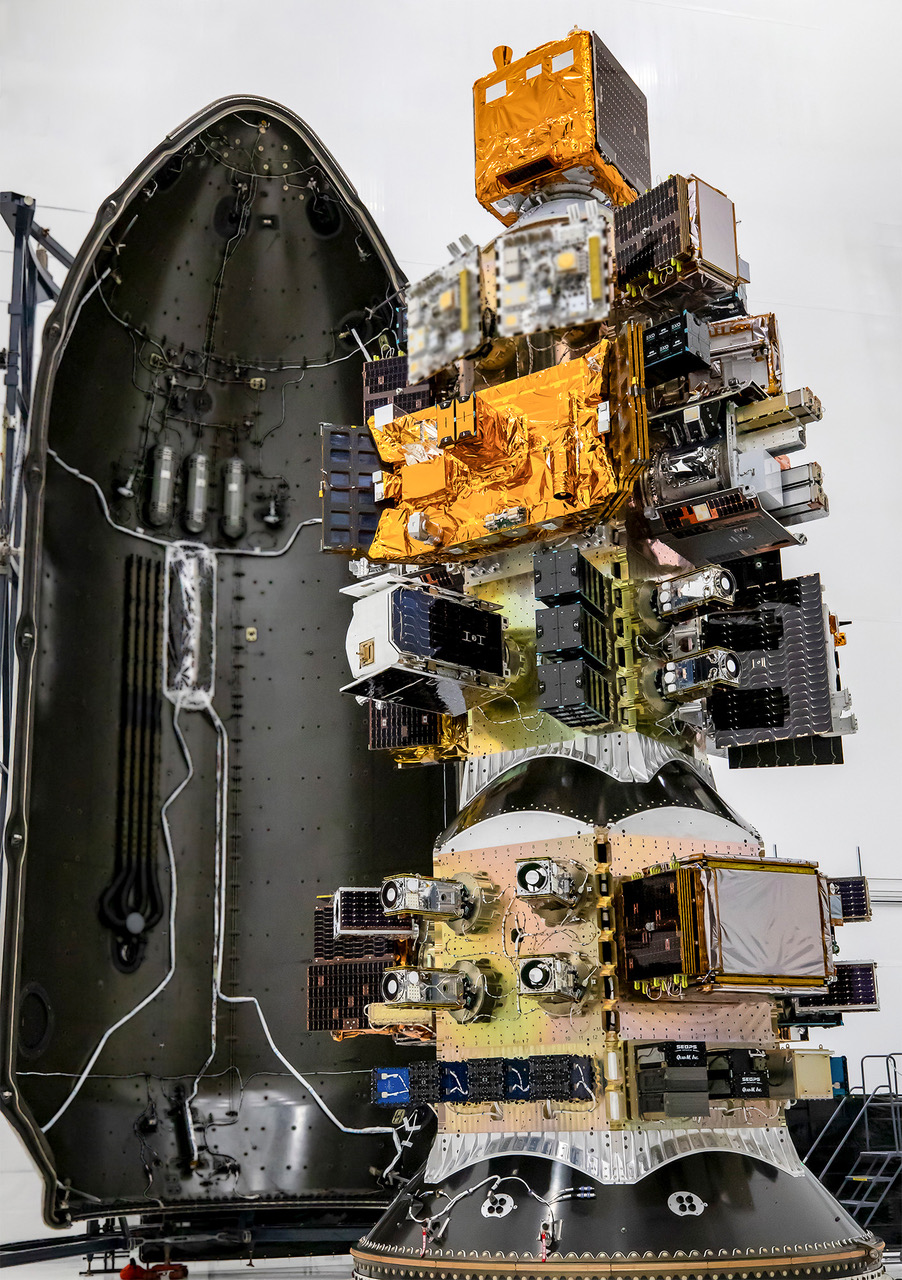
As far as I know the launch went perfectly, but I’m waiting for confirmation of payload deployment, which begins about an hour after launch. The vehicle is carrying 140 different satellites, of which MAUVE (“Mission to Analyze the UltraViolet universE”) is just one.

The following is taken from my previous post. I repeat it here for completeness.
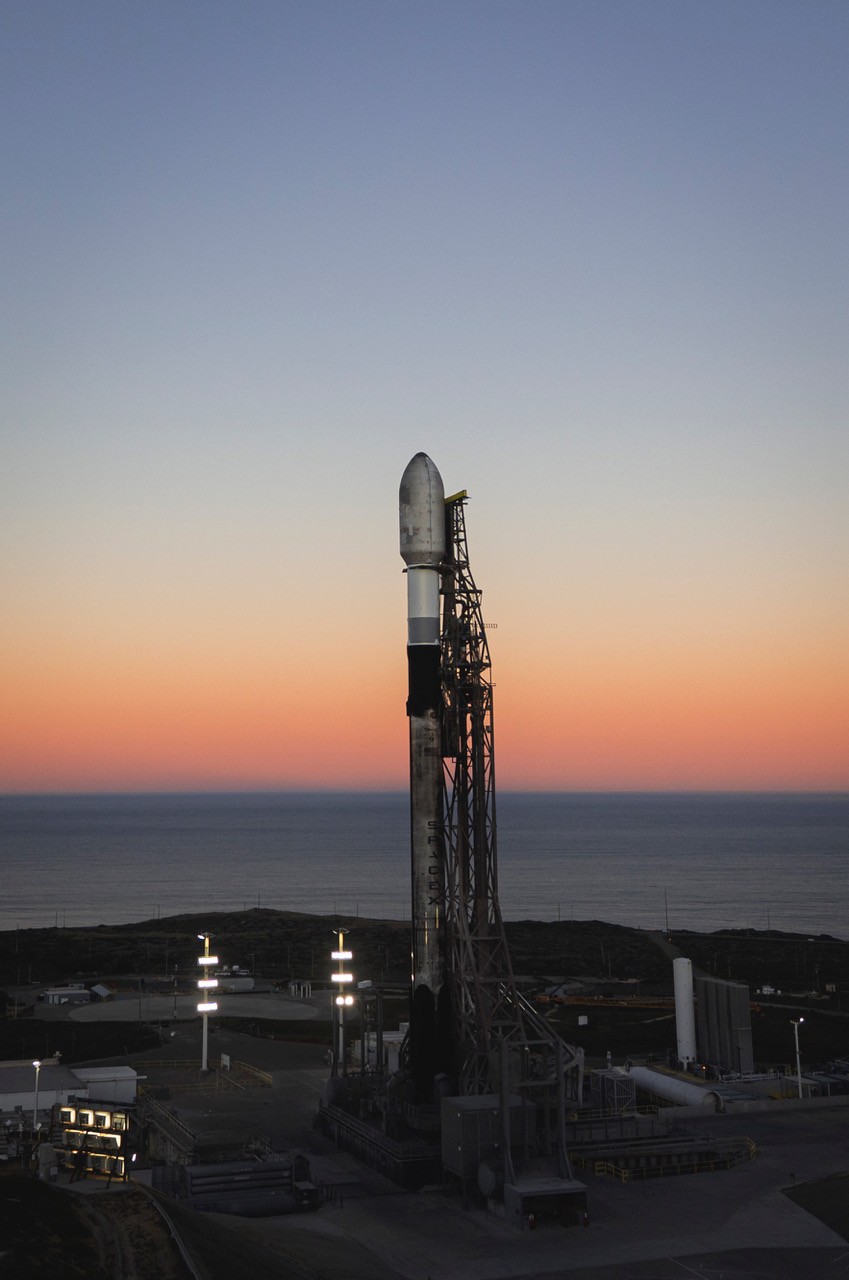
I’m not personally involved in MAUVE but the Department of Physics at Maynooth University is, through my colleague Dr Emma Whelan (who sent the above pictures) and her group. You can read more about the science – related to star and planet formation – it will do in a nice piece by Emma on RTÉ Brainstorm.
MAUVE Postponed

Posted in Maynooth, The Universe and Stuff with tags , , , , on November 26, 2025 by telescoper

I was hoping to do a post this evening about the satellite MAUVE which was due to be launched at 18.18 GMT from Vandenberg Space Force Base in California on a SpaceX Falcon-9 Transporter-15. Unfortunately the launched was scrubbed with about 15 minutes to go. In fact it was originally scheduled for 11th November but was postponed then. It’s now supposed to be launched on Friday 28th November. Let’s hope it’s third time lucky!

MAUVE is a small satellite, which is to be launched with a number of others; the name stands for “Mission to Analyze the UltraViolet universE” and the heart of it is a 60cm ultraviolet telescope.

I’m not personally involved in MAUVE but the Department of Physics at Maynooth University is, through my colleague Dr Emma Whelan (who sent the above pictures) and her group. You can read more about the science – related to star and planet formation – it will do in a nice piece by Emma on RTÉ Brainstorm.

There’s a more technical description of MAUVE on the arXiv here. The abstract reads:

We present the mission concept “Mission to Analyze the UltraViolet universE” (MAUVE), a wide-field spectrometer and imager conceived during the inaugural NASA Astrophysics Mission Design School. MAUVE responds to the 2023 Announcement of Opportunity for Probe-class missions, with a budget cap of $1 billion, and would hypothetically launch in 2031. However, the formulation of MAUVE was an educational exercise and the mission is not being developed further. The Principal Investigator-led science of MAUVE aligns with the priorities outlined in the 2020 Astrophysics Decadal Survey, enabling new characterizations of exoplanet atmospheres, the early-time light curves of some of the universe’s most explosive transients, and the poorly-understood extragalactic background light. Because the Principal Investigator science occupies 30% of the observing time available during the mission’s 5 yr lifespan, we provide an observing plan that would allow for 70% of the observing time to be used for General Observer programs, with community-solicited proposals. The onboard detector (THISTLE) claims significant heritage from the Space Telescope Imaging Spectrograph on Hubble, but extends its wavelength range down to the extreme UV. We note that MAUVE would be the first satellite in decades with the ability to access this regime of the electromagnetic spectrum. MAUVE has a field of view of 900″ x 900″ a photometric sensitivity extending to mUV ≤ 24 , and a resolving power of R ~ 1000. This paper provides full science and mission traceability matrices for this concept, and also outlines cost and scheduling timelines aimed at enabling a within-budget mission and an on-time launch.

Anyway, I hope to be able to give an update on Friday evening about the successful launch of MAUVE. Fingers crossed!

Countdown to the Euclid Launch

Posted in Euclid, The Universe and Stuff with tags , , , on July 1, 2023 by telescoper

Today’s the day! Weather permitting, of course, all eyes will be on Cape Canaveral for the launch of the Euclid satellite later this afternoon (as reckoned in Ireland). You can watch the launch on YouTube via the following stream (but it won’t start until 15.30 Irish Time; 16.30 CEST):

The Key Events to look for in local time are:

16:12 Euclid launch on SpaceX Falcon 9
16:53 Separation of Euclid from Falcon 9
16:57 Earliest expected time to establish communication with Euclid

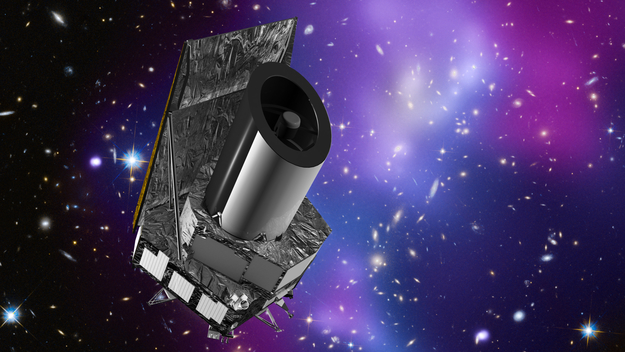
After that, the mission is handed over to the ESA Space Operations Centre in Darmstadt, Germany as it sets out for the Sun-Earth Lagrange point L2. Approximately four weeks after launch, Euclid will enter in orbit around this point, which is located at 1.5 million km from Earth, in the opposite direction from the Sun. Once in orbit, mission operators will start verifying all the functions of the telescope. During this, residual water is outgassed, after which Euclid’s instruments will be turned on. Between one and three months after launch, Euclid will go through several calibrations and scientific performance tests and get ready for science. The telescope begins its early phase of the survey of the Universe three months after launch. There will be a preliminary release of a small amount of data in December 2024, but the first full data release – DR1 – will take about two years.

UPDATE: All critical stages of the launch passed satisfactorily, and contact has been established with the ground control. Euclid is now on its way to L2. Bon Voyage, Euclid!

SpaceX for Euclid

Posted in The Universe and Stuff with tags , , , , , , , on October 20, 2022 by telescoper

Aa few months ago I posted a piece about the European Space Agency’s Euclid Mission which had been due to be launched in 2023 on a Soyuz ST 2-1b rocket. That no longer being possible because of Russian’s invasion of Ukraine, it seemed there would be a lengthy delay in the launch of Euclid, with late 2024 seeming the earliest feasible date for launch on the obvious alternative, the new Ariane 6.

I ended that piece with this:

It seems to me that the best hope for a resolution of this problem would be for ESA to permit the launch of Euclid using something other than Ariane 6, which means using a vehicle supplied by an independent commercial operator. I sincerely hope ESA is able to come up with an imaginative solution to this very serious problem.

In the Dark, 17th June

Well I’ve just read official confirmation that a few hours ago ESA Council has approved the proposal to launch Euclid on a Falcon 9 rocket operated by SpaceX. If all goes well -specifically if the Euclid Consortium member states agree with this move – it might be possible to launch Euclid by the end of 2023. Although I don’t have any firm information about what date is being proposed I believe it could be as soon as July 2023.

Setting aside any personal opinions about Elon Musk, the Falcon 9 has proved to be very reliable, with the latest version having 110 out of 110 successful launches. Euclid will not be in an Earth orbit, like most of the satellites so far launched by SpaceX, but has to be delivered to the 2nd Lagrange Point, L2. That should not pose to much of a difficulty, however.

SpaceX – the Anatomy of an Explosion

Posted in The Universe and Stuff with tags , , , on June 29, 2015 by telescoper

Yesterday an unmanned Falcon-9 SpaceX rocket was launched from Cape Canaveral in Florida. All seemed to go well. At first…

Here’s a super-slow-motion video of the terrifying explosion that engulfed and destroyed the rocket:

I’m no rocket scientist – and no doubt a full expert analysis of this event will be published before too long – but it does seem clear that the problem originated in the Stage 2 rocket. I fancy I can see something happen near the top of the rocket just before the main explosion started.

It’s not easy putting things into space, but we shouldn’t stop doing things just because they’re hard.