Archive for Fluid Dynamics

A Question of Bores

Posted in Cute Problems, The Universe and Stuff with tags , , , on June 7, 2013 by telescoper

I was at a lengthy meeting this morning so naturally there popped into my mind the subject of bores. The most prominent of these that will be familiar to British folk is the Severn Bore, but they happen in a variety of locations, including Morecambe Bay (which is in the Midlands):

Tidal_Bore_-_geograph.org.uk_-_324581

As you can see, a bore consists of a steep wavefront that travels a long distance without disruption, and is one manifestation of a more general phenomenon called a hydraulic jump; in a coordinate frame that moves with the wavefront, a bore is basically identical to a stationary hydraulic jump.

Anyway, I while ago I decided to set an examination question about this, which I reproduce here in severely edited form for your amusement and edification; you can click on it to make it larger if you have difficulty reading the question. With the examination season over I’m sure there are many people out there missing the opportunity to grapple with physics problems! Or perhaps not…

Bore

If you need hints, I suggest first working out how the pressure P varies with depth and then using the result to work out to work out the balance of forces either side of the discontinuity. Then deploy Bernoulli’s theorem and Bob’s your uncle!

P.S. For another hint, try the yellow pages:

Boring

Fun with Vortex Rings

Posted in Education, The Universe and Stuff with tags , , on November 5, 2012 by telescoper

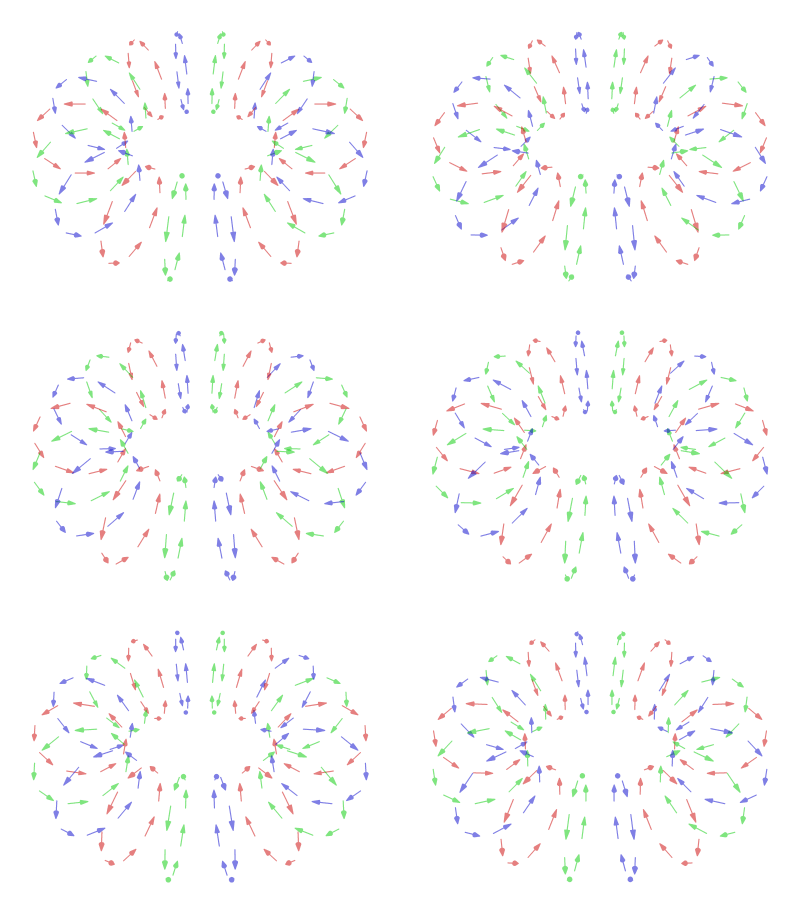
I decided to squeeze in a little bit about vortex rings into this morning’s lecture, partly because they illustrate the connections between fluid vorticity and magnetism, and partly because they’re fun…

Here’s an animation of a vortex ring showing how the fluid elements move around it (you might need to click on it to make it animate):

It’s quite easy to generate vortex rings in everyday situations, the simplest way being when a mass of fluid is impulsively pushed from an enclosed space through a narrow opening. In this case the poloidal flow is set in motion, at least in part, by interaction between the outer parts of the fluid mass and the edges of the opening. This results in fluid elements travelling in little circles, like those above, around a “core”; the direction of the vorticity is at right angles to these circles, i.e. in the toroidal direction. A vortex line can be formed from by joining together the vorticity vectors from each little circle to form a circle defining the core of the vortex ring. The behaviour of vortex lines in flows like this is entirely analogous to that of magnetic field lines. In this case, the vortex line follows the motion of the fluid, which is at right angles to it, so it propagates more-or-less without disruption. This is how most vortex ring toys work, such as shown in the two examples here; the second is far more dramatic!

The last video features some naturally-occurring vortex rings (as well as some  distinctly man-made examples). What I didn’t realise until I found this video last night is that whales and dolphins know how to make vortex rings too, only underwater. Why do they do this? Is there an evolutionary explanation? I doubt it! I think they’re just having fun.

http://www.youtube.com/watch?v=mHyTOcfF99o

Blowing Smoke

Posted in Education, The Universe and Stuff with tags , , , , on July 18, 2012 by telescoper

I’ve been trying to make myself useful over the last few days thinking about the new module I’m supposed to start teaching in October. I’m a bit daunted by it to be honest. The title is The Physics of Fields and Flows and it will be taken by students when they return to start their second year after the summer break.  It’s twice the size of our usual modules, which means a lot of teaching and it’s all new for me, which means a lot of preparation.

The idea behind introducing this module was to teach a number of things together which previously had been taught in separate modules, specifically electromagnetism and vector calculus, or not at all, e.g. fluid mechanics. I’m not sure when or why classical fluid mechanics dropped out the syllabus, but I think it’s an essential part of a physics curriculum in its own right and also helps develop a physical understanding of the mathematics used to describe electric and magnetic fields. It’s one of the unhappy side-effects of modular teaching that it hides the important underlying connections between apparently disparate phenomena which are the essence of what physics is about.

Another thing I reckon we don’t do enough of these days is use lecture demonstrations. That’s harder to do these days because we tend to use pooled lecture theatres that don’t have the specialist equipment that they might have if they were dedicated to physics lectures only.  Practical demonstrations are now usually given second-hand, by using video clips.  That’s fine, but not as good as the real thing.

Anyway, it struck me that it would be quite easy to arrange a demonstration of the transition between laminar and turbulent flow using the simple and relatively inexpensive equipment shown in the rather beautiful image. Unfortunately, however, demonstrating this sort of thing isn’t allowed on University premises even for scientific purposes…