Archive for France

Six Nations Rugby

Posted in Rugby with tags , , , , , , , , on March 16, 2025 by telescoper

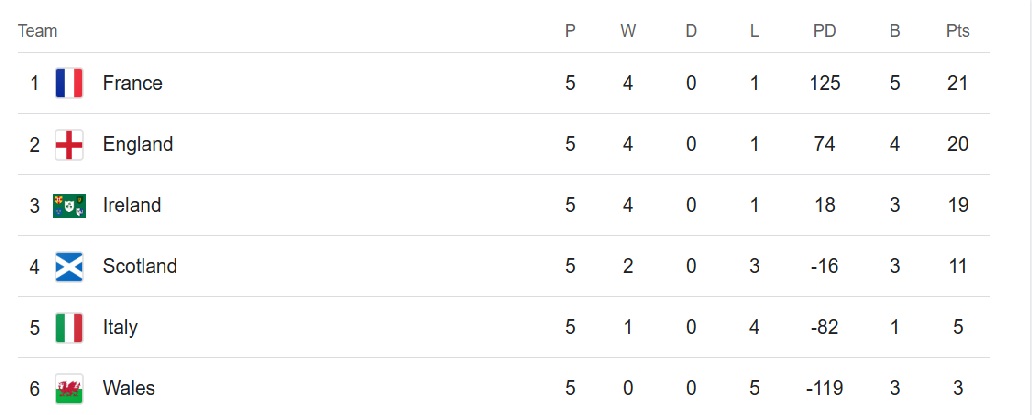
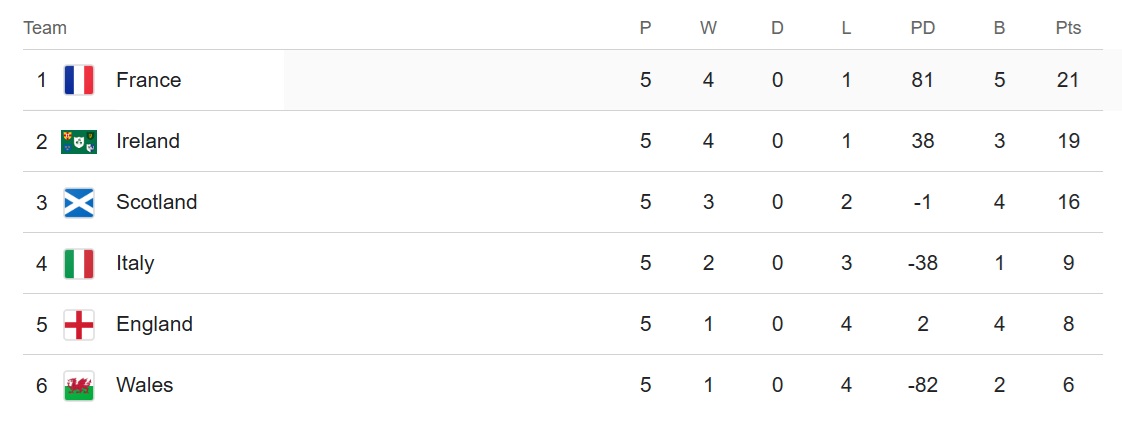
Yesterday I watched the last round of matches in this years Six Nations rugby Championship so, as I did last year, I thought I would do a quick summary of the games and the competition as a whole.

In the first game yesterday, thanks largely to their own errors, Ireland struggled to beat a spirited Italian side in Rome 17-22. That put them briefly top of the table, but with fewer bonus points and a worse points difference than either England or France so needed both those teams to lose in order to win the Championship. Hope of that happening vanished quickly when England scored a try about 2 minutes into their game against Wales in Cardiff, quickly followed by another. England thereafter ran riot and won 68-14 taking them to the top. England did play well, but Wales were very poor. To be honest, I found the game a bit painful to watch. If it had been boxing the referee would have stopped the fight. Memories of the great Welsh teams of the past are very distant nowadays. It’s hard to see where they go from here, with their second successive Wooden Spoon.

Then it was time for the finale, France versus Scotland. I did think that France would win easily but Scotland gave it a good go, and were unlucky not to take a lead into half-time. They wilted in the second half, however, and France duly picked up a bonus point win and the Championship. They are worthy winners, and all credit to them.

(The atmosphere at the Stade de France last night was so raucous that I had difficulty hearing the commentators over the crowd noise. I find commentators rarely add much to the experience, so this isn’t a complaint. In fact, I think it would be good if TV broadcasts allowed the viewer to turn off the commentary but keep the sounds from the stadium.)

The only game France lost was against England on a rainy day at Twickenham on 8th February, a game I watched. France should really have won that game but made a ludicrous number of mistakes and lost by a single point at the death. But for that Les Bleus would have had a Grand Slam. Fair play to England for hanging on and showing great resilience. After an unconvincing start as the competition went on they got better and better, though they needed a slice of luck to beat Scotland 16-15 as Finn Russell missed a conversion that would have won the game.

Up until last week the only team able to do a Grand Slam was Ireland, but they were outplayed in Dublin by France who won 42-27. Sports journalists have a habit of seeing everything as either a triumph or a disaster, and the Irish media portrayed that as the latter. The way I see it is that Ireland’s rugby team reached a high-water mark with their Grand Slam two years ago since when a number of important players have retired. It’s been a time for reconstruction and rebuilding. This is the way of things. I remember Ireland beating France comfortably last season, but France came back strongly this year. At least Ireland collected another Triple Crown, beating England, Wales and Scotland.

After last night’s game I was reflecting on why I enjoy the Six Nations so much. I think it’s mainly because there are relatively few games so each one takes on a significance, either in the context of the Championship or because it represents a longstanding rivalry (e.g. the Calcutta Cup). The point is that there is real jeopardy attached to many of the games. Contrast this with the United Rugby Championship. The games featuring the Irish teams in this competition (Leinster, Munster, Connacht and Ulster) are broadcast free-to-air on television here and I watch quite a few of them. There are 16 teams in this competition, divided into four pools of four: each side plays the 15 others once, and an additional game against the other three in their pool, meaning 18 games per team. After 18 rounds, all that happens is that the bottom eight in the league table are eliminated and the top eight go into the knockout stage. Eighteen games is a long slog when all it does is eliminate half the teams, and it means that there’s much less at stake in individual matches. Still, now the Six Nations is over I’ll be watching the URC for the rest of the season, starting next weekend.

Opinion Polls, Exit Polls and Election Results

Posted in Politics with tags , , , , , , , , , on July 8, 2024 by telescoper

It has been quite an eventful week for voters either side of the English channel. In the United Kingdom, Keir Starmer’s Labour Party were victorious in the General Election, turfing out the Tories after 14 years of misrule, while in France a left-wing coalition managed against the odds to beat Marine Le Pen’s fascist National Rally into third place in their runoff election. In both elections tactical voting clear played a big role. In France many third-placed candidates of the centre or left stood aside to help defeat the Far Right. What happens now with regard to forming a government is anyone’s guess, even for people who know far more about French politics than me.

In the runup up to the UK general election, opinion polls had Labour much further ahead in terms of popular vote. As it turned out, however, Labour won 411 seats on a share of the vote of just 33.7% compared to the Conservatives 23.7% and a smaller number of votes than in 2019 when they won just 202 seats. The UK system is not proportional – and doesn’t pretend to be – so this kind of outcome is not surprising. Pundits have rightly pointed to the fact that the far-right Reform party got 14.3% of the vote which undoubtedly took seats from the Tories, but only managed 5 seats and that Labour profited greatly from the collapse of the SNP vote in Scotland.

There are other factors, however. One is that the turnout was 59.9%, well down on 2019 (67.35). That may well be partly due to voters generally not being enthused. But there may be more to it than that. The last time the turnout was below 60% in a UK general election was in 2001. In that year, Labour were miles ahead in the opinion polls so I suppose many Labour voters thought the result was a foregone conclusion and didn’t bother to turn out. It seems likely to me that there was a similar effect on the Labour vote this time. Rather than merely predicting the final result, opinion polls often influence it.

Another factor is that there may have been higher levels of tactical voting, especially with Labour voters switching to the Liberal Democrats to remove the Tory. That might account for why the LibDems did so well. Opinion polls play a role in this too. Yet another is that Labour lost several seats to Independents, standing against the stance on Gaza, and former Labour leader Jeremy Corbyn won his seat standing as an Independent.

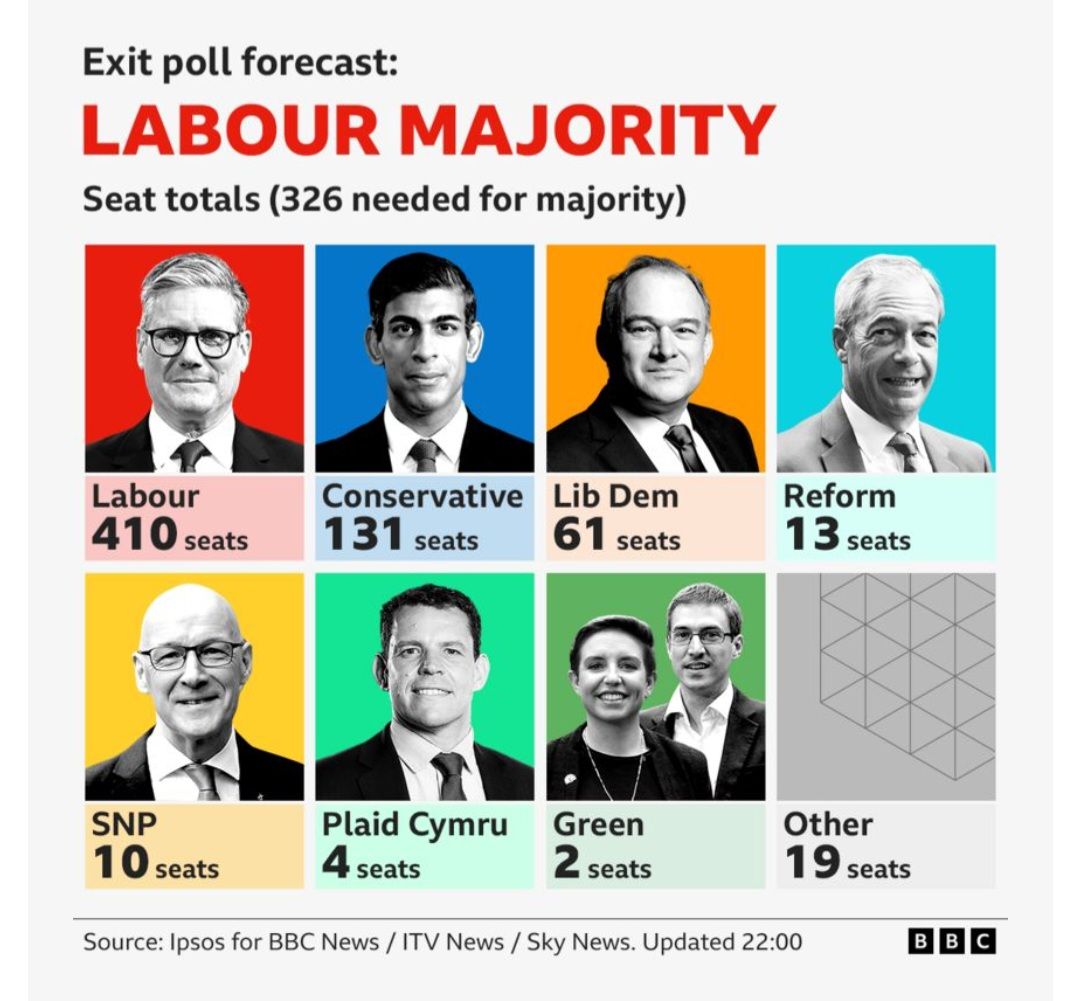
That brings me to the exit polls in the UK and France. Here the projections, the first released at 10pm on Thursday and the second at 9pm on Sunday:

Both are pretty accurate, but I’ve always been annoyed by the way the UK exit poll projection (left) is presented as a point estimate without any indication of the uncertainty (which must be considerable, especially for the smaller parties). The final results were Labour 411, Conservative 121, Lib Dem 72, Reform 5, SNP 9, Plaid Cymru 4, Green 4.

The French method of presenting the results (right) is much better in my opinion. In this case the results were 182, 168 and 143 respectively – all within the range presented.

I have to say that I greatly prefer the voting system used here in Ireland to those deployed in either France or the United Kingdom. Elections here are held under Proportional Representation (Single Transferable Vote) which seems to me a very sensible system. One ranks the candidates in order of preference; you can rank all the candidates or just some. In the system employed here in Ireland, votes are progressively reallocated in various rounds until one ends up with the top n candidates to fill the available seats. The STV system involves a quota for automatic election which is N/(m+1) + 1 votes, where N is the number of valid ballots cast and m is the number of seats in the constituency.  To see why this is the case consider a four-seat constituency, where the quota would be 20% of the votes cast plus one. No more than four candidates can reach this level so anyone managing to get that many votes is automatically elected. Surplus votes from candidates exceeding quota, as well as those of eliminated candidates, are reallocated to lower-preference candidates in this process. This system returns representatives with a local constituency connection but is also (approximately) proportional.

One problem with the First Past The Post system deployed in the UK is that if a Reactionary party (Reform) gets 5 seats while a Progressive party (Green) gets only 4, the former gets all the press coverage and the latter gets none..

P.S. I didn’t vote in the UK general election, but the four constituencies in which I lived before moving to Ireland (Cardiff West, Brighton Kemptown, Broxtowe, and Bethnal Green & Stepney) all voted in Labour MPs.

Six Nations Summary

Posted in Rugby with tags , , , , , , , , , on March 17, 2024 by telescoper

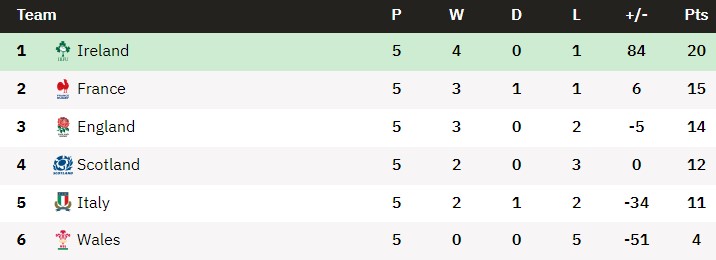
I didn’t see many of the games in this year’s Six Nations Rugby because I was abroad for most of it, but yesterday I saw the last round of matches. The last one, between France and England in Lyon, was probably the best game I’ve seen in this year’s tournament. After a fascinating ebb and flow, England thought they had snatched it with a converted try to make it 31-30 with just a couple of minutes to go, but then immediately conceded a penalty on the halfway line. Up stepped Thomas Ramos, who had scored from a similar distance earlier in the game, stepped up and scored. France won 33-31 in a game that could have gone either way. It was effectively a playoff for 2nd place.

Earlier in the day, Ireland held off a spirited challenge from Scotland in a tense and scrappy match to win 17-13 which guaranteed they would be Six Nations Champions. for the sixth time. I don’t think the team reached the heights of last year’s Grand Slam but it was a deserved victory. It was all a bit more comfortable than the scoreline suggests, though Scotland did score a try late on when Ireland lost concentration which made for a nervy few minutes. A defeat would have meant metaphorical rain on the St Patrick’s Day parades going on today, but in the end there was no rain, either metaphorical or literal.

Given the result in Lyon, Ireland would have been Champions by virtue of their bonus points, even if they had lost to Scotland. England (who beat Ireland last week in a game I didn’t see) had to win with a bonus point to catch them; they managed the bonus point for four tries, but lost the match. Some pundits have commented on whether it was fair for a team to have won having lost more games than the second place team. Of course all the teams know the rules before the competition starts, so there’s no point complaining after the fact. Ireland played attacking rugby knowing that the try count might be important. However, I do think there is a point. In the old Five Nations, and indeed in the World Cup Pools, each team played four games. A bonus point from each of those matches would add 4 to a team’s total, the same as a win. In the Six Nations each team places five matches, so the bonus points could add up to more than a win. A way to remedy this might be to award more points for a win: six for a win and three for a draw is my suggestion.

The first game of the last round yesterday was between Wales and Italy, a game which Italy won to finish 5th. They were unlucky not to beat France earlier in the competition and have played some excellent rugby this year. If they can deal with a marked tendency to fade in the last twenty minutes – as they did yesterday, but managed to hold on – then they will be genuine contenders. Wales had a terrible competition, losing all their games and finishing last. I am reliably informed that “wooden spoon” in Welsh is “llwy bren”. But nil desperandum: the last time Wales got the wooden spoon was in 2003; two years later they did the Grand Slam!

Tour de France – Première Étape

Posted in Barcelona, Biographical with tags , on November 22, 2023 by telescoper
First Leg

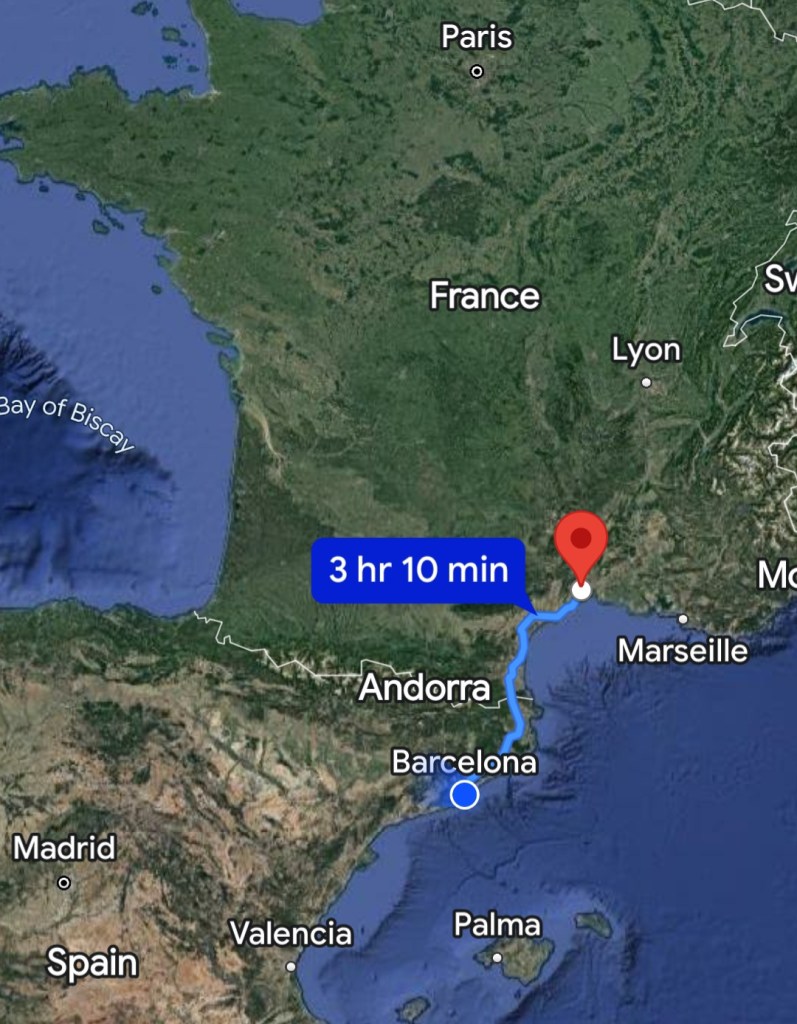
I’m up reasonably early this morning to embark on the first leg of a visit to France. My first stop is at Montpellier on the French Riviera, where I’m giving a talk this afternoon at the Laboratoire Univers et Particules de Montpellier (LUPM) and will be staying for a few days before heading North to Paris and then back South again to Barcelona next week.

I’m looking forward to the trip as all three legs are on TGVs, which I’m told are comfortable, and I’ll hopefully get some nice views on the way. I’ve actually been to Montpellier before, to be on the jury for a PhD examination, but that was a long time ago and I don’t remember it very well.

Update: the travel went smoothly. It was a bit of an adventure getting the tram from Montpellier Saint-Roch railway station to the campus, and a bit more of an adventure navigating the building sites on the way to the seminar venue, but I got there in time and the talk went well. Now I have to find my hotel and then it will be necessary to consume alcoholic beverages.

Six Nations Super Saturday

Posted in Rugby with tags , , , , , , on March 21, 2021 by telescoper

Study week is over and next week we return for the second half of Spring Semester. At least we do for about a fortnight, after which there is the Easter break (Good Friday plus the following week). I’ve just about caught up with what I should have done before the Study break started so I spent a big chunk of yesterday watching the Six Nations Rugby. Super Saturday would normally be the last day, with three matches determining the Championship, but that’s not quite how it worked out as France’s game against Scotland was postponed for Covid-related reasons.

The day started off with a 52-10 victory for Scotland over hapless Italy at Murrayfield. The visitors started well enough but soon melted away as Scotland got into gear, eventually scoring eight tries. A lot of people are asking what is going to happen about Italy. Although they have won the odd game in the Six Nations over the years they have never really been contenders and this year they have been consistently woeful. Despite millions being poured into Italian rugby from the competition they have got worse, not better.

One possibility would be to have a second division of the tournament, with promotion and relegation. One problem is finding teams to make up the other places, the European Championship includes such teams as Russia, Portugal, Spain, Romania, Germany and Belgium. One could add Georgia into that mix too. The greater problem is whether there would be enough of an audience to make this financially viable.

Anyway, the second match of the day was Ireland versus England in Dublin. I have to say that I thought England were strong favourites to win that match but what the heck do I know? Ireland put in their best performance of the tournament and ran out relatively comfortable winners against a lacklustre England by 32 points to 18. England, whom many thought would win the tournament, finish in fifth place out of six.

The final stages of that game were marred by atrocious violent conduct by England prop Ellis Genge which was not spotted by the referee at the time but which will be reviewed and should lead to a lengthy ban.

And then the pièce de résistance, France versus Wales. Wales were looking for a victory that would give them a Grand Slam, an outcome that looked very unlikely at the start of the competition. The game started at a frenetic pace with two tries each in the first 20 minutes or so. If they had kept up that rate of scoring the match could have ended 56-56!, but at half-time the score was 17-17.

Wales gradually exerted their dominance and stretched their lead to 20-30. With Paul Willemse for sent off for France sticking his hand in an opponent’s eye with just 12 minutes to go the game looked over. The French disagreed and brought out some of their best attacking rugby against a tiring Welsh side who resorted to persistent infringement at the breakdown. A succession of penalties and two yellow cards ensued. France took full advantage, scoring a converted try to make it 27-30. Wales were still in front, and in possession of the ball in a good attacking position, with less than two minutes to go but then conceded a penalty. France kept the ball alive from the resulting lineout then used their extra player to score wide on the left wing with no time left to play. It finished 32-30.

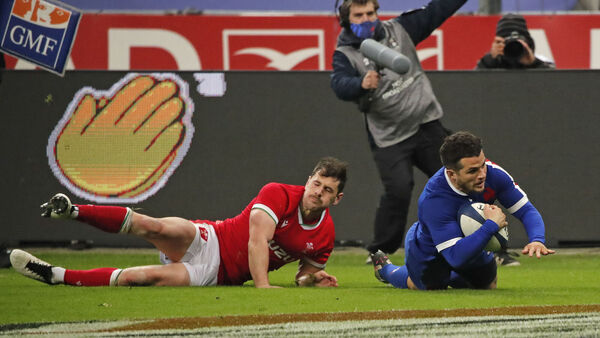
The winning try, scored by Brice Dullin

Heartbreak for Wales, but a brilliant comeback by France. What a game of rugby!

Apart from everything else I don’t think I’ve ever seen a game of rugby with so many potential tries prevented by defensive players holding the ball up to prevent grounding in the in-goal area. I counted at least six, each of them just inches away from being a try.

At the risk of incurring the wrath of my Welsh friends I think France just deserved to win that game. Wales had the benefit of most of the marginal refereeing decisions and Wales should have had even more yellow cards near the end for persistent infringement. Above all, they deserved it for refusing to give up when all seemed lost. Magnifique!

The Six Nations is not yet over; there’s still France versus Scotland to come on Friday night (26th March). If France win that game heavily and get a bonus point they could still finish as Champions. France need to overturn a 20-point points difference though so they’ll have to win by 21 points or more and score four tries. I think that’s unlikely, but they’ll definitely go for it!

A Grand Day for a Grand Slam

Posted in Rugby with tags , , , , , on March 17, 2012 by telescoper

It’s a lovely morning in Cardiff. Later on, at 2.45pm, Wales will be playing their final match of the 2012 Six Nations Rugby against France here in Cardiff. Having won all four previous games they’re in line for a Grand Slam if they win. The atmosphere here is already electric with anticipation. Last night the city was filled with men in berets here to support France and today everything will be at a standstill for the match. I can’t describe what a wonderful feeling it is to be in Cardiff on match days, even if you don’t have a ticket!

People here seem to be taking it for granted that Wales will win this afternoon. I’d love a Welsh Grand Slam to happen, but I’m not sure it’s as much of cast-iron certainty the Welsh supporters seem to think it is. France are a dangerous side and their disappointing performances so far in the Six Nations don’t preclude the possibility that they’ll turn it on in the Millennium Stadium; they’re certainly not here just to make up the numbers. The Welsh team has its weaknesses and may yet meet their downfall…

Comparisons with the great Welsh teams of the 1970s are inevitable today. Although it may be tempting fate, I thought I’d post this video showing some of the great players of that era in action. Good though the current team is – and clearly the best of the six nations playing in the competition this year – I don’t think they’re in the same league as the side that included such wonderful players as Gerald Davies, Gareth Edwards, J.P.R. Williams, Barry John and, of course, Mervyn Davies who sadly died last week and in whose honour there will be a minute’s silence before this afternoon’s kick off. Here are some scintillating moments from that great team. We’ll never see their like again.

Even the commentators – especially the great Bill Maclaren – were so much better than the current generation!

But that was then and this is now. Good luck to Wales, and here’s to another Grand Slam this afternoon!

Raising the Veil

Posted in Biographical, Politics with tags , , , , , , on April 11, 2011 by telescoper

We’re now into the last week of teaching term here in Cardiff, and I’m feeling like I’m running the final stages of a marathon. I like the idea of fitting all the second semester’s teaching in before the Easter break but I have to admit I’m struggling to make the distance, especially because so many things have to be done this week before we finish. Next week I’m off to the National Astronomy Meeting in Llandudno too. For all these reasons (and a few others) I won’t have much blogging time for a bit, so my posts may be a bit thin on the ground (or whatever it is that the blogosphere rests on).

However, I couldn’t resist using this blog to express my opinion about one of the big news items of the day, the introduction, today, in France, of a ban on women  wearing of the veil in public. I think it’s particularly interesting timing after the discussion of religion and science that arose after I reblogged a post by Andy Lawrence about the Templeton Prize.

Frankly, I think the new French law is monstrous. I’m not a Muslim, but it is  abhorrent to me that the state should seek to prevent individuals expressing their religious beliefs. I obviously don’t think anyone should be forced to wear the veil against their will, but in an open society those who choose to wear it  should be allowed to do so.    And I don’t buy the argument that it’s some sort of identification issue, either. What’s next, a ban on sunglasses and balaclavas? No. In any case there are only about 2,000 women in France who regularly wear the veil. Let’s make no bones about it, this law is specifically intended to pander to anti-Muslim sentiments. It stinks. I like to think we’d never allow such a thing in this country.

But here’s the flip side. I read at the weekend of the case of a candidate for the forthcoming Welsh Assembly Elections. Sion Owens is on the South Wales West Regional List for the British National Party (BNP). At the weekend he was arrested under the Public Order Act after a video emerged in which he was seen to be burning a copy of the Qur’an. Apparently the original charge was dropped today when Mr Owens appeared before the Magistrates Court in Swansea, but investigations are still continuing.

I haven’t seen the video so can’t comment further on what precisely Mr Owens is alleged to have done. I’m not an expert on the Public Order Act(s)  either- or at least not the parts that deal with religiously motivated offences – but some sections are open to extremely broad interpretations, and that’s really what the problem is.

I would say though that I’m the last person to want to support the BNP,  which as far as I’m concerned is an extremist organisation run by right-wing thugs for the benefit of other right-wing thugs.  It seems possible, therefore, and perhaps even likely, that this person did set alight to the Qur’an with the specific intention of  provoking religious tension. If that were the case then it would clearly fall within the law as defined by the Public Order Act.

However, even if that were the case I have to say I do not think that what he did should be a criminal offence. It might be  abusive, uncivilised, and reprehensible – words not infrequently applied to the BNP, I might add – but I don’t think it should be illegal. If we’re going to have a truly  free society we have to get used to the idea that people have the right to do and say things we wouldn’t do or say ourselves. And if people even want to vote for creatures like Mr Owens, they should be allowed to do so….

..although I’ll be hoping he loses his deposit.


Share/Bookmark