Archive for Franz Schubert

Mahler, Weber, Schubert and Strauss at the NCH

Posted in Biographical, Music with tags , , , , , , , , , , , , on January 14, 2023 by telescoper

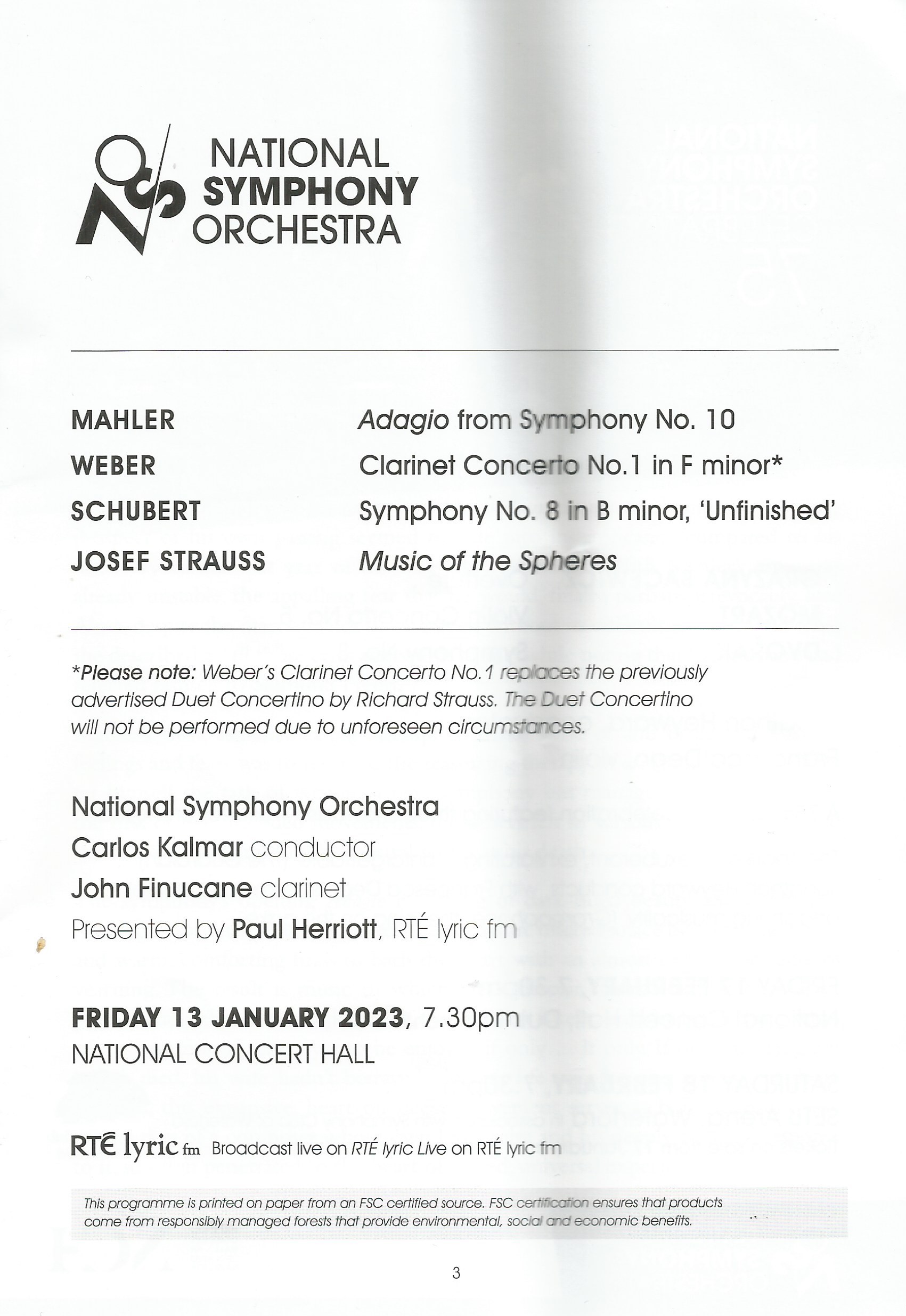
And so it came to pass that last night I took the train into Dublin for my first concert of the year 2023 at the National Concert Hall in Dublin which happened to be by the National Symphony Orchestra under the direction of guest conductor Carlos Kalmar.

It was an unusual programme in terms of its construction. Often the menu for such concerts begin with a short appetizer but this one started with the first movement of  Gustav Mahler‘s 10th Symphony. The composer died a hundred years ago in 1910 having not actually finished the rest of the symphony, but I gather that he left sufficiently detailed sketches and notes that complete versions have been constructed, but nevertheless the first movement is frequently performed on its own. It’s quintessentially Mahler in many ways, but it’s a strange opening for a symphony because it’s a very long Adagio movement (lasting about 30 minutes). It’s a complex and weighty movement for a full orchestra, rather cryptic in nature but overall with a rather dark tone, far from the usual lollipop to start a concert!

Originally this programme was supposed to feature the Duet Concertino by Richard Strauss but it was announced last week that this would be replaced by the Clarinet Concerto No. 1 in F Minor by Carl Maria von Weber with the NSO’s principal clarinettist John Finucane. Unusually for a concerto performance, John Finucane was reading a score, which perhaps suggests he stood in at short notice but in any case the performance was very fine. The third movement, a spirited Rondo kicked off by a very jaunty theme, is probably the most familiar piece, but I particularly enjoyed the interplay between clarinet and horns in the slow (2nd movement). John Finucane had brought his fan club with him, and the audience responded warmly.

After the wine break we had Symphony No. 8 in B Minor by Franz Schubert, the famous “Unfinished Symphony”. Somewhat surprisingly, I am pretty sure that I had never heard this piece performed live until this concert.

Schubert apparently wrote the first two wonderful movements of this piece in the space of only eight days in 1822 but then seems to have abandoned it. The composition wasn’t interrupted by his death – he didn’t pass away until 1828 – so it’s a mystery why he didn’t finish it. It wasn’t even discovered until the 1860s. Unlike Mahler 10, we don’t have any idea what the rest of this symphony would have been but the two existing movements are exceptional, not least for the stream of lovely melodies. This work clearly belongs to the same world as the Weber piece (which was composed in 1811) but having one after the other emphasizes the transition from Classical to Romantic, and having Mahler on the same programme contrasts early and late Romantic in a very illuminating way.

The last piece was Music of the Spheres, a waltz by Josef Strauss, the younger brother of the more famous Johan Strauss II. It’s a jolly enough but rather insubstantial piece that seemed rather incongruous to me in this programme, especially at the end as it is the sort of piece one could imagine as an appetizer. It seems to have been decided that something was needed in place of the missing movement(s) of the Schubert Symphony, so perhaps it was meant to play the role of a dessert?

In any case it was an upbeat way to end the concert which was very enjoyable. I then made my way out into the rain to get the train back to Maynooth. For a Friday night, Dublin was very quiet indeed, perhaps because of the inclement weather and/or the post-Christmas lull. The NCH wasn’t full but there was a decent attendance and the performance was warmly appreciated.

P.S. Note that the National Symphony Orchestra is no longer the RTÉ National Symphony Orchestra owing to some restructuring. Note also that it is planned to close down the NCH for at least two years for extensive refurbishment. I’m not sure what will happen to the NSO during this period.

Mahler & Schubert at the National Concert Hall

Posted in Music with tags , , , , , , on May 28, 2022 by telescoper

Yesterday evening, after a very pleasant wine reception at the end of ITP2022, I walked to the National Concert Hall in Dublin for my second concert in two days. Before the lockdown I used to go regularly to the Friday evening performances by the National Symphony Orchestra but until last night I hadn’t attended one since February 2022. Since I was in Dublin anyway and Mahler was on the menu I couldn’t resist this one and have now at last added to my stock of souvenir programmes. Last night’s concert was actually the last of the season but hopefully I’ll be able to go more frequently from September when the next season starts.

Last night’s performance began with Mahler’s Blumine which began life as the second movement (marked Andante) of his First Symphony but which was subsequently deleted. We heard the four-movement version of the work (i.e. without this part) in the second half of the concert. Blumine is a nice enough piece, relaxed and lyrical, but it is difficult to see how it was supposed to fit in with the rest of the symphony which is now always performed without it. Still, it served as a very good warm-up for the orchestra which, under the direction of Jaime Martín, established a polished tone and warm colour for this piece and for the rest of the evening.

After Blumine a large fraction of the orchestra left the stage to leave a pared-down version for some Lieder by Franz Schubert performed by legendary Swedish mezzo soprano Anne Sofie von Otter who was resplendent for the occasion in an emerald green dress.

You wait two years to go a concert and then along come two in the space of two days! Only one of the songs, the first, Romanze from the incidental music for the play Rosamunde, was actually orchestrated by Schubert; the other were written with piano accompaniment and then orchestrated by others. I have to say I didn’t find the addition of a full orchestra added much to these songs, many of which have a rather spare piano accompaniment that works superbly well. A good example is An Sylvia which has its origins in Shakespeare’s play The Two Gentlemen of Verona. I love the sprightly version of this with piano accompaniment but the orchestrated version was much slower, as if weighed down by the arrangement. Still, these pieces were beautifully sung and that made them very enjoyable. After rapturous applause, Anne Sofie von Otter returned to give an encore of the old song The Last Rose of Summer which, as you can imagine because it is set to a traditional Irish tune, went down very well with the Irish audience.

After the interval the full orchestra returned to deliver a powerfully impressive performance of Mahler’s First Symphony. The programme notes remind us that for much of his life Gustav Mahler was celebrated as a conductor rather than a composer, and the First Symphony was not well received largely because it was deemed in some quarters at the time to have a structure that was insufficiently symphonic. There’s no reason why we should pay much attention the opinions of over a hundred years ago. The symphonic form has been pulled around in many directions since this work, not least by Mahler himself, and I think Mahler 1 is a very fine work. I always particularly enjoy the 3rd movement, with its occasionally raucous evocation of a Klezmer band.

The final movement brought the piece – and the whole concert – to a thrilling climax. Near the end, the entire brass section of the orchestra (7 horns, 5 trumpets, 4 trombones, and a tuba) stood up at which point I thought “this is going to be loud”. It was. Gloriously loud.

I’ve said before on this blog how much I enjoy watching a full orchestra in action. From my position at the right of the auditorium I had a great view of the double basses who were working very hard but clearly enjoying themselves.

Anyway, last night’s concert was broadcast live on the radio and also streamed and you don’t have to take my word for anything because you can watch the whole thing yourself here:

Llŷr Williams plays Schubert

Posted in Music with tags , , , , , , on November 13, 2017 by telescoper

I’ve been away from blogging for a few days, so I thought I’d begin the process of catching up with a short review of the concert I went to on Thursday evening (9th November) at the Royal Welsh College of Music and Drama in Cardiff featuring acclaimed Welsh pianist Llŷr Williams playing music by Franz Schubert. Llŷr Williams recently completed a series of concerts in which he performed all the works for keyboard by Beethoven, and now he has embarking on another journey, this time of Schubert. The concert was recorded and will, I believe, be released commercially.

The first half of the recital consisted of the Sonata in G Major D894 (Op. 78) which was written in 1826, just two years before the composer’s death. Although Schubert was already ill when he wrote this piece it is generally optimistic in tone.    The first and third movements introduce  dance-like elements, and the final movement is a light and breezy Allegretto in the form of a rondo. The piece is tempestuous in places but  generally resolves into a more tranquil mood. It’s a well-balanced and  enjoyable piece, wonderfully played.

To close the first half we had three transcriptions for solo piano by Franz Liszt of Schubert songs:  Ständchen, Auf dem Wasser zu singen, and Ave Maria.  The last of these (Ellens Gesang III) is probably the most famous as a song but also the least successful as a solo piano piece. On the other hand, Auf dem Wasser zu singen, works well. I’m not a huge fan of Liszt and although it was interesting to hear these works in this form I much prefer them sung by a human voice with a piano accompaniment.

After the interval  wine break we had a later Piano Sonata (in C Minor D 958), written during the last year of Schubert’s life. In four movements like the piece we heard in the first half, this piece has a much greater depth and sense of drama to it (at least to my ears), at least partly because it is clearly influenced in structure and tonality by Beethoven. Perhaps it was for that reason that this work inspired Llŷr Williams to a performance of great intensity as well as virtuosity, especially in the final Allegro movement which is extremely agitated, even frenzied. As he introduced the piece, Llŷr Williams spoke of this as being like a `dance of death’. Schubert probably knew he was dying when he wrote this piece, but it’s not as bleak as some of his other late works.  It seems to me to be characterised by a sense of determination,  to get as much done as possible before his life came to an end.

Schubert died before his 32nd birthday, but he was astonishingly prolific, especially towards the end of his life, and he left a huge legacy of wonderful music. I’m very much looking forward to the next concert in this series of explorations of his piano music.


Der Doppelgänger

Posted in Mental Health, Music with tags , , on July 12, 2017 by telescoper

Writing yesterday about depersonalisation for some reason brought this song by Franz Schubert to mind. I heard it on the radio recently and found it profoundly moving. Der Doppelgänger is a setting of a poem by Heinrich Heine that Schubert composed in 1828 near the end of his life; it was published posthumously in 1929 as part of Schwanengesang.t’s relevance to the topic of depersonalisation lies in the middle verse, in which the poet describes seeing a tormented figure only to realise that the figure is he (the last line says `The Moon shows me my own form’):


Da steht auch ein Mensch und starrt in die Höhe,
Und ringt die Hände, vor Schmerzensgewalt;
Mir graust es, wenn ich sein Antlitz sehe –
Der Mond zeigt mir meine eigne Gestalt.

It’s a very bleak piece, its desolate atmosphere underlined by the inexorable piano accompaniment which consists mostly of block chords. I think you can tell that this is written by a man who knows his days are numbered, but the simplicity and beauty of the composition and pervading sense of loneliness and desolation mark it as a work of genius, which Schubert undoubtedly was.

The singer is the late great Dietrich Fischer-Dieskau.

Horowitz plays Schubert

Posted in Music with tags , , on September 9, 2016 by telescoper

This was doing the rounds on Facebook earlier this summer and I meant to post it on here, but forgot. Anyway, better late than never.  This is the great Vladimir Horowitz playing the Impromptu No. 3  in G flat major D899  by Franz Schubert. It’s a stunning performance to watch as well as listen to, despite – or maybe because of – the fact that he was an old man at the time and this was to be his last concert in Vienna. I love the way he takes his time to settle at the start, and then all of a sudden, his hands apparently almost still, he starts to caress the keyboard with his fingers and this beautiful music comes to life, almost as if it’s coming directly from another world. Take a few minutes off, and let some beauty into your heart..


Talking about Winterreise

Posted in Music with tags , , , on December 18, 2012 by telescoper

Well, here’s a find! A fascinating bit of film featuring Benjamin Britten and Peter Pears discussing and performing Franz Schubert‘s great song cycle, Winterreise.

R.I.P Dietrich Fischer-Dieskau

Posted in Music with tags , , , on May 19, 2012 by telescoper

I was very sad to hear, first thing this morning, of the death at the age of 86 of legendary singer Dietrich Fischer-Dieskau. I can’t add anything to the host of tributes that have already appeared, except to say that his voice will always be very special to me because his recording of Schubert’s Winterreise (with Gerald Moore on piano) was the first I ever heard of any Schubert Lieder.

Instead of trying to write an appreciation which couldn’t possibly to justice to the man and his musical legacy, I’ll just post this video and let it speak for itself. This is Winterreise in its entirety, performed in 1979 by Fischer-Dieskau with Alfred Brendel on piano.

Rest in peace, Dietrich Fischer-Dieskau (1925-2012).

Im Frühling

Posted in Music with tags , , on March 25, 2012 by telescoper

We’re enjoying a spell of perfect weather at the moment, so I’m going to be out most of the afternoon enjoying the flowers and trees in Bute Park. I assume  I’m not in danger of being run over by a lorry speeding along the paths, since I don’t think they work on Sundays. Anyway, BBC Radio 3 is devoting the period until the end of March to a “Spirit of Schubert” festival, so I thought I’d join in by posting an appropriately seasonal ditty. This is Im Frühling (D. 882) (“In Spring”), sung by Peter Pears with piano accompaniment by Benjamin Britten way back in 1950. Gives me a lovely glow inside listening to this. I hope you feel the same..