Archive for Friedman equations

Everything is a Simple Harmonic Oscillator

Posted in mathematics, The Universe and Stuff with tags , , , on December 13, 2025 by telescoper

Anyone who has studied theoretical physics for any time will be familiar with the simple harmonic oscillator, which I will call the SHO for short. This is a system that can be solved exactly and its solutions can be applied in a wide range of situations where it holds approximately, e.g. when looking at small oscillations around equilibrium. I’ve often remarked in lectures that we spend much of our lives solving the SHO problem in various guises, often pretending that the difficult system we have in front of us can, if looked at in the right way, and with sufficient optimism, be approximated by the much simpler SHO. Cue the old joke that if all you have is a hammer, everything looks like nail…

That rambling prelude occurred to me when I found this little problem in some old notes. It is a cute mathematical result that shows that the Friedman equations that underpin our standard cosmological model can in fact be written in the same form as those describing a Simple Harmonic Oscillator. In what follows we take the cosmological constant term to be zero.
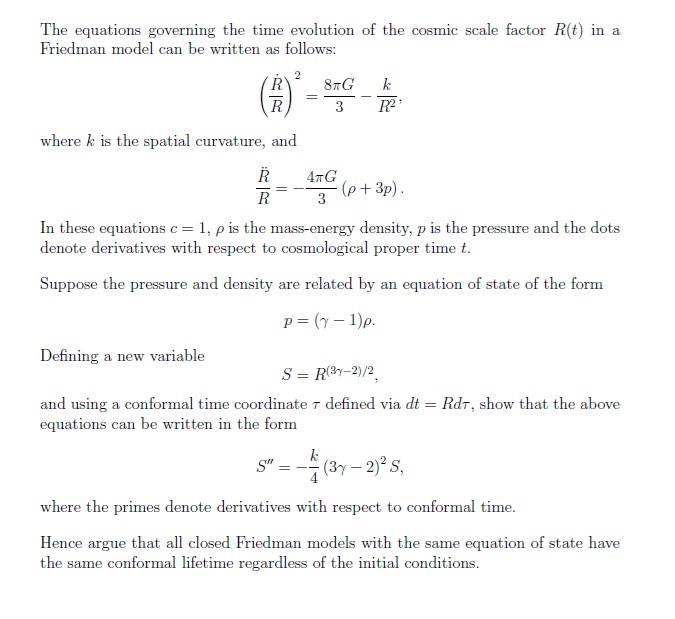
The resulting equation is the SHO equation if k>0. I’m not sure whether this result is very useful for anything, but it is cute. It also goes to to show that, if looked at in the right way, the whole Universe is a Simple Harmonic Oscillator!
Redshift and Distance in Cosmology

Posted in The Universe and Stuff with tags , , , , , on April 29, 2019 by telescoper

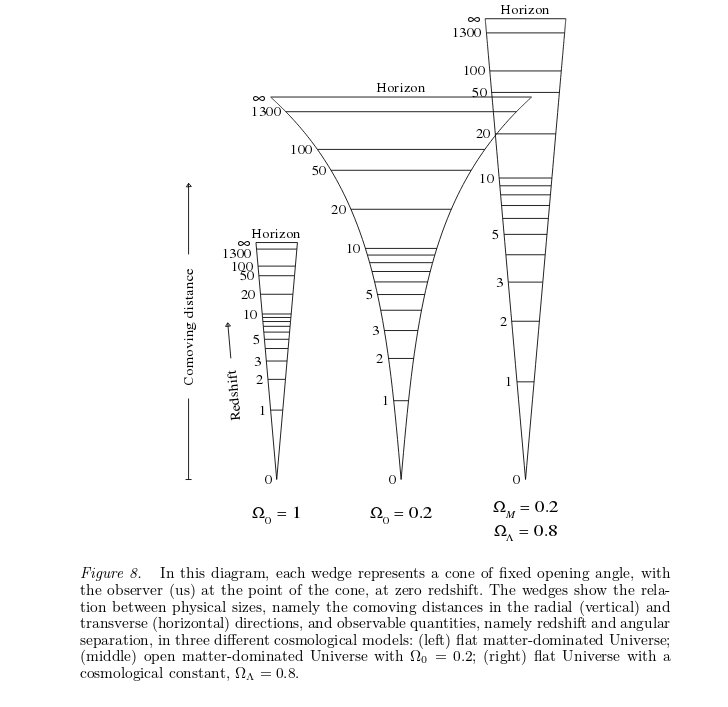
I was looking for a copy of this this picture this morning and when I found it I thought I’d share it here. It was made by Andy Hamilton and appears in this paper. I used it (with permission) in the textbook I wrote with Francesco Lucchin which was published in 2003.

I think this is a nice simple illustration of the effect of the density parameter Ω and the cosmological constant Λ on the relationship between redshift and (comoving) distance in the standard cosmological models based on the Friedman Equations.

On the left there is the old standard model (from when I was a lad) in which space is Euclidean and there is a critical density of matter; this is called the Einstein de Sitter model in which Λ=0. On the right you can see something much closer to the current standard model of cosmology, with a lower density of matter but with the addition of a cosmological constant. Notice that in the latter case the distance to an object at a given redshift is far larger than in the former. This is, for example, why supernovae at high redshift look much fainter in the latter model than in the former, and why these measurements are so sensitive to the presence of a cosmological constant.

In the middle there is a model with no cosmological constant but a low density of matter; this is an open Universe. Because it decelerates much more slowly than in the Einstein de Sitter model, the distance out to a given redshift is larger (but not quite as large as the case on the right, which is an accelerating model), but the main property of interest in the open model is that the space is not Euclidean, but curved. The effect of this is that an object of fixed physical size at a given redshift subtends a much smaller angle than in the cases either side. That shows why observations of the pattern of variations in the temperature of the cosmic microwave background across the sky yield so much information about the spatial geometry.

It’s a very instructive picture, I think!