Archive for GCSE

Sexism, of course…

Posted in Education with tags , , on June 21, 2010 by telescoper

I’ve only just recovered from the shock  of seeing the sheer hopelessness of British science education laid bare last week. Indeed, I was so staggered to discover how poorly conceived the current GCSE science examinations are that I forgot that I’d already blogged about the lamentable tendency of the modern education system to concentrate on getting kids to swallow and regurgitate little bite-sized factoids, rather than actually learning to think for themselves.  Leaving aside the issue that quite a few of the things that are being taught seem to be wrong anyway, my point there was that teaching science isn’t about teaching facts at all, it’s about trying to develop critical thinking and problem-solving skills. At least that’s what it should be, if only the dumbers-down would stop meddling.

Well, I’d almost come to terms with my despair when I saw another article (from Friday’s Guardian) which tells a tale that’s not just idiotic, but also sinister and offensive. Here’s the full text

One of the country’s biggest exam boards is developing different GCSE courses for boys and girls, it emerged today.

The Assessment and Qualifications Alliance (AQA) said it was looking into creating a science GCSE with more coursework in it for girls, and one which gave more weighting to exam marks for boys.

Studies have shown that girls perform better in coursework than boys, while boys do better in exams.

AQA said it would not prevent boys from taking the girls’ course and vice versa.

The courses in English, maths and science could be available from September next year.

Bill Alexander, the exam board’s director of curriculum and assessment, told the Times Educational Supplement: “We could offer a route for boys that is very different to a route for girls.

John Bangs, head of education at the National Union of Teachers, said it was “extremely dangerous” to get into gender stereotyping. “There are lots of boys who like the investigative element of coursework as well,” he said.

John Dunford, general secretary of the Association of School and College Leaders, said it was a “wild generalisation” to state that boys did better in exams, while girls performed better in coursework, but that it had “more than a grain of truth” to it.

However, he suggested that as well as sitting the gender-specific exams, pupils’ work should be marked in part by professional assessors.

Experts believe that this year could end a 20-year trend for girls to outperform boys in GCSEs because many new courses have no coursework. Instead, pupils complete work over a prolonged period, but under exam conditions.

There’s also a longer piece on the same topic in the Times Education Supplement.

Different courses for boys and girls? Are they serious? This is gender stereotyping of the worst possible kind. I find it absolutely abhorrent that anyone in any position of authority in the education system could even have contemplated doing something so offensively patronising. What’s next, different courses for different racial groups?

I sincerely hope that the new government intervenes and stops the AQA from going along this road. Better still, it should scrap these worthless examination factories and sack the profiteering dunderheads in charge who are responsible for turning the education system into a national disgrace.

Science Examination Blues

Posted in Education, The Universe and Stuff with tags , , , , , on June 16, 2010 by telescoper

I woke up this morning …

.. to the 7am news on BBC Radio 3, including a story about how GCSE science examinations are not “sufficiently rigorous”. Then, on Twitter, I saw an example of an Edexcel GCSE (Multiple-choice) Physics paper.  It’s enough to make any practising physicist weep.

Most of the questions are very easy, but there’s just as many that are so sloppily put together that they  don’t make any sense at all. Take Question 1:

I suppose the answer is meant to be C, but since it doesn’t say that A is the orbit of a planet, as far as I’m concerned, it might just as well be D. Are we meant to eliminate D simply because it doesn’t have another orbit going through it?

On the other hand, the orbit of a moon around the Sun is in fact similar to the orbit of its planet around the Sun, since the orbital speed and radius of the moon around its planet are smaller than those of the planet around the Sun. At a push, therefore you could argue that A is the closest choice to a moon’s orbit around the Sun. The real thing would be something close to a circle with a 4-week wobble variation superposed.

You might say I’m being pedantic, but the whole point of exam questions is that they shouldn’t be open to ambiguities like this, at least if they’re science exams. I can imagine bright and knowledgeable students getting thoroughly confused by this question, and many of the others on the paper.

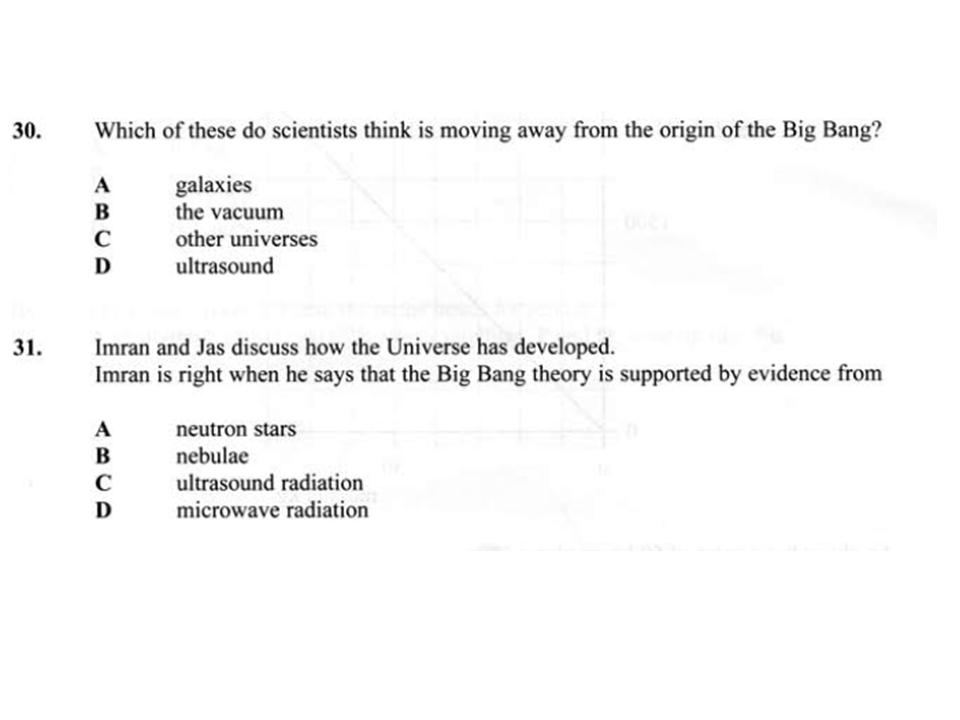
Here’s a couple more, from the “Advanced” section:

The answer to Q30 is, presumably, A. But do any scientists really think that galaxies are “moving away from the origin of the Big Bang”?  I’m worried that this implies that the Big Bang was located at a specific point. Is that what they’re teaching?

Bearing in mind that only one answer is supposed to be right, the answer to Q31 is presumably D. But is there really no evidence from “nebulae” that supports the Big Bang theory? The expansion of the Universe was discovered by observing things Hubble called “nebulae”..

I’m all in favour of school students being introduced to fundamental things such as cosmology and particle physics, but my deep worry is that this is being done at the expense of learning any real physics at all and is in any case done in a garbled and nonsensical way.

Lest I be accused of an astronomy-related bias, anyone care to try finding a correct answer to this question?

The more of this kind of stuff I see, the more admiration I have for the students coming to study physics and astronomy at University. How they managed to learn anything at all given the dire state of science education in the UK is really quite remarkable.

Space without Physics…

Posted in Uncategorized with tags , , , , , on March 24, 2010 by telescoper

I’m indebted to a colleague (Annabel Cartwright) for sending me this (coincidentally topical) sample question, illustrating the quality of a modern British school science examination.

Since it’s now clear  that there is no room for science in the new era of the UK Space Agency, I suppose we should get used to the removal of science from other things too. Starting with science exams.

This question is taken from a GCSE Physics examination.

Some people think that governments spend too much money on space research.

Which ONE of the following statements is true?

  1. Science can tell us what the planets are made of, and whether they ought to be explored.
  2. Science can tell us what the planets are made of, but not whether they ought to be explored.
  3. Science cannot tell us what the planets are made of but can tell us whether they ought to be explored.
  4. Science cannot tell us what the planets are made of, nor whether they ought to be explored.

Apparently one (and only one) answer is correct. Any offers?