Archive for Genetics

Proto, by Laura Spinney

Posted in History, Irish Language with tags , , , , , , , , on September 24, 2025 by telescoper

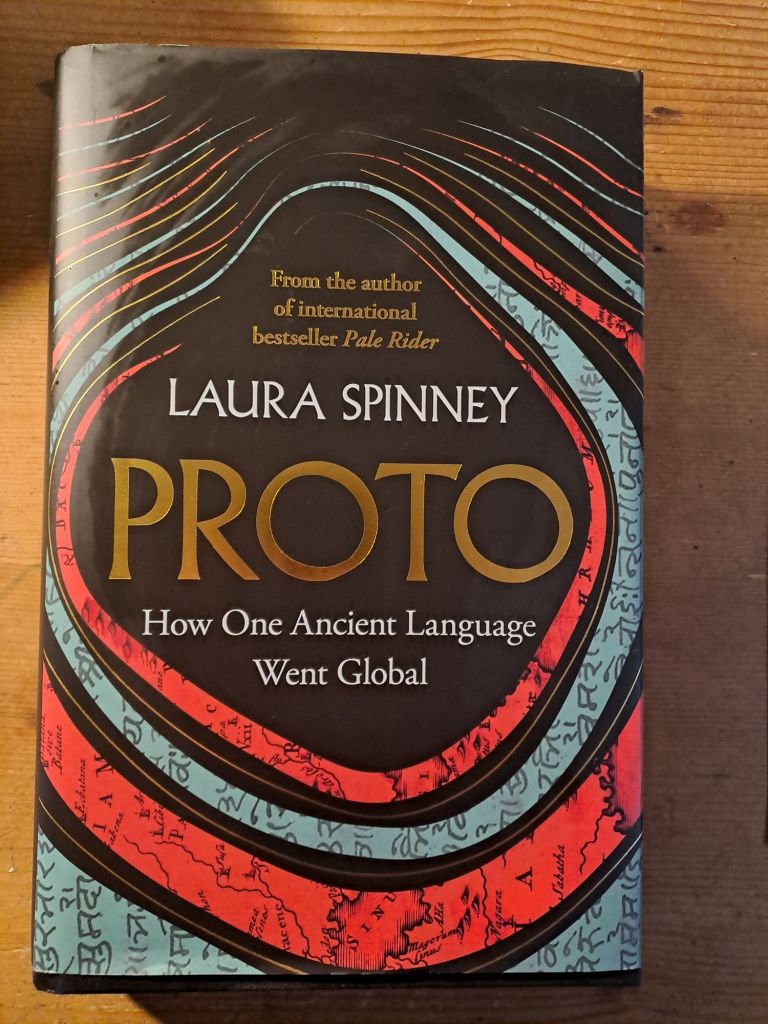
I interrupted the sequence of novels I’ve been reading recently to absorb a non-fiction book, Proto by Laura Spinney (left). I find linguistics a fascinating subject and when I saw a review of this recently and couldn’t resist. I’m glad I bought it because it’s absolutely fascinating. It is the story – or at least a very plausible account of the story of the lost ancestor of the Indo-European languages, the methods that have been used to reconstruct “Proto”, and why it was the spark that generated so many other languages across Europe, Eurasia and India.

The topic is very complex and I won’t attempt to describe it all in depth here; each chapter could be a book in itself because each family of languages within the Indo-European group – including lost ones such as Tocharian – has its own fascinating story. There are chapters focussing on the origins of language itself, the possibilities surround Proto (a language that was never written and probably exists in many dialects), Anatolian, Tocharian, Celtic, Germanic and Italic, the Indo-Iranian group (based on Sanskrit), Baltic and Slavic, and Albanian, Armenian and Greek. The last of these is fascinating because it used a method of writing borrowed from a  non-Indo-European source that became the origin of the European alphabet.

The story of which all these are subplots begins around the Black Sea shortly after end of the last Ice Age. In this area there lived mesolithic hunter-gatherers who had survived the ice who interacted with farmers moving up from the direction of modern day Syria. Their languages would have merged in some way to allow them to describe things that their neighbours had that they didn’t. Hunter-gatherers would not have words for, e.g., ploughing or barley while farmers would have fewer words for spears and other hunting equipment. Into this mix, the argument goes, came a third group, a fully nomadic culture called the Yamnaya people. These people and their successors subsequently underwent vast migrations from the steppes across the continent and were responsible for spreading the Proto-Indo-European languages. That’s a hypothesis, not a proven fact, but it is plausible and has a reasonable amount of evidence in its favour.

Recent progress in this field has been driven not only by linguists but also by archaeologists and geneticists, with each aspect of this triangulation vital. It was reading about archaeology in this book that prompted me to write a post about the Nebra Sky Disc. There are some fascinating snippets from palaeogenetics, too. Full DNA sequences are now known for about 10,000 individuals who lived in prehistoric times.

One extraordinary find involves two burials of individuals who both lived about 5,000 years ago. Their DNA profiles match so well that they were probably second cousins or first cousins once removed. The thing is that one of them was buried in the Don Valley, north-east of Rostov in modern-day Russian, while the other was found 3,000 km away in the Altai mountains. Assuming they were both buried where they died, the implications for the distance over which people could move in a lifetime are remarkable.

Another fascinating genetic snippet applies to Irish, a Celtic language. The Celtic languages derive from a proto-Celtic source that probably arose about 1000 BC. Around 2450 BC one of the cultures preceding the Celts arrived in Britain and Ireland, now called the Bell Beaker People because of their taste in pottery. The genetic record shows that the DNA of the Beaker folk replaced about 90% of the previous local gene pool, and all of the Y chromosomes; for some reason men of the earlier culture stopped fathering children. A similar change happened in Ireland, about 200 years later.One possible inference is that there was a violent conquest involving the erasure of the male population, but we don’t know for sure that it was sudden and catastrophic.

Whatever language the Beaker people brought with them was not Celtic (though it may have been Indo-European). The fascinating conundrum is that when Celtic languages arrived in Ireland whoever brought them left not a trace in the genetic record. This is unlike any of the similar changes in language use throughout European pre-history. Either the population responsible has not been identified or the language was spread through communication (e.g. for trade) rather than settlement. Irish may be a Celtic language, but there is little evidence of significant numbers of Celts settling here and bringing it with them.

Some time ago I wrote a post about the Celtic languages, which you might want to look at if you’re interested in this topic. A lot of that post I now realize to be very simplistic, but to add one other snippet I should mention that the name of Turkish football team Galatasaray translates to “Palace of the Celts” after the Celtic-speaking people who settled in Anatolia; these were the Galatians to whom Paul addressed his Epistle.

I thoroughly recommend this fascinating book. It made me want to find out more about so many things. It also gacve me additional motivation to pursue an idea I had a while ago to do a Masters in Linguistics wehn I retire from physics…
Lessons from Physics and Biology

Posted in Sport, The Universe and Stuff with tags , , , on August 6, 2024 by telescoper

As I’ve mentioned before on this blog, one of my English teachers at school would occasionally give us exercises in creative writing inspired by `Only Connect’ – the epigraph of the novel Howard’s End by E.M. Forster. We were given two apparently disconnected things (usually news items), asked to think of a possible connection between them and write an story joining them together. From time to time when trying to think of something to write about I’ve resorted to playing the same game and am going to do it today.

This time, I thought I would connect two of my own recent blog posts, one about the case of female boxer Imane Khelife and the other about about the death of theoretical physicist TD Lee. What could the connection be?

Tsung-Dao Lee’s most famous work – for which he won the 1957 Nobel Prize with was on parity violation, which was detected experimentally by Chien-Shiung Wu in 1956. Parity is a conserved quantity in classical physics (e.g. in electromagnetism and gravity) and it was believed until the mid-20th century that it would be conserved in the quantum theory of nuclear interactions too. Wolfgang Pauli, for example, criticized Hermann Weyl’s suggestion of a two-component weakly interacting massless particle because it implied parity violation.

The experimental proof of parity violation in some weak interactions led to a much deeper understanding of fundamental physics, including the the idea of chiral gauge interactions, and the development of the standard model of particle physics. Parity is violated in some strong interactions too. Our simple-minded view of how things are changed as a result of an exception to a widely-held assumption. That’s how progress happens.

You might think now that I’m going to write about the fact that double-helix structure of DNA is right-handed, i.e. that it exhibits a form of parity violation, but that’s not it. Or only a little bit. You see, not all DNA is right-handed…

What does this have to do with Olympic boxing? Well, much of the furore about about Imane Khelif is about the (unproven) assertion that she has XY chromosome and is therefore male and should not be allowed to box in the women’s competition. A ‘biological’ female would have XX chromosomes.

It is true in the vast majority of cases that men have XY chromosomes and women have XX chromosomes, but if you read any reasonably modern book on human biology, the statement that ‘females have XX chromosomes’ is preceded by a “usually” or “in most cases”. But there exceptions: some women have XY chromosomes and some men have XX chromosomes; there are also individuals who have an extra chromosome and are XXY.

How can a person be said to be female if they have XY chromosomes? Well, that is because there is a very long journey between the information encoded in genetic material and the expression of that information in form and function. That entire process determines whether an athlete may nor not have an advantage over another. In a rare, sensible article about the Imane Khelif case I found this

Alun Williams, professor of sports and exercise genomics at Manchester Metropolitan University, said that when considering if a person had an unfair advantage it was necessary to look at chromosomes, levels of testosterone and other hormones, as well as the body’s response to testosterone.

“That then is a clinical assessment, which is really very invasive,” Williams said. “Simply looking at someone’s sex chromosomes … is incomplete.”

In most cases individuals with XY chromosomes develop “male” characteristics and those with XX chromosomes develop “female” but there are exceptions. For example, there are women – with ovaries, a uterus and no male sex organs – who have XY chromosomes. These are biologically female, even if their karyotype indicates otherwise. There is much more to biology than genetics, just as there is much more to physics than electromagnetism and gravity.

I don’t know whether Imane Khelif has XY chromosomes or not, and frankly I don’t care. The fact is that she was assigned female gender at birth, has been raised as female, and her gender is female as on her passport. She is a woman. I won’t use the phrase biological woman, because it is silly: every human being is biological. Caster Semenya is female too.

You might not care about this case and prefer top stick to the rigid definition that XX=male and XY=female. I don’t think that’s appropriate in sports: chromosomes don’t compete in sports, people do. I’ve also been accused of being ‘unscientific’ for accepting that the exceptions to a rule. On the contrary, I think such exceptions are how our understanding improves, not only in scientific terms but also in our respect for our fellow human beings.

Deciphering the past using ancient Irish genomes

Posted in Education, History, Maynooth with tags , , , , on March 30, 2022 by telescoper

I thought I’d use the medium of this blog to advertise the forthcoming Dean’s Lecture at Maynooth University by Prof. Daniel Bradley of Trinity College Dublin which takes place tomorrow evening at 7pm.

Prof. Bradley

The abstract is:

Our genomes are our biological blueprints. Their DNA code also carries the traces of our family ancestry and at a deeper level, the history of the population we come from. With modern instruments we can sequence for the first time the DNA of people who lived thousands of years ago and read their long-lost biological stories. Genomes from ancient Ireland, including from those buried in famous megalithic tombs such as Newgrange and Poulnabrone dolmen, highlight the great migrations that brought different waves of people to the island, and also give us hints of the very different societies that prevailed in our prehistory.

I’ll be attending the lecture in person on Maynooth University campus but it will also be streamed via Youtube so if you find this sort of thing as fascinating as I do but can’t attend in person please do register here in order to get the link that will enable you to join the live stream.

Update: it was very interesting!