I wasn’t there in person yesterday – I haven’t been to a concert for a couple of years now – but I thought I’d share this recording of the sold-out Good Friday performance of Handel’s Messiah from the National Concert Hall in Dublin. Although nowadays associated mainly with Christmas, Messiah was intended to be performed at Easter and had its premiere 280 years ago in Dublin on Good Friday in 1742. The National Symphony Orchestra was conducted by Nicholas McGegan, with soloists including Máire Flavin (soprano) James Oxley (tenor) and Stephan Loges (bass-baritone) with the National Symphony Chorus (David Young, chorus director). Enjoy!
Archive for George Frideric Handel
Handel’s Messiah at the National Concert Hall
Posted in Music with tags George Frideric Handel, Messiah, National Concert Hall on April 16, 2022 by telescoperMessiah in Dublin
Posted in Biographical, Maynooth, Music with tags Dublin, George Frideric Handel, Messiah, National Concert Hall, RTE Concert Orchestra on December 14, 2018 by telescoper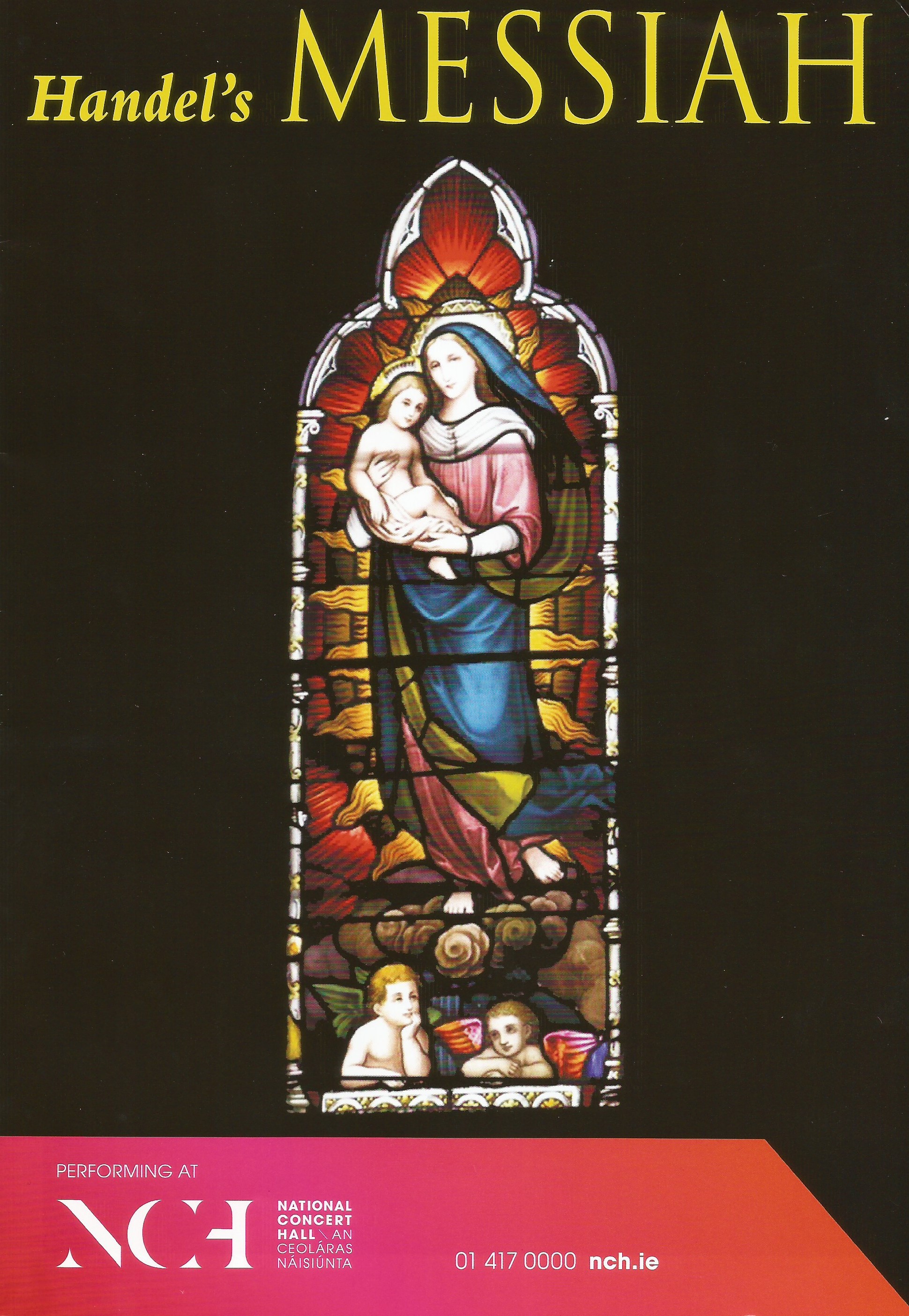
On 10th December last year I posted a review of a performance of Handel’s Messiah in Cardiff. At the end of that item I wondered where I would be listening to Messiah in 2018. Well, the answer to that question turned out to be at the National Concert Hall in Dublin, the city where Messiah received its premiere way back in 1742.
Messiah was initially performed at Easter (on 13th April 1742) and it’s by no means clear (to me) why it ended up almost universally regarded as a Christmas piece. The work actually spans the entire biblical story of the Messiah, from Old Testament prophecy to the Nativity (Part 1), the Passion of Christ (Part II), culminating in the Hallelujah Chorus, and the Resurrection of the Dead (Part III). The Nativity only features (briefly) in Part I, which is why it’s a little curious that Messiah is so strongly associated with Christmas.
The printed programme for last night (cover shown above) included the first advertisement for the first performance of Messiah:
For the relief of the prisoners in the several Gaols and for the Support of Mercer’s Hospital in Stephen’s Street and of the Charitable Infirmary on the Inn’s Quay, on Monday 12th April will be performed at the Musick Hall in Fishamble Street, Mr Handel’s new Grand Oratorio MESSIAH…
The venue was designed to hold 600 people (less than half the capacity of the National Concert Hall) but 700 people crammed in. Ladies had been asked not to wear hoops in their dresses and gentlemen were asked not to bring their swords to help squeeze in the extra hundred. The concert raised the huge sum of £400 and Messiah was an immediate hit in Ireland.
It wasn’t the same story when Messiah was first performed in England the following year. It failed again in England when performed in 1745 but after some rewriting Handel put it on again in 1749 and it proved an enormous success. It has remained popular ever since. But it is still exceptionally popular in Dublin. There are umpteen performances of Messiah at this time of year, and the one I attended last night was one of three in the same week at the same venue, all more-or-less sold out. The Dubliners I chatted to in the bar before the concert were extremely proud that their city is so strongly associated with this remarkable work.
I don’t mind admitting that Messiah is a piece that’s redolent with nostalgia for me. Some of the texts remind me a lot of Sunday School and singing in a church choir when I was little and then, a bit later, listening to the whole thing at Christmas time at the City Hall in Newcastle. I loved it then, and still do now, well over 40 years later. I know it’s possible to take nostalgia too far – nobody can afford to spend too much time living in the past – but I think it’s good to stay in contact with your memories and the things that shaped you when you were young.
Last night’s performance was by Our Lady’s Choral Society with the RTÉ Concert Orchestra. Soloists were Sarah Brady (soprano), Patricia Bardon (mezzo), Andrew Gavin (tenor) and Padraic Rowan (bass), the latter really coming into his own in the second half with a wonderfully woody sonority to his voice, especially in No. 40:
Why do the nations so furiously rage together, and why do the people imagine a vain thing?
Topical, or what?
Our Lady’s Choral Society is an amateur outfit and, while it might not sound as slick and polished as some professional choirs, there was an honesty about its performance last night that I found very engaging. It actually sounded like people singing, which professional choirs sometimes do not. The orchestra played very well too, and weren’t forced to use the dreaded `period instruments’. There was a harpsichord, but fortunately it was barely audible. Anyway, I enjoyed the concert very much and so did the packed house. I couldn’t stay for all the applause as I had dash off to get the last train back to Maynooth, but that doesn’t mean I didn’t appreciate the music.
Incidentally, among the bass section of Our Lady’s Choral Society last night was my colleague Brian Dolan. On Monday next I’m going to another Concert at the National Concert Hall, Bach’s Christmas Oratorio. Among the choir for that performance is another of my colleagues, Jonivar Skullerud. Obviously, choral singing is the in-thing for theoretical physicists in this part of the world!
Handel’s Messiah
Posted in Music with tags BBC National Chorus of Wales, Dean Wright, George Frideric Handel, Messiah, Orchestra of Welsh National Opera on December 14, 2016 by telescoperA performance of Handel‘s Messiah at St David’s Hall is always a pretty sure sign that the Christmas season is upon us, although the work itself was actually first performed at Easter and it’s by no means clear why it ended up being so strongly associated with this time of year. Whatever the reason I don’t mind admitting that Messiah is a piece that’s redolent with nostalgia for me – some of the texts remind me a lot of Sunday School and singing in a church choir when I was little and then, a bit later, listening to the whole thing at Christmas time at the City Hall in Newcastle. I loved it then, and still do now, over 40 years later. I know it’s possible to take nostalgia too far – nobody can afford to spend too much time living in the past – but I think it’s good to stay in contact with your memories and the things that shaped you when you were young. It’s actually been far too long – six years in fact – since I last went to a performance of Messiah (in the same venue) so I relished the chance to hear it again.
Messiah is the most frequently performed choral work in the entire repertoire, and so much has been said and written about it already that I’m not going to say much about here, except for one thing that struck me about it last night that I hadn’t thought about before which makes it quite an unusual work: unlike most other oratorios I’ve heard, the four vocalists are not associated with specific characters or roles. The reason for that is that the work spans the entire biblical story of the Messiah, from Old Testament prophecy to the Nativity (Part 1) , the Passion of Christ (Part II, culminating in the Hallelujah Chorus), and the Resurrection of the Dead (Part III). The Nativity only features (briefly) in Part I, which is why it’s a little curious that Messiah is so strongly associated with Christmas.
Last night’s performance involved the Orchestra of Welsh National Opera (conducted by Adrian Partington) and the BBC National Chorus of Wales (including Ed’s sister) with soloists Soraya Mafi (soprano), Patricia Bardon (mezzo), Ben Johnson (tenor) and James Platt (bass). Handel’s original scoring was for a relatively small orchestra and chorus but over the years it has become fashionable to perform it with larger forces. Last night the orchestra was modest in size, but the BBC National Chorus of Wales was more-or-less at full strength. There was a harpsichord.
I felt it took both the orchestra and the chorus a little while to warm up: the strings were a little ragged during the opening Sinfony and, early on, the large choir seem to lack the sharpness one might have expected given the very high standards to which they usually perform. Once they got into their stride, however, they were really excellent and Parts II and III (after the interval) were superb throughout. I can see the attraction of using smaller forces for this work, actually, because it’s much easier to bring a smaller choir into a tight focus. One the other hand, the larger choir makes the louder moments (such as the Hallelujah Chorus, for which as usual the audience stood) absolutely thrilling. It’s worth mentioning also that the orchestra expanded a little bit for Parts II and III – no brass or percussion are used in Part I – but trumpets and timpani appeared after the interval. I’d like to pick out the percussionist Patrick King (although to be honest his beard needs a bit more work) and the principal trumpet Dean Wright (whose brilliant solo playing during “The trumpet shall sound”” was absolutely thrilling when juxtaposed with the splendidly deep sonority of James Platt’s bass voice (whose beard is magnificent). I also enjoyed the crystal clarity and wonderful agility of soprano Soraya Mafi, especially on “I know that my redeemer liveth“.
All in all, it was a hugely enjoyable evening at St David’s Hall, which was so busy it seemed to take an age to get out at the end of the performance! The concert was recorded for broadcast by BBC Radio 3 on Monday 19th December at 7.30, so you can listen to it yourself and make your own mind up whether my comments above are fair.
Well, that will be the last of my concert-going for 2016 so I’d just like to thank all the musicians and singers I’ve had the pleasure of listening to since I returned to Cardiff for shining some much-needed light into what has otherwise been a very gloomy year.

 In the Dark