This week’s veggie box included the following beauty
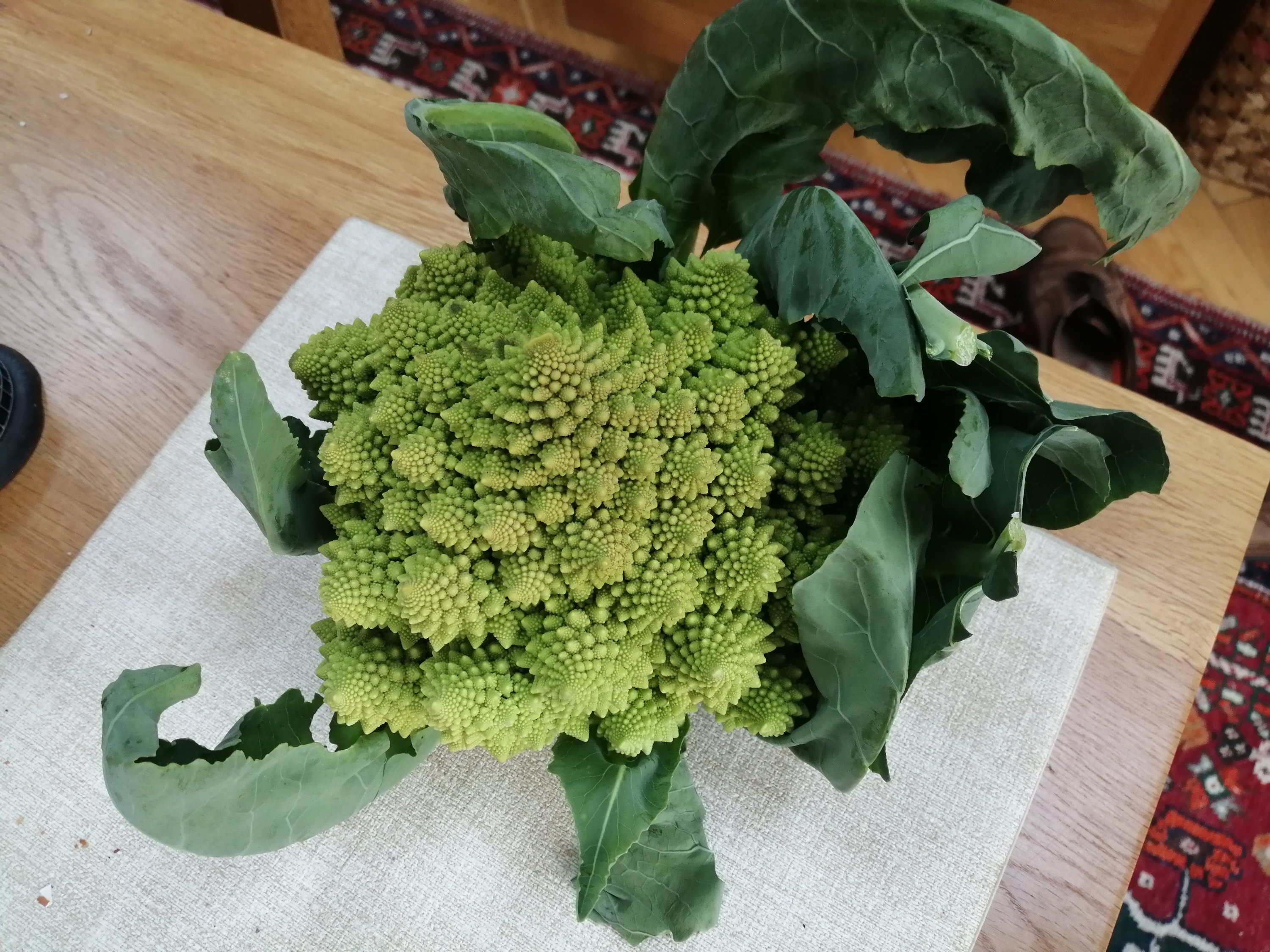
The vegetable in the picture is called Romanesco. I’ve always thought of it as a cauliflower but I’ve more recently learned that it’s more closely related to broccoli. It doesn’t really matter because both broccoli and cauliflower are forms of brassica, which term also covers things like cabbages, kale and spinach. All are very high in vitamins and are also very tasty if cooked appropriately. Incidentally, the leaves of broccoli and cauliflower are perfectly edible (as are those of Romanesco) like those of cabbage, it’s just that we’re more used to eating the flower (or at least the bud).
A while ago, inspired by a piece in Physics World, I wrote an item about Romanesco, which points out that a “head” of Romanesco displays a form of self-similarity, in that each floret is a smaller version of the whole bud and also displays structures that are smaller versions of itself. That fractal behaviour is immediately obvious if you take a close look. Here’s a blow-up so you can see more clearly:

There is another remarkable aspect to the pattern of florets, in that they form an almost perfect golden spiral. This is a form of logarithmic spiral that grows every quarter-turn by a factor of the golden ratio:

Logarithmic, or at least approximately logarithmic, spirals occur naturally in a number of settings. Examples include spiral galaxies, various forms of shell, such as that of the nautilus and in the phenomenon of phyllotaxis in plant growth (of which Romanesco is a special case). It would seem that the reason for the occurrence of logarithmic spirals in living creatures is that such a shape allows them to grow without any change in shape.
Although it is rather beautiful, the main attraction of Romanesco is that it is really delicious. It can be eaten like cauliflower (e.g. in a delicious variation of cauliflower cheese) but my favourite way of cooking it is to roast it with a bit of olive oil, lemon juice and garlic. Yum!


 In the Dark