Last night the clocks went forward an hour so we are now on Irish Summer Time (GMT+1, the same as BST). Among other things, this means that for the next seven months or so the clock on my oven will actually be set correctly…
One of the more sensible decisions made by the European Parliament some years ago was to approve a directive that will abolish `Daylight Saving Time’. I’ve long felt that the annual ritual of putting the clocks forward in the Spring and back again in the Autumn was a waste of time effort, so I’ll be glad when this silly practice is terminated. It would be better in my view to stick with a single Mean Time throughout the year. This was supposed to happen in 2021 but was delayed by the pandemic and still hasn’t happened.
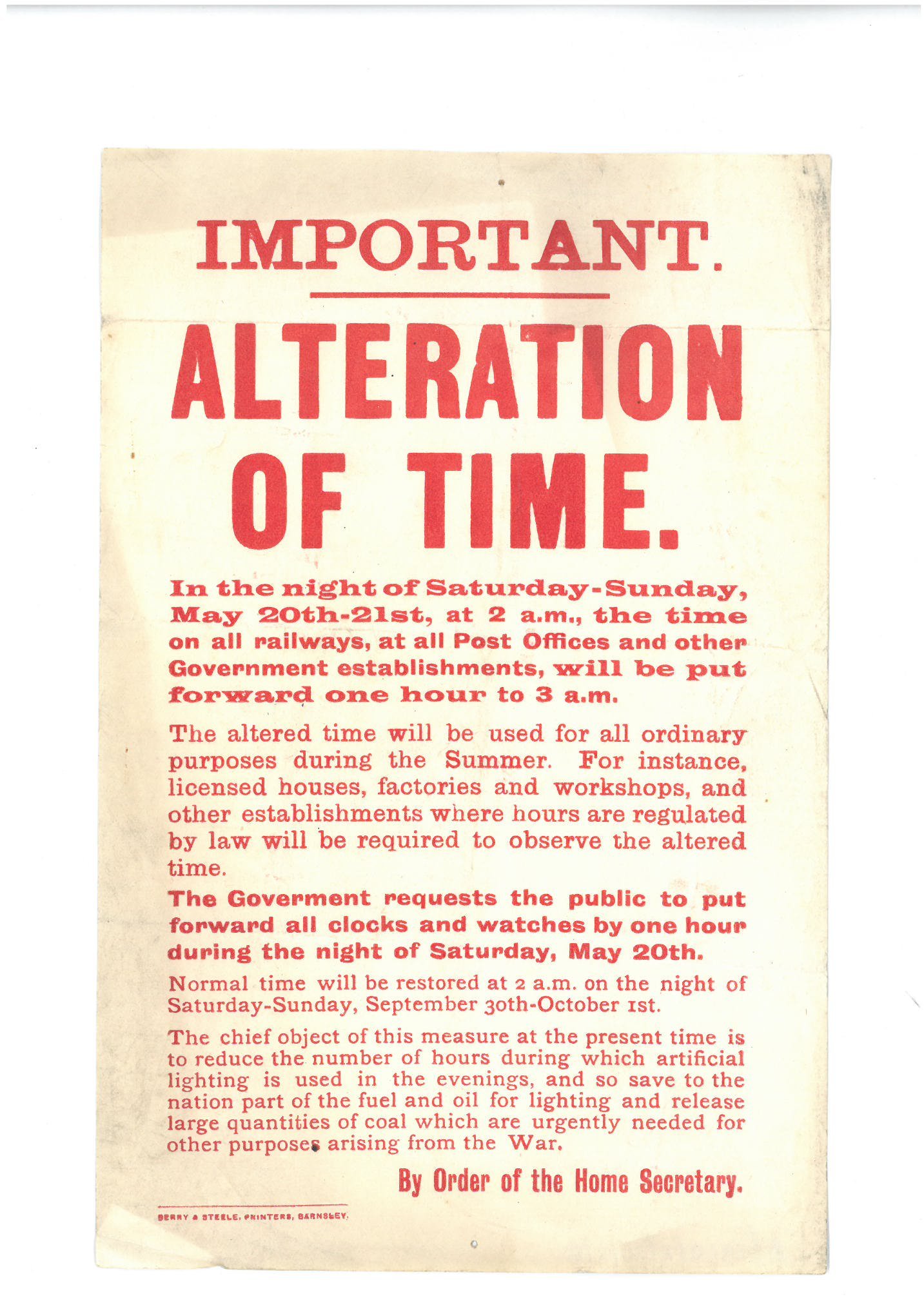
The marvellous poster above is from 1916, when British Summer Time was introduced, though it ran for only about 4 months (May to September), rather than the seven we have now (March to October).
You might be surprised to learn that the practice of changing clocks backwards and forwards is only about a hundred years old. in the United Kingdom. To be honest I’m also surprised that the practice persists to this day, as I can’t see any real advantage in it. Any institution or organization that really wants to change its working hours in summer can easily do so, but the world of work is far more flexible nowadays than it was a hundred years ago and I think few would feel the need.
Anyway, while I am on about Mean Time, here is a another poster from 1916.

Until October 1916, clocks in Ireland were set to Dublin Mean Time, as defined at Dunsink Observatory, rather than Mean Time as defined at Greenwich. The adoption of GMT in Ireland was driven largely by the fact that the British authorities found that the time difference between Dublin and London had confused telegraphic communications during the Easter Rising earlier in 1916. Its imposition was therefore, at least in part, intended to bring Ireland under closer control of Britain. Needless to say, this did not go down well with Irish nationalists.
Ireland had not moved to Summer Time with Britain in May 1916 and was still on Dublin Mean Time, which was 25 minutes 21 seconds behind GMT, so the change to GMT was introduced at the same time as BST ended in the UK, hence the alteration by one hour minus 25 minutes 21 seconds, i.e. 34 minutes and 39 seconds as in the poster.

 In the Dark